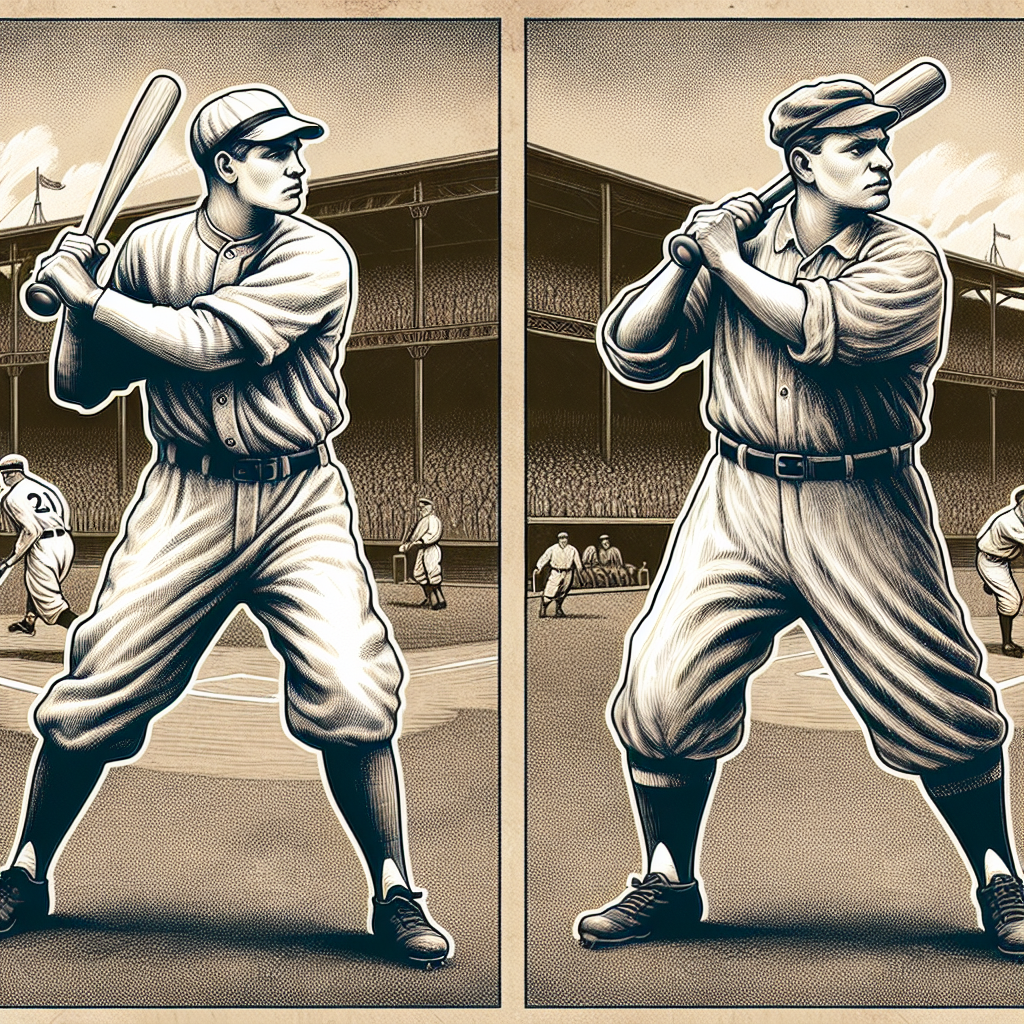
The early history of baseball is a fascinating vortex of lore, development, and the emergence of iconic athletic figures who forever altered the landscape of the sport. Among these titans, two legends stand out not just for their unmatched prowess on the field but also for their compelling personalities that captivated an entire nation: Ty Cobb and Babe Ruth. These early stars played crucial roles in shaping the game, setting standards of excellence, and leaving lasting legacies that still resonate in the baseball world today. Our dive into the eras dominated by Cobb and Ruth will paint a vivid picture of baseball’s formative years, highlighting the contributions of these two extraordinary athletes.
Ty Cobb: The Georgia Peach
Before the widespread adoration of Babe Ruth, Ty Cobb already had the nation in his baseball grip. Known as the “Georgia Peach,” Cobb’s fierce competitive nature and unparalleled skill set a high bar for baseball excellence. Born in 1886 in Narrows, Georgia, Cobb made his Major League debut with the Detroit Tigers in 1905. Over a 24-season career, primarily spent with the Tigers, Cobb rewrote the record books with his astonishing statistics. By the time he retired, his career batting average stood at a monumental .366, a record that remains unbroken.
Cobb’s ascent in baseball was rooted in relentless ambition and aggressive play. He won the American League batting title 12 times within a 13-year span, showcasing his consistency and mastery at the plate. His 4,191 hits remained the MLB benchmark until Pete Rose surpassed him in 1985. Cobb was also a master of baserunning, notorious for his daring and often controversial slides that intimidated opponents. He scored 2,245 runs during his career, another record that speaks volumes about his role as a scoring machine.
Off the field, Cobb was as complex as he was controversial. His fiery temper and reported altercations both on and off the diamond cast a shadow over his otherwise stellar career. He was criticized for his abrasive personality, and stories of his contentious relationships with teammates and fans abound. Yet, despite these challenges, Cobb was an inaugural inductee into the Baseball Hall of Fame in 1936, cementing his legacy as one of the sport’s earliest and most prominent stars.
Babe Ruth: The Sultan of Swat
As Ty Cobb’s star began to wane in the late 1910s, another player was ready to capture America’s imagination and elevate the game to even greater heights. Enter George Herman “Babe” Ruth, whose impact on baseball is virtually unparalleled. Originally a pitcher for the Boston Red Sox, Ruth’s switch to becoming a full-time outfielder with the New York Yankees allowed him to concentrate on his prodigious slugging abilities. Born in 1895 in Baltimore, Maryland, Ruth began his Major League career in 1914.
Babe Ruth’s hitting prowess was nothing short of revolutionary. While the sport had traditionally emphasized small-ball tactics—such as bunting and base-stealing—Ruth’s ability to hit home runs with dramatic frequency changed the game fundamentally. In 1920, his first year with the Yankees, Ruth hit 54 home runs, shattering the previous single-season record. By the time he retired, Ruth had amassed 714 home runs, a record eventually broken by Hank Aaron in 1974.
Ruth’s larger-than-life persona complemented his on-field achievements. He was known for his charismatic personality and off-field antics as much as his prodigious talent. Stories of Ruth’s indulgent lifestyle, including his affinity for hot dogs and nightclubs, endeared him to the public. His larger-than-life image made him a marketing icon, helping to elevate baseball’s profile nationwide.
Beyond individual accolades, Ruth’s presence had monumental impacts on his teams’ fortunes. Ruth led the Yankees to four World Series titles, firmly establishing them as baseball’s premier franchise. His ability to draw crowds helped fill stadiums and inspired a greater commercial interest in the sport. Ruth’s legacy was so dominant that it precipitated a new era in baseball, often referred to as the “Live Ball Era,” characterized by an emphasis on hitting and scoring.
The Rivalry and Legacy
Though they played in overlapping periods, Ty Cobb and Babe Ruth never developed a personal rivalry. However, their contrasting styles and personalities often led fans and sportswriters to draw comparisons. Cobb’s game was built on speed, precision, and tactical acumen, while Ruth’s relied on sheer power and audacity. This divergence provided a broader appeal to baseball, attracting fans with different tastes and preferences.
While Cobb was known for his aggressive play and combative nature, Ruth’s approach was seen as more genial and flamboyant. These differing personas were often highlighted in the press, with Cobb frequently portrayed as the game’s cerebral tactician and Ruth as its carefree powerhouse. Their coexistence in the baseball narrative offered a rich tapestry of skills and storylines for fans to appreciate.
The legacies of Cobb and Ruth extend beyond mere statistics and gameplay. Cobb’s relentless pursuit of excellence set a standard for future generations of players, instilling a culture of dedication and hard work in the sport. Ruth, on the other hand, expanded the game’s horizons, showing that baseball could be both a spectacle and a competitive endeavor. Together, they helped shape baseball into a more dynamic and engaging sport that would captivate generations of fans.
Early 20th Century Context
Understanding the impact of Cobb and Ruth requires a look at the broader context of the early 20th century. This was a period of significant social and cultural transformation in the United States. As America industrialized and urbanized, baseball emerged as a unifying pastime that provided a sense of community and shared identity amidst rapid change. This context offered a fertile ground for stars like Cobb and Ruth to become national figures.
The early 1900s also saw the rise of the mass media, with newspapers, radio, and eventually newsreels bringing baseball and its stars into the daily lives of Americans. Cobb and Ruth’s exploits were avidly covered by sportswriters, who played a crucial role in constructing their public images. Baseball games became communal events, drawing people from diverse backgrounds to witness the prowess of the game’s first big stars.
The game’s increasing commercialization further cemented its status as America’s pastime. Players began to earn substantial salaries and endorsements, and stadiums like Yankee Stadium and Tiger Stadium became iconic landmarks. The popularity of Cobb and Ruth helped drive this commercial growth, as their on-field successes translated to financial prosperity for their teams and the sport as a whole.
Baseball’s Evolution
The contributions of Ty Cobb and Babe Ruth resonate deeply in the evolution of baseball. Cobb’s approach to the game highlighted the importance of strategic thinking, versatility, and resilience. He showed that baseball was not just about physical prowess, but also about mental acuity and adaptability. In contrast, Ruth’s emphasis on power and spectacle introduced a new dimension to the sport, demonstrating that baseball could thrive on excitement and entertainment.
Both players showcased different aspects of what makes baseball compelling. Cobb’s emphasis on speed, contact hitting, and aggressive baserunning underscored the game’s strategic depth. His success laid the groundwork for future players who would adopt and refine these tactics. Meanwhile, Ruth’s influence ushered in an era where hitting prowess and home runs became key attractions, altering team strategies and overall game dynamics.
Their dual legacies also paved the way for subsequent stars to navigate the balance between individual excellence and team dynamics. Players like Lou Gehrig, Jackie Robinson, and Hank Aaron built on the foundations laid by Cobb and Ruth, each contributing unique skills and stories that enriched the sport further. The evolution of baseball can thus be seen as a tapestry woven from the distinct but complementary strands of Cobb’s and Ruth’s influences.
Modern Perspective
From a modern perspective, revisiting the early history of baseball and its first big stars offers valuable insights into the sport’s current landscape. The principles and qualities embodied by Ty Cobb and Babe Ruth continue to influence contemporary baseball, from the emphasis on strategic play to the celebration of home run heroes. The analytical approaches to understanding and appreciating the game have also evolved, with advanced metrics shedding new light on the achievements of early stars.
Today’s baseball stars, such as Mike Trout and Shohei Ohtani, can trace aspects of their gameplay and public personas back to Cobb and Ruth. The analytical frameworks applied to their performances have roots in the early efforts to quantify and celebrate the contributions of players like Cobb and Ruth. Understanding their impact helps contextualize the modern game’s continual evolution, driven by innovations in training, strategy, and fan engagement.
Moreover, the stories of Cobb and Ruth remind fans and players alike of the sport’s rich heritage. They highlight the importance of perseverance, adaptability, and the ability to captivate audiences through sheer talent. As baseball continues to grow and evolve, the legacies of its first big stars offer a reservoir of lessons and inspirations that remain relevant and influential.
Conclusion
Reflecting on the early history of baseball and its first big stars, Ty Cobb and Babe Ruth reveals a tapestry of ambition, talent, and transformation that shaped the sport as we know it today. Cobb’s relentless pursuit of excellence and Ruth’s larger-than-life charisma provided complementary models of what it means to be a baseball star. Their legacies, built on a foundation of unrivaled skill and passion, continue to inspire and captivate.
Baseball’s journey from a burgeoning pastime to a cornerstone of American culture has been significantly influenced by the contributions of Cobb and Ruth. Their stories, rich in both triumphs and trials, offer a window into the soul of the sport. By understanding their impact, we gain a deeper appreciation for the game’s history and its ongoing evolution.
In the end, Ty Cobb and Babe Ruth were not just baseball players; they were icons who transcended the sport and became symbols of a dynamic era in American history. Their influence extends far beyond the diamond, contributing to baseball’s enduring status as America’s favorite pastime. Whether through Cobb’s strategic brilliance or Ruth’s powerful presence, the early history of baseball remains a testament to the remarkable talents and indomitable spirits of its first big stars.