
As one of America’s favorite pastimes, baseball has a rich history filled with legendary teams and memorable moments. The early 20th century stands out for fans and historians alike due to the dominant teams that helped shape the game. Among these icons, none stand as proudly as the New York Giants. Under the guidance of visionary managers and driven by storied players, the Giants solidified themselves as a baseball dynasty, particularly in the World Series and playoffs. This article delves into the fascinating journey of the early 20th-century Giants, exploring their triumphs, challenges, and the legacy they left behind.
Starting from the dawn of the century, the New York Giants established a reputation for excellence that would endure for decades. Their tale is intertwined with significant events in baseball history, including rule changes, player revolutions, and the dynamic strategies brought forth by progressive managers. The Giants not only won games but also revolutionized how baseball was played and consumed by fans around the globe.
In this article, we look back at key moments and figures that defined the Giants’ dominance from their early brush with greatness to their solidified status as the team to beat. We aim to provide a detailed and vivid recount of the seasons, players, and strategies that earned them their place in the annals of baseball history. Join us on this nostalgic journey through time as we explore the rise of the New York Giants and their place within the pantheon of baseball legends.
The Beginnings of a Dynasty
The New York Giants, established as the Gotham’s baseball pride, began laying their foundation for greatness as the 20th century dawned. Eluding the early struggles that some teams face, the Giants found their stride under the determined leadership of their manager John McGraw. Appointed in 1902, McGraw cultivated a culture of tenacity and innovation that would come to define his tenure and the team’s fortunes.
McGraw’s aggressive style of play, emphasis on strategic base running, and militaristic discipline turned the Giants into formidable contenders. The roster, boasting talents like Christy Mathewson, Admiral Schlei, and future Hall of Famers, became the backbone of their early success. Mathewson, in particular, epitomized McGraw’s philosophy, combining skill, intelligence, and sportsmanship in a way few others could.
The early 1900s saw the Giants making headline news, particularly during their 1904 season. Finishing with an astonishing .693 win percentage, the Giants were expected to play in the World Series. However, in a controversial decision, McGraw and team owner John T. Brush refused to participate, disparaging the American League. This moment, albeit contentious, underscored the team’s confident, sometimes bullish, ethos.
By 1905, the dust had settled, and the Giants were eager to prove their mettle against the best. Facing off against the Philadelphia Athletics in the World Series, they displayed unparalleled poise and skill. Christy Mathewson’s three shutouts across the series remain a showcase of pitching excellence. The 4-1 series victory not only cemented their prowess but also served as the first of many championships that would define this epoch.
The Giants’ Golden Era
The period from 1910 to 1924 can aptly be described as the golden era for the New York Giants, highlighted by a streak of World Series appearances and National League pennants. With John McGraw still at the helm, the Giants continued to build on their early success, and the infusion of new talent kept them ahead of their competitors.
During this era, the Giants won the National League pennant in 1911, 1912, and 1913, making three consecutive World Series appearances. Although they faced stiff competition and fell short in these series, the very fact that they were perennial contenders spoke volumes about their consistency and dominance.
The years 1917 and 1921 to 1924 saw the Giants return to the pinnacle of baseball. Particularly memorable was the 1921 World Series victory against the New York Yankees, igniting what would become one of the most storied rivalries in sports history. With household names like Frankie Frisch, known as the ‘Fordham Flash’, and a later addition in George Kelly, the Giants’ roster was replete with talent.
The 1922 season was particularly notable, as the Giants not only dominated the National League but also completed a clean sweep of the Yankees in the World Series, a feat that solidified their standing as baseball’s elite. Through rigorous training, smart trades, and an unwavering commitment to excellence, John McGraw’s Giants exemplified what it meant to be a dynasty during their golden era.
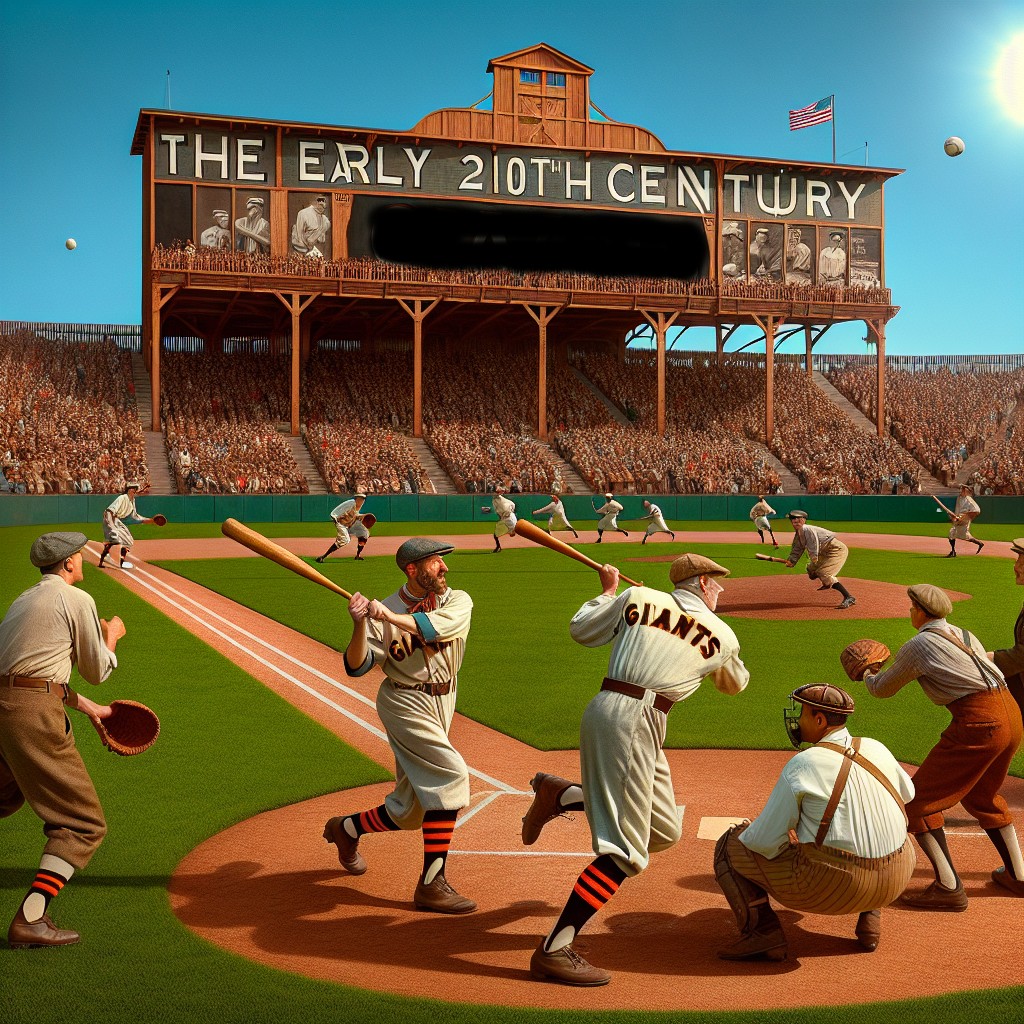
Iconic Players of the Era
No discussion about the early 20th-century Giants would be complete without highlighting the iconic players who made lasting contributions to the team’s success. The most prominent of these is undeniably Christy Mathewson, whose pitching was revolutionary for its time. With over 370 career wins and a lifetime ERA of 2.13, Mathewson was more than just a key player; he was a trailblazer who elevated the sport’s standards.
Additionally, John McGraw’s knack for identifying and nurturing talent brought numerous players into the limelight. Another notable name is Bill Terry, who came to embody the elegance and prowess associated with the Giants. Terry’s 1930 season, in which he hit .401, remains one of the most remarkable batting achievements in baseball history.
The Giants also benefitted from the talents of Mel Ott, whose prodigious hitting made him an indispensable part of the lineup. A natural leader, Ott captained the team with distinction and concluded his career with over 500 home runs, securing his place in the annals of baseball fame.
The balanced combination of pitching prowess, batting brilliance, and defensive mastery made the Giants a formidable opponent. These individual stars, through their collective efforts, brought an unparalleled level of excitement and success to the Giants, captivating fans and solidifying their place in baseball’s hall of fame.
Rivalries and Challenges
During their reign, the Giants faced numerous challenges from formidable teams, resulting in some of baseball’s most exciting and memorable rivalries. Chief among these were their confrontations with the Philadelphia Athletics and the formidable Chicago Cubs. These rivalries not only tested the Giants’ mettle but also provided fans with riveting baseball that further heightened the sport’s popularity.
The 1913 World Series against the Athletics, for instance, saw the Giants come agonizingly close to victory, only for their efforts to fall short in the face of managerial and pitching superiority from their opponents. These series were lessons in resilience, illustrating that even the mightiest could be humbled.
Arguably the most compelling rivalry was with the New York Yankees. Sharing the same city, the Giants and Yankees became emblematic of baseball’s growth and metropolitan pride. The early 1920s World Series editions were particularly significant, as they marked the beginning of the Yankees’ ascent to their own dynasty status. Yet, the 1921 and 1922 victories by the Giants demonstrated their ability to rise to the occasion when it mattered most.
However, the journey was not devoid of internal turmoil. Contract disputes, player injuries, and the pressures of maintaining high performance took their toll. Amidst these challenges, John McGraw’s leadership remained a stabilizing force, guiding the team through turbulent waters and ensuring their continuous pursuit of excellence.
The Legacy of John McGraw
John McGraw’s influence on the New York Giants, and indeed baseball itself, cannot be overstated. Often referred to as ‘Little Napoleon’ due to his authoritative style and strategic genius, McGraw’s tenure with the Giants spanned from 1902 to 1932, an astounding 30 years that saw the team become synonymous with success and innovation in baseball.
McGraw’s managerial record speaks for itself. He led the Giants to 10 National League pennants and three World Series titles, a testament to his unparalleled understanding of the game. Under his guidance, the Giants remained a team to watch, bringing excitement and competitive baseball to fans year after year.
Beyond the statistics, McGraw’s approach to the game left an indelible mark on baseball. His emphasis on aggressive base running, tactical bunting, and psychological play influenced generations of players and managers. McGraw was ahead of his time, introducing practices that would become standard strategies in the sport.
After retiring, McGraw’s legacy continued to resonate. His methods, philosophies, and fierce determination set a standard for future baseball managers and teams. McGraw’s dedication to the Giants and to baseball paved the way for the team’s sustained success and cemented his place as one of the greatest figures in the sport’s history.
Conclusion
The early 20th century was a transformational period for baseball, and the New York Giants stood at the heart of this transformation. Under the astute guidance of John McGraw and powered by a constellation of iconic players, the Giants engineered a dynasty that left an everlasting impact on the sport. Their story is not just one of triumphs and titles but of pioneering a baseball ethos marked by tenacity, strategy, and an unyielding spirit.
From their initial challenges and landmark 1905 World Series win to their golden era that defined the 1910s and early 1920s, the Giants provided baseball fans with moments of unparalleled excitement and brilliance. The players immortalized on the diamond set records and achieved feats that remain benchmarks of excellence to this day.
As we reflect on the enduring legacy of the early 20th century Giants, it is clear that their contributions went beyond the confines of the ballpark. They helped shape the cultural landscape of America, turning baseball into the national pastime it is celebrated as today. Their story is a testament to what can be achieved with vision, talent, and cohesion, and it continues to inspire both current and future generations of baseball enthusiasts.
The New York Giants of the early 20th century are more than just champions; they are icons whose spirit continues to enrich the game of baseball.
Frequently Asked Questions
1. What made the early 20th-century New York Giants a baseball dynasty?
The New York Giants’ dominance in the early 20th century is the hallmark of a true baseball dynasty, characterized by consistent success and overwhelming talent. From 1900 to 1925, the Giants established themselves as a powerhouse under the leadership of legendary managers such as John McGraw. Known for his fiery personality and strategic brilliance, McGraw’s tenure included ten National League pennants between 1904 and 1924 and three World Series championships in 1905, 1921, and 1922. The Giants were not only defined by their winning records but also by their remarkable players. Hall of Famers like Christy Mathewson, one of the most commanding pitchers in baseball history famous for his devastating screwball, and Mel Ott, known for his powerful bat, contributed significantly to the team’s success. This period of sustained excellence reinforced the team’s prominence in baseball history and left a legacy that influenced future generations.
2. Who were some of the standout players on the early 20th-century New York Giants?
The early 20th-century New York Giants roster was a collection of some of the game’s most storied and influential players. Christy Mathewson, often referred to as “Big Six,” was a linchpin of the Giants’ pitching staff. With his remarkable control and strategic pitching techniques, Mathewson’s contributions were instrumental in securing the Giants’ victories, especially during the World Series. Another notable player was John McGraw himself, more remembered for his managerial skills but also a formidable force as a player in his earlier years. In the latter part of this era, Mel Ott emerged as a powerful hitter, eventually becoming a fixture in the Giants’ lineup and one of baseball’s most prolific home run hitters. These players, along with others like catcher Roger Bresnahan, played pivotal roles in all aspects of the game, from strategic plays to clutch performances, thus helping the Giants build and maintain their dynasty.
3. How did John McGraw contribute to the Giants’ success in the early 20th century?
John McGraw, often dubbed “The Little Napoleon” for his commanding presence and diminutive stature, was fundamental to the New York Giants’ success between 1902 and 1932. His managerial style was aggressive and authoritative, characterized by a no-nonsense approach to baseball that emphasized discipline and innovative strategies. McGraw’s keen eye for talent and emphasis on fundamentals allowed him to craft teams that were both strategic and adaptable. He utilized the dead-ball era’s playing conditions to the Giants’ advantage, focusing on strong pitching, defense, and base running. Moreover, McGraw’s ability to manage and motivate players from diverse backgrounds helped in maintaining team cohesion and performance on the field. His genius was not just in winning games; it also showcased his ability to envision and execute a long-term strategy that sustained the team’s dominance over multiple decades, cementing the Giants’ legacy as a baseball dynasty.
4. In what ways did the early 20th-century Giants influence the way baseball is played today?
The early 20th-century Giants were pioneers in multiple facets of baseball, leaving an indelible mark on how the game is played today. Firstly, John McGraw’s strategic approach, with an emphasis on adaptability and situational gameplay, laid the groundwork for modern game management. This included prioritizing bullpen use, strategic base stealing, and player matchups—principles that continue to influence current-day managers. The Giants also showcased the importance of robust farm systems and player development, foreseeing the need for nurturing and developing talent from within, which has become a cornerstone of successful Major League Baseball franchises. Additionally, the dynamic and diverse lineup strategies employed by McGraw and his roster management predicated the importance of platooning— a strategy where different players are used in different situations based on favorable matchups. The Giants’ influence is seen in these enduring strategies and systems, reflecting their foresight and understanding of baseball as a dynamic and evolutionary sport.
5. How did the broader context of the early 20th century affect the Giants and baseball in general?
The early 20th century was a transformative time for both baseball and American society, influencing how teams like the Giants operated and thrived. This era saw the rise of baseball as America’s pastime, a unifying cultural phenomenon that rose above regional differences, especially important during times of societal change and upheaval. Technological advancements and urbanization led to easier and faster transportation, allowing teams to expand their reach and build broader audiences. The media, particularly print newspapers, began to extensively cover baseball, a development that spotlighted the Giants and kept the spotlight on their winning ways, enhancing their mystique and fan base. The racial segregation of the time period also defined baseball—while regrettable and unjust, it was during these years that the foundations for change, albeit slow, began laying the groundwork for the eventual integration of baseball. The Giants, playing in New York, a hub of innovation and diversity, found themselves at the epicenter of these changes, contributing to and benefiting from the sport’s growth as a national institution.