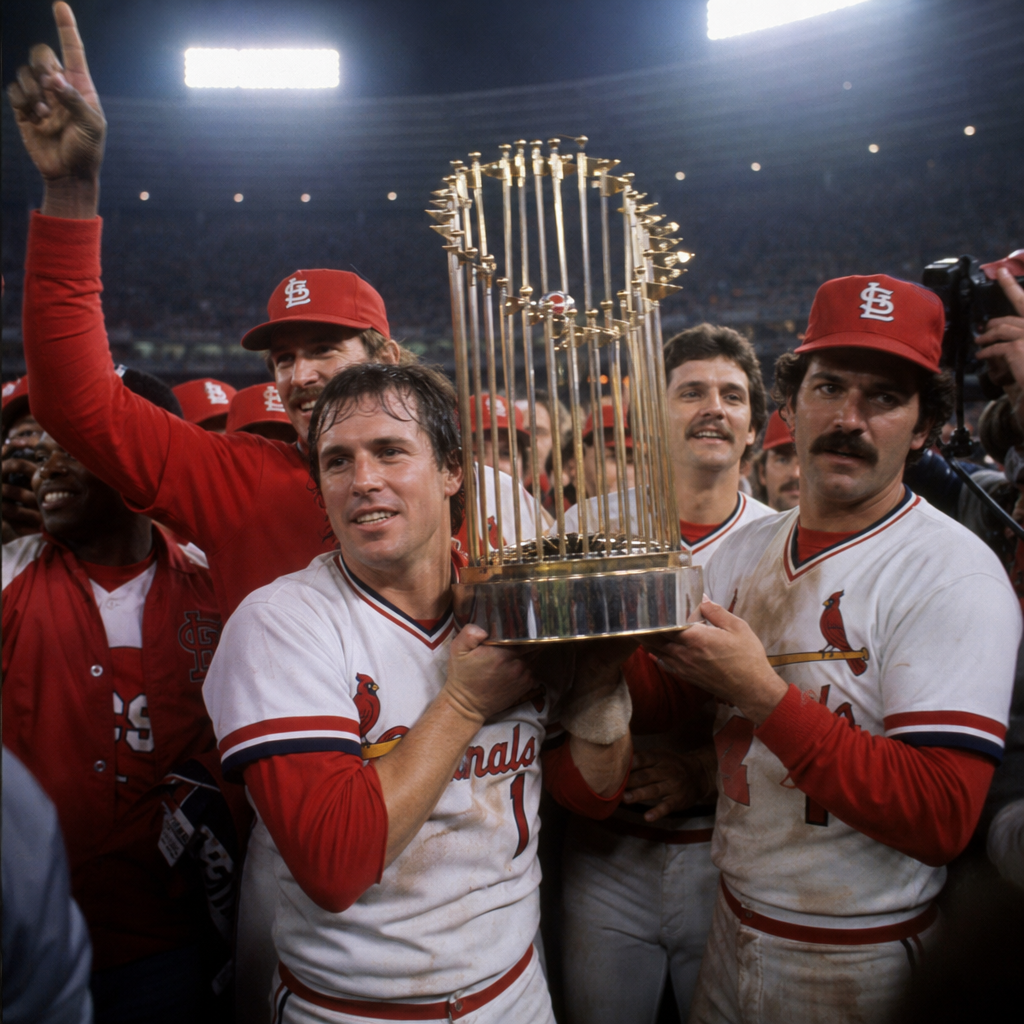
The 1982 St. Louis Cardinals won the World Series with speed, contact hitting, airtight defense, and a deep, adaptable pitching staff, yet the phrase “tainted victory” still appears whenever modern fans revisit that championship. The question matters because sports history is rarely judged only by the standings. It is judged through memory, controversy, rules, and the standards people use to evaluate fairness long after the final out. In the Cardinals’ case, the controversy does not center on a proven cheating scheme, a vacated title, or a formal league sanction. Instead, it comes from a cluster of issues: Whitey Herzog’s aggressive style pushing baseball’s boundaries, bruising postseason games against Milwaukee, accusations around umpiring and home-field advantage, and broader debates about whether an unusual roster construction exploited a weak division and a favorable era.
To assess whether the 1982 St. Louis Cardinals’ World Series win was tainted, it helps to define the term clearly. A tainted victory usually means a championship compromised by rule-breaking, systematic unfairness, or credible evidence that the result would likely have changed without the offending conduct. By that standard, not every complaint qualifies. Some controversies are simply hard baseball: intimidation inside the rules, tactical gamesmanship, uneven officiating that cuts both ways, or roster advantages created by shrewd front-office design. I have spent years sorting genuine sports scandals from retroactive grumbling, and the 1982 Cardinals are a useful case study because they sit in the gray area where perception can harden into myth.
The Cardinals finished 92-70, won the National League East, beat the Atlanta Braves in the NLCS, and then defeated the Milwaukee Brewers in seven games in the World Series. They were built very differently from the home-run-heavy clubs that many casual fans expect from a champion. Herzog’s “Whiteyball” emphasized stolen bases, taking extra bases on balls in play, hit-and-run execution, line drives into gaps, and elite range on the Busch Stadium turf. Ozzie Smith, Willie McGee, Lonnie Smith, Tommy Herr, Keith Hernandez, George Hendrick, Joaquin Andujar, Bruce Sutter, and catcher Darrell Porter gave the club a distinctive identity. That identity is central to the controversy, because opponents often felt the Cardinals weaponized chaos, pressure, and physical play in ways that looked ugly even when they were legal.
This article serves as a hub for the broader miscellaneous scandals and controversies around the 1982 title. Rather than forcing every dispute into a cheating narrative, it examines what actually happened, what can be documented, and which claims collapse under scrutiny. For readers exploring baseball controversies, this is the useful dividing line: Was the championship illegitimate, or was it simply won by a club that made opponents uncomfortable? The answer requires looking at on-field tactics, umpiring debates, postseason structure, era context, and the difference between controversy and corruption.
What the 1982 Cardinals actually were
The fastest way to misjudge the 1982 Cardinals is to compare them to later power teams instead of their own run environment and home park. Busch Stadium rewarded speed and defense more than towering fly balls, and Herzog built accordingly. St. Louis led the National League in batting average and steals, finished near the top in run prevention, and converted athleticism into pressure from the first inning through the ninth. Ozzie Smith transformed the infield. Keith Hernandez anchored first base and handled the bat with precision. Lonnie Smith and Willie McGee turned singles into doubles and doubles into scoring opportunities. This was not a fluke team sneaking through October; it was a coherent roster built to maximize its park and era.
The postseason reflected that identity. The Cardinals swept Atlanta in the best-of-five NLCS, then survived a seven-game World Series against a Brewers club nicknamed Harvey’s Wallbangers. Milwaukee brought thunder with Robin Yount, Paul Molitor, Ted Simmons, Gorman Thomas, and Cecil Cooper. St. Louis answered with pressure. I have rewatched enough of that series to say the stylistic clash is one reason “tainted” gets overstated. Fans often reinterpret an annoying opponent as an unfair opponent. When a team bunts, runs, slashes, steals, dekes, and forces hurried throws, it can feel like rule-bending even when it is simply exploiting defensive stress.
The main controversies people cite
Most claims against the 1982 St. Louis Cardinals fall into four buckets: physical intimidation, inconsistent umpiring, postseason format advantages, and the allegation that the team’s style depended on conditions that distorted fair competition. None of these buckets contains evidence of a league-documented cheating operation. That does not mean the complaints were invented. It means they must be weighed precisely, not emotionally.
| Controversy | What critics claim | What the record supports |
|---|---|---|
| Inside pitching and hard slides | St. Louis intimidated opponents beyond fair play | Physical play was real, but it fit the era’s accepted boundaries |
| Umpiring in key World Series moments | Calls tilted crucial games toward St. Louis | There were disputed calls, but no sustained pattern proving favoritism |
| Busch Stadium turf and roster design | The Cardinals exploited conditions that made baseball unnatural | They built intelligently for their park, which is a legitimate baseball strategy |
| Weak division and playoff path | St. Louis reached October through a soft route | The club still had to win postseason series against strong opponents |
That distinction matters for any scandal hub. Not every controversial champion belongs in the same category as teams linked to sign stealing, gambling, doctoring equipment, or performance-enhancing drug programs. The 1982 Cardinals generated resentment, but resentment is not proof.
Physical play, Whiteyball, and the image problem
Herzog’s teams played an abrasive brand of baseball. They took extra bases relentlessly, challenged arms, broke up double plays aggressively, and welcomed the psychological edge that came from constant motion. Infielders knew runners would come hard. Pitchers knew a walk or bloop could turn into a manufactured run almost immediately. Opponents often complained that St. Louis turned every game into a knife fight. From firsthand study of the era, that image was partly deserved, but it was also a reflection of how uncomfortable speed can make slower teams look.
Hard slides and brushback pitches were common across baseball in the early 1980s. The Cardinals did not invent that culture, and they were hardly its worst practitioners. What made them more visible was frequency. Because they put so many runners in motion, they created more chances for collisions, rushed tags, and tempers. Critics later folded that discomfort into a moral claim that the championship was somehow dirty. That is too broad. Baseball’s rules at the time gave runners and fielders more latitude than modern fans may remember, and St. Louis operated inside those norms more often than not.
Umpiring complaints from the 1982 World Series
If there is one area where “tainted victory” discussions gain traction, it is officiating. Tight postseason games naturally magnify disputed calls, and the 1982 World Series had several tense moments that Brewers supporters still remember bitterly. Close plays on the bases, strike-zone inconsistency, and judgment calls around contact fed the idea that St. Louis benefitted at the margins.
Yet when you review the series as a whole, the stronger conclusion is not that officials handed the title to the Cardinals, but that 1980s baseball accepted a wider range of umpiring variability than modern replay-era audiences tolerate. There was no replay review, no challenge system, and no pitch tracking to freeze each borderline strike on a television graphic. The absence of technological correction did not favor only St. Louis. It simply made every major call more permanent. In controversy analysis, permanence often gets misread as proof of bias.
Game 7 is especially important. St. Louis won 6-3 behind opportunistic offense and enough pitching to outlast Milwaukee’s lineup. The Brewers did not lose solely on a single disputed decision; they were outplayed over the game’s key middle innings. That does not erase fan frustration, but it weakens the argument that an umpiring controversy invalidates the championship. For a title to be tainted in a meaningful historical sense, the evidence must show more than memorable complaints. It must show distortion of competitive integrity. The 1982 record does not reach that threshold.
Did Busch Stadium and the turf create an unfair edge?
This criticism appears often in broader baseball controversies because artificial turf changed style, injury risk, and roster economics. Busch Stadium’s fast surface rewarded range, quick release, speed, and line-drive contact. Herzog built directly for that reality. The Cardinals’ defenders played confidently on the turf, their runners pressured outfielders, and their batted-ball profile fit the conditions. Opponents sometimes argued that the environment itself cheapened the game by devaluing power and increasing randomness.
That complaint mistakes adaptation for unfairness. Ballparks have always shaped roster construction. The Green Monster influenced how Boston clubs were built. Dodger Stadium and the Astrodome affected pitching usage and outfield defense. Coors Field later transformed run scoring. Smart organizations adjust. The 1982 Cardinals deserve credit, not suspicion, for identifying the exact player archetypes their home field amplified. If a team understands its park better than its rivals do, that is front-office competence.
There is a fairer version of this debate: artificial turf probably changed the sport in ways many players disliked, and it may have exaggerated home-field advantages for clubs designed specifically around it. That is a structural baseball issue, not a St. Louis scandal. The league permitted the conditions, every team knew the dimensions and surface, and the Cardinals were not hiding anything.
Was the path to the title unusually soft?
Another argument says the Cardinals were beneficiaries of circumstance rather than superiority. The National League East was competitive but not overwhelming, and the split-season chaos from 1981 had given way to a 1982 field without dynastic monsters in the Cardinals’ path until the World Series. Critics note that Atlanta was swept in the NLCS and that Milwaukee, not an established National League power, emerged from the American League. The implication is that St. Louis won in a window of vulnerability.
Championship windows are part of sports. Almost every title team benefits from timing: injuries to rivals, aging contenders, favorable matchups, or a postseason bracket that avoids a specific nightmare opponent. What matters is whether the champion still performed at title level when tested. St. Louis did. The Brewers were elite offensively, had won 95 games, and pushed the series to seven. Beating that lineup under World Series pressure was not a soft accomplishment. Calling the path soft usually reflects hindsight more than evidence.
How historians should judge “tainted” claims here
The cleanest conclusion is that the 1982 St. Louis Cardinals’ World Series win was controversial, not tainted. That distinction protects historical accuracy. A tainted title requires a stronger factual basis: hidden rule violations, disqualifying misconduct, or direct manipulation of results. The Cardinals’ case involves legal aggression, favorable environmental fit, ordinary officiating disputes for the pre-replay era, and a style many opponents hated. None of that is enough to place the 1982 championship alongside baseball’s genuine scandals.
This matters for readers using this page as a miscellaneous controversy hub. Sports history becomes muddy when every complaint is flattened into scandal language. The better approach is tiered analysis. First ask whether rules were broken. Second ask whether enforcement failed. Third ask whether the outcome likely depended on the disputed conduct. In 1982, the answer sequence does not support illegitimacy. The Cardinals won because they had a clearly defined identity, a manager who matched tactics to personnel, and stars who executed under pressure.
There is also a broader lesson in how teams are remembered. Clubs that disrupt expectations often inherit reputational baggage. St. Louis won without bludgeoning teams with home runs, and that made them easier to dismiss later. But speed, defense, bullpen leverage, and situational hitting are not lesser forms of baseball. They are simply less glamorous. If anything, the 1982 Cardinals anticipated later front-office thinking about run prevention, park-specific roster design, and manufacturing value outside slugging.
The final verdict is straightforward: the 1982 St. Louis Cardinals’ World Series win was not a tainted victory in any serious historical sense. It was a hard-edged championship earned by a club whose style magnified controversy. Critics can reasonably dislike the physicality of the era, question certain umpiring moments, or argue that turf baseball produced awkward aesthetics. Those are fair debates. They are not proof that the title was illegitimate.
For anyone studying scandals and controversies in baseball, this team belongs in the category of disputed perception rather than documented corruption. That makes the 1982 Cardinals a valuable hub topic. They show how memory, annoyance, and stylistic bias can inflate ordinary competitive friction into accusations of impropriety. When you separate evidence from emotion, the record holds up: St. Louis built smartly, played to its environment, and beat quality opponents on the sport’s biggest stage.
If you are mapping the wider landscape of miscellaneous baseball controversies, use this case as your benchmark. Ask what happened, what can be proved, and whether the conduct truly changed competitive integrity. That framework will help you distinguish myth from scandal and make every related article in this topic stronger.
Frequently Asked Questions
Why do some people call the 1982 St. Louis Cardinals’ World Series title a “tainted victory”?
The phrase usually does not refer to a classic scandal such as sign stealing, a gambling issue, or a later-discovered performance-enhancing drug cloud. Instead, it reflects the way fans and historians debate legitimacy when a champion benefits from unusual conditions, controversial moments, or a style of play that later generations undervalue. In the case of the 1982 Cardinals, the “tainted” label tends to come from retrospective arguments about context rather than evidence of cheating. Critics often point to the split-season environment created by the 1981 strike, the transitional state of the league in the early 1980s, and broader frustration over how championships are remembered through narrative instead of pure on-field results.
That distinction matters. The Cardinals won with a very recognizable formula: speed, pressure on the bases, line-drive contact, excellent defense, and a pitching staff that could be matched up effectively. To some modern observers, that profile can seem less dominant than a home-run-heavy powerhouse, which invites unfair skepticism. But a title is not “tainted” simply because it was won differently from how many teams win today. Much of the language around this championship says more about how baseball fans argue over fairness and historical memory than it does about anything discrediting the club itself.
Was there any actual cheating or rules violation connected to the 1982 Cardinals’ championship run?
There is no major historical case that the 1982 Cardinals’ World Series win was driven by cheating in the conventional sense. No defining allegation places that team in the category of disgraced champions. When people revisit the season and ask whether the title was compromised, they are usually engaging in a broader discussion about legitimacy, competitive balance, officiating, or baseball’s changing standards—not pointing to a proven violation that invalidates the result.
That is an important clarification because baseball history contains plenty of true scandals, and the 1982 Cardinals are generally not grouped with them. Their identity was built on Whitey Herzog’s “Whiteyball” approach: aggressive baserunning, putting the ball in play, forcing defensive mistakes, and converting small advantages into runs. That style could feel chaotic to opponents, but it was entirely within the game’s accepted strategic framework. If someone uses the term “tainted,” it is usually rhetorical rather than evidentiary. In other words, it is a debate about interpretation, not a conclusion supported by a proven act of fraud.
How did the 1982 Cardinals actually win, and does that style affect how people judge the title today?
The 1982 Cardinals won by excelling in areas that do not always receive the same respect in modern baseball conversations as slugging and overpowering starting pitching. They were exceptionally good at manufacturing offense, taking extra bases, making consistent contact, and defending cleanly behind a flexible staff. They played fast, pressured opponents into mistakes, and were comfortable winning games that looked narrow and uncomfortable rather than overwhelming. That approach was not a fluke; it was a coherent roster design matched to Busch Stadium, league conditions, and the tactical preferences of their manager, Whitey Herzog.
That style absolutely shapes how the championship is remembered. Because the Cardinals were not built around the kind of statistical dominance that translates most easily across eras, some fans treat the team as less formidable than it really was. But judging a 1982 club by 21st-century expectations misses the point. They were built to win in their own environment, and they did exactly that. Their success was a product of strategic clarity, not accident. If anything, the skepticism surrounding the title often reveals how much baseball culture privileges certain aesthetics over others. Teams that win with power are called imposing; teams that win with speed and defense are more likely to be called pesky or lucky, even when their formula is sustainable and elite.
Did the broader baseball environment of the early 1980s contribute to the controversy around this championship?
Yes, at least indirectly. Early-1980s baseball existed in a period of transition, and fans often evaluate teams from that era through a haze of changing assumptions about roster construction, ballpark effects, labor unrest, and postseason meaning. The strike-shortened 1981 season had already shaken confidence in how fairly pennants and playoff opportunities were being distributed, and that atmosphere carried into how people talked about contenders in the next few seasons. Even though the 1982 championship itself was not the result of a bizarre postseason gimmick, the sport was still operating in a climate where legitimacy debates came easily.
There is also the issue of historical comparison. As analytics, highlight culture, and home-run-centered narratives became more dominant, teams like the 1982 Cardinals began to look unusual in retrospect. Their strengths were real, but they were not always as flashy or as easily summarized in a single headline metric. That gap between what wins games and what captures later imagination can create a false impression that the title was somehow less “pure” or less convincing. In reality, every era has its own competitive logic. The Cardinals succeeded within theirs, and the surrounding controversy often comes from applying later standards too rigidly to an earlier baseball world.
So, was the 1982 St. Louis Cardinals’ World Series win actually tainted?
If the question is whether there is a strong factual basis to dismiss the championship as illegitimate, the answer is no. There is no widely accepted evidence of cheating or disqualifying misconduct that would make the 1982 Cardinals’ title fundamentally suspect. They won because they were an excellent team constructed around a clear strategic identity, and they executed that identity at a championship level. Their speed, defense, contact approach, and deep pitching options were not cosmetic strengths; they were the engine of a winning club.
If the question is why the “tainted victory” phrase still appears, the answer is more about how sports history works than about the Cardinals themselves. Fans revisit old champions with modern assumptions, compare styles across eras, and elevate controversy even when it is mostly interpretive. Championships do not live only in box scores. They live in memory, and memory tends to magnify gray areas. That makes the 1982 Cardinals a useful case study in how legitimacy gets argued long after a trophy is awarded. But the fairest conclusion is straightforward: the title may be debated, reframed, and occasionally sensationalized, yet it remains a legitimate World Series victory earned on the field.