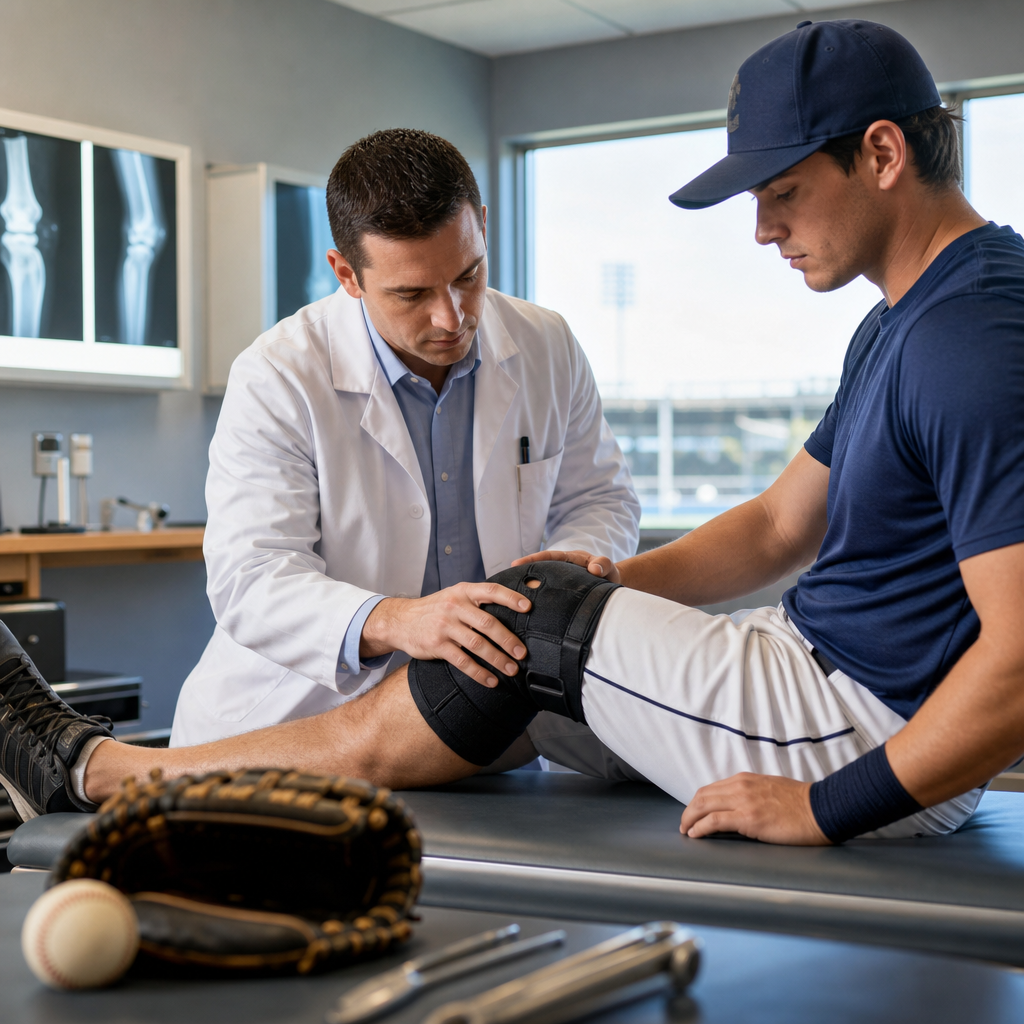
Baseball has shaped modern sports medicine and orthopedics more than most fans realize. Beyond rules, rivalries, and records, the game has served as a living laboratory for understanding shoulder mechanics, elbow overload, hip rotation, concussion assessment, workload management, and return-to-play decision-making. When physicians, athletic trainers, physical therapists, biomechanists, and strength coaches discuss throwing injuries today, many of the core concepts come directly from baseball. In that sense, baseball’s contribution to sports medicine and orthopedics is not a side story in the sport’s history; it is one of the most important innovations and changes in baseball itself.
Sports medicine refers to the prevention, diagnosis, treatment, and rehabilitation of athletic injury and illness. Orthopedics is the medical specialty focused on the musculoskeletal system, including bones, joints, ligaments, tendons, muscles, and cartilage. Baseball intersects both fields because its movements are repetitive, asymmetric, and highly explosive. A pitcher may throw with near-maximal intent dozens of times in a game and thousands of times across a season. A catcher repeatedly squats, blocks, throws, and absorbs foul-tip impacts. Position players sprint, decelerate, dive, rotate violently through the trunk, and stress their wrists, hands, knees, and hamstrings.
I have worked with baseball performance and rehabilitation planning long enough to see the same pattern at every level: the sport forces medical practitioners to become precise. A sore shoulder is never just a sore shoulder. It may involve scapular dyskinesis, posterior capsule tightness, labral irritation, rotator cuff overload, thoracic spine stiffness, or poor workload progression after time off. The demands of baseball created a need for better examination methods, better imaging interpretation, and better rehab sequencing. Those advances now influence care well beyond the diamond, helping athletes in tennis, cricket, javelin, softball, volleyball, and even workers with repetitive upper-limb strain.
The throwing athlete changed orthopedic thinking
Baseball’s largest medical contribution is the way it transformed understanding of the overhead throwing athlete. Before specialists studied pitchers closely, many clinicians treated the shoulder and elbow as isolated joints. Baseball forced a broader view. High-speed throwing is now understood as a full kinetic chain event beginning at the ground, moving through the legs and pelvis, transferring through the trunk, and ending at the shoulder, elbow, wrist, and fingers. If the hips fail to rotate efficiently or the trunk loses timing, extra stress shifts distally. That principle is foundational in modern sports medicine.
Pitching research also changed how clinicians distinguish normal adaptation from true pathology. Throwers commonly develop increased external rotation in the dominant shoulder, reduced internal rotation, humeral retrotorsion, and sport-specific soft tissue changes. These findings may support performance rather than signal damage. The key is recognizing when adaptation becomes maladaptation. Concepts such as glenohumeral internal rotation deficit, total range of motion assessment, scapular control, and valgus stress at the elbow became mainstream largely because baseball demanded better answers. This helped orthopedists avoid both underdiagnosis and overtreatment.
Baseball also sharpened physical examination. Tests for instability, labral injury, ulnar collateral ligament compromise, and posterior shoulder tightness gained practical value because teams needed decisions quickly and accurately. Imaging improved too, but baseball taught medicine that MRI findings do not always equal symptoms. Many asymptomatic pitchers show structural changes. Experienced clinicians therefore correlate imaging with strength loss, mechanics, workload history, and symptom behavior. That balanced approach is one of baseball’s most durable gifts to orthopedic practice.
UCL injuries, Tommy John surgery, and the elbow revolution
No baseball-driven innovation is more famous than ulnar collateral ligament reconstruction, commonly called Tommy John surgery. In 1974, Dr. Frank Jobe reconstructed the torn elbow ligament of pitcher Tommy John using a tendon graft, opening a path that once seemed impossible. The procedure did more than save careers. It expanded orthopedic ambition, refined graft selection and fixation methods, and made ligament reconstruction a realistic option for high-demand athletes. Over decades, surgeons improved tunnel placement, protection of the ulnar nerve, and rehabilitation timelines, raising success rates dramatically for appropriately selected throwers.
The deeper contribution, however, is that baseball made the elbow measurable. Researchers quantified valgus torque, late cocking stress, and the relationship between velocity and joint load. Motion-capture systems, wearable sensors, and force-plate data now help clinicians connect mechanics to tissue stress. Baseball also drove prevention models. USA Baseball and Major League Baseball’s Pitch Smart guidelines put hard numbers around pitch counts, rest periods, and age-specific workload recommendations. Those guidelines are not perfect, but they changed youth sports culture by replacing guesswork with evidence-informed limits.
Real-world examples show why this matters. A 14-year-old who pitches year-round for school, travel ball, and showcases may accumulate more stress than a professional with supervised recovery. In clinics, medial elbow pain in teenagers often traces back to volume spikes, poor rest, and early breaking-ball emphasis rather than one dramatic event. Baseball medicine helped normalize the idea that overuse is a systems problem involving schedule design, coaching incentives, sleep, strength, and growth-related vulnerability. That systems view now guides injury prevention in many sports.
The shoulder, labrum, and rotator cuff became clearer
If the elbow brought surgical fame, the shoulder brought diagnostic sophistication. Baseball pushed surgeons and therapists to understand internal impingement, superior labrum anterior-posterior lesions, partial-thickness rotator cuff tearing, and the role of scapular mechanics in elite performance. The throwing shoulder experiences tremendous angular velocity, and tiny deficits in timing can produce major symptoms. Because of this, baseball care evolved beyond simple rest and generic cuff strengthening. Effective treatment now considers thoracic extension, rib cage position, posterior shoulder mobility, lower-trap and serratus anterior function, and trunk rotation capacity.
Baseball also taught caution. During the 2000s, labral surgery became common, but outcomes in throwers were often inconsistent compared with lower-demand patients. Teams learned that not every imaging finding should lead to the operating room. Many athletes improved through targeted rehabilitation, graded throwing progressions, and mechanical adjustment. The modern standard is more nuanced: surgery can help, especially for clear instability or significant structural damage, but conservative management is often the first line when strength, motion, and symptom pattern support it. That restraint reflects maturity in orthopedic decision-making.
In practice, the best throwing rehab plans are sequential. First calm irritability and restore motion. Then rebuild rotator cuff endurance, scapular upward rotation, trunk control, and lower-body force production. Only after those pieces return does interval throwing begin, usually with distance and effort carefully progressed. Baseball organizations refined these stepwise return-to-throw programs over years of trial, data collection, and multidisciplinary collaboration. Similar staged models now inform rehab after shoulder injury in other overhead populations.
Baseball advanced biomechanics, screening, and workload management
Modern sports medicine depends on data, and baseball helped create that expectation. Professional organizations invested early in high-speed video, marker-based motion capture, force plates, bat and ball tracking, and later systems such as TrackMan, Hawk-Eye, Rapsodo, and wearable inertial sensors. While many fans know these tools for performance analysis, clinicians use them to understand joint loading, movement efficiency, fatigue patterns, and risk markers. The result is a more objective conversation about why an athlete hurts and what must change before return to competition.
Screening improved as well. Range-of-motion profiles, strength testing with handheld dynamometry, grip strength trends, hop testing, force-plate asymmetries, and wellness questionnaires now complement the physical exam. None of these tools can predict injury perfectly, but together they identify red flags such as sudden velocity loss, reduced shoulder external rotation strength, poor recovery scores, or lower-body power decline after a dense competition block. Baseball normalized longitudinal monitoring, where the value lies in change over time rather than one isolated measurement.
| Baseball innovation | Medical contribution | Practical example |
|---|---|---|
| Pitch counts and rest rules | Structured overuse prevention | Youth pitchers follow age-based recovery days after high-volume outings |
| Interval throwing programs | Graduated tissue loading during rehab | Post-injury athletes progress from flat ground tosses to mound sessions |
| Motion capture and force plates | Objective analysis of mechanics and load transfer | Clinicians identify hip-trunk timing deficits that increase arm stress |
| Dominant-side adaptation research | Better distinction between normal change and pathology | Throwers are not overtreated for expected range-of-motion differences |
| Multidisciplinary care models | Integrated decisions across medicine and performance | Surgeons, PTs, trainers, and coaches align on return-to-play criteria |
Workload management is where baseball’s influence is especially broad. Teams now track acute and chronic throwing volume, high-intensity efforts, recovery quality, travel load, and schedule congestion. There is still debate about the best equations, and no metric eliminates injury risk, but baseball established an essential truth: tissue capacity changes with exposure, and spikes in demand are dangerous. That principle now shapes return-to-run plans, soccer sprint exposure, and basketball jump monitoring. Baseball helped make load management a clinical language rather than a buzzword.
Rehabilitation, return to play, and team-based care
Baseball’s culture of long seasons and specialized skill demands forced rehabilitation to become more organized. Return to play is not simply the moment pain stops. For a pitcher, it means the athlete can tolerate repeated high-intent throws, recover between outings, hold command, and maintain mechanics under fatigue. For a hitter, it means rotating explosively without hand, wrist, oblique, or hip symptoms. Because those standards are demanding, baseball medicine developed detailed criteria-based progressions instead of calendar-based guesses.
This is where interdisciplinary care became standard. The orthopedic surgeon may repair the tissue, but the physical therapist restores motion and motor control, the athletic trainer monitors day-to-day response, the strength coach rebuilds force and durability, the pitching coach adjusts mechanics, and the sports scientist tracks workload. In better organizations, those roles do not compete. They share objective markers and agree on progression checkpoints. Baseball was one of the clearest early examples of this integrated model, and other sports copied it because it works.
Baseball also contributed to lower-body and trunk rehabilitation. Hamstring strains, hip impingement, core muscle injury, meniscus problems, sliding hand fractures, and catcher-specific knee stress all required sport-specific plans. Clinicians learned that a batter returning from an oblique strain cannot be cleared solely by plank tolerance; he must rotate at game speed. A catcher recovering from hip surgery must squat, block, transfer, and throw repeatedly, not just pass a generic strength test. This sport-specific thinking has become a hallmark of high-quality orthopedic rehab.
What baseball still teaches medicine today
Baseball continues to drive innovation because its injury problems are hard and highly visible. Youth specialization remains a concern, and medical professionals now speak more directly about seasonal breaks, multi-sport development, and the risks of chasing velocity too early. At the professional level, teams are using machine learning, video review, and individualized recovery plans to detect subtle changes before they become injuries. Regenerative approaches such as platelet-rich plasma are studied carefully, though evidence remains mixed and indication-specific. The sport rewards optimism, but its medical progress has come from disciplined skepticism.
The most important lesson is that baseball improved sports medicine and orthopedics by demanding specificity. It taught clinicians to respect adaptation, measure workload, connect mechanics to tissue stress, and build rehabilitation around the exact tasks an athlete must perform. It also proved that better outcomes come from collaboration rather than isolated expertise. For readers exploring innovations and changes in baseball, this is the hub idea to remember: the sport did not simply benefit from medical advances; it actively created them. If you want to understand how baseball changed the wider sports world, follow the path from the mound and training room into modern orthopedic practice, then continue through the related articles in this subtopic.
Frequently Asked Questions
How has baseball influenced the development of modern sports medicine and orthopedics?
Baseball has had an outsized impact on sports medicine and orthopedics because it repeatedly exposes the body to highly specific, high-speed movements that are easy to study and difficult to ignore clinically. Throwing a baseball is one of the most demanding actions in all of sports, especially for the shoulder and elbow. Over time, team physicians, orthopedic surgeons, athletic trainers, physical therapists, biomechanists, and performance specialists began using baseball as a model for understanding how repetitive stress affects joints, muscles, tendons, ligaments, and movement patterns. Many of today’s standard concepts in injury prevention, tissue loading, pitch counts, kinetic chain efficiency, progressive throwing programs, and return-to-play protocols were refined through baseball research and clinical experience.
Baseball also helped move the field away from a simplistic “treat the painful area only” approach. Clinicians learned that a pitcher’s elbow pain may be connected to shoulder mobility, trunk control, hip rotation, or lower-body force production. That broader, system-based view became foundational in modern orthopedic and sports medicine care. The sport has also driven advances in imaging, surgical decision-making, rehabilitation timelines, and objective performance testing. In practical terms, baseball did not just create better care for baseball players; it helped shape how clinicians evaluate overhead athletes, manage repetitive strain injuries, and balance performance with long-term joint health across many sports.
Why is baseball so important in understanding shoulder and elbow injuries?
Baseball is especially important because the throwing motion places extraordinary stress on the arm, making the sport a natural environment for studying injury mechanisms in real time. During pitching and hard throwing, the shoulder must generate extreme velocity while remaining stable, and the elbow must tolerate substantial valgus stress over and over again. This has given clinicians a clear setting in which to study conditions such as rotator cuff irritation, labral injuries, internal impingement, ulnar collateral ligament damage, flexor-pronator strain, and adaptive changes in range of motion. Baseball has taught the medical community that not every physical change in an athlete is harmful; some are normal adaptations to repeated throwing, while others signal overload or impending breakdown.
The sport also helped establish the idea that injury is rarely caused by a single structure acting alone. Researchers and clinicians observed that shoulder and elbow problems often arise when timing, mechanics, fatigue, workload, recovery, or lower-body contribution begin to fail. This insight led to more complete evaluations that include strength, scapular control, thoracic mobility, hip function, throwing volume, and previous injury history. Baseball’s injury patterns made it possible to distinguish between healthy adaptation and pathological stress, which remains one of the most important principles in sports orthopedics today. As a result, lessons learned from pitchers and position players now influence care for quarterbacks, tennis players, javelin throwers, volleyball players, and other overhead athletes.
What role has baseball played in the evolution of Tommy John surgery and ligament repair?
Baseball is closely associated with one of the most recognizable procedures in sports medicine: ulnar collateral ligament reconstruction, commonly known as Tommy John surgery. The procedure became famous through baseball because pitchers place such high repetitive stress on the inside of the elbow that UCL injury emerged as a major clinical challenge. The success of early surgical reconstructions changed expectations dramatically. Before these advances, many elite throwers with serious ligament damage faced a career-ending diagnosis. Baseball pushed surgeons to refine graft choices, fixation techniques, rehabilitation sequences, and functional testing standards in order to help athletes return not just to daily life, but to elite throwing performance.
Just as important, baseball shaped the conversation around when surgery is appropriate and when nonoperative care may be sufficient. Physicians became more precise about differentiating partial tears, chronic attenuation, acute injuries, and associated nerve or flexor tendon problems. Rehabilitation science also advanced because return to throwing after elbow surgery requires carefully staged loading, not just basic healing. Interval throwing programs, workload monitoring, objective strength testing, and criteria-based progression all became central because baseball demanded a high-performance return. In recent years, baseball has also contributed to discussion about ligament repair with internal brace augmentation in selected cases, especially among younger athletes or acute injury patterns. Whether the treatment is reconstruction, repair, or conservative management, baseball has been the proving ground for much of the elbow ligament knowledge used throughout modern orthopedics.
How has baseball improved the way doctors and therapists approach injury prevention and workload management?
Baseball has fundamentally changed how sports medicine professionals think about prevention because it made clear that overuse injuries are influenced by far more than a single event or isolated mistake. Repeated throwing, condensed competition schedules, inadequate recovery, poor mechanics, fatigue, and year-round play all emerged as meaningful risk factors through baseball observation and research. That led to major advances in workload management, including pitch counts, rest recommendations, seasonal planning, throwing-volume tracking, and more thoughtful communication among coaches, parents, trainers, and medical staff. While these strategies continue to evolve, the core idea is now widely accepted: tissue tolerance and recovery matter just as much as talent and effort.
Baseball also helped normalize a proactive prevention model rather than a reactive one. Instead of waiting for pain to become severe, clinicians began screening mobility, strength asymmetries, scapular mechanics, hip rotation, core control, and previous throwing history to identify risk earlier. Preventive arm care programs, dynamic warm-ups, recovery routines, and progressive loading plans became staples largely because baseball showed how repetitive stress accumulates. Importantly, the sport also taught practitioners that prevention cannot be reduced to one exercise or one rule. Effective injury prevention is multifactorial and must account for age, position, mechanics, physical maturity, prior workload, and overall movement quality. That perspective now informs prevention efforts in many youth, amateur, collegiate, and professional sports beyond baseball.
What has baseball taught sports medicine about rehabilitation and return-to-play decisions?
Baseball has been central to modern thinking on rehabilitation and return-to-play because the demands of throwing make shortcuts easy to expose. An athlete may feel better in daily life long before the arm is ready for high-velocity pitching, so baseball forced clinicians to develop more precise, criteria-based approaches to recovery. Rehab in baseball is rarely about eliminating pain alone. It involves restoring range of motion, rebuilding strength and endurance, improving scapular and trunk control, reestablishing lower-body contribution, correcting movement inefficiencies, and gradually reintroducing throwing stress in a controlled way. This process helped establish the now-standard principle that return to sport should be based on function, tolerance, and progressive testing rather than time alone.
Baseball also reinforced the importance of sport-specific progression. A player recovering from shoulder, elbow, hip, or even concussion-related issues does not simply go from the clinic to full competition. Instead, they often move through staged activity: basic strengthening, plyometrics, flat-ground throwing, long toss, mound progression, simulated competition, and then game exposure. At each step, the athlete’s symptoms, mechanics, workload response, and performance markers are reassessed. This approach has influenced return-to-play decision-making throughout sports medicine because it blends healing, biomechanics, conditioning, psychology, and performance readiness into one framework. In that sense, baseball helped define what high-quality rehabilitation looks like when the goal is not merely recovery, but a safe and durable return to elite movement.