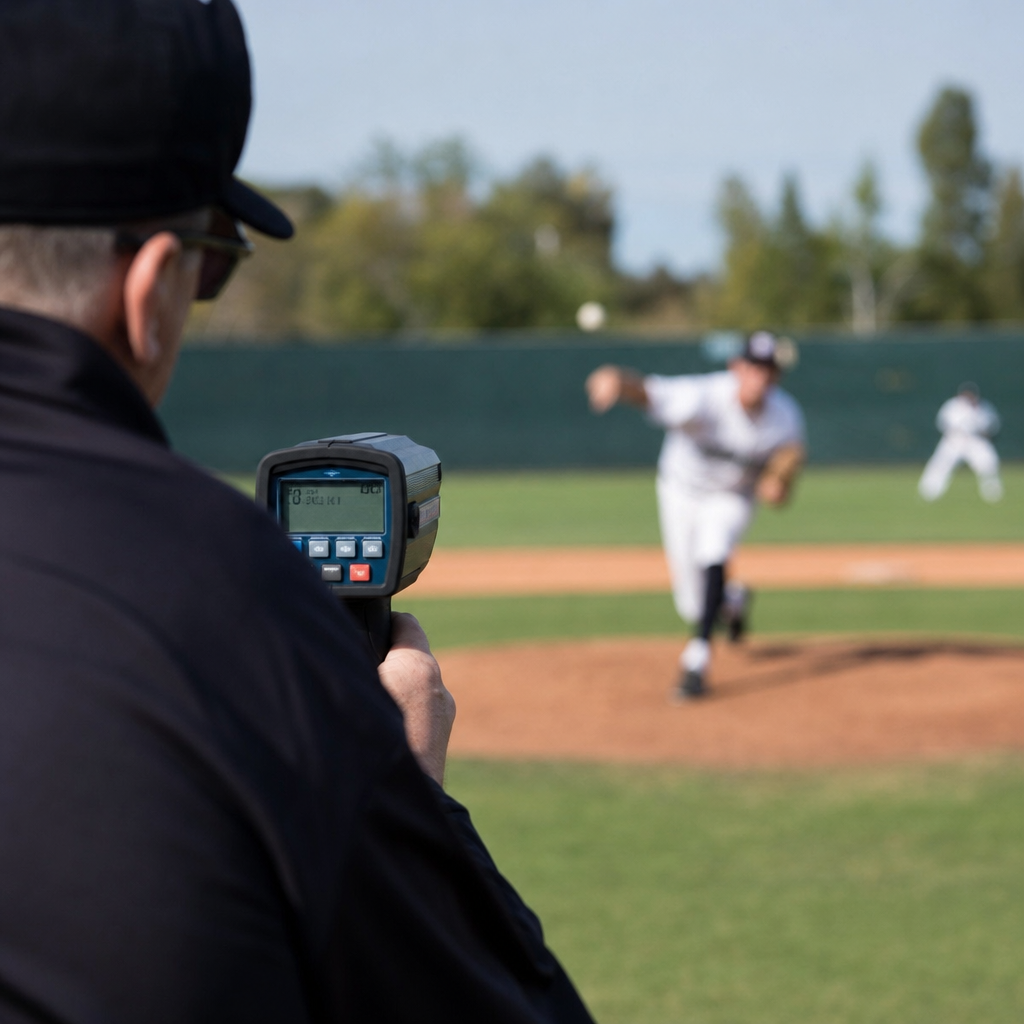
The invention of the radar gun changed baseball by turning pitch velocity from rumor into measurable fact. Before teams, broadcasters, and fans could read a pitcher’s speed instantly, “hard thrower” was a subjective label built on catcher testimony, hitter reactions, and newspaper legend. A radar gun uses radio waves to detect the speed of a moving object through the Doppler effect, and in baseball that object is the pitched ball. Once this tool entered professional parks, it reshaped scouting, player development, media coverage, injury conversations, and even how young pitchers understood success. In the broader history of baseball technology, the radar gun belongs beside night games, synthetic materials, video analysis, and modern tracking systems because it altered both performance and perception.
As a hub topic within historic baseball innovations, the radar gun matters because it links several larger changes across the sport. It influenced how scouts compared prospects, how coaches designed training plans, how front offices valued arms, and how television packaged drama for audiences. It also created new pressures. When velocity became visible, pitchers chased higher readings, organizations filtered talent through speed thresholds, and amateur players began treating radar numbers as public report cards. I have worked with pitch data in player-development settings, and the pattern is consistent: once a metric is displayed, behavior changes around it. Understanding the radar gun means understanding not only the device itself but also the culture it created. That makes it an essential starting point for exploring historic innovations in baseball, especially those that moved the game from qualitative judgment to continuous measurement.
How the radar gun was invented and why baseball adopted it
Radar technology emerged from military research in the early twentieth century and advanced rapidly during World War II, when nations needed reliable ways to detect aircraft and measure movement. The same scientific principle later enabled speed-detection devices for civilian use. Traffic radar became a practical law-enforcement tool in the mid-twentieth century, and compact Doppler radar units eventually became portable enough for sports applications. The basic concept is straightforward: the gun emits a radio signal, that signal reflects off the ball, and the frequency shift reveals velocity. In practice, accuracy depends on operator positioning, calibration, and whether the reading captures release speed or a point closer to the plate.
Baseball adopted radar guns because the sport has always valued the fastball, but until radar there was no standardized method for quantifying it in public. Scouts had stopwatches for runners and scorebooks for outcomes, yet arm strength remained difficult to compare across leagues and ballparks. By the 1970s and 1980s, handheld radar devices became more common in scouting circles, and by the 1990s velocity readings were a routine part of broadcasts and draft coverage. The technology fit baseball perfectly because each pitch is a discrete event. Unlike continuous-motion sports, baseball offers repeated, controlled moments where one measurable input can be isolated and discussed. Once teams realized velocity correlated with strikeout potential and margin for error, the radar gun moved from novelty to necessity.
How radar changed scouting, coaching, and player evaluation
The first major impact of the radar gun was on talent evaluation. Scouts still judged mechanics, deception, command, body control, and competitiveness, but velocity gave them an objective anchor. A pitcher sitting 94 miles per hour demanded attention in a way a subjective “good arm” report never could. In draft rooms, radar readings became shorthand for upside. A high school pitcher with a raw delivery but premium speed might now outrank a polished strike-thrower at 88. In international scouting, where looks could be brief and competition uneven, velocity readings helped clubs compare players across regions with more consistency.
Coaching changed as well. Once velocity could be tracked daily, throwing programs became more structured. Coaches used radar to monitor effort level in bullpens, verify whether mechanical changes improved arm speed, and evaluate recovery after heavy workloads. Strength staffs tied lower-body power, rotational force, and mobility training to measurable velocity gains. Weighted-ball programs, long-toss progressions, mound-force testing, and high-speed video all found a stronger foothold because radar offered a simple output that everyone understood. In my experience, that clarity was both useful and dangerous. Useful because players buy into development when they see evidence. Dangerous because they may chase the number instead of the skill package that makes velocity playable in games.
The radar gun also changed the language of projection. A scout could now say a pitcher was 89-91 and might reach 94 with physical maturity. Front offices built models around velocity bands, age, spin characteristics, and strikeout rates. Relievers throwing in the upper 90s became more valuable because radar highlighted the difference between average and elite arm strength. Over time, fastball speed became one of the quickest ways to separate prospects, especially when paired with a breaking pitch that could miss bats. Yet radar alone never answered the full question. Some pitchers with modest velocity sustained long careers through command, tunneling, movement, and sequencing, proving that speed was influential but not absolute.
The cultural impact on pitchers, fans, and broadcast storytelling
Once television graphics began flashing pitch speeds after every throw, the radar gun became part of baseball’s entertainment language. Fans no longer had to imagine what “blown away” meant. A 99 on the screen conveyed power instantly. Broadcasters used velocity changes to explain strategy: a starter losing two miles per hour by the sixth inning might be tiring; a reliever at 98 with a sharp slider looked overpowering; a veteran surviving at 89 had to “pitch backward” and locate. The number made pitching easier to narrate, and that storytelling power helped the radar gun become culturally important beyond its technical function.
For pitchers, the effect was more personal. Velocity became identity. Young pitchers introduced themselves with numbers: “I’m up to 92,” “I touched 95,” “I need 90 by summer.” Travel-ball events, showcase circuits, and college recruiting camps reinforced that mindset because radar readings offered a quick sorting mechanism. The result was a visible acceleration in velocity training across amateur baseball. A generation earlier, many coaches prioritized strikes and innings. Later, many prioritized arm speed first and trusted player development to refine command later. That shift produced more explosive arms, but it also narrowed how some players and families understood value.
| Era or Context | How velocity was judged | Main effect on pitching culture |
|---|---|---|
| Pre-radar mainstream era | Scout observation, catcher comments, hitter reactions | Reputation formed through testimony and legend |
| Early scouting radar adoption | Handheld readings in workouts and games | Objective comparisons influenced drafting and signing |
| Broadcast radar era | On-screen speed after many pitches | Fans equated dominance more directly with power |
| Modern tracking era | Velocity paired with spin, extension, and movement data | Pitch design and individualized development became standard |
The fan experience changed because radar readings gave everyone a common reference point. Casual viewers could appreciate Nolan Ryan, Randy Johnson, or Aroldis Chapman not just through highlight descriptions but through visible speed ranges that distinguished them from ordinary pitchers. Even debates across eras increasingly revolved around velocity, though those comparisons can be misleading because radar systems, stadium setups, and measurement points have not always been standardized. Still, the cultural lesson is clear: the radar gun transformed velocity from hidden information into shared spectacle, and baseball has never returned to a world where pitch speed is invisible.
Limits, unintended consequences, and the move beyond radar alone
The radar gun improved decision-making, but it also introduced distortions. The biggest was overemphasis. Velocity is valuable because faster pitches reduce hitter reaction time and generally improve strikeout potential, yet radar numbers can hide flaws. A straight 97 with poor location may be less effective than a well-commanded 92 with ride or sink. Scouts who lean too heavily on the gun risk missing pitchers with elite command, deception, release traits, or unusual movement profiles. Baseball history is full of examples, from Greg Maddux to Mark Buehrle, showing that effectiveness depends on more than peak speed.
There are measurement limitations too. Different parks historically displayed readings from different points in ball flight. A pitch measured near release can read several miles per hour faster than one measured closer to home plate because the ball slows as it travels. Operator angle matters with handheld devices; calibration matters; environmental conditions matter. These details are not trivial. They influence contract discussions, draft impressions, and public narratives. Modern systems such as PITCHf/x, Statcast, and Hawk-Eye improved consistency by automating pitch tracking and defining measurement standards more clearly, but even now analysts must understand what exactly a number represents before comparing it across eras.
The radar gun also contributed, indirectly, to the sport’s modern injury debate. As velocity became more prized, pitchers trained more aggressively for arm speed. Higher intent throwing, year-round competition, and showcase culture increased stress on developing arms. No single device caused that shift, but the visibility of the velocity number absolutely intensified it. In player development, the challenge is balancing performance gains with workload management, sound mechanics, recovery protocols, and realistic timelines. The best organizations now use radar as one input among many, pairing it with force-plate data, biomechanical assessment, pitch shapes, strike quality, and health monitoring. That broader approach is a direct response to the lesson radar eventually taught: what is easy to measure can dominate attention, even when success is more complex.
The radar gun’s legacy within historic baseball innovations
Among major baseball innovations, the radar gun stands out because it changed both front-office process and public consciousness. Night baseball expanded scheduling. Video replay changed officiating. Composite bats reshaped amateur offense. Advanced ball-tracking systems revolutionized analysis. The radar gun belongs in this lineage because it marked a decisive transition from observational baseball to quantified baseball. It did not eliminate traditional expertise; in fact, it made expert interpretation more important. Numbers are only powerful when someone understands context, reliability, and relevance. But once velocity entered the conversation in measurable form, every layer of the sport adapted around it.
Its legacy is easiest to see in the technologies that followed. Modern pitch labs use edgertronic cameras, motion-capture systems, Rapsodo units, TrackMan, and Hawk-Eye to measure spin rate, spin axis, induced vertical break, horizontal movement, release height, extension, and seam effects. Those tools are more advanced than a handheld radar gun, but conceptually they extend the same revolution: performance can be captured, compared, and improved through objective feedback. In many facilities, radar still serves as the first gateway metric because it is intuitive. A pitcher may not initially understand vertical approach angle, but he understands 90 becoming 93.
For readers exploring historic innovations in baseball, the most important takeaway is that the radar gun did more than clock pitches. It changed incentives. It shifted scouting language, altered development priorities, enriched broadcasts, sharpened fan perception, and accelerated the sport’s embrace of data. At the same time, it exposed the limits of single-metric thinking, pushing baseball toward richer forms of analysis. That dual legacy is why the radar gun remains such a significant invention. It made pitching easier to measure, harder to misunderstand, and impossible to discuss without numbers. If you are tracing how baseball evolved from tradition-bound observation to modern evidence-based decision-making, start here, then follow the path into video, biomechanics, and full pitch-tracking systems.
Frequently Asked Questions
What is a radar gun, and how does it measure the speed of a baseball pitch?
A radar gun is an electronic device that measures the speed of a moving object by using radio waves and the Doppler effect. In baseball, the device is aimed toward the pitcher and the path of the ball. It emits a radio signal that bounces off the moving baseball and returns to the gun at a slightly different frequency. That frequency shift tells the device how fast the ball is traveling. What made the radar gun so important to the sport is that it replaced guesswork with immediate, repeatable measurement. Instead of relying on a catcher saying a pitcher was “exploding” the ball past hitters or a reporter describing someone as “blazing fast,” teams could attach a number to velocity in real time.
That simple change had enormous consequences. Once pitch speed became visible, it changed how players were evaluated, how fans understood pitching, and how broadcasters described performance. A 95 mph fastball became more than a reputation; it became a measurable trait. Over time, radar readings also helped distinguish between different kinds of pitchers. Velocity could now be compared from one game to another, one prospect to another, and even one inning to the next. In that sense, the radar gun did more than measure speed. It helped turn pitching into a more data-driven craft and gave baseball a new language for discussing power on the mound.
Why was the invention of the radar gun such a turning point for pitchers and scouts?
Before radar guns became common in baseball, evaluating arm strength was far more subjective. Scouts depended heavily on visual impressions, catcher comments, hitter reactions, and their own instincts. A pitcher might be labeled a hard thrower based on how late hitters swung or how lively the ball looked coming out of the hand, but there was no universal number to support that claim. The radar gun changed that by giving scouts an immediate, standardized piece of information. Velocity became one of the easiest tools to identify and compare, which dramatically affected how pitchers were discussed and projected.
For scouts, this meant a stronger ability to separate reputation from measurable skill. A young pitcher throwing 96 mph in a small town or minor league park could suddenly draw attention in a way that might have been missed in an earlier era. For pitchers, it created both opportunity and pressure. A big fastball became a clearer path to prospect status, draft interest, and professional advancement. At the same time, it narrowed focus in some evaluations, because velocity numbers could overshadow command, movement, deception, and durability. In other words, the radar gun improved scouting precision, but it also encouraged baseball to place even greater value on pure speed. That shift reshaped player development and changed what organizations prioritized when building pitching staffs.
How did radar gun readings change the way fans and broadcasters understood pitching?
Radar gun readings made pitching more accessible to the public because they turned an invisible quality into an easy-to-understand number. Fans no longer had to infer whether a pitcher was overpowering hitters; they could see 98 mph on the scoreboard or hear it announced on a broadcast. That immediate information added drama to every pitch. A rising velocity reading could signal that a reliever had extra life in a key moment, while a sudden drop might suggest fatigue, injury, or mechanical trouble. For broadcasters, velocity became a useful storytelling tool that helped explain what viewers were watching in more concrete terms.
This also changed how pitching performances were remembered and compared. Instead of describing a pitcher in broad terms like “fireballer” or “soft tosser,” commentators could anchor those descriptions with numbers. Fans began to track not just strikeouts and earned run average, but also average fastball velocity and peak speed. Over time, that helped create a more informed audience, one that could better appreciate the relationship between speed, pitch selection, and effectiveness. At the same time, the prominence of radar readings sometimes encouraged oversimplification, making it easy to assume that harder always meant better. Even so, the radar gun undeniably deepened public engagement with pitching by making one of its most exciting elements visible in real time.
Did the radar gun affect how pitchers were developed and trained?
Yes, significantly. Once pitch velocity became a widely tracked metric, coaches, teams, and players began treating it as a major development target rather than just a natural trait. Training methods evolved to help pitchers throw harder through better mechanics, strength work, mobility training, and more specialized throwing programs. Pitchers learned that adding even a few miles per hour could dramatically change how they were perceived by scouts and front offices. As a result, development systems increasingly emphasized velocity gains, especially for younger pitchers trying to stand out in amateur baseball, college programs, and the minor leagues.
The impact was not entirely one-dimensional, though. Radar guns also gave pitchers and coaches a feedback loop. They could test whether a mechanical adjustment improved speed, whether a pitcher maintained velocity deep into games, or whether an offseason training plan was producing measurable results. That made instruction more precise. However, the focus on radar readings also created risks. Some pitchers began chasing velocity at the expense of command, pitchability, or long-term health. In modern baseball, many organizations try to balance these competing priorities by viewing velocity as one important tool among many rather than the only marker of success. Still, there is no question that the radar gun changed pitcher development by making speed more central to training, evaluation, and career advancement.
What was the long-term impact of the radar gun on baseball strategy and the culture of pitching?
The long-term impact of the radar gun was profound because it altered both strategy and identity within the sport. Strategically, teams became more aware of how velocity could play in different roles. High-speed fastballs became especially prized in late-inning relief, helping fuel the rise of power bullpens and specialized relievers. Starters, meanwhile, were increasingly evaluated not only on whether they could throw hard, but on whether they could sustain that velocity across multiple innings. The radar gun also contributed to broader analytical thinking by providing a measurable data point that could be paired with strikeout rates, spin, movement, and location. It became one of the building blocks of modern pitching analysis.
Culturally, the radar gun changed how pitchers saw themselves and how the game celebrated them. Velocity became part of a pitcher’s public identity, often mentioned alongside wins, strikeouts, or signature pitches. Young players began to grow up knowing their numbers, comparing them with peers, and understanding that scouts were watching those readings closely. This helped create a baseball culture that admired power in a more explicit and quantifiable way than ever before. At the same time, the radar gun did not eliminate the value of finesse, command, or intelligence on the mound. Instead, it sharpened the contrast between different pitching styles and made those differences easier to discuss. Ultimately, the invention of the radar gun helped move baseball from a sport built partly on myth and anecdote to one more grounded in measurement, without taking away the drama that made pitching compelling in the first place.