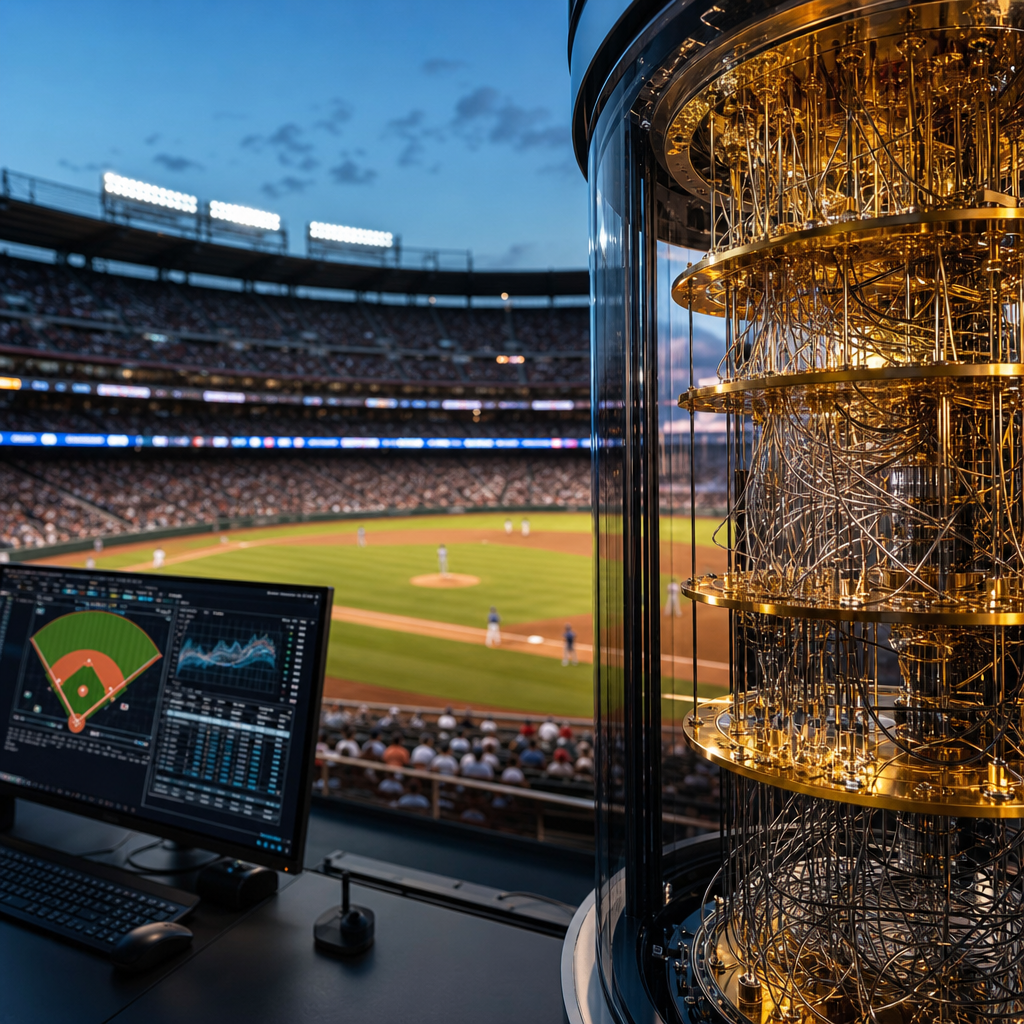
Quantum computing could revolutionize baseball analytics by solving optimization and pattern-recognition problems that strain even today’s best cloud systems, opening new ways to evaluate players, simulate games, prevent injuries, and plan strategy across an entire season. In baseball analytics, teams already use large datasets from Statcast, biomechanical sensors, video tagging, radar tracking, and medical records to estimate outcomes such as pitch effectiveness, lineup value, defensive positioning, and injury risk. Quantum computing refers to hardware and algorithms that use qubits, superposition, entanglement, and quantum interference to process certain classes of problems differently from classical computers. That does not mean every baseball model suddenly becomes faster or better. It means a narrow but important set of high-complexity tasks could eventually be tackled in ways that are impractical today. For front offices, player development staff, and performance scientists, that matters because baseball decisions are rarely isolated. A draft pick affects bonus pool strategy, development resources, future roster flexibility, and trade options. A pitching change alters matchups, bullpen availability, fatigue, and win expectancy several innings later. I have worked with sports data pipelines long enough to know that the hardest part is often not collecting data but combining many competing variables into one useful decision. Quantum methods are relevant precisely because baseball is a web of constrained choices, uncertain outcomes, and massive state spaces.
As a hub for future gazing and predictive trends, this article maps where quantum computing may create genuine value, where it remains speculative, and how baseball organizations should prepare now. The practical questions are straightforward: What problems in baseball fit quantum approaches? Which use cases could emerge first? What standards, tools, and limitations should teams understand before investing? The short answer is that quantum advantage in baseball is most plausible in optimization, Monte Carlo-style scenario modeling, feature discovery in very large datasets, and scheduling under constraints. It is less likely, at least near term, to replace established machine learning workflows or the domain expertise of coaches, scouts, and analysts. The smarter view is not “quantum replaces analytics.” It is “quantum extends the frontier of what analytics can search, simulate, and optimize.” Baseball has repeatedly rewarded organizations that adopt useful technology early, from video scouting to PITCHf/x to Hawkeye-based tracking. Quantum computing is not ready to run a major league front office today, but its eventual impact could be profound for clubs that learn where it fits.
Why Baseball Is a Natural Fit for Quantum-Inspired Problem Solving
Baseball generates unusually rich decision environments because the sport is discrete, sequential, and deeply contextual. Every pitch can be described by count, movement, location, release characteristics, batter tendencies, defensive alignment, weather, park effects, fatigue, and umpire zone tendencies. Those variables multiply quickly. Classical analytics handles much of this well through regression, gradient boosting, Bayesian models, reinforcement learning, and simulation. The challenge appears when teams want to optimize across many interdependent variables at once. Examples include selecting a 26-man roster while balancing platoon value, options status, service time, injury recovery windows, and travel fatigue; designing a draft board under bonus constraints; or sequencing pitcher usage over a ten-game stretch to maximize aggregate win probability rather than one game in isolation.
These are combinatorial problems. The number of possible combinations can explode beyond what brute-force search can evaluate efficiently. Quantum computing is attractive here because algorithms such as the Quantum Approximate Optimization Algorithm and quantum annealing approaches are designed for constrained optimization landscapes. In plain terms, they can be used to search through many possible configurations and identify high-quality solutions when exact search is too expensive. Sports organizations do not need perfect answers; they need better answers delivered in time to act. If a quantum or quantum-inspired method improves a scheduling, lineup, or resource-allocation decision by even a small margin over 162 games, the competitive impact could be meaningful.
Player Evaluation, Projection, and Hidden Pattern Discovery
One of the most promising long-term uses of quantum computing in baseball analytics is player projection. Today, projection systems combine historical performance, aging curves, batted-ball quality, strike-zone judgment, pitch metrics, injury history, and league translations. They work, but every analyst knows their limits. Breakouts are hard to predict. Skill interactions are nonlinear. Context shifts matter. A hitter’s swing change, bat-speed gain, and improved chase discipline may interact in ways that standard models underweight because they are trained on the past, not on emerging combinations of traits.
Quantum machine learning is often overstated, but there is a credible possibility that quantum feature maps and kernel methods could help detect structure in high-dimensional baseball data that classical pipelines miss or can only approximate inefficiently. Consider a pitching lab trying to identify which minor league arms are most likely to convert from fringe starters into high-leverage relievers. The input space might include seam orientation, induced vertical break, extension, release variability, spin efficiency, lower-half force production, recovery markers, and biomechanics. The key is not one metric. It is the interaction pattern among them. If quantum methods can separate complex clusters more effectively, clubs could identify undervalued players earlier than rivals.
Realistically, the first gains may come through hybrid workflows rather than fully quantum models. Classical systems would still clean and engineer the data using Python, SQL, Spark, or Databricks, then pass selected subproblems to quantum tools from IBM Quantum, D-Wave, or Rigetti. In practice, that mirrors how good baseball analytics departments already operate: use the right tool for the right task, preserve auditability, and demand out-of-sample validation before changing decisions.
Game Strategy, Lineup Construction, and Bullpen Optimization
In-game baseball strategy looks simple on television and brutally complex inside a front office model. A manager choosing a lineup is not merely ordering nine hitters. The club must weigh handedness, rest, defensive range, catcher framing, baserunning, weather, recent workload, and likely opponent bullpen sequencing. During the game, every move changes the next decision. Pinch-hitting now may weaken defense later. Using the closer in the eighth may lower expected runs now but raise risk in extra innings. Classical win expectancy tables help, yet they often simplify future branching paths because enumerating every path is expensive.
Quantum optimization could help clubs evaluate larger trees of possible decisions under real constraints. That is especially relevant to bullpen management, where the state space grows quickly across consecutive games. Teams want to maximize current win probability without overloading arms and increasing injury risk. This can be framed as a constrained optimization problem with uncertain future states, exactly the kind of structure researchers explore with hybrid quantum solvers. Similar logic applies to lineup construction across a series rather than one game. The best lineup Tuesday may not be the best sequence of choices for Tuesday through Sunday if certain players need recovery days or if upcoming opposing starters create better matchup opportunities.
| Baseball decision | Why it is hard classically | Potential quantum value | Near-term reality |
|---|---|---|---|
| Bullpen usage over a series | Many branching scenarios, fatigue constraints, leverage changes | Search better allocations across multiple games | Hybrid optimization is more likely than full quantum control |
| Lineup construction | Interactions among offense, defense, platoons, and rest | Evaluate more combinations under constraints | Useful first in pregame planning, not live dugout decisions |
| Draft bonus pool strategy | Signability uncertainty and cascading opportunity costs | Optimize portfolio choices across rounds | Strong candidate for early experimentation |
| MLB and minor league scheduling | Travel, recovery, venue, and broadcast constraints | Better solutions to complex scheduling formulations | Likely valuable at league-operations level |
Injury Prediction, Biomechanics, and Performance Science
Another area where quantum computing could reshape baseball analytics is health modeling. Injury prediction is notoriously difficult because the underlying system is multicausal and noisy. Workload matters, but so do biomechanics, sleep, tissue capacity, recovery quality, prior injury, stress, travel, weather, and even subtle compensations after a minor issue. Most teams already use force plates, markerless motion capture, high-speed video, and wellness data to monitor players. The problem is translating all of that into reliable intervention decisions without generating false confidence.
Quantum-enhanced modeling may help by finding interactions among biomechanical and workload variables that standard dimensionality-reduction methods blur. For pitchers, a club might examine how shoulder rotation timing, trunk tilt, velocity spikes, spin-axis changes, and between-outing recovery markers combine to alter injury probability. For hitters, the relevant mix could include bat speed, attack angle variability, rotational power asymmetry, and swing-decision stress under heavy playing loads. The goal is not a magic injury forecast. It is better risk stratification and earlier detection of unstable patterns. In baseball operations, even modest improvements matter. Preventing one avoidable injured-list stint can preserve millions of dollars in value and stabilize roster planning.
There is an important caution here. Medical and biomechanical models require strict governance. Any quantum-based system would need the same standards as existing performance science tools: documented inputs, privacy controls, reproducibility, and human review by medical staff. Clubs should treat these systems as decision support, not diagnosis engines. The organizations that benefit most will be those that integrate model outputs with coaching observations, athlete feedback, and established sports medicine protocols rather than chasing black-box certainty.
Scouting, Draft Strategy, and International Player Markets
Baseball’s acquisition markets are ideal testing grounds because they involve portfolio decisions under uncertainty. In the amateur draft, clubs must rank talent, estimate signability, manage bonus pools, account for medical flags, and anticipate what other teams will do. In international scouting, they project teenagers with limited track records and uneven competition quality. In trades and free agency, they estimate future production, aging, injury risk, clubhouse fit, and contract efficiency. These are not one-player decisions. They are allocation problems across budgets, timelines, and probabilities.
Quantum optimization could make a difference here because the value of one choice depends on the options it unlocks or blocks later. A team drafting an expensive high school shortstop in the first round changes its entire pool strategy afterward. A club choosing between two free-agent starters must consider not only projected WAR, but also how each pitcher affects rotation depth, prospect timelines, trade flexibility, and competitive windows. Analysts often approximate these interactions with scenario trees and heuristics. Better search methods could improve those approximations.
This is where future-facing front offices should pay attention now. Even before large-scale quantum hardware matures, quantum-inspired optimization already exists and can run on classical infrastructure. That means teams can begin reformulating scouting and portfolio problems in ways that are compatible with future systems. Organizations that build clean decision models today will be able to test new solvers faster tomorrow.
What Will Happen First, and What Will Take Longer
The likely adoption path is gradual. First, baseball organizations will use quantum-inspired optimization and hybrid solvers for bounded problems such as travel scheduling, draft portfolio modeling, and multi-game bullpen planning. Next, as hardware improves in qubit quality, coherence, and error mitigation, teams may experiment with richer simulation tasks and high-dimensional classification problems. Full-scale quantum advantage in everyday baseball operations is still uncertain because current systems remain noisy and specialized. Error correction is costly, data loading is nontrivial, and many classical methods continue to improve quickly.
That limitation matters. A serious baseball analytics department should be skeptical of claims that quantum computing will instantly transform player valuation or make traditional models obsolete. Most workloads in baseball today are better served by standard machine learning, high-performance computing, and disciplined causal inference. The point is not replacement. The point is expansion into classes of problems where search and interaction effects become overwhelming. In my experience, the best innovation bets in sports are the ones attached to a clear operational question. If a club cannot define the decision, data source, success metric, and review process, the technology is not the problem; the workflow is.
How Baseball Organizations Should Prepare
Teams do not need a quantum lab to get ready. They need clean data architecture, well-defined optimization problems, and staff who can translate baseball questions into mathematical formulations. Start with areas where constraints are explicit: roster construction, scheduling, draft budgets, rehab planning, and pitcher deployment. Build benchmark models classically. Then test whether hybrid solvers produce better solutions or faster search. Use established frameworks for model governance, including holdout evaluation, backtesting, sensitivity analysis, and documentation. Partner selectively with universities, cloud providers, or specialist vendors, but keep internal ownership of baseball context. The clubs that win from future predictive trends will not be those chasing buzzwords. They will be the ones that connect advanced computation to specific baseball decisions, validate results rigorously, and act before the rest of the market catches up. For teams, analysts, and curious fans following innovations and changes in baseball, now is the moment to watch this space closely and start learning where quantum computing can create a real edge.
Frequently Asked Questions
1. How could quantum computing improve baseball analytics beyond what current systems already do?
Quantum computing could expand baseball analytics by tackling classes of problems that become extremely difficult as data volume, interdependencies, and uncertainty all grow at once. Today’s teams already rely on advanced models built from Statcast data, radar tracking, biomechanical measurements, video analysis, scouting inputs, and medical information. Classical cloud systems can process enormous datasets, but they still struggle when analysts try to optimize many variables simultaneously across a full roster, schedule, opponent pool, injury profile, and strategic scenario set. That is where quantum computing becomes especially interesting.
In practical baseball terms, quantum systems may eventually help teams evaluate millions of possible lineup combinations, defensive alignments, pitch sequences, player usage plans, and development pathways more efficiently than conventional approaches alone. Instead of asking isolated questions such as “Who should bat third?” or “What pitch should this pitcher throw in a 1-2 count?”, teams could analyze much larger decision spaces in which every choice affects others. A quantum-assisted model might weigh batter-pitcher matchups, park factors, fatigue trends, travel schedules, platoon splits, defensive range, weather conditions, and injury risk at the same time.
Another major area is pattern recognition. Baseball data is highly complex and often noisy. A player’s true value is hidden behind changing mechanics, small sample sizes, context effects, and interaction effects that are difficult to model cleanly. Quantum machine learning could eventually help uncover deeper relationships in swing paths, pitch tunneling, spin behavior, base-running decisions, and defensive reactions. That does not mean quantum computers would replace current analytics stacks overnight. More likely, they would augment classical systems, helping analysts solve especially hard optimization and simulation tasks faster or more accurately. The real revolution would come from combining richer data with stronger computational tools to make better decisions across an entire season, not just in isolated moments.
2. What specific baseball problems are best suited for quantum computing?
The best candidates are problems involving large-scale optimization, simulation, and complex pattern recognition. Baseball is full of these. One obvious example is lineup construction. Setting a lineup is not just a matter of ranking hitters by on-base percentage or slugging. Teams need to balance handedness, defensive value, rest schedules, opponent tendencies, park dimensions, weather, late-game substitution flexibility, and expected bullpen usage. As constraints multiply, the number of viable combinations grows quickly. Quantum optimization could help identify stronger solutions in that kind of high-dimensional problem.
Pitching strategy is another promising application. Teams want to know not only which pitcher should face which lineup, but also how to sequence pitches, when to pull a starter, how to structure bullpen roles over a series, and how to preserve pitcher health over a 162-game season. Those decisions involve tradeoffs between immediate win probability and long-term durability. Quantum methods may be useful for finding better solutions when all of those variables are linked together.
Defensive positioning also fits well. Modern teams already shift and reposition fielders based on hitter spray charts, swing tendencies, and game context. But the ideal defensive setup depends on batter behavior, pitcher command, pitch type, count, runner speed, game state, and ballpark geometry. A quantum-assisted system could search through huge numbers of positioning scenarios and recommend alignments that maximize expected run prevention.
Player development and injury prevention may be just as important. Baseball organizations collect biomechanics data, workload histories, force-plate readings, motion-capture information, and recovery markers. The challenge is identifying subtle patterns that indicate performance gains or injury risk before they become obvious. Quantum-enhanced pattern recognition could potentially help discover hidden relationships in mechanics, fatigue, and movement signatures that current systems miss. In short, the most promising baseball uses are the ones where there are many possible choices, many interacting variables, and no easy shortcut to the best answer.
3. Could quantum computing help predict player performance and reduce injuries?
Yes, at least in theory, and this is one of the most compelling long-term applications. Predicting player performance is difficult because baseball outcomes are shaped by overlapping layers of skill, health, mechanics, psychology, environment, and randomness. A hitter’s results might be influenced by bat speed, swing decisions, pitch recognition, sleep quality, prior workload, lower-body stability, opponent pitch mix, and even travel-related fatigue. Classical models do a strong job with many of these inputs, but there are still limits when trying to capture the full web of interactions. Quantum computing could help by improving how those complex relationships are modeled, especially when the data is nonlinear and highly interdependent.
For performance forecasting, a quantum-assisted approach might identify deeper patterns in how players age, adjust, recover, or break out. It could potentially improve projections for pitchers whose repertoires are changing, hitters rebuilding swings, or defenders whose positioning and reaction metrics are evolving. This could give teams a better sense of not only expected production, but also volatility, downside risk, and development upside.
Injury prevention may be even more transformative. Baseball injuries often emerge from cumulative stress, mechanical inefficiencies, overuse, compensation patterns, and recovery gaps rather than one simple cause. Teams now track throwing workloads, movement quality, joint stress indicators, force production, and medical histories, but integrating all of that into actionable predictions remains difficult. Quantum computing may help process these diverse data streams together to identify risk signatures earlier. For example, a system might detect that a pitcher’s arm slot variation, lower-body force output decline, and recent workload pattern collectively signal elevated injury risk, even if no single metric looks alarming by itself.
That said, quantum computing would not create perfect prediction. Baseball will always include uncertainty, and injuries are influenced by human biology in ways no model can fully control. The realistic benefit is not certainty but better probability estimates, earlier warnings, and more personalized planning. Teams that can make smarter workload decisions, training adjustments, and recovery interventions would gain a meaningful competitive edge.
4. Will quantum computing replace traditional baseball analytics and current cloud-based models?
No, the most realistic future is a hybrid one. Traditional baseball analytics, machine learning, and cloud computing are already deeply embedded in player evaluation, scouting, game preparation, and front-office decision-making. These systems are highly effective for many tasks and will remain essential because they are practical, scalable, and well understood. Quantum computing is not likely to sweep in and replace all of that infrastructure. Instead, it would be used for specific problems where classical methods become too slow, too approximate, or too limited when the complexity gets very high.
Think of quantum computing as an advanced layer added to an existing analytics environment. Teams would still gather data from Statcast, high-speed cameras, biomechanical sensors, medical platforms, and scouting databases. They would still clean data, engineer features, train standard models, and use cloud resources for large-scale storage and routine analysis. Quantum processors would likely be called on for specialized workloads such as combinatorial optimization, large scenario simulation, or difficult pattern-recognition tasks. The output from those quantum routines would then feed back into classical systems used by analysts, coaches, and decision-makers.
This matters because baseball operations are not just about raw computing power. Results need to be interpretable, actionable, and trusted by coaches and front offices. If a model recommends a radical bullpen plan or a major defensive adjustment, staff members need to understand why. Classical analytics pipelines are better suited for reporting, dashboards, communication, and integration into everyday workflows. Quantum tools would be most valuable when they improve the quality of the recommendations behind those workflows.
It is also important to recognize that quantum hardware is still developing. Error rates, scaling challenges, and implementation costs mean that broad real-world adoption in sports will take time. So the near-term story is not replacement. It is selective augmentation. Teams that combine conventional analytics with emerging quantum methods could eventually gain sharper strategic insights without abandoning the systems they already rely on.
5. How soon could Major League Baseball teams realistically use quantum computing in day-to-day decision-making?
The short answer is that meaningful experimentation could happen relatively soon, but widespread day-to-day adoption is probably still years away. Quantum computing has made major progress, yet most current hardware remains limited for large, reliable, real-world operational use. Baseball organizations are practical businesses, and they are unlikely to rebuild their analytics departments around an immature technology. What is more likely in the near term is targeted research, pilot projects, and partnerships with cloud providers, research labs, or specialized vendors.
Early use cases would probably focus on narrow, high-value problems rather than full organizational transformation. A team might test quantum-assisted optimization for travel and rest planning, lineup generation under complex constraints, minor league player development pathways, or injury-risk clustering from biomechanics data. These are areas where even incremental improvements could deliver value. Over time, if hardware improves and algorithms mature, those pilot applications could expand into game simulation, pitch design, roster construction, and season-long strategy optimization.
Adoption will also depend on economics and organizational culture. Wealthier and more analytically aggressive franchises are the most likely to explore quantum methods first, especially if they already invest heavily in R&D. Teams with strong data engineering and sports science departments will be better positioned to benefit because quantum computing does not solve poor data quality or weak decision processes. It amplifies the value of a strong analytics foundation rather than replacing the need for one.