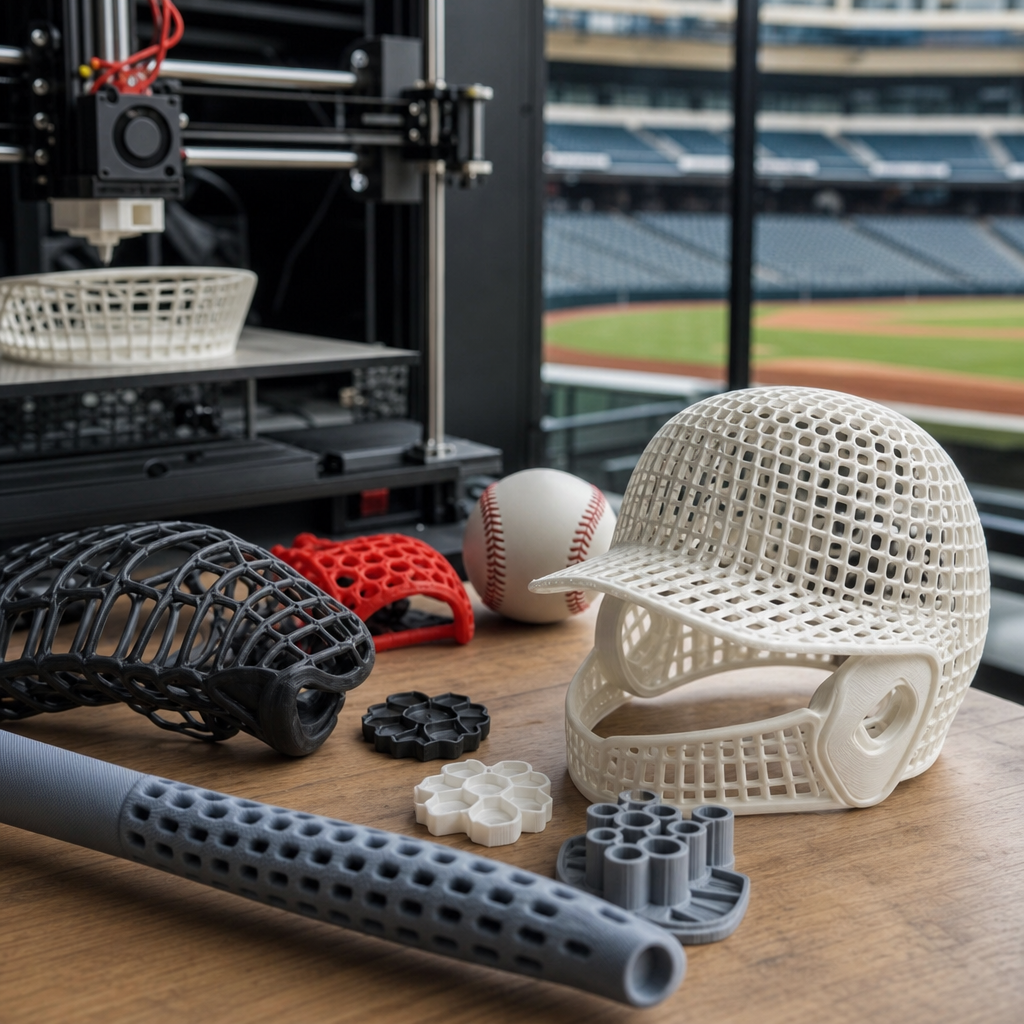
3D printing is moving from novelty to infrastructure in baseball, reshaping how teams design equipment, train athletes, manage injuries, and imagine the next decade of the sport. In practical terms, 3D printing, also called additive manufacturing, builds an object layer by layer from a digital model instead of cutting it from a larger block of material. That difference matters because it allows rapid prototyping, precise customization, and low-volume production that would be too slow or expensive with traditional methods. Baseball, a game built on repeatable mechanics and tiny performance margins, is especially suited to this technology. A few grams shifted in a cleat plate, a guard contoured to a hitter’s hand, or a rehab brace matched exactly to a pitcher’s forearm can influence comfort, confidence, and durability over a 162-game season.
I have worked with performance staff and product teams evaluating printed prototypes, and the biggest change is not speed alone. It is the ability to test ideas that previously died on a whiteboard because tooling costs were too high. A coach can identify a grip issue, a designer can alter geometry overnight, and an athlete can try a revised version the next day. That loop compresses innovation. As this sub-pillar hub for future gazing and predictive trends in baseball, this article maps where 3D printing already fits, where it is likely headed, and which limits still matter. The future of 3D printing in baseball is not one breakthrough. It is a series of practical advances across equipment, player development, medicine, facilities, fan products, and supply chains.
Why 3D printing fits baseball so well
Baseball rewards personalization because players perform highly individualized movements within standardized rules. A catcher’s stance, an infielder’s first step, and a pitcher’s arm slot all create different equipment needs. Traditional manufacturing is excellent for mass production, but it struggles when each athlete needs small changes in shape, stiffness, ventilation, or weight distribution. Additive manufacturing solves that problem by letting clubs and brands produce one-off or short-run items without creating expensive molds. That is why the strongest near-term use cases in baseball are not entire bats or helmets printed in one piece. They are customized components, inserts, guards, training tools, and fit-specific accessories.
Material science is the second reason adoption is accelerating. Modern printers work with nylon, thermoplastic polyurethane, carbon-fiber-reinforced polymers, elastomers, photopolymer resins, and metal powders. Selective laser sintering, fused deposition modeling, stereolithography, Multi Jet Fusion, and direct metal laser sintering each serve different needs. In baseball terms, that means flexible lattice padding for impact management, rigid cleat structures for force transfer, lightweight jigs for clubhouse repair, and complex metal parts for pitching machines or biomechanics rigs. Teams do not need every process in-house. Many already use service bureaus and sporting goods partners, combining internal design capability with external manufacturing expertise.
The performance value also aligns with the data-driven direction of baseball operations. Motion capture systems such as Hawk-Eye, force plates, bat sensors, and 3D body scans produce measurable inputs. Those inputs can feed directly into digital design. If a player loads heavily on one side, cleat traction can be tuned. If a catcher develops recurring hand irritation, a mitt insert or finger protector can be reshaped around pressure points. This is future gazing grounded in current workflow: collect athlete data, model a solution, print a prototype, test it, refine it, and scale only if results justify it.
Equipment innovation: from custom fit to smarter performance
The most visible future applications of 3D printing in baseball will appear in equipment. Cleats are already an obvious category because foot morphology varies widely, and comfort has a direct link to movement quality. Brands in other sports have used printed midsoles and lattice structures to tune cushioning and energy return. In baseball, expect more printed cleat plates, heel cups, and orthotic elements tailored to position and playing surface. A middle infielder on artificial turf does not need the same outsole geometry as an outfielder tracking deep balls on natural grass. Over time, custom traction maps based on force-plate testing could become routine for elite players.
Protective gear is another major growth area. Batting gloves, elbow guards, sliding mitts, shin guards, and catcher’s equipment all benefit from exact anatomical fit. A printed lattice can absorb impact while reducing bulk and heat retention compared with solid foam. That matters in baseball because players wear gear for long periods and often reject protection that feels restrictive. I have seen athletes accept a custom guard they would never have tolerated in a generic retail shape. Better compliance can translate into more aggressive baserunning, more confidence in the box, and fewer avoidable bruising injuries. For catchers, where every ounce matters over nine innings, reduced weight with maintained protection is a meaningful advantage.
Bats and balls sit under tighter regulatory scrutiny, so transformative change will be slower. Professional rules governing bat construction, materials, and performance testing limit what can reach competition. Still, 3D printing can influence legal bat development through knobs, grips, training bats, and prototype handle geometries. Teams and manufacturers can test feel, load distribution, and swing intent in training before finalizing conventional production. For baseballs, printed molds, seam prototypes, storage tools, and quality-control fixtures may prove more useful than printed game balls themselves. The key forecast is simple: additive manufacturing will affect the ecosystem around regulated equipment faster than it changes the regulated core.
Player development, biomechanics, and injury management
The deepest long-term impact of 3D printing in baseball may come from player development and sports medicine rather than headline equipment launches. Baseball organizations already invest heavily in biomechanics labs, high-speed video, markerless motion capture, and workload monitoring. The next step is turning those measurements into physical tools tailored to the athlete. Printed drill aids can guide wrist position, stride alignment, glove presentation, or scapular movement. Unlike generic training gadgets, these tools can be built around a player’s dimensions and movement constraints. That customization is especially valuable in the minor leagues, where development plans are individualized but budgets still demand efficient solutions.
Rehabilitation is where additive manufacturing can deliver immediate, measurable value. Custom splints, braces, finger supports, and protective shells can be printed quickly after a scan, improving fit and potentially reducing pressure sores or slippage. In hand injuries, common in baseball from hit-by-pitch incidents and diving plays, exact contouring matters. A poorly fitted support can alter mechanics and delay return-to-play progressions. A custom printed brace can protect the injured structure while preserving as much functional movement as possible. Hospitals and orthopedic clinics have already adopted patient-specific printed devices in selected cases, and baseball will increasingly pull that capability into performance medicine settings.
The future extends to surgical planning and education. When team physicians can review a printed anatomical model based on CT or MRI imaging, they can visualize complex fractures or joint issues more clearly and explain procedures to athletes in plain terms. That improves decision-making and trust. Over the next decade, clubs with integrated medical, biomechanics, and design teams will use printed models not only for treatment but also for prevention. If repeated screening identifies a recurrent stress pattern, staff can prototype a grip aid, throwing implement, or protective modification designed to reduce load in a targeted way.
| Application area | What gets printed | Baseball benefit | Likely adoption timeline |
|---|---|---|---|
| Footwear | Cleat plates, heel cups, orthotics | Better traction, comfort, lower fatigue | Near term |
| Protection | Elbow guards, sliding mitts, catcher padding | Custom fit with less bulk | Near term |
| Training | Grip aids, swing path guides, drill tools | Faster individualized development | Near to mid term |
| Medical | Splints, braces, anatomical models | Improved rehab and treatment planning | Near term |
| Operations | Machine parts, jigs, replacement components | Reduced downtime and inventory needs | Mid term |
Clubhouse operations, manufacturing, and the baseball supply chain
One underappreciated future trend is operational resilience. Baseball clubs run like small manufacturing ecosystems, with equipment rooms, training spaces, repair needs, travel logistics, and constant iteration. A 3D printer in that environment is not just for innovation; it is for uptime. Broken clips, storage adapters, protective covers, sensor mounts, cup holders for bullpens, and replacement parts for training devices can all be produced quickly if the design files exist. That reduces dependence on shipping delays and obsolete inventory. During long seasons, avoiding even minor disruptions has real value.
For manufacturers, additive processes will complement rather than replace conventional production. Injection molding remains superior for high-volume parts with stable designs, but 3D printing is ideal for prototyping, athlete-specific editions, and bridge manufacturing before full tooling. Sporting goods brands serving baseball can use digital inventories, storing files instead of warehouses full of every niche size. Limited-run catcher masks, youth adaptation pieces, or replacement components for discontinued models become easier to supply. The broader trend mirrors aerospace and medical manufacturing: print where complexity and customization matter most, then use traditional methods where scale and unit cost dominate.
Sustainability claims should be handled carefully. 3D printing can reduce waste because additive methods often use only the material needed, and digital distribution can shrink shipping and storage demands. Yet energy use, failed prints, support structures, and material recyclability vary by process. The responsible forecast is that baseball organizations will adopt additive manufacturing first for performance and logistics benefits, with environmental gains as a secondary advantage when processes are chosen well. Expect more use of recyclable polymers and better lifecycle analysis, but not a simple story in which printing is automatically greener.
What the next decade could look like across amateur and professional baseball
In youth and amateur baseball, 3D printing may have its most democratic effect. Local academies, college programs, and independent trainers can create low-cost training aids that previously required custom machining or large retail orders. A coach could print bat path guides, personalized grip trainers, or glove-shaping tools sized for younger athletes. For players with disabilities, adaptive baseball equipment can be customized far more easily, improving access and safety. This matters because innovation in baseball often spreads downward slowly. Additive manufacturing shortens that delay by making specialized solutions easier to produce outside major league budgets.
At the professional level, the edge will come from integration. The clubs that benefit most will connect scan data, biomechanics, medical information, and design expertise into a repeatable workflow. A pitcher reports discomfort, a therapist identifies a pressure issue, a designer modifies a support, and the athlete tests it within a day. A baserunner struggles with stability out of the box, force data reveals asymmetry, and a revised orthotic or cleat component is printed for the next session. These are not science-fiction scenarios. They are realistic extensions of workflows already in place in advanced organizations.
There are limits. League rules, product liability, material durability, and quality assurance will constrain rapid expansion into all game-used categories. Printed parts must withstand heat, moisture, repeated impact, and travel stress. Teams also need documentation, version control, and testing standards so that a custom part is safe and repeatable. ASTM and ISO standards already shape additive manufacturing practices in other industries, and baseball applications will increasingly borrow that discipline. The future of 3D printing in baseball is therefore neither hype nor inevitability. It is a disciplined adoption curve led by use cases where customization, speed, and problem-solving clearly outweigh complexity.
Baseball’s future will be shaped by technologies that make individual performance more precise, medical care more responsive, and equipment design more adaptive, and 3D printing sits near the center of that shift. The clearest takeaway is that additive manufacturing will not replace every existing process. Instead, it will become a high-value layer within baseball’s innovation stack, especially for custom gear, rehabilitation tools, training aids, and operational parts. The organizations that gain the most will be the ones that connect athlete data to rapid design decisions and evaluate each printed solution against real outcomes, not novelty.
For readers following innovations and changes in baseball, this hub should frame the broader trend clearly: the future is personalized, iterative, and increasingly digital from scan to prototype to field use. Expect the next wave of baseball advances to come less from one revolutionary product and more from hundreds of small, targeted improvements that help players move better, recover faster, and compete with fewer compromises. If you are building out your understanding of future gazing and predictive trends in baseball, use 3D printing as a lens for the larger story. It shows how the sport evolves when data, design, and practical problem-solving finally meet at game speed.
Frequently Asked Questions
1. How is 3D printing being used in baseball right now?
3D printing is already finding practical uses across baseball, especially in areas where speed, precision, and customization matter. One of the most immediate applications is equipment development. Teams, manufacturers, and training facilities can create prototype bat grips, protective guards, catcher’s gear components, helmet inserts, and training aids much faster than with traditional manufacturing methods. Because additive manufacturing builds parts directly from a digital file, designers can test multiple variations in shape, weight distribution, texture, and fit without waiting through long tooling cycles or paying for expensive molds.
It is also being used in player-specific solutions. For example, an athlete’s hand, foot, face, or joint can be scanned to create customized braces, splints, padding, orthotics, or recovery devices. That level of personalization is especially valuable in a sport where small changes in comfort and movement can affect performance over a long season. Training staffs may also use 3D-printed models of bones or joints to better explain an injury, plan a treatment approach, or create a protective device that allows a player to return safely while still healing.
Another current use is in biomechanics and player development. Coaches and sports science teams can build custom drill tools designed around a player’s swing path, release mechanics, or defensive movement patterns. These tools do not replace coaching, but they can make feedback more tangible. In short, 3D printing in baseball today is less about producing entire finished products at massive scale and more about helping teams iterate faster, personalize better, and solve specific problems with far less delay.
2. Why is 3D printing such a good fit for baseball compared with traditional manufacturing?
Baseball is a sport built on fine margins, individual differences, and constant adjustment, which is exactly why 3D printing fits so well. Traditional manufacturing works best when a company wants to make very large numbers of identical items. Baseball often needs the opposite: low-volume, highly customized products made quickly for specific players, coaches, or medical situations. Additive manufacturing makes that possible because it does not require expensive molds, dies, or tooling for every new idea. A digital design can be modified in hours and printed soon after, which dramatically shortens the path from concept to testing.
That flexibility matters because no two players are exactly alike. A catcher may need a thumb guard shaped to a particular grip style. A pitcher recovering from an injury may need a brace that protects one area without restricting another. A hitter may prefer a training accessory tailored to hand placement or bat control. With conventional manufacturing, those kinds of custom pieces can be too slow or too expensive to produce repeatedly. With 3D printing, they become much more realistic.
There is also a strategic advantage in experimentation. Baseball organizations are always searching for small improvements in comfort, protection, recovery, and performance. 3D printing supports rapid prototyping, which means teams can test several versions of a product, gather feedback, and refine the design without committing to a full production run. That lowers the risk of innovation and encourages more creative problem-solving. In a sport where tiny gains can translate into wins, a technology that enables faster iteration and more individualized solutions is naturally valuable.
3. Could 3D printing change baseball equipment in the future?
Yes, and that is one of the most important long-term possibilities. The future of 3D printing in baseball equipment is likely to center on smarter customization, better protective design, and more responsive product development. Rather than selling one standard item to every player, manufacturers may increasingly offer digitally tailored gear based on body scans, performance preferences, and positional demands. That could include shin guards shaped to a catcher’s exact leg contours, batting helmet liners engineered for a player’s head geometry, cleat components tuned for movement patterns, or batting aids designed around specific swing mechanics.
As printable materials improve, equipment may also become more sophisticated in how it manages force, flexibility, and comfort. Designers can create internal lattice structures and complex geometries that are difficult or impossible to make through conventional manufacturing. In baseball, that could lead to gear that is lighter without sacrificing protection, or protective equipment that absorbs impact more efficiently while still allowing mobility. Those advantages are especially relevant in a sport with repeated stress, quick reaction demands, and injury risks from foul tips, sliding, collisions, and overuse.
That said, any major shift in equipment will still have to work within league rules, safety standards, and competitive integrity concerns. Not every item can simply be redesigned without oversight, especially if it might alter performance in ways that create unfair advantages. So the future is unlikely to be a free-for-all. More realistically, 3D printing will reshape how legal equipment is developed, fitted, and improved. The biggest gains may come not from radical changes to the look of baseball gear, but from making existing categories of equipment more personalized, more protective, and more adaptable to the needs of each athlete.
4. What role could 3D printing play in injury treatment and recovery for baseball players?
Injury management is one of the most promising areas for 3D printing in baseball because recovery often depends on balancing protection, comfort, and functional movement. Standard off-the-shelf braces and supports can help, but they are not always ideal for a specific player’s anatomy or injury profile. With 3D printing, medical staff can create customized splints, braces, casts, finger supports, and padding that fit more precisely and can be designed to protect only the affected area while leaving other movements less restricted. That level of control can be especially useful in baseball, where even small limitations in wrist, elbow, shoulder, or hand motion matter.
There is also value in planning and communication. A 3D-printed anatomical model based on imaging data can help physicians, trainers, and even players better understand a fracture, joint issue, or structural abnormality. In some cases, those models may support surgical planning or help guide rehabilitation decisions. For athletes, seeing and physically handling a model of the injured area can make the recovery process easier to understand, which may improve compliance and confidence.
Looking ahead, the medical side of 3D printing in sports could become even more advanced as materials and biomedical applications continue to improve. While highly complex uses such as bioprinting tissue are still largely emerging and not part of everyday baseball operations, the broader direction is clear: more personalized care, better-fitting recovery tools, and faster turnaround when a player needs a protective solution. Over the course of a long season, that kind of responsiveness can make a real difference in both player health and roster management.
5. What might baseball look like in the next decade if 3D printing becomes a core part of the sport?
If 3D printing becomes deeply integrated into baseball over the next decade, the sport may become more personalized, more data-driven, and more efficient behind the scenes. Teams could build internal workflows where player scans, motion data, and performance feedback feed directly into the design of custom training tools, recovery devices, and equipment modifications. Instead of waiting weeks for prototypes or relying on generalized product lines, organizations may be able to move from identifying a problem to testing a tailored solution in a matter of days. That shift would make additive manufacturing less of a novelty and more of an operational capability.
Player development could also become more individualized. Prospects and major leaguers alike may use custom-designed tools for swing training, grip development, throwing mechanics, fielding drills, and workload management. Strength and conditioning departments may use printed components for specialized mobility or rehab work. Sports medicine staffs may routinely produce player-specific supports or protective inserts. Equipment companies, meanwhile, could use feedback from pro teams to accelerate product innovation at every level of the sport, from youth baseball to the major leagues.
At the same time, widespread adoption will depend on cost, material durability, regulatory oversight, and organizational willingness to invest in design expertise. The teams that benefit most will likely be the ones that do more than buy printers; they will build systems around digital design, testing, biomechanics, and collaboration between coaches, medical staffs, and equipment specialists. If that happens, 3D printing could become part of baseball’s infrastructure in the same way analytics, high-speed video, and wearable tech have become essential. The future is not just about printing objects. It is about creating a faster, smarter way to solve baseball problems.