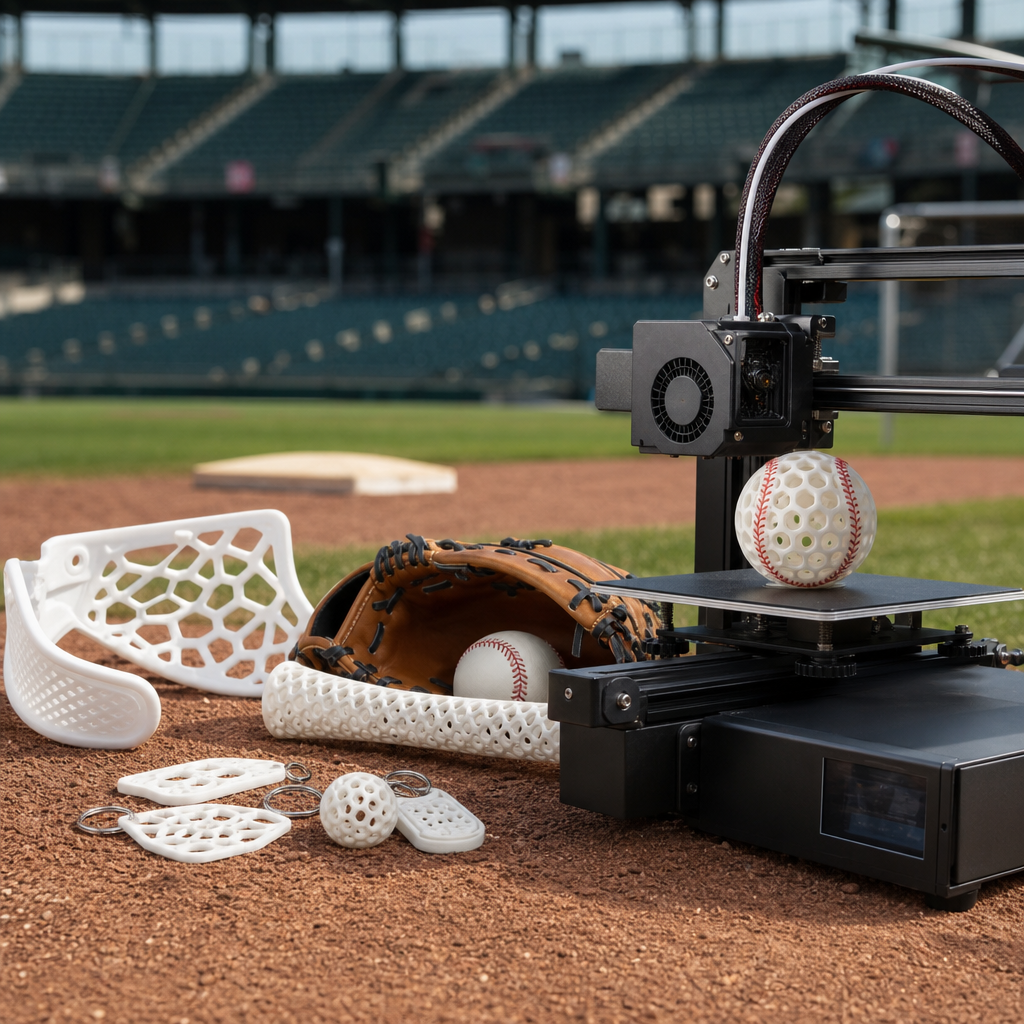
3D printing in baseball has moved from novelty to practical tool, changing how teams prototype equipment, how facilities solve day to day problems, and how fans buy personalized souvenirs. In baseball, 3D printing usually refers to additive manufacturing, a process that builds an object layer by layer from a digital file instead of cutting material away. That difference matters because it allows fast iteration, complex shapes, and low volume customization at a cost and speed traditional manufacturing often cannot match. I have seen clubs, training sites, and small baseball businesses use desktop printers for simple fixes and industrial systems for high performance parts, and the gap between experiment and standard practice keeps narrowing.
For baseball organizations, the appeal is straightforward: shorten development cycles, tailor products to individual players, and make replacement parts without waiting on long supply chains. For consumers, the benefits show up in customized bat racks, stadium replicas, player themed displays, and memorabilia stands that would be uneconomical to mass produce. The technology also sits at the center of a broader shift in the sport toward data driven performance, rapid prototyping, and direct to fan personalization. As a result, 3D printing in baseball is not one isolated trend. It is a hub innovation connecting equipment design, player development, operations, retail, and collectibles.
Understanding this space requires clear definitions. Fused deposition modeling, often called FDM, melts thermoplastic filament and is common for prototypes, organizers, jigs, and fan products. Stereolithography, or SLA, uses resin and is useful for high detail models, display pieces, and some tooling. Selective laser sintering, known as SLS, fuses powder into durable parts and is often the better choice when teams need stronger functional components with more complex geometry. Materials matter as much as machine type. PLA is easy to print for souvenirs, PETG offers better durability for functional accessories, nylon works well for tougher parts, and flexible polymers can support padding, grips, or fit testing.
Why does it matter now? Because baseball has become a sport of marginal gains, and additive manufacturing is built for marginal gains. A few grams removed from a training aid, a custom fit insert that improves comfort, or a redesigned mount that stabilizes a camera during bullpen work can produce measurable operational value. At the same time, clubs are under pressure to create better fan experiences and new revenue streams. Limited edition 3D printed collectibles, stadium topography models, and personalized nameplates meet that need. As this hub article shows, the most important story is not whether 3D printing belongs in baseball. It already does. The real question is where it creates the most value and what limitations teams and businesses must manage.
How 3D Printing Improves Baseball Equipment Development
The clearest impact of 3D printing in baseball is equipment development. Teams, sporting goods companies, and independent designers use additive manufacturing to test concepts before paying for expensive tooling. In my experience, this is where the economics become obvious. A bat grip prototype, helmet accessory, or protective insert can be modeled in CAD, printed overnight, handled by a player the next morning, and revised the same day. Traditional prototyping might take weeks and involve outside vendors, minimum orders, or machining costs that discourage experimentation.
Protective gear is a strong use case because fit and geometry matter so much. Catcher’s mask padding, jaw guards, wrist protectors, and face shield mounts can all be prototyped quickly. The final game ready product may still be manufactured through injection molding, thermoforming, or composite layups, but the design process gets faster and more precise with printed iterations. Orthotics and cleat related fit tools also benefit. While league rules and safety testing limit what can be worn in competition, additive methods help engineers evaluate shape, ventilation channels, weight distribution, and attachment points before committing to final production methods.
Training equipment may benefit even more because it is less constrained by formal certification. Coaches print ball holders, tee adapters, pitch tunnel markers, portable sensor mounts, and drill specific guides that would never justify a full production run. A private hitting lab can build custom fixtures around a Blast Motion sensor, bat tracking camera, or Rapsodo setup instead of buying generic accessories that fit poorly. This matters because training environments are highly individualized. One cage may need a left handed camera mount at an unusual angle; another may need a compact bracket that avoids ricochet risk. With 3D printing, those niche needs become practical to solve.
Bat design attracts attention, but it comes with important limits. Game bats used in professional and amateur competition must comply with league and governing body standards, including BBCOR, USA Baseball, NCAA, NFHS, or MLB supplier requirements depending on context. Fully 3D printed bats are therefore more relevant as research objects, training tools, or design studies than as mainstream competition equipment. Even so, printed prototypes help manufacturers refine knob geometry, handle contours, weighted inserts, and swing trainers. The value lies less in printing the final certified bat and more in compressing the development cycle around components, ergonomics, and testing fixtures.
Player Specific Customization and Sports Medicine Applications
Customization is where additive manufacturing aligns best with baseball’s needs. No two players have identical hand size, wrist mobility, stance mechanics, or comfort preferences, so one size fits all equipment often leaves performance on the table. 3D scanning combined with CAD modeling allows clubs and vendors to create individualized pieces for fit assessment, support, and rehabilitation. I have seen this logic work especially well in sports medicine settings, where trainers need something between an off the shelf brace and a slow custom fabrication process.
Finger splints, hand supports, and protective shells can be designed around a player’s anatomy after minor injuries, then adjusted as swelling changes or healing progresses. The Mayo Clinic, Hospital for Special Surgery, and other medical leaders have documented broader orthopedic uses of patient specific additive manufacturing, and baseball benefits from that same workflow. A hand specialist can evaluate a fracture or tendon issue, define a safe immobilization strategy, and work with a fabrication partner to produce a lighter, more breathable support than a traditional bulky option. That does not replace medical judgment or regulatory requirements, but it can improve compliance and comfort.
Biomechanics departments also use printed components during testing. Marker clusters, wearable housings, custom grips for force measurement, and repeatable positioning aids are easier to produce in house than source externally. This is a hidden but important category because it supports the data infrastructure now common in player development. If a pitching lab needs a custom mount for an inertial measurement unit or a repeatable hand placement guide for strength testing, additive manufacturing can deliver it in hours. The better the testing setup, the more reliable the data a club uses to make coaching decisions.
| Baseball use | Typical printing method | Why teams use it |
|---|---|---|
| Equipment prototypes | FDM or SLS | Fast revisions before tooling |
| Medical supports | SLA or SLS | Custom fit and lighter structures |
| Training lab fixtures | FDM | Low cost mounts, guides, and adapters |
| Fan souvenirs | SLA, FDM, or binder jet services | Personalized low volume production |
There are tradeoffs. Custom pieces require quality control, material validation, and clear communication between coaches, medical staff, and fabricators. A strong looking part can still fail under heat, sweat, impact, or repeated flex. That is why serious baseball applications should follow disciplined testing, documented material selection, and, when medical use is involved, clinician oversight. Customization creates value only when it is matched by process rigor.
Team Operations, Ballpark Maintenance, and Manufacturing Efficiency
Some of the best uses of 3D printing in baseball are not visible to fans. Clubhouses, dugouts, player development complexes, and stadium operations teams constantly need replacement knobs, cable clips, storage dividers, labeling systems, wall mounts, and machine adapters. Historically, these small items were improvised, backordered, or bought as imperfect substitutes. Additive manufacturing changes that equation. When a bullpen tablet holder breaks or a batting cage machine needs a discontinued spacer, a staff member with a printer and basic modeling skills can often produce a working replacement the same day.
This is especially valuable for older facilities and specialized equipment. Many baseball environments contain custom built systems assembled over years from multiple vendors. OEM replacement parts are not always available, and machining a one off component can be too slow or expensive. 3D printing fills the gap for non critical parts and for prototypes used to validate dimensions before machining a final metal version. Operations departments that understand these boundaries save money without taking irresponsible risks. In practice, that means printing housings, guides, organizers, and covers, while reserving high load, high heat, or safety critical applications for certified materials and traditional fabrication.
The supply chain angle also matters. During periods of shipping disruption, sports organizations learned that even simple accessories could become hard to source. Printing in house reduces dependence on long lead times for low complexity parts. It also improves inventory discipline because digital files can replace shelves full of rarely used spares. A club can maintain a library of proven designs for locker room accessories, camera mounts, and maintenance tools, then print on demand. That is not a full substitute for conventional procurement, but it is a practical resilience strategy.
Manufacturing efficiency extends to external baseball businesses as well. Small brands selling batting tee upgrades, glove display stands, or training aids can launch products without committing to expensive molds. They can test demand, gather user feedback, and iterate design before moving to larger scale manufacturing. This lowers the barrier to innovation in the baseball market. Some products remain best suited to additive production because volumes stay small and customization stays high. Others graduate to injection molding after the design stabilizes. Either way, 3D printing reduces early stage risk.
Fan Souvenirs, Collectibles, and Retail Opportunities
For fans, the most visible side of 3D printing in baseball is personalized merchandise. Stadium replicas, miniature ballparks, player busts, wall art based on famous home run trajectories, and customized jersey number displays are now common on marketplaces like Etsy and through direct to consumer brand sites. What makes additive manufacturing powerful here is mass personalization. A seller can change a name, date, team color, or seating section in the digital file and produce a unique item without retooling a factory line.
Ballpark architecture is a particularly strong category because baseball stadiums have distinctive dimensions and visual identities. Fenway Park’s Green Monster, Wrigley Field’s ivy lined outfield, and Dodger Stadium’s tiered pavilions translate well into miniature models. High detail resin printing captures signage and facade elements, while larger FDM prints work for affordable decorative pieces. Teams and licensed partners can use this approach for premium season ticket gifts, stadium giveaway concepts, or online limited editions tied to anniversaries, retirements, and postseason milestones.
Collectors also respond to the ability to transform data into objects. Spray chart sculptures, topographic maps of historic parks, and layered displays showing a record setting home run path turn baseball moments into tactile products. This links nicely with the sport’s statistical culture. A commemorative piece can include launch angle, exit velocity, distance, game date, and inning in a design that feels more substantial than a generic plaque. When done well, these objects bridge memorabilia and storytelling, giving fans a physical way to revisit a specific event.
Licensing and authenticity are essential here. Team logos, player likenesses, and official marks are protected intellectual property. Businesses entering the 3D printed baseball souvenir market need proper licensing or original designs that avoid infringement. Quality also matters more than many sellers expect. Layer lines, weak supports, brittle resin, and poor finishing quickly turn a personalized item into a disappointing one. The best baseball souvenir brands treat additive manufacturing as one stage in a full product process that includes design refinement, sanding or curing, paint or dye work, packaging, and clear customer expectations about scale and materials.
The Limits, Risks, and Future of 3D Printing in Baseball
3D printing is useful, but it is not a universal answer. Material strength, surface finish, repeatability, and throughput still limit what makes sense to print. A printed prototype may feel excellent in hand yet behave very differently under repeated impact, ultraviolet exposure, sweat, or summer heat. Baseball is demanding on equipment because the sport combines vibration, collision, weather, and repetitive motion. Teams that ignore those realities risk overestimating what a printer can deliver.
Governance is another limit. Official playing equipment is constrained by league rules, safety standards, and certification requirements. Youth, high school, college, and professional environments all have their own compliance layers. That means innovation must be filtered through approval processes, not just technical possibility. When I evaluate baseball applications, I separate them into four buckets: concept prototype, training use, operational use, and competition use. That framework helps organizations move quickly where risk is low and slow down where safety, legality, or fairness are involved.
Even with those constraints, the future is strong. Multi material printing, lattice structures, and better scanning workflows will improve fit and comfort in protective products. Metal additive manufacturing may play a larger role in tooling and specialized facility hardware. On the consumer side, web based customization tools will make it easier for fans to design souvenirs around ticket dates, seat locations, or favorite players. The organizations that benefit most will be the ones that combine engineering discipline, baseball context, and smart commercialization rather than treating the printer as a gimmick.
3D printing in baseball matters because it connects performance, operations, and fan experience in one flexible manufacturing approach. It speeds equipment prototyping, enables player specific supports, solves practical clubhouse and stadium problems, and opens profitable new categories of souvenirs and collectibles. Just as importantly, it lowers the cost of trying new ideas. In a sport where small advantages accumulate, that is a meaningful competitive and commercial edge.
The key takeaway is simple: additive manufacturing works best in baseball when the use case is specific, the material choice is intentional, and the limits are respected. Print the prototype, test the fit, improve the fixture, personalize the souvenir, and use conventional manufacturing when scale or certification demands it. That balanced approach produces better results than either blind enthusiasm or skepticism.
As this hub for deep dives into specific innovations, this page should guide your next step. Explore adjacent articles on smart equipment, biomechanics technology, stadium modernization, and fan experience tools, then identify where 3D printing fits your baseball operation or product line. The opportunity is already here; the advantage goes to the teams and businesses that apply it with precision.
Frequently Asked Questions
What does 3D printing mean in baseball, and why is it becoming so important?
In baseball, 3D printing usually means additive manufacturing, a process that creates an object layer by layer from a digital design file. That is different from traditional manufacturing methods that often cut, carve, or mold material into shape. The layer-by-layer approach matters because it makes it easier to produce complex geometries, test multiple design variations quickly, and create small batches of customized parts without the high setup costs associated with conventional production. For baseball organizations, that combination of speed, flexibility, and lower-volume efficiency has made 3D printing far more than a novelty.
Its growing importance comes from how well it fits the real needs of the sport. Teams, training staffs, clubhouse managers, and facility operators often need solutions fast, whether that means prototyping a grip aid, replacing a small broken component, organizing equipment more effectively, or developing player-specific training tools. Instead of waiting weeks for outside manufacturing or trying to adapt generic products, a team can design, print, test, and revise a part in a much shorter time frame. That rapid iteration is especially valuable in a sport where tiny changes in comfort, fit, and repeatability can affect performance.
3D printing is also becoming important because baseball operates in many different environments beyond the field itself. Front offices and player development departments can use it for prototyping, stadium operations teams can use it for maintenance and problem-solving, and retail and fan engagement teams can use it to create personalized souvenirs and limited-edition merchandise. In other words, the technology is relevant across performance, operations, and consumer experience. As printers, materials, and design software continue to improve, 3D printing is becoming a practical tool that helps baseball organizations move faster, customize more effectively, and solve problems with greater precision.
How are baseball teams using 3D printing for equipment and player development?
Baseball teams use 3D printing primarily as a prototyping and customization tool rather than as a one-size-fits-all replacement for traditional sporting goods manufacturing. One of the biggest advantages is the ability to evaluate design concepts quickly. Coaches, analysts, and equipment staff can work with designers to produce test versions of bat grips, training aids, protective gear components, ball holders, alignment tools, or wearable accessories. Because a new version can often be printed rapidly after feedback, teams can go through multiple iterations in a short period and arrive at a design that better matches an individual player’s needs.
In player development, customization is especially valuable. Baseball players are highly sensitive to feel, fit, hand position, balance, and consistency. A hitter may prefer a certain handle contour in a training device, a catcher may need a specific fit for support equipment, or a pitcher may benefit from a personalized drill tool that reinforces mechanics. 3D printing makes it possible to tailor these tools for a specific athlete instead of forcing the athlete to adapt to a generic product. Even when the final game-ready equipment is made through traditional manufacturing methods, the 3D-printed prototype can dramatically shorten the path to an effective design.
Teams also benefit from 3D printing in support areas tied to performance. For example, organizations may create custom storage inserts for gear, bullpen accessories, rehab aids, video analysis mounts, or portable organizers that improve daily workflows. These are not always glamorous uses, but they can make an immediate difference in efficiency and consistency. It is important to note that any equipment intended for official competition must still meet league rules, safety standards, and product performance requirements. That means 3D printing is often most powerful during testing, training, and development, where experimentation can happen quickly and cost-effectively before anything is considered for wider use.
Can 3D printing really help with everyday problems in baseball facilities and clubhouses?
Yes, and this is one of the most practical reasons the technology has gained traction. Baseball facilities constantly deal with small but persistent operational issues: missing brackets, broken clips, equipment holders that do not fit properly, cable routing problems, signage mounts, custom organizers, replacement knobs, repair jigs, and countless other parts that are too specific to buy off the shelf easily. In the past, these issues might have required expensive custom fabrication, lengthy vendor lead times, temporary workarounds, or simply living with inefficiencies. With 3D printing, facilities can often design and produce a targeted solution much faster.
The value comes from on-demand problem solving. If a training room needs a custom tray insert, a batting cage needs a specialized mount, or a clubhouse needs a replacement part for a storage system that is no longer manufactured, a 3D printer can help bridge the gap between need and implementation. Instead of waiting for a supplier to tool up for a tiny production run, staff can create a digital model and print the part in-house or through a local service. That speed is especially useful during a long season, when operational disruptions can affect players, coaches, and staff every day.
Another major benefit is iterative improvement. A first version does not need to be perfect. If a hook is too shallow, a bracket too thin, or an organizer slightly misaligned, the design can be adjusted and reprinted. That is a major advantage over traditional methods for low-volume parts, where changing the design can be slow and expensive. Of course, durability, heat resistance, and load-bearing requirements still matter, so material selection and engineering judgment are important. But for many non-critical facility needs, 3D printing offers a highly effective way to solve day-to-day problems with speed, flexibility, and relatively low cost.
What kinds of personalized baseball souvenirs can be made with 3D printing?
3D printing opens the door to a wide range of personalized baseball souvenirs because it is well suited to low-volume, custom production. Fans are no longer limited to mass-produced items with generic team branding. Instead, they can buy products designed around personal preferences, memorable moments, and unique visual details. Common examples include miniature stadium models, custom player figurines, personalized nameplates, team-logo display pieces, commemorative ticket holders, bobblehead-style keepsakes, replica trophies, and desktop collectibles inspired by iconic baseball imagery. These items can often be customized with names, jersey numbers, dates, game scores, or event-specific themes.
What makes 3D printing especially compelling in the souvenir market is its ability to combine personalization with design complexity. A stadium replica, for instance, can include architectural features that would be difficult or costly to produce using traditional methods in small quantities. A fan collectible can be tailored to celebrate a first game, a milestone home run, a youth tournament championship, or a retirement gift for a coach. Because the manufacturing process does not require the same kind of expensive tooling as injection molding or other mass-production methods, even niche or one-off products can be economically viable.
For teams, retailers, and sports marketers, this creates new opportunities for fan engagement. Merchandise can be tied to special promotions, playoff runs, alumni events, ballpark anniversaries, or premium VIP experiences. It also supports direct-to-consumer personalization, where a fan orders a souvenir built around their own choices rather than accepting a standard item from a store shelf. The result is a more memorable product and often a stronger emotional connection to the team or event. While finish quality, color options, and material selection vary depending on the printing technology used, the overall trend is clear: 3D printing allows baseball souvenirs to become more personal, more creative, and more meaningful.
What are the biggest advantages and limitations of 3D printing in baseball?
The biggest advantages are speed, customization, and design freedom. In baseball, those strengths align perfectly with the need to test ideas quickly, adapt products for individual users, and solve specialized problems that do not justify large production runs. A team can prototype multiple versions of a training aid in days instead of weeks, a facility can print a custom replacement part without searching endlessly for a discontinued component, and a retailer can offer personalized souvenirs without committing to high inventory levels. The ability to produce complex shapes that would be difficult or inefficient with subtractive manufacturing is another major benefit, particularly for ergonomic tools, internal structures, and one-off designs.
Cost efficiency can also be a significant advantage, but it depends on the use case. For low-volume parts, prototypes, and customized items, 3D printing is often highly economical because it avoids molds, tooling, and minimum order requirements. That makes it ideal for experimentation and short-run production. It can also reduce downtime when a simple fix is needed quickly. In a baseball environment, where timing matters and the season leaves little room for delay, that responsiveness can be just as valuable as the direct cost savings.
At the same time, 3D printing has real limitations. Not every printed part is suitable for high-impact, high-stress, or safety-critical applications. Material properties vary widely, and some plastics may not offer the same durability, finish, or long-term reliability as parts made through established industrial processes. Surface quality may require post-processing, and printing large quantities of identical items is often less efficient than traditional mass manufacturing. There are also compliance considerations for anything used in competition, as leagues and governing bodies may regulate equipment specifications. In short, 3D printing is most effective when used strategically. It excels at prototyping, customization, small-batch production, and problem-solving, but it works best alongside traditional manufacturing rather than