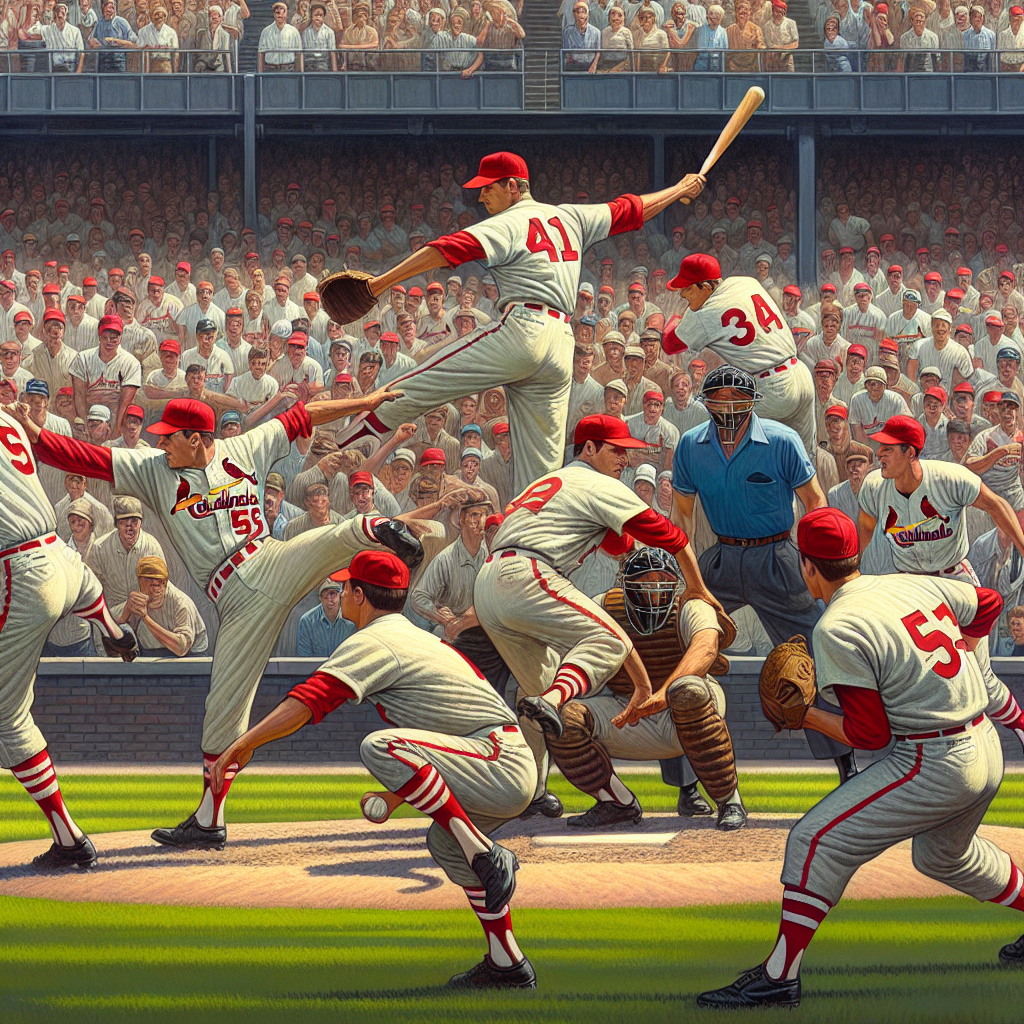
The 1968 St. Louis Cardinals are often remembered as one of the most dominant and formidable teams in baseball history. Known for their exceptional pitching staff, solid fielding, and strategic acumen, the team dominated the National League (NL) and came tantalizingly close to securing a World Series victory. This period, often referred to as “The Year of the Pitcher,” exemplified the heights of pitching excellence. Among the team’s standout figures, the legendary Bob Gibson’s phenomenal season remains a benchmark for pitchers. This article delves into the construction, performance, and legacy of the 1968 Cardinals, capturing the essence of a team that became the epitome of baseball excellence.
The Core of the Team
The foundation of the 1968 St. Louis Cardinals was built on a solid core of players who had consistently exhibited brilliance. At the heart of this team was Bob Gibson, whose legendary season boasted an astonishing 1.12 ERA, setting a modern record that still stands as one of the lowest in history. Gibson’s performance didn’t just stop at his ERA; he racked up 268 strikeouts and won 22 games, earning him the NL MVP and the Cy Young Award.
Surrounding Gibson was a cadre of talented players like Lou Brock, Curt Flood, and Orlando Cepeda. Lou Brock was not only a menace on the base paths but also a reliable hitter; his 62 stolen bases in 1968 were instrumental in creating scoring opportunities. Curt Flood, known for his defensive prowess in center field, provided stability and consistency in the outfield. Orlando Cepeda, coming off his MVP season in 1967, continued to be a pivotal presence in the lineup, driving in runs with his powerful batting.
Pitching Dominance
The 1968 season is particularly remembered for its pitching dominance, and the Cardinals were at the forefront of this trend. Alongside the incredible Bob Gibson, pitchers like Nelson Briles, Steve Carlton, and Larry Jaster provided depth and reliability throughout the season. Gibson’s dominance often overshadowed these pitchers, but each made significant contributions to the team’s success.
Steve Carlton, who would later achieve great fame with the Philadelphia Phillies, was a significant contributor despite being in the shadow of Gibson’s greatness. Carlton managed to strike out 162 batters, boasting a 2.99 ERA. Nelson Briles chipped in with a remarkable 2.81 ERA, securing 19 wins of his own. The bullpen, anchored by Joe Hoerner, provided the necessary support, ensuring that the Cardinals could close out games and maintain their strong defensive record.
Offensive Strategy
While pitching was the hallmark of the 1968 Cardinals, their offense employed a strategy focused on speed, contact hitting, and situational play. Manager Red Schoendienst understood the need for a balanced approach and leveraged the talents of his players to maximize their offensive output.
Lou Brock’s speed was a crucial component of the Cardinals’ offensive strategy. His ability to steal bases at will, coupled with his knack for getting on base, disrupted opposing pitchers and created opportunities for hitters like Curt Flood and Orlando Cepeda. The team didn’t rely heavily on power hitting; instead, they focused on consistent contact and situational hitting. Timely hits from players like Roger Maris and Julian Javier were often the difference in close games, emphasizing the importance of a well-rounded offensive approach.
Fielding Excellence
The defensive prowess of the 1968 Cardinals was as critical to their success as their pitching. The outfield trio of Lou Brock, Curt Flood, and Roger Maris provided a formidable barrier, with Flood’s defensive skills in center field garnering immense praise. Flood was a Gold Glove winner and his ability to track down fly balls and make difficult catches look routine was essential for the team’s defensive stability.
The infield, anchored by third baseman Mike Shannon, shortstop Dal Maxvill, second baseman Julian Javier, and first baseman Orlando Cepeda, was equally impressive. Maxvill’s sharp fielding and quick reflexes ensured that ground balls were routinely converted into outs, while Javier’s steady presence at second base provided reliability and flexibility. With a solid defensive unit backing up the stellar pitching, the Cardinals were able to maintain a low runs-against statistic, adding an extra layer of difficulty for opposing teams.
The World Series Clash
The pinnacle of the 1968 season was the World Series clash between the St. Louis Cardinals and the Detroit Tigers. Entering the series, the Cardinals were favorites, given their unparalleled performance throughout the season. Bob Gibson continued his dominance in Game 1 with a record-setting 17 strikeouts, setting the tone for what many believed would be a decisive series.
The series, however, took unexpected twists and turns. The Tigers, led by pitcher Mickey Lolich, who won three games, including the decisive Game 7, provided a formidable challenge. Despite Gibson’s brilliance (2 wins and a remarkable ERA of 1.67 over 27 innings), the Cardinals fell short, losing the series in seven games. Detroit’s victory hinged on timely hitting and an equally strong pitching staff, highlighting the unpredictable nature of baseball.
Legacy and Impact
The 1968 St. Louis Cardinals, despite their World Series loss, left an indelible mark on baseball history. Bob Gibson’s monumental season is still revered, serving as a benchmark for pitching excellence. The team’s overall performance underscored the importance of a balanced squad, integrating pitching, offense, and defense.
In the years that followed, Major League Baseball would undergo significant changes, including the lowering of the pitching mound in 1969. The extraordinary performances seen in the 1968 season, particularly by pitchers like Gibson, had a lasting impact, pushing the league to make adjustments to restore offensive balance.
For fans and historians, the 1968 Cardinals symbolize a pinnacle of competitive baseball. The lessons from their approach to team-building, their strategic emphasis on pitching and fielding, and the memorable moments from that season continue to inspire and educate new generations of baseball enthusiasts. The legacy of the 1968 Cardinals endures, reminding us of an era where precision and excellence were paramount.
Conclusion
In sum, the 1968 St. Louis Cardinals represent a significant chapter in the annals of baseball history. Their meticulous approach to the game, combined with individual excellence, particularly by Bob Gibson, set new standards in several facets of baseball. The season, riddled with outstanding performances, team coordination, and strategic innovation, remains a reference point for both players and managers aiming for success in Major League Baseball.
Even though the Cardinals did not clinch the World Series title, falling narrowly to the Detroit Tigers in an epic seven-game series, their journey through the 1968 season is etched in the memories of baseball aficionados. The combination of dominant pitching, dependable defense, and a strategic offensive approach made the Cardinals a formidable force throughout the regular season and playoffs.
Reflecting on the 1968 Cardinals, we are reminded of an era when baseball was as much about strategy and finesse as it was about raw power and athleticism. The team’s performance continues to resonate, embodying the values of teamwork, perseverance, and excellence. As we look back on that historic season, it’s clear that the legacy of the 1968 St. Louis Cardinals endures, inspiring future generations to strive for greatness in the world of baseball.
Frequently Asked Questions
What made the 1968 St. Louis Cardinals such a dominant team in baseball history?
The 1968 St. Louis Cardinals stood out in the annals of baseball history due to their incredibly dominant performance, especially in the pitching department. This period in the MLB is aptly named “The Year of the Pitcher,” and the Cardinals were prime exemplars of pitching excellence. At the heart of their success was Bob Gibson, a legendary pitcher known for his intense competitiveness and extraordinary skill on the mound. In 1968, Gibson achieved a staggering 1.12 ERA, one of the lowest in baseball history, alongside 13 shutouts and 268 strikeouts. The team’s robust pitching lineup didn’t end with Gibson; it also boasted talents like Nelson Briles, Steve Carlton, and Ray Washburn—all contributing to their overwhelming control from the mound.
Beyond pitching, the Cardinals excelled with solid fielding and impressive strategic mastery, undoubtedly orchestrated by manager Red Schoendienst. Their defense was airtight, minimizing opponents’ scoring opportunities, while the offense was timely, employing precision batting and speed on the bases. Players like Curt Flood and Lou Brock emphasized this aspect, where Flood’s consistent fielding and Brock’s aggressive base running wreaked havoc on their opponents. Overall, the 1968 Cardinals harmonized pitching, defense, and strategy to dominate the National League, making them near-unbeatable and memorable as one of baseball’s all-time great squads.
How close did the 1968 Cardinals come to winning the World Series?
The 1968 Cardinals were tantalizingly close to achieving World Series glory, losing narrowly to the Detroit Tigers in a gripping seven-game showdown. The World Series itself was a captivating display of high tension and baseball excellence. The Cardinals took an early lead in the series, winning three of the first four games. However, the Tigers, led by future Hall of Famer Mickey Lolich, mounted a resolute comeback, claiming the last three games to capture the championship. In the decisive Game 7, Bob Gibson pitched valiantly for the Cardinals, reflecting his season-long dominance by holding the Tigers scoreless for much of the game. However, a combination of timely hitting by the Tigers and a critical misstep in the field led to their ultimate 4-1 victory, denying the Cardinals a second consecutive World Series title. Despite the loss, the 1968 series remains a testament to both the skill of the Cardinals and the unpredictability inherent in the sport.
Who were the standout players on the 1968 Cardinals team?
While the 1968 Cardinals showcased talent across the board, several players truly defined the team’s exceptional year. Bob Gibson was certainly the headliner, with an almost mythical season that included a 1.12 ERA, 13 shutouts, and over 300 innings pitched—a singular performance that continues to captivate baseball fans and historians alike.
Aside from Gibson’s unforgettable exploits, Lou Brock emerged as a critical offensive force. Known for his exceptional speed, Brock stole 62 bases, which was a significant factor in generating scoring chances, often pressuring opponents’ defenses. Curt Flood, providing not just offensive support but a defensive masterclass in center field, was instrumental in the Cardinals’ success during the season. Additionally, Flood contributed consistently with a nearly .300 batting average.
On the pitching front, in addition to Gibson, Steve Carlton demonstrated his burgeoning prowess, providing significant depth and strength in the starting rotation. With such remarkable contributions from these players and more, the 1968 Cardinals crafted a team where every aspect of play—from pitching to fielding to strategic execution—melded seamlessly into a dominant era.
Why is 1968 known as ‘The Year of the Pitcher’, and how did this influence the performance of the Cardinals?
The 1968 baseball season earned the moniker “The Year of the Pitcher” due to the extraordinary dominance of pitchers across Major League Baseball. This was seen in historically low scoring, with many teams and players struggling to maintain strong offensive statistics against a backdrop of overwhelming pitching prowess. The Cardinals were a perfect embodiment of this phenomenon—their success was built substantially on the supremacy of their pitching staff, most notably the incomparable season of Bob Gibson.
Throughout that season, Gibson’s performances reverently defined pitching excellence. With his 1.12 ERA setting a modern record and his 13 shutouts keeping batters mystified, he personified the very spirit of “The Year of the Pitcher.” His unwavering control and execution forced MLB to consider changes to restore balance between pitchers and hitters, leading to the lowering of the pitcher’s mound the following year. This pitching-centric environment provided the Cardinals with a strategic advantage, allowing them to leverage Gibson and their other seasoned pitchers to both control games and suffocate opponents’ offenses. Hence, the 1968 Cardinals thrived in an era that celebrated and accentuated the art of pitching.
What impact did the 1968 Cardinals have on baseball following that season?
The legacy of the 1968 Cardinals extends beyond their immediate achievements and into broader baseball history. Their sterling performances, especially from the mound, helped reinforce the importance of strong pitching as the cornerstone of successful teams. Notably, Bob Gibson’s historic exploits catalyzed significant changes in the game itself. Due to the overwhelming dominance of pitchers like Gibson, MLB instituted rule changes such as lowering the pitching mound in 1969 and shrinking the strike zone to make games more hitter-friendly, reflecting the profound impact of the 1968 season on the sport’s evolution.
Apart from structural changes in the game, the Cardinals left a lasting influence on how teams approached the integration of speed and strategic base running into their arsenals. Lou Brock’s explosive speed on the bases demonstrated the value of aggressive base running strategies and inspired future generations to incorporate similar tactics to disrupt and agitate opponents’ defenses.
In essence, the 1968 St. Louis Cardinals not only represented the pinnacle of baseball excellence in their time but also acted as catalysts for tangible evolutions in how baseball was both played and governed thereafter. Their legacy continues to influence the essence and strategic thinking within the sport today, underscoring their pivotal role in baseball lore.