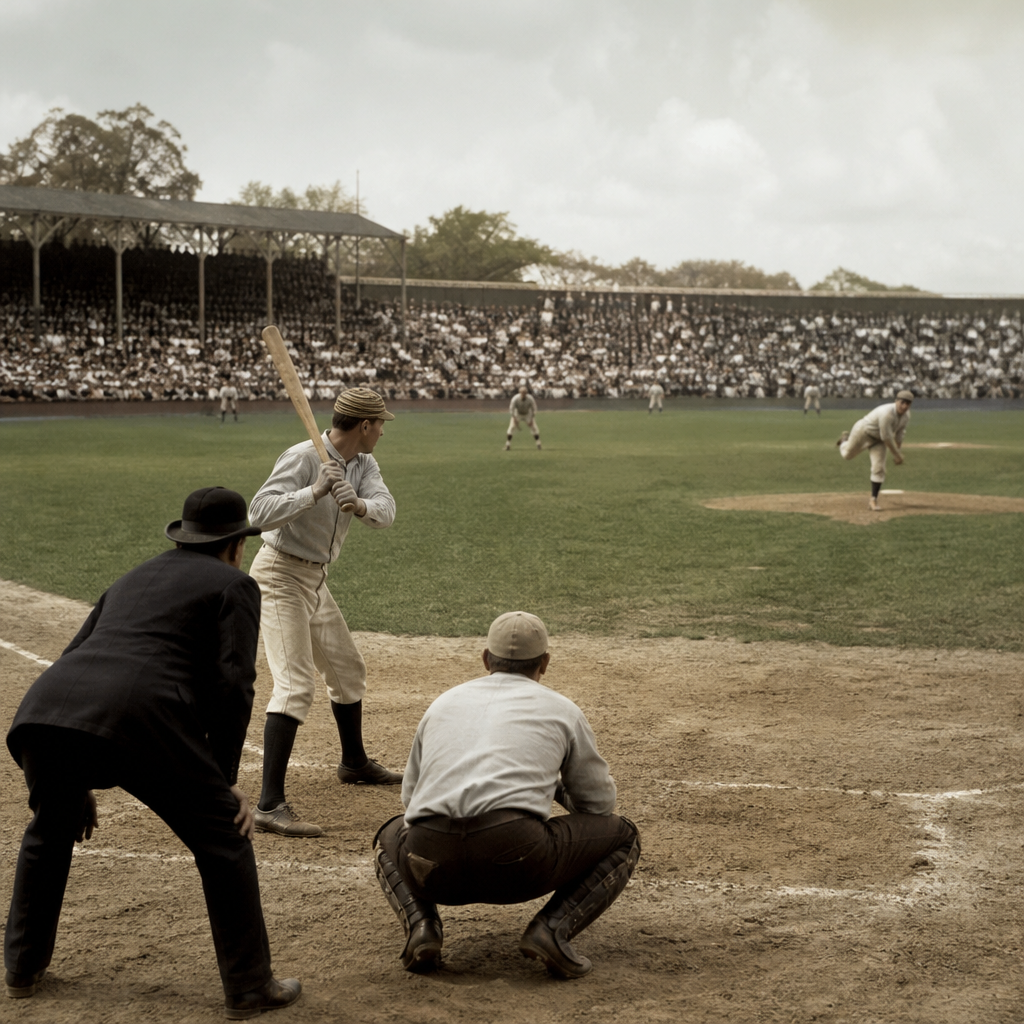
Step into an American ballpark in 1885 and you would recognize baseball instantly, yet almost every detail would feel rougher, louder, and less standardized than the modern game. A baseball game in 1885 was played during a pivotal moment in 19th century baseball, when professional leagues were established but the sport still carried many habits from its earlier, more improvised decades. Rules differed from today’s code, equipment offered less protection and less consistency, strategy revolved around bunting, baserunning, and contact, and fans participated with a directness that modern stadium security would never allow. To understand what a baseball game looked like in 1885, you have to place it within the larger Baseball Eras story: this was the high-competition age of the National League and the American Association, the era of barehanded or lightly gloved fielders, underhand-to-three-quarters deliveries evolving toward modern pitching, and crowds who treated the ballpark as both sporting ground and public theater. The 1885 season matters because it sits at the intersection of amateur roots and modern professionalism. Key terms define the experience. “Battery” meant pitcher and catcher operating as a unit. “Base on balls” existed but was awarded under a different count than today. “Muff” meant an error. “Scientific baseball” described smart, tactical play built on placement and pressure rather than power. When I study period rule books, box scores, and newspaper game accounts, the clearest conclusion is that 1885 baseball was faster in some ways, messier in others, and far more fluid than the polished major league product familiar now.
The Setting: Ballparks, Leagues, and the Shape of the Professional Game
In 1885, the professional game was anchored by the National League and challenged aggressively by the American Association, with clubs in cities such as Chicago, St. Louis, Boston, New York, Philadelphia, and Cincinnati. This league rivalry shaped scheduling, player salaries, travel, and fan identity. A game often unfolded in a wooden ballpark or enclosed ground that mixed permanent grandstand sections with simpler bleacher seating and large standing-room areas. Unlike today’s highly engineered venues, 19th century ballparks were constrained by nearby streets, rail lines, and real estate parcels, creating unusual field dimensions. Foul territory could be vast, outfield fences inconsistent, and field conditions dependent on weather, maintenance budgets, and local drainage. The grass might be uneven, the infield bumpy, and roped boundaries or basic fencing more common than seamless walls.
The ballpark atmosphere reflected this semi-modern stage. Teams traveled mainly by rail, so schedules grouped games into road swings and home stands. Day baseball was the norm because electric lighting for night major league play did not yet exist. Games could begin in afternoon light and race against dusk, which affected umpiring, hitting visibility, and outfield judgment. Newspaper coverage was already robust, and clubs depended heavily on gate receipts, making attendance central to financial survival. Some grounds sold alcohol openly, especially in the American Association, which cultivated a broader working-class audience than the National League’s more restrictive image. That difference was not trivial; it influenced crowd behavior, marketing, and the cultural meaning of a ballgame in each city.
Because this page is a 19th century hub, 1885 should also be seen as one point on a timeline. Earlier decades featured looser organization and more local variation. Later years brought mound distance changes, the 1890s pitching revolution, tougher governance, and eventually the modern foul-strike regime. In 1885, baseball was already a national spectator sport, but not yet fully standardized in play or presentation.
The Rules in 1885: Familiar Structure, Different Details
The basic structure was recognizable: nine innings, three outs per side, ninety feet between bases, and the objective of scoring runs by advancing runners around the diamond. Yet several core rules produced a game that looked meaningfully different. The pitcher delivered from a box rather than a raised mound, and the permitted motion remained more restricted than the fully overhand style that later dominated. Pitchers in the mid-1880s were moving away from the old underhand tradition, but their mechanics still existed within tighter legal boundaries. Distance also differed from the modern sixty feet six inches. In 1885, the delivery point was still closer, which changed reaction time and the balance between deception and velocity.
One of the biggest differences involved balls and strikes. A walk did not come after four balls. In 1885, a batter generally received first base only after seven balls, a rule that encouraged more contact and forced hitters to be less passive. The called strike zone was also less settled than today, with umpires and leagues refining enforcement in response to pitcher and batter gamesmanship. Foul balls did not count as strikes in the modern way, which allowed good bat handlers to prolong at-bats by spoiling pitches repeatedly. This rule alone supported a style focused on bat control, chopping the ball, and waiting for a hittable offering. Hit by pitch rules, fair-foul interpretations near the lines, and batter requests for pitch height all evolved across the century, so game accounts from 1885 often mention disputes that modern fans would find unusual.
Umpiring was harder and more exposed. Many games used a single umpire, leaving one official to judge balls, strikes, fair-foul calls, force plays, and general conduct. Disputes were constant, and players regularly argued decisions with intensity. Ejections happened, but enforcement relied heavily on personal authority rather than layered replay systems or full crews. This gave games a volatile energy and made local press coverage part of the sport’s afterlife, since reporters frequently judged the umpire as sharply as they judged the clubs.
Equipment: Balls, Bats, Gloves, Uniforms, and the Physical Cost of Play
The equipment of 1885 made baseball look more dangerous because it was. The baseball itself was less standardized in manufacturing than a modern major league ball, and game balls could soften, discolor, and change behavior as a contest progressed. A softer, less lively ball reduced home run totals but increased the importance of placement and fielding precision. Bats were made of wood, often heavier in feel, with less exact standardization in handle shape and barrel profile. Players selected bats for balance and control, not simply maximum exit velocity, because the strategic environment rewarded putting the ball in play.
Fielders’ gloves in 1885 were primitive by modern standards. Some players still played essentially barehanded, while others used thin leather gloves or workmanlike padded designs that protected the palm more than they secured the ball. Catchers wore more protection than most fielders, but even catcher’s gear was limited compared with modern masks, chest protectors, and shin guards. The catcher’s mask had been introduced in the late 1870s and was becoming established, a critical innovation because catchers often worked much closer to the batter than modern receivers. Mitt development remained incomplete, so receiving pitches and handling foul tips imposed a brutal physical burden. Broken fingers, split nails, and chronic hand injuries were common occupational hazards, not exceptional events.
| Aspect | 1885 Baseball | Modern Major League Baseball |
|---|---|---|
| Walk awarded after | Seven balls | Four balls |
| Pitcher’s delivery area | Pitcher’s box | Raised mound |
| Fielding gloves | Thin, lightly padded, sometimes unused | Specialized gloves by position |
| Catcher protection | Mask and limited padding | Full modern protective set |
| Foul balls as strikes | Generally no | Yes, with standard exceptions |
| Umpire crew | Often one umpire | Four or more with replay support |
Uniforms contributed to the visual identity of the game. Clubs wore wool uniforms, stockings, belts, and caps that could be handsome but uncomfortable in summer heat. Team colors mattered enough that early baseball writing often identified clubs by stocking color or city nickname. There were no batting helmets, and protective cups, sliding pads, and other safeguards were far less developed. When you read 19th century baseball injury reports, you see how much the sport demanded pain tolerance. Players expected bruises, spikes, collisions, and hand trauma as part of normal competition.
Strategy and Style of Play: Scientific Baseball Before the Home Run Age
If you want the clearest answer to what a baseball game looked like in 1885, watch the tactics rather than the final score. The game was built around what contemporaries often called scientific baseball: advancing runners intelligently, exploiting defensive weaknesses, and manufacturing runs one base at a time. Bunts, chopped hits, hit-and-run style actions, stolen bases in the broad 19th century sense, and aggressive extra-base advancement defined offensive play. Because equipment was crude and field surfaces inconsistent, simply forcing defenders to field the ball cleanly under pressure created opportunities. An infielder charging a slow roller with a thin glove and uneven footing faced a much harder task than his modern counterpart.
Pitchers and catchers worked to disrupt rhythm rather than overpower lineups with modern velocity and breaking-ball arsenals. That does not mean pitchers were ineffective. On the contrary, elite 1885 pitchers understood movement, location, and stamina at a high level. Charles “Old Hoss” Radbourn had just thrown one of the most famous workloads in baseball history the prior year, illustrating both the expectations placed on pitchers and the strategic centrality of a durable ace. In 1885, managers expected starters to finish what they began, and the concept of a specialized bullpen barely resembled the modern version. Endurance was a skill, not an emergency measure.
Defensively, positioning mattered, but shifts were informal and based on observation rather than data systems. Middle infield play emphasized quick transfers and relay awareness. Outfielders had to play caroms off irregular boundaries and judge balls in changing light with less reliable gloves. On offense, speed changed everything. A runner who reached first could pressure the battery immediately, and because catchers handled difficult pitches with limited equipment, the running game carried real leverage. Contemporary box scores sometimes understate this chaos because not every advancement, bobble, or tactical choice was measured in the way modern analysts would prefer, but newspaper descriptions make clear that 1885 baseball was dynamic and constantly in motion.
The Players and Competitive Culture of the Mid-1880s
The stars of 1885 were already public figures, though their careers unfolded under labor conditions far harsher than those facing modern professionals. Contracts bound players tightly, reserve practices limited movement, and salary disputes were common. Clubs sought any edge in signing talent, and league competition pushed wages upward in some markets. Cap Anson in Chicago represented disciplined, high-level team leadership and hitting excellence. King Kelly embodied flair, versatility, and celebrity. Buck Ewing stood out as one of the era’s most complete players, especially valuable at catcher when the position demanded exceptional toughness. These were not quaint pioneers stumbling toward a future game. They were sophisticated professionals maximizing victory inside the rules and conditions available to them.
Club culture could be fractious. Drinking, curfew disputes, gambling concerns, and arguments with management appeared regularly in the sporting press. At the same time, teams practiced seriously, developed signs, and scouted opponents through direct observation and newspaper intelligence. Managers balanced personalities while controlling travel fatigue, injury risks, and short rosters. Segregation also defined the limits of the era. In 1885, organized professional white major leagues were hardening the color line that would exclude Black players from the majors for decades. Any honest 19th century baseball overview must include this fact. The game’s growth and popularity existed alongside exclusion, and that contradiction shaped baseball history profoundly.
What Fans Saw and Did at the Ballpark
Fans in 1885 were close to the action in every sense. Seating could place spectators near baselines with minimal barriers, and crowd noise was immediate, personal, and often confrontational. Rooting sections, betting talk, heckling, and direct exchanges with players and umpires formed part of the spectacle. Newspapers sometimes praised “enthusiastic” support and just as often condemned rowdy conduct. Because the sport competed with theater, horse racing, boxing, and other urban entertainments, a baseball game had to feel lively. Vendors moved through crowds, scorekeeping was often done by attentive spectators themselves, and many attendees followed the game through the next day’s sporting pages with equal passion.
The social makeup of crowds varied by city and league. Businessmen, clerks, laborers, immigrants, and families all attended, though class signaling differed from park to park. Ladies’ days were used by clubs to attract women and project respectability. The American Association’s more permissive policies, especially around Sunday baseball and beer sales in some contexts, broadened attendance but also intensified moral criticism from reformers and rival executives. A fan in 1885 did not consume baseball through giant screens, walk-up music, or constant public-address prompts. The attention stayed on the field, the bench chatter, the umpire’s decisions, and the live conversation of the crowd. That immediacy is a defining feature of the 19th century ballgame experience.
A baseball game in 1885 looked like a sport halfway between its improvised beginnings and the tightly regulated major leagues of the 20th and 21st centuries. The rules preserved the nine-inning framework but altered pacing through seven-ball walks, a pitcher’s box, and different foul-strike treatment. Equipment made play riskier and more skill-dependent, with thin gloves, limited catcher protection, wool uniforms, and inconsistent baseballs shaping every inning. Strategy centered on scientific baseball: contact, bunting, speed, pressure, and stamina rather than the home run. Fans saw a louder, closer, and less filtered spectacle, one tied deeply to league rivalry, urban identity, and the growing business of professional sport. As a hub for 19th century baseball, this 1885 snapshot provides the essential baseline for understanding how the game evolved across the era. If you are building out your Baseball Eras research, use 1885 as the anchor point, then trace how rules, labor, segregation, ballparks, and tactics changed before and after it.
Frequently Asked Questions
How different were the rules of baseball in 1885 compared with the modern game?
Baseball in 1885 was clearly the same sport in its basic structure, but many of the rules would have felt noticeably different to a modern fan. The game was played with nine innings, three outs per side, and the familiar layout of bases and field positions, yet the rulebook had not fully settled into the standardized form people know today. Pitching was in the middle of a major transition. Earlier underhand traditions still influenced the sport, and although pitchers were becoming more aggressive and more central to the game, the modern style of overpowering, overhand pitching had not fully taken over. The relationship between pitcher and batter was therefore different, with pitchers often trying to deceive, disrupt timing, and induce weak contact rather than simply dominate with velocity.
Other rules also created a different rhythm. Umpiring could be inconsistent by modern standards, partly because rules were still evolving and partly because enforcement varied. Fouls, balls, strikes, and batter conduct were not always handled with the same precision modern fans expect. Depending on the exact league and local customs, interpretations could differ in ways that would surprise today’s audience. The result was a game that looked recognizable but felt looser around the edges. In short, 1885 baseball sat between the improvised early decades of the sport and the more fully standardized game of the 20th century, making it a pivotal and fascinating version of baseball history.
What kind of equipment did players use in 1885?
The equipment in 1885 was much rougher, less protective, and less uniform than modern baseball gear. Gloves existed, but they were still primitive by today’s standards. Many fielders used thin leather gloves or glove-like hand protection that offered only modest help, especially compared with the heavily padded, position-specific mitts used now. Some players still prided themselves on fielding with little assistance, and even those who wore gloves did not have the benefit of deep pockets, advanced webbing, or modern shock absorption. That meant fielding was harsher on the hands and errors were an even more natural part of play.
The baseball itself could vary more in liveliness and construction than modern fans might expect, and bats were not standardized with the tight manufacturing consistency seen today. Catchers faced an especially demanding job. Protective gear was developing, but it remained limited and often uncomfortable. Masks were in use, and chest protection was becoming more common, yet catchers still worked under conditions that were physically punishing. Uniforms were simpler as well, made of heavier fabrics and lacking the technical design of modern sportswear. Altogether, equipment in 1885 reflected a sport that had become professional but had not yet fully modernized, leaving players to rely more on toughness, hand-eye coordination, and adaptability than on advanced gear.
What was the style of play and strategy like in an 1885 baseball game?
Strategy in 1885 centered far more on contact, placement, speed, and pressure than on power hitting. This was not a home-run driven game in the modern sense. Teams often emphasized putting the ball in play, forcing fielders to make difficult plays, and taking advantage of the less reliable gloves and rougher field conditions of the era. Baserunning was aggressive, and smart teams looked to create chaos with well-timed steals, sharp turns, and constant pressure on the defense. Because defensive equipment was less advanced and playing surfaces could be uneven, simply making contact and testing the opposition could be an effective offensive plan.
Pitchers and catchers also operated under a very different strategic framework. Rather than working through a modern mix of specialized bullpen roles and analytically shaped pitch sequencing, clubs leaned heavily on endurance and improvisation. Star pitchers often carried huge workloads, and game plans relied on stamina as much as stuff. Defensively, teams had to position themselves according to hitter tendencies, but without the modern data systems that now guide shifts and matchup decisions. Managers and captains depended on observation, instinct, and practical experience. The result was a game that could feel scrappier and more opportunistic, with victories often shaped by nerve, hustle, and the ability to exploit small mistakes rather than by sheer power.
What would the fan experience at a baseball game in 1885 have been like?
Attending a baseball game in 1885 meant stepping into a louder, more intimate, and less polished environment than a modern major league park. The setting would have been instantly recognizable as baseball, but the surroundings were more basic. Ballparks varied widely in quality, seating, and layout, and many lacked the architectural consistency and creature comforts of later stadiums. Fans were closer to the action in both a physical and emotional sense. The crowd could be vocal, partisan, and highly reactive, with less of the carefully managed entertainment atmosphere common today. Spectators came not just to watch but to argue calls, cheer local heroes, and take part in the social event of the afternoon.
The culture of the stands reflected a sport still building its identity as a mass commercial attraction. Professional baseball was established enough to draw dedicated followings, but it still retained some of the rough energy of its earlier years. Crowds were often a mix of die-hard supporters, curious locals, working people on leisure time, and socially connected urban spectators. Ballgames could feel rowdier and more spontaneous, and the line between sport and public performance was thin. Without giant scoreboards, amplified sound systems, or modern concessions culture, the focus stayed tightly on the contest itself and on the personalities of the players. For many fans, the appeal was the immediacy of competition and the sense that they were watching a game still being shaped in real time.
Why is 1885 considered such an important year or period in baseball history?
The year 1885 sits in one of the most revealing transition periods in baseball history because the sport had already become recognizably professional while still preserving many older habits and inconsistencies. By this point, organized leagues had helped give baseball structure, public legitimacy, and a wider commercial footprint. At the same time, many features of the game were still unsettled. Rules were being refined, equipment was still evolving, and styles of play had not yet hardened into the patterns that later generations would treat as standard. That makes 1885 especially valuable for understanding how baseball moved from a rough 19th-century pastime into a modern national sport.
It is also important because the era highlights how change in baseball was gradual, not sudden. Modern fans sometimes imagine a sharp divide between “old-time baseball” and the contemporary game, but 1885 shows a more interesting reality. The sport was already sophisticated in competition, public interest, and tactical depth, even if it remained uneven in presentation and regulation. Studying an 1885 game reveals the foundations of modern baseball: professional teams, organized schedules, serious fan culture, and growing strategic complexity. At the same time, it preserves a version of the sport that was rawer, riskier, and less standardized. That tension is exactly what makes the period so historically important and so compelling to revisit.