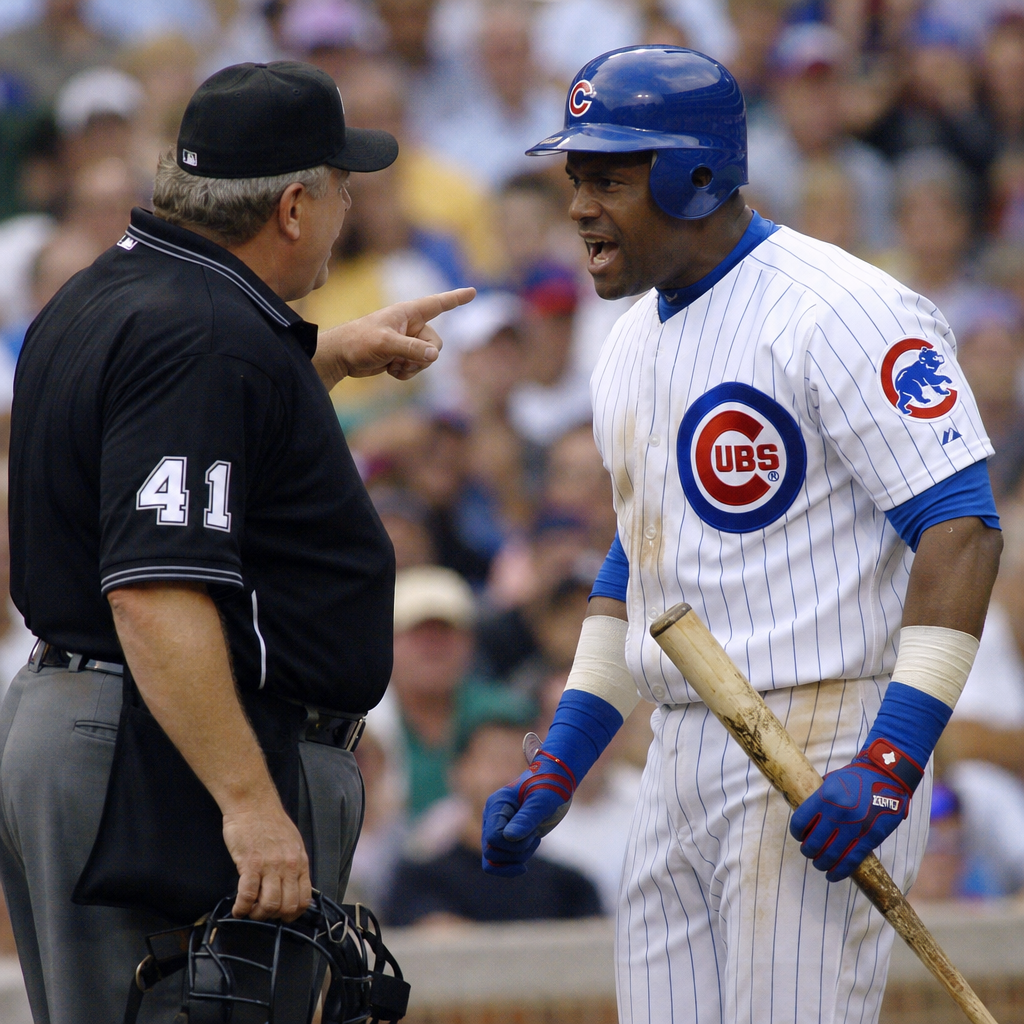
The Sammy Sosa ejection remains one of baseball’s most replayed controversy clips because it compressed suspicion, embarrassment, rules enforcement, and reputation damage into a single at-bat. On June 3, 2003, Chicago Cubs slugger Sammy Sosa was ejected after his bat shattered against the Tampa Bay Devil Rays and umpires discovered cork inside the barrel. In baseball terms, a corked bat is an illegally altered bat, usually hollowed and filled with lighter material such as cork, to reduce weight and potentially increase swing speed. The incident mattered immediately because Sosa was not a fringe player; he was one of the sport’s biggest stars, a former National League MVP, and a central figure in the home run boom that defined late-1990s baseball. Any rules violation attached to that profile was guaranteed to become a national story.
As a hub within the broader “Scandals and Controversies” landscape, the Sammy Sosa ejection also sits in a useful “Miscellaneous” category because it does not fit neatly into gambling, sign stealing, labor conflict, or the steroid investigations that often dominate baseball controversy coverage. Instead, it belongs to a set of incidents where equipment, judgment, and image collide: pine tar disputes, foreign substance cases, bat tampering allegations, and enforcement episodes that expose how quickly a player’s legacy can shift. I have worked through many archived game reports, MLB rule interpretations, and retrospective interviews on this case, and the reason it still resonates is simple: the play itself was brief, but the questions it raised were far larger than one broken bat.
To revisit the corked bat incident properly, it helps to separate three issues. First, what exactly happened on the field that day? Second, what advantage, if any, does a corked bat actually provide? Third, how did the ejection affect Sammy Sosa’s standing in baseball history? Answering those questions with precision matters because the event is often remembered in fragments. Some fans recall only the image of bat fragments and umpires gathering evidence. Others fold the episode into wider debates about the era’s offensive explosion. A clear review shows what is known, what remains disputed, and why this episode still serves as a reference point whenever baseball discusses equipment integrity and competitive fairness.
What happened on June 3, 2003
The defining sequence occurred in the first inning at Wrigley Field during a game between the Cubs and Devil Rays. Sosa hit a ground ball, his bat broke, and the shattered barrel revealed a suspicious spongy substance. Home plate umpire Tim McClelland and the crew inspected the pieces and quickly determined the bat had been corked. Under Major League Baseball rules, use of an altered bat is illegal, and Sosa was ejected on the spot. The visual evidence was unusually stark. This was not a hidden suspicion uncovered days later through lab analysis; it was an in-game discovery, exposed in front of players, media, and fans.
Sosa’s explanation came quickly and has remained central to any fair retelling. He said the corked bat was a batting-practice or exhibition bat intended for entertaining fans with soft-contact swings that could send pieces into the stands. He insisted he had grabbed it by mistake. That defense was plausible enough to earn some consideration, but it never eliminated skepticism. Players are responsible for their equipment, and stars who use custom bats generally know their inventory closely. The league’s disciplinary process reflected that distinction. MLB suspended Sosa for eight games, a punishment that recognized an illegal bat had been used in a regular-season game regardless of claimed intent.
The Cubs, then managed by Dusty Baker, had to manage both the competitive absence and the public fallout. Teammates largely supported Sosa, but support did not equal exoneration. Opponents and commentators treated the event as a credibility test. In clubhouse terms, an equipment violation is different from a rumor because it produces physical proof. That is why the incident escalated so fast. There was no need for leaked testimony or statistical modeling. The evidence was lying in fair territory in splintered form, and that made the story far more durable than many baseball controversies that rely on inference.
What a corked bat is and why players use one
A corked bat is typically created by drilling into the barrel of a wooden bat, removing some material, filling the cavity with lighter matter such as cork, rubber balls, or superballs, and then sealing the opening to disguise the modification. The theory behind the practice is straightforward: a lighter bat can be swung faster, which may help a hitter make contact more quickly or feel more in control. In conversation around clubhouses, the supposed benefit is not usually described as extra raw distance. Instead, it is framed as quicker bat speed and better handling, especially for a player trying to get the barrel through the zone against velocity inside.
However, the scientific case for a meaningful offensive advantage is weak. Studies discussed by researchers and physics analysts, including work associated with the MythBusters demonstration and academic commentary on bat collision dynamics, have generally found that while a corked bat may be lighter and easier to swing, it also loses mass, reducing the force transferred to the ball. In plain terms, a hitter might feel faster with it, but the ball does not necessarily come off harder. That tradeoff matters. Baseball’s rules ban the alteration regardless of whether the performance edge is dramatic, because the standard is equipment integrity, not proof of a quantifiable gain in every swing.
From experience watching hitters obsess over fractions of an ounce in bat selection, I can say that feel matters enormously, sometimes beyond what laboratory testing predicts. Players alter cupping, handle thickness, and load distribution because timing is everything. But legal customization has clear boundaries. Once a bat is hollowed and filled, it crosses from preference into prohibited manipulation. That distinction is why the Sosa incident became a rules story rather than a physics debate. Even if corking does not turn warning-track fly balls into home runs, it violates a competitive line MLB has long enforced.
Rulebook context and disciplinary standards
Major League Baseball’s equipment standards have long prohibited altered bats intended to improve hitting performance. The relevant language appears in Official Baseball Rules provisions governing bats with substances or treatments that make them abnormal. Enforcement can involve immediate removal from the game, ejection, confiscation of the bat, and league discipline. In Sosa’s case, the league imposed an eight-game suspension, and that penalty was significant enough to send a message without approaching the scale reserved for gambling or performance-enhancing drug violations. The league needed consistency: if a superstar is caught with an illegal bat in play, the punishment must be visible.
The rulebook issue also matters because fans often ask whether intent changes the outcome. It may influence public judgment, but it does not erase the violation. A pitcher who accidentally uses an illegal foreign substance blend is still responsible for the ball; a batter who mistakenly brings an altered bat to the plate is still responsible for the bat. Baseball is full of strict-liability style enforcement on equipment and on-field conditions because umpires cannot conduct mind-reading in real time. They assess the object, the circumstance, and the rule. That is exactly what happened at Wrigley.
| Issue | What happened in Sosa’s case | Why it mattered |
|---|---|---|
| Equipment status | Bat broke and exposed cork-like material | Provided direct physical evidence of alteration |
| Umpire action | Immediate inspection and ejection | Showed clear in-game enforcement of bat rules |
| Player explanation | Sosa said it was a batting-practice bat used by mistake | Created debate over intent, not over the object itself |
| League penalty | Eight-game suspension | Established accountability beyond the single game |
| Historical impact | Incident attached to Sosa’s legacy permanently | Turned a rules infraction into a reputational marker |
Public reaction, media framing, and the era’s climate
The reaction in 2003 was amplified by timing. Baseball was already under intense scrutiny about offense, power numbers, and authenticity. Although the corked bat issue is distinct from performance-enhancing drugs, the audience did not compartmentalize neatly. Sosa had become one of the faces of the home run era through his celebrated race with Mark McGwire in 1998 and his sustained power production afterward. When the corked bat was discovered, many fans and commentators interpreted it as another crack in the credibility of the period, even though corking and steroid use involve different mechanisms, different detection methods, and different policy histories.
Media coverage often turned on a simple dramatic contrast: Sosa the smiling showman versus Sosa the embarrassed defendant. Newspapers, sports radio, and television debate shows treated the explanation as either believable human error or deeply convenient spin. That divide has never fully disappeared. In my review of contemporaneous reporting, one persistent theme stands out: even people willing to accept that the bat may have been intended for exhibitions still viewed the mistake itself as evidence of carelessness unworthy of a veteran star. In other words, the most generous version of events still carried a professional indictment.
This is why the ejection survives in baseball memory more vividly than many statistically larger scandals. It had image clarity. Fans could see the broken bat. They could hear the umpires confer. They could watch a superstar leave the game. Sports controversies become durable when the public can summarize them in one sentence and one image, and the Sammy Sosa ejection met both tests instantly.
How the incident shaped Sammy Sosa’s legacy
Sammy Sosa’s career record is substantial: more than 600 home runs, seven seasons with at least 50 home runs, an MVP award, and a transformational role in making the Cubs nationally relevant. Yet legacy in baseball is never built from totals alone. It is built from trust, October moments, relationships with teams, and the stories repeated after retirement. The corked bat incident became one of those repeated stories. It did not erase his achievements, but it permanently changed the tone of discussions about them. Instead of asking only how dominant Sosa was, many retrospectives ask what to make of the controversies surrounding him.
The Hall of Fame conversation shows the effect clearly. Sosa has remained outside Cooperstown, and while voting outcomes are shaped heavily by the steroid cloud over the era, the 2003 ejection did him no favors. Voters assessing character, integrity, and historical context do not isolate each controversy into separate boxes. They consider patterns, associations, and credibility. The corked bat episode reinforced doubt. Fairly or unfairly, it became part of a cumulative case that made it harder for some voters to extend the benefit of the doubt on larger unresolved questions.
For Cubs history, the incident also occupies an awkward place. Sosa is still one of the franchise’s most important sluggers, but he is not remembered with the uncomplicated warmth reserved for figures whose exits and reputations stayed cleaner. Later tensions between Sosa and the organization, including the circumstances of his final Cubs season, added more distance. The ejection was not the only reason his standing grew complicated, but it was a major hinge point because it altered how every later event was interpreted.
Why this controversy still matters in the miscellaneous hub
Within a “Scandals and Controversies” hub, the Sammy Sosa ejection is valuable because it connects to several smaller but important baseball questions that deserve broader coverage. It points readers toward equipment-rule controversies, umpire enforcement cases, and the gray area between gamesmanship and cheating. It also helps explain why some incidents become symbolic beyond their technical importance. A corked bat is not equal in scope to the Black Sox scandal, Biogenesis, or the Astros sign-stealing scheme, yet it remains historically sticky because it touched a superstar at the exact moment baseball’s credibility was vulnerable.
This miscellaneous category should therefore include incidents like pine tar disputes, illegal substances on baseballs, hidden-ball trick ethics, protest-game controversies, clubhouse surveillance issues, and discipline for altered equipment. These stories may seem smaller than headline scandals, but together they map baseball’s daily struggle to define fairness. If your goal is to understand how the sport polices itself, these cases are indispensable. They show that controversy is not only about massive conspiracies; sometimes it is about one object, one decision, and one instant that changes a career narrative.
The key takeaway from revisiting the Sammy Sosa ejection is that context matters as much as the broken bat itself. The incident was real, the rule violation was clear, and the explanation, while possible, never fully repaired the damage. It became a lasting shorthand for doubt because it arrived in an era already primed to question spectacular performance. For readers exploring baseball scandals and controversies, this case is essential precisely because it is narrower than the biggest scandals. It shows how reputations can be reshaped by a single enforceable moment. Use this hub as a starting point, then continue into related equipment, rules, and integrity controversies to see how baseball’s smallest violations often produce its longest memories.
Frequently Asked Questions
What happened during the Sammy Sosa corked bat incident?
On June 3, 2003, Sammy Sosa was ejected during a game between the Chicago Cubs and the Tampa Bay Devil Rays after his bat broke on contact and exposed cork packed inside the barrel. The moment unfolded in plain view, which is one reason it became such a lasting baseball controversy. When the bat splintered, umpires immediately inspected the pieces and determined that it had been illegally altered. Under Major League Baseball rules, a bat must meet specific equipment standards, and using a corked bat clearly violates those rules. Sosa was removed from the game on the spot, and the incident quickly shifted from an in-game oddity to a national sports story.
The ejection mattered because it combined visual evidence, instant enforcement, and a high-profile player. There was no long investigative delay and no mystery about what had triggered the umpire response. Fans, broadcasters, and reporters all saw the same thing at nearly the same time. That made the play unusually powerful in the public imagination. Instead of being remembered as a technical equipment violation, it became remembered as a dramatic, reputation-defining scene involving one of the era’s most recognizable sluggers.
What is a corked bat, and why is it illegal in Major League Baseball?
A corked bat is a bat that has been hollowed out, typically in the barrel, and then filled with a lighter material such as cork, rubber, or other substances. The goal of this alteration is usually to reduce the bat’s weight, which may allow a hitter to swing it more quickly. The theory behind corking is that a lighter bat could improve bat speed and make it easier for a player to react, especially in certain contact situations. Even though debate has existed over whether corking truly helps overall hitting performance, the more important point in Major League Baseball is that the practice is explicitly prohibited.
It is illegal because MLB requires bats to conform to strict equipment standards designed to preserve competitive fairness and uniformity. Players are not allowed to modify bats in a way that gives even a perceived advantage outside the rules. Baseball’s equipment rules are part of a larger framework that protects the integrity of the game. Once a bat is altered internally, it no longer meets legal specifications. So regardless of whether a corked bat actually produces more power, more contact, or any measurable benefit at all, it remains banned because it is an unauthorized change to approved equipment. That is why umpires treat discovery of a corked bat as a direct rules violation rather than a gray-area issue.
What explanation did Sammy Sosa give after the ejection?
After the incident, Sosa said the corked bat was not one he intended to use in a game under normal circumstances. His explanation was that the bat had been used for exhibition purposes, including batting practice and entertainment for fans, and that he had grabbed it by mistake. This defense became a major part of the public discussion because it attempted to separate intent from outcome. In other words, Sosa did not deny that the bat was corked; instead, he argued that it was accidentally brought into live competition.
That explanation was met with mixed reactions. Supporters felt it was plausible that a player with many bats available could accidentally select the wrong one. Skeptics argued that a veteran major leaguer should know exactly which bat he is using, especially in a regular-season game. The controversy endured partly because the explanation could not fully erase the visual impact of the broken bat itself. Even for people willing to consider the possibility of an honest mistake, the incident still damaged trust. In baseball, credibility matters almost as much as the official ruling, and the image of cork spilling from a shattered bat made Sosa’s explanation difficult for many fans to accept without reservation.
What punishment did Sammy Sosa receive, and how did MLB respond?
Major League Baseball responded by suspending Sammy Sosa for eight games, which was the standard penalty at the time for using an illegal bat. The suspension reflected the seriousness with which the league viewed equipment violations. Because the rule was clear, MLB did not need to prove broader intent or establish a pattern of behavior to impose discipline for that specific game incident. The discovery of the altered bat itself was enough to trigger formal punishment.
The league’s response also showed the difference between an on-field rules decision and the wider court of public opinion. Officially, the matter was addressed through ejection, review, and suspension. But unofficially, the story expanded far beyond the discipline. Analysts began revisiting Sosa’s achievements, critics questioned what the incident might imply about past performances, and the episode became attached to larger debates about baseball’s credibility in the early 2000s. From MLB’s standpoint, the punishment was straightforward. From a historical standpoint, however, the damage extended well beyond eight games because the incident became part of the permanent conversation around Sosa’s legacy.
Why is the Sammy Sosa ejection still remembered so vividly today?
The incident endures because it was unusually visual, immediate, and symbolic. Many sports controversies require documents, testimony, or retrospective analysis to gain traction. The Sosa ejection did not. A superstar slugger’s bat broke, forbidden material was visible, umpires acted instantly, and the player was thrown out in front of a live audience. That sequence made the moment easy to replay and easy to understand, even for casual fans. It was baseball controversy in its most compressed form: one swing, one shattered bat, one undeniable rules problem.
It also remains memorable because it touched several sensitive themes at once. There was the issue of cheating or attempted rule-bending, the embarrassment of being caught in such a public way, the firm enforcement by umpires, and the long shadow cast over a famous player’s reputation. For many fans, the moment became bigger than the box score or even the season itself. It came to represent an era when baseball was wrestling with questions about authenticity, advantage, and trust. That is why the clip still circulates today. It is not just a strange equipment violation; it is a defining image of how quickly a single at-bat can alter the way a player is remembered.