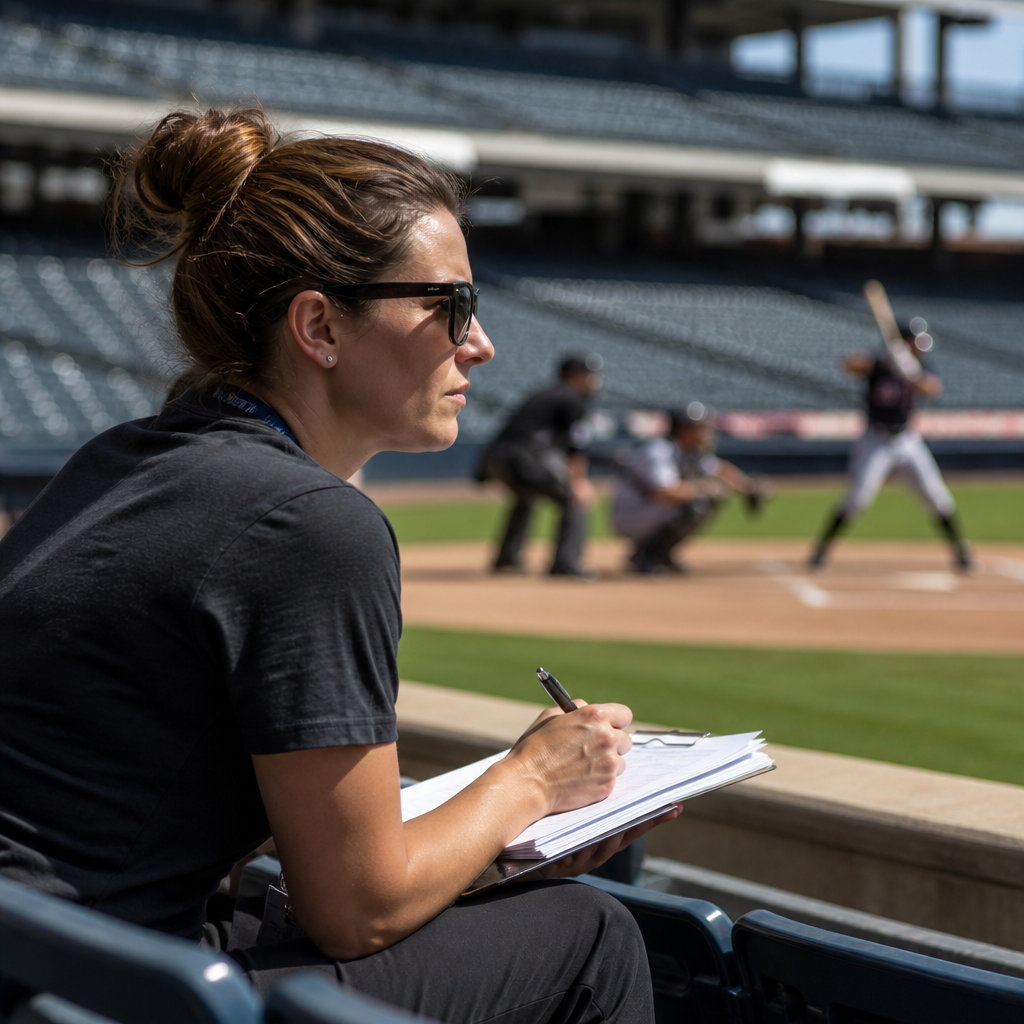
The pioneering spirit of female baseball scouts has reshaped how talent is found, evaluated, and developed across professional baseball, even though their contributions have often been overlooked in mainstream histories of the game. In baseball, a scout is the evaluator who identifies amateur, collegiate, international, or professional players and projects whether their skills, makeup, health, and athletic tools can succeed at higher levels. Female baseball scouts are women who perform that same rigorous work inside a profession long dominated by men, traveling constantly, filing detailed reports, crosschecking opinions, and defending their evaluations in front offices that increasingly blend traditional observation with analytics. Their story matters because scouting influences who gets drafted, who gets signed, and which organizations gain competitive advantages through sharper judgment.
I have worked around baseball research, player evaluation workflows, and archival material long enough to know that scouting is rarely romantic in practice. It is miles on rental cars, radar guns in cold bleachers, notebooks full of body language observations, and late-night report deadlines after doubleheaders. For women entering this world, the challenge historically extended beyond mastering velocity bands, swing decisions, arm action, and projection. They also had to prove, repeatedly, that they belonged in clubhouses, backfields, showcase circuits, and draft rooms. That extra burden makes their breakthroughs especially significant. Every woman who earned trust as a scout changed the hiring imagination of the sport, making it easier for the next candidate to be judged on skill rather than stereotype.
This hub article explores the broader miscellaneous landscape of women in baseball scouting: the early trailblazers, the day-to-day mechanics of the job, the institutional barriers women faced, the hiring shifts that slowly opened doors, and the legacy these scouts created for front office leadership. It also serves as a foundation for related articles on women in player development, women in baseball operations, women on the amateur scouting trail, and women in international evaluation. Understanding female baseball scouts is not only about representation. It is about how organizations discover value, reduce blind spots, and improve decision-making when more perspectives are present in the room. Baseball has always rewarded teams that see talent earlier and more clearly than their rivals. Women scouts helped push the game toward that clearer vision.
How Female Baseball Scouts Entered a Closed Profession
For much of the twentieth century, scouting operated as a relationship-driven network passed from former players, coaches, and long-established baseball men to people who looked and sounded like them. Open postings were rare. Apprenticeship mattered more than formal credentials. That structure made entry difficult for anyone outside the traditional pipeline, and especially difficult for women. Yet some women found ways in by combining persistence, technical competence, and a willingness to take on the least glamorous assignments. They attended showcases, built contacts with college coaches, covered local territories, and produced reports that were too good to ignore.
One of the most important names in this history is Bernice Gera, better known for umpiring and for challenging baseball’s gender barriers, but emblematic of a generation of women who forced the game to confront exclusionary assumptions. In scouting specifically, Edith Houghton stands out as an early landmark. Houghton, a former player and baseball pioneer from the Philadelphia Bobbies era, later worked in the Philadelphia Phillies organization as a scout in the 1940s and is widely recognized as one of the first women to hold that title in Major League Baseball. Her presence did not create immediate industry-wide change, but it established a precedent that women could evaluate talent professionally long before the modern diversity conversation reached front offices.
Later generations built on that precedent in more visible organizational settings. The growth of women in baseball operations during the late twentieth and early twenty-first centuries created adjacent pathways into scouting, player development, and research. Some women entered through internships and coordinator roles before moving onto the road. Others arrived after college baseball playing careers, softball backgrounds, sports management study, video analysis work, or player development support positions. In nearly every case, entry required evidence: strong reports, trusted recommendations, and a demonstrated understanding of what separates present performance from future major league value.
What Baseball Scouts Actually Do
To understand why female baseball scouts matter, it helps to define the work with precision. A scout does not merely watch games and choose favorites. A professional scout evaluates current players in affiliated or independent baseball, often for potential trades, waiver claims, Rule 5 Draft decisions, and free-agent signings. An amateur scout covers high school and college players eligible for the draft, while an international scout evaluates players in countries such as the Dominican Republic, Venezuela, Japan, Mexico, or South Korea, depending on organizational structure. Crosscheckers review area scout recommendations, and scouting directors synthesize reports into organizational decisions.
The evaluation itself is disciplined. Scouts often grade tools on the 20-80 scale, where 50 is major league average and each grade corresponds to a standard deviation-like step in baseball usage. For position players, common categories include hit, power, run, field, and arm. For pitchers, scouts assess fastball quality, secondary pitches, command, control, delivery, durability indicators, and role risk. Modern reports also account for biomechanics, swing path efficiency, pitch shape, chase behavior, contact quality, defensive versatility, and psychological makeup. A strong scout balances objective data with contextual observation. Ninety-five miles per hour means something different if the pitcher cannot repeat the delivery, if the shape is flat, or if the body suggests future injury risk.
Women scouts have excelled in this environment because success depends on acuity, preparation, and communication rather than on fitting an outdated image of who belongs behind home plate with a stopwatch. The best scouts I have encountered are exacting note takers. They know when a hitter’s hands work, when a catcher steals strikes, and when a college reliever lacks the starter traits his stat line implies. They can explain why a player with ordinary box score numbers may still become a major leaguer because the body projects, the decision-making is advanced, and the skills translate. That evaluative clarity has nothing to do with gender and everything to do with craft.
Trailblazers Who Changed the Talent Pipeline
Several women deserve attention for changing not only perceptions but actual organizational practice. Edith Houghton remains foundational because she proved the concept early. More recent figures show how the role evolved within contemporary front offices. Kim Ng, though best known as an executive and later as the first woman general manager of a major North American men’s professional sports team, helped normalize women’s authority in player personnel conversations that intersect directly with scouting. Her career signaled that women could advance from evaluation and operations work into top decision-making jobs.
Marti Sementelli is another prominent example. Hired by the Milwaukee Brewers as a scout, she became one of the most publicly visible women on the amateur scouting side and has spoken openly about both the grind and the opportunity in the profession. Her role mattered because visibility matters. When young women see someone covering showcases, filing reports, and representing a club at the field, scouting becomes imaginable as a career. That is how pipelines start: one credible example at a time.
Other women have contributed across organizations in roles such as area scout, baseball operations assistant, coordinator, analyst-scout hybrid, and player personnel adviser. Some names receive press; many do not. Yet the pattern is consistent. Teams that hire women in evaluation often discover they have expanded their information network, improved communication, and challenged stale assumptions about players or markets. In practice, pioneering rarely looks dramatic. It looks like being assigned a territory, outperforming expectations, and slowly becoming indispensable to a process that once excluded you.
Barriers, Bias, and the Practical Realities of the Job
The central obstacles facing female baseball scouts have been structural, cultural, and logistical. Structural barriers include closed hiring networks, uneven mentorship access, and the old tendency to recruit primarily ex-male players. Cultural barriers include skepticism from coaches, players, or fellow evaluators who assume authority must look masculine. Logistical barriers include extensive travel, late-night reporting, safety concerns, and balancing family responsibilities with a calendar built around tournaments, spring training, draft season, and summer showcases.
These barriers are not abstract. Women scouts have described being mistaken for family members rather than evaluators, challenged on technical terminology they clearly understood, or excluded from informal conversations where real information is often exchanged. Baseball still contains spaces where credibility is tested performatively. The fastest way through that resistance has usually been consistency: show up prepared, ask sharp questions, write better reports, and let accurate evaluations accumulate. Over time, clubs value correct information more than preconception, but the cost of having to overprove competence should not be minimized.
At the same time, it is important to avoid flattening the story into one of adversity alone. Many women who entered scouting also found mentors who opened doors, scouting directors willing to judge output fairly, and colleagues who cared more about report quality than old clubhouse attitudes. Progress in baseball usually comes unevenly. Some organizations modernized their hiring cultures earlier than others. The meaningful point is that once women were present in sufficient numbers to be compared on performance instead of novelty, the case for excluding them collapsed.
How Scouting Modernized and Created New Openings
The professionalization of front offices created better conditions for women in scouting. As clubs adopted integrated databases, TrackMan, Hawk-Eye, biomechanical assessment, and video tagging platforms such as Synergy and BATS, evaluation became more interdisciplinary. Teams still need experienced eyes in the stands, but they also need scouts who can connect observation to data and explain contradictions. A pitcher might post elite strikeout rates in college, for example, yet a scout may note a reliever-only delivery, poor strike efficiency, and effort that shortens outings. Conversely, an underpowered hitter may project upward because bat-to-ball skill, swing decisions, and physical maturation point to future gains. The modern scout must synthesize evidence rather than rely on intuition alone.
That shift opened opportunities for candidates with diverse backgrounds, including women who developed expertise in analytics, video, biomechanics, operations, or communications before moving into evaluation. It also changed how credibility is built. Instead of inheriting authority from a playing résumé alone, scouts can now demonstrate value by producing accurate forecasts, integrating medical and performance context, and communicating clearly across departments.
| Scouting Area | Traditional Focus | Modern Expanded Focus | Why It Helped Open Doors |
|---|---|---|---|
| Amateur scouting | Tools, body, competition level | Data, biomechanics, swing decisions, projection models | Broader expertise became valuable beyond old networks |
| Professional scouting | Current stuff and role fit | Pitch shape, bat speed, injury risk, option value | Clear analysis mattered more than stereotype |
| International scouting | Relationships and live looks | Video, age verification processes, market context | Process discipline gained importance |
| Crosschecking | Subjective confirmation | Multi-source synthesis and draft-board calibration | Communication skill became central |
Modernization did not erase bias, but it did weaken the myth that only one kind of baseball background could produce reliable evaluations. Organizations that embraced broader hiring often became better at connecting scouting, analytics, and player development into one coherent pipeline.
Why Female Scouts Matter to the Future of Baseball
Female baseball scouts matter because talent evaluation improves when organizations widen the range of capable evaluators without lowering standards. In fact, standards rise when clubs recruit from a larger pool. Better hiring increases the chance of spotting market inefficiencies, especially in undervalued regions, overlooked players, and nontraditional developmental profiles. Diverse evaluative teams also reduce groupthink. If every scout in a room was trained the same way, played the same positions, and came from the same networks, the organization risks repeating inherited biases about body type, age, competition level, or makeup.
The wider significance reaches beyond front offices. Women scouts provide visible proof that baseball expertise is not gendered, which affects youth participation, internships, mentorship, and the ambitions of future executives. The line from scout to crosschecker to director to assistant general manager is real. Representation at the evaluation level can influence leadership decades later. That is why this topic belongs at the center of any serious Women in Baseball hub. Scouting is where organizations decide whose future to invest in, and women who succeeded there changed more than their own careers. They changed baseball’s understanding of who gets to judge the game.
For readers exploring the broader women in baseball landscape, female scouts connect naturally to related topics: women in baseball operations, women in analytics, women executives, women in player development, and women breaking barriers in coaching and umpiring. Together, these stories reveal a common lesson. Baseball becomes smarter when it stops confusing tradition with expertise. The pioneering spirit of female baseball scouts is ultimately a story of professional rigor winning out over exclusion. Study their path, follow the linked subtopics in this hub, and you will better understand how the sport modernized from the inside out.
Frequently Asked Questions
What does a female baseball scout do, and how is the role similar to or different from any other scout in professional baseball?
A female baseball scout does the same core job as any professional scout: she evaluates players and projects whether their skills can translate to higher levels of competition. That includes watching amateur, collegiate, international, and professional talent; grading tools such as hitting ability, power, speed, arm strength, fielding, and pitching traits; assessing makeup, competitiveness, coachability, and baseball instincts; and reporting on whether a player fits an organization’s development model. Scouts spend countless hours at ballparks, showcases, tournaments, and training facilities, building detailed reports that can influence drafts, trades, signings, and player development decisions.
The role itself is not inherently different because the scout is a woman. The standards of evaluation, the need for a trained eye, and the pressure to make accurate projections are the same. Where the experience has often differed is in the path to recognition. Female baseball scouts have historically had to establish credibility in environments where scouting was long seen as a male-dominated profession. That has made many of them pioneers not because the work changed, but because they helped expand who was seen as qualified to do it. Their success has reinforced an important truth within baseball: the ability to identify talent depends on knowledge, preparation, discipline, and judgment, not gender.
Why are female baseball scouts considered pioneers in the history of the game?
Female baseball scouts are considered pioneers because they entered and succeeded in a profession that for decades offered women limited visibility, few opportunities, and even fewer formal pathways to advancement. Scouting has traditionally been built on networks of former players, long-tenured baseball insiders, and regional relationships that often excluded women. By breaking into that world, female scouts challenged assumptions about who could evaluate talent and who belonged in decision-making spaces across professional baseball.
Their pioneering spirit is especially significant because scouting sits at the foundation of roster building. Scouts help determine which players are drafted, signed, developed, and promoted. When women stepped into those roles, they were not simply adding representation; they were participating directly in the talent pipeline that shapes the future of the sport. In many cases, their work also expanded organizational thinking. Teams benefited from evaluators who brought fresh perspectives, strong communication skills, and a willingness to question conventional wisdom. Even when their names were absent from mainstream baseball histories, their influence was felt in the players they advocated for, the systems they helped strengthen, and the doors they opened for those who followed.
How have female baseball scouts influenced the way talent is identified and evaluated?
Female baseball scouts have helped broaden the culture of evaluation by proving that effective scouting depends on disciplined observation and nuanced judgment rather than narrow tradition. Their presence has contributed to a more inclusive and thoughtful scouting environment, one that is often more open to collaboration across departments such as analytics, player development, biomechanics, and medical evaluation. In modern baseball, identifying talent is no longer just about seeing raw tools; it is about understanding how a player learns, adapts, competes, and fits into long-term development plans. Female scouts have been part of that evolution.
Just as importantly, their success has encouraged organizations to widen their hiring lens. When teams recruit evaluators from more diverse backgrounds, they often gain stronger coverage, broader insight, and a healthier range of opinions on players. That can reduce blind spots and improve decision-making. Female baseball scouts have also helped normalize merit-based evaluation within front offices and scouting departments. By consistently producing quality reports, building trusted relationships, and identifying legitimate talent, they have shown that excellence in scouting comes from expertise and work ethic. Their influence is both practical and cultural: they have impacted individual player evaluations while also helping baseball become more open to different voices in the process of finding and developing talent.
What challenges have female baseball scouts faced, and how have they overcome them?
Female baseball scouts have often faced a combination of structural, cultural, and visibility-related challenges. Structurally, there have historically been fewer mentorship pipelines available to women in baseball operations and scouting. Culturally, some female scouts have had to navigate skepticism about their expertise simply because they were entering a field long dominated by men. Visibility has also been an issue, as important contributions by women in baseball have often been underreported or omitted from popular histories of the sport. In addition, scouting itself is demanding for anyone: long travel, irregular schedules, relentless note-taking, difficult projection calls, and the need to earn trust from players, coaches, and executives.
They have overcome these barriers the same way respected scouts earn standing anywhere in baseball: through preparation, consistency, and results. Strong female scouts build credibility by knowing the game deeply, presenting well-supported evaluations, communicating clearly, and maintaining professional relationships across the baseball landscape. Many have also succeeded by being adaptable, embracing both traditional live evaluation and modern performance data. Their perseverance matters because it has not only advanced individual careers but also helped reshape expectations throughout the sport. Each woman who established herself in scouting made it harder for outdated assumptions to survive and easier for the next generation to be judged on ability rather than stereotype.
Why is it important to recognize the contributions of female baseball scouts today?
Recognizing the contributions of female baseball scouts matters because baseball history is incomplete when the people who helped build the game’s talent pipeline are overlooked. Scouts are often behind the scenes, but their decisions can alter franchises for years. When women who performed that work are left out of the conversation, the public misses a fuller understanding of how teams find players, how baseball evolves, and who has shaped that evolution. Acknowledging their role restores accuracy to the story of the sport and gives deserved credit to professionals whose expertise affected drafts, signings, development strategies, and organizational success.
Recognition also has practical importance for baseball’s future. Visibility creates pathways. When aspiring scouts, analysts, and front-office professionals see women represented in baseball operations, the profession becomes more accessible and more credible as a career option. That strengthens the talent pool for the sport as a whole. For teams, valuing the contributions of female scouts reinforces a culture that prioritizes knowledge and performance over outdated assumptions. For fans and historians, it deepens appreciation for the many people who shape the game beyond the field. In that sense, honoring female baseball scouts is not just about correcting the record; it is about understanding baseball more honestly and building a stronger, smarter future for the sport.