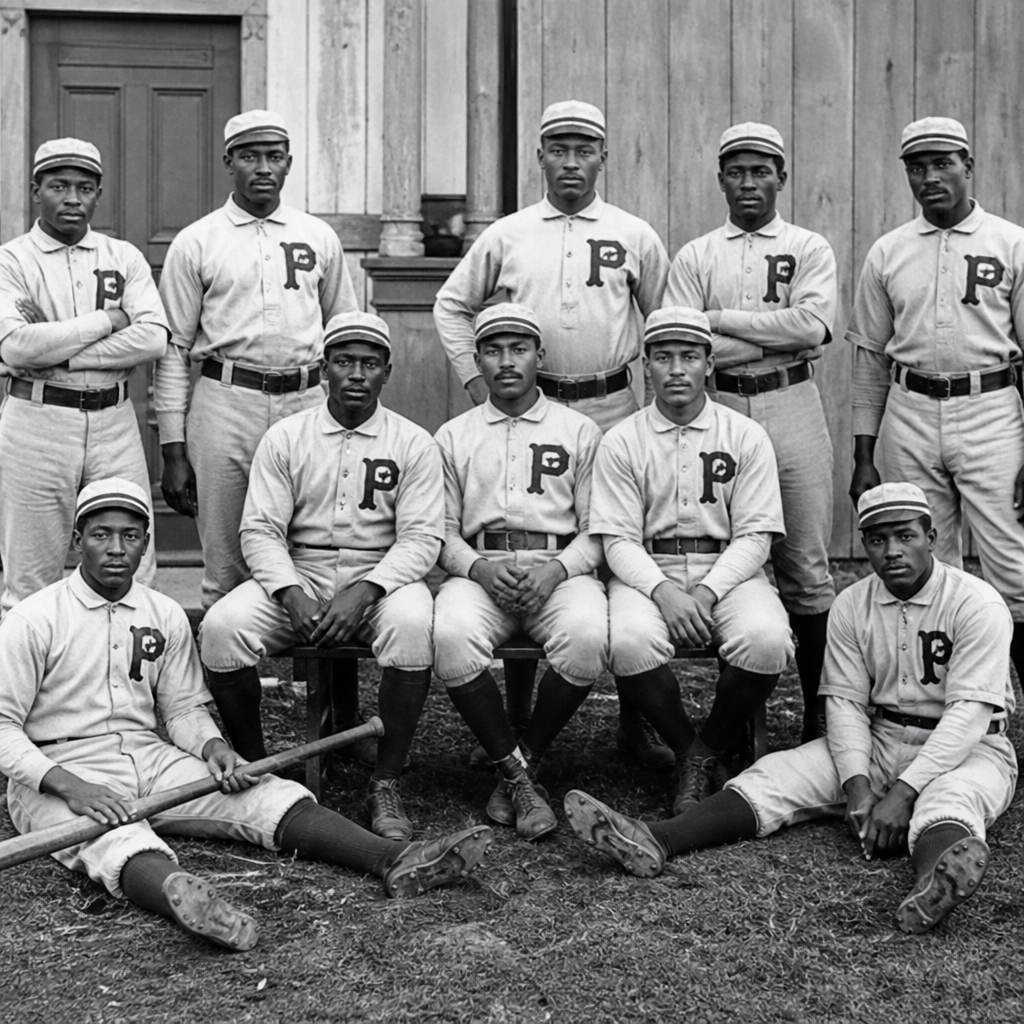
The Philadelphia Pythians stand at the center of early Black baseball history because they show how organized African American clubs competed, built institutions, and challenged exclusion decades before the Negro Leagues existed. Founded in Philadelphia in the mid nineteenth century, the Pythians were more than a local amateur team. They were part athletic club, part mutual aid network, and part public statement that Black Americans would claim space in the national game despite legal discrimination and informal segregation. When historians discuss amateur clubs and early competition, the Pythians belong near the beginning of the story because they reveal how baseball developed outside the white professional structures that later hardened into the color line.
Understanding the Philadelphia Pythians requires defining a few terms. An amateur club in nineteenth century baseball was usually a self organized team whose players did not openly receive salaries, even though expenses, jobs, or indirect payments could blur that status. Early competition refers to the period when clubs arranged matches independently, traveled regionally, and relied on newspaper coverage, civic sponsors, and community reputation rather than league offices. Black baseball pioneers were the players, managers, organizers, scorers, and club officers who built teams before formal Black professional circuits emerged. In the Pythians’ case, that work included recruiting players, securing grounds, arranging fixtures, raising funds, and defending the club’s legitimacy in hostile public spaces.
I have found that when people hear “before the Negro Leagues,” they often imagine a gap in baseball history. The Pythians prove the opposite. Long before Rube Foster founded the Negro National League in 1920, Black clubs in Philadelphia, Brooklyn, Baltimore, Washington, and other cities played serious baseball with discipline and ambition. They studied rules, kept score, published challenges, and expected to be judged by performance. The Pythians mattered because they transformed baseball from informal recreation into organized Black civic life. They also exposed the limits of integration in the post Civil War North. Their effort to gain recognition from white baseball authorities, and the rejection they received, became an early marker of institutional exclusion in American sport.
As a hub for amateur clubs and early competition, this article explains who the Pythians were, how they operated, who they played, why white baseball excluded them, and how their model influenced later Black teams. Their story links baseball history to Reconstruction era politics, Black associational life, and the development of independent competition. It also helps readers understand later milestones, from all Black barnstorming teams to the fully organized Black leagues of the twentieth century.
Who the Philadelphia Pythians Were
The Philadelphia Pythians Base Ball Club emerged in 1865, only months after the Civil War ended. The club was closely associated with Octavius V. Catto and Jacob C. White Jr., two leading Black educators and civil rights activists in Philadelphia. That connection matters. The Pythians were not an isolated sporting curiosity. They grew from a literate, politically active Black middle class that valued education, self help, and public respectability. Catto, in particular, understood that organized baseball could display discipline, intelligence, and equality in a society that routinely denied all three to Black citizens.
Philadelphia was a logical home for such a club. The city had one of the largest free Black communities in the United States, a strong network of churches and beneficial societies, and access to newspapers that covered local baseball. The Pythians adopted the organizational habits common to leading amateur clubs of the era. They elected officers, recorded proceedings, scheduled meetings, and maintained enough order to be taken seriously by opponents and journalists. Their existence demonstrates that early Black baseball did not simply imitate white clubs from a distance. It developed through the same club culture of constitutions, dues, social events, and formal challenges that defined nineteenth century amateur baseball generally.
The roster changed over time, but the club’s significance came from structure as much as talent. Like many successful amateur teams, the Pythians needed a dependable core of players, practice space, proper equipment, and supporters willing to underwrite travel and uniforms. Those details are easy to overlook, yet they explain why some early clubs lasted only a season while others built reputations. The Pythians endured because they were anchored by leadership and community backing.
How Amateur Black Baseball Worked in the 1860s and 1870s
To understand the Pythians fully, it helps to see how amateur baseball functioned in their era. Clubs did not join polished national schedules. Instead, they issued challenges, accepted return matches, and negotiated dates directly. A strong club’s reputation depended on newspaper reports, win loss records, and the quality of opponents. Grounds were sometimes rented, borrowed, or shared with cricket clubs and other organizations. Equipment costs mattered. Uniforms were symbols of seriousness. Travel, though usually regional, could still be expensive and logistically difficult.
Black clubs faced all of those normal burdens plus racial barriers. They often had reduced access to desirable grounds, limited press coverage, and fewer invitations from prominent white teams. Even so, the best Black amateur clubs built competitive circuits among themselves. In Philadelphia and nearby cities, games became community events that blended sport, sociability, fundraising, and public representation. A match was not only a contest on the field. It was evidence that Black institutions could organize successfully under pressure.
In my experience studying early club baseball, the strongest amateur teams usually shared four traits: stable leadership, regular practice, careful bookkeeping, and opponents worth beating. The Pythians checked all four boxes. They pursued respectable competition, understood the value of publicity, and sought official recognition because they knew legitimacy in baseball came from being seen, recorded, and measured against established clubs.
| Feature | How early amateur clubs operated | How the Pythians adapted it |
|---|---|---|
| Scheduling | Teams issued and accepted direct challenges | Arranged matches with Black clubs and pursued broader competition |
| Governance | Clubs elected officers and kept records | Used formal leadership tied to respected civic figures |
| Financing | Dues, donations, and local support covered costs | Relied on Black community networks and club discipline |
| Public reputation | Newspapers and scorekeeping established credibility | Sought coverage and formal standing in baseball circles |
| Competition | Quality of opponents shaped status | Played fellow Black clubs and sought interracial legitimacy |
Competition, Opponents, and the Meaning of the Games
The Pythians played within a growing network of Black clubs, including teams from Philadelphia and other Mid Atlantic cities. These contests were important because they proved Black baseball was not a one club phenomenon. By the late 1860s, multiple African American teams were developing enough skill and organization to sustain recurring competition. Games against clubs such as the Excelsiors and other regional opponents created the beginnings of a Black baseball public, complete with rivalries, return fixtures, and local pride.
Contemporary baseball looked different from the modern game. The rules evolved quickly, pitching was underhand, fielding gloves were not yet standard, and scoring could be high because defensive play was less refined. Still, by the standards of the day, a well played club match required strategy, conditioning, and repetition. Clubs practiced relay throws, batting order management, and positional coordination. A team that looked orderly in the field signaled competence to spectators and critics alike. For Black clubs, that competence carried added weight because white observers often judged them through racist assumptions before the first pitch.
The games also had social meaning beyond the box score. They drew Black spectators eager to support their own institutions at a time when civic representation mattered intensely. Baseball offered a visible stage on which Black Philadelphians could demonstrate collective pride and discipline. In that sense, the Pythians were doing cultural and political work every time they took the field. Their matches helped normalize the idea that Black Americans belonged in organized public recreation, not merely as laborers or bystanders but as decision makers and competitors.
The National Association Rejection and the Early Color Line
No episode captures the significance of the Philadelphia Pythians more clearly than the club’s effort to gain acceptance in organized white baseball. In 1867, the Pythians sought admission to the National Association of Base Ball Players, the leading governing body for amateur baseball clubs. Their application mattered because membership offered status, access, and acknowledgment that a club belonged within the recognized baseball world. The Pythians did not ask for charity. They asked for equal standing under the norms that other clubs used.
The association rejected them, and the debate around that rejection exposed a hardening racial barrier. Delegates reportedly feared that admitting one Black club would force acceptance of others. That logic is crucial to understanding pre Negro Leagues baseball. Exclusion was not accidental or purely local. It became institutional. The Pythians had shown that Black clubs could meet organizational standards, so white baseball leaders shifted the issue from competence to race. In effect, the gatekeepers said ability was not the real criterion.
This moment deserves to be treated as a foundational event in baseball segregation. It happened before the major leagues were fully formed and long before the rigid professional color line of the late nineteenth century. The rejection demonstrated that organized baseball’s leadership was willing to codify exclusion even during Reconstruction, when federal law and constitutional amendments were supposedly expanding Black citizenship. For historians, the Pythians’ application is a primary example of how sport mirrored broader political retrenchment.
The practical impact was severe. Without equal access to governing institutions and top level opponents, Black clubs had to build parallel systems of recognition. That meant more reliance on independent scheduling, Black newspapers, church networks, civic sponsors, and self generated legitimacy. Ironically, exclusion helped create the separate tradition that later produced Black professional baseball. The Pythians were among the first clubs forced to prove that formal recognition could be denied, but baseball excellence could still flourish outside official approval.
Octavius Catto, Community Leadership, and Club Culture
Any serious account of the Pythians must emphasize Octavius Catto. He was not simply a baseball enthusiast. He was an educator, military veteran, and voting rights advocate whose life embodied the ambitions and risks of Black citizenship after the Civil War. Catto understood institutions. He knew that schools, militia service, political organizations, and athletic clubs all shaped how Black Americans were perceived and how they defended themselves. Baseball fit naturally into that world because it combined public visibility with disciplined association.
Under leaders such as Catto and White, the Pythians reflected a broader Black club culture in Philadelphia. Membership was about conduct as much as skill. Teams of the era often emphasized character, punctuality, decorum, and respectability. That language can sound restrictive today, but in context it was strategic. Black clubs operated under relentless scrutiny. A poorly run organization could be dismissed as proof of racial inferiority by hostile observers. A well run club challenged that lie every week.
Catto’s murder in 1871 during election day violence reminds us that the Pythians existed in a dangerous political environment. Black athletic achievement did not unfold separately from racial conflict. It existed alongside voter intimidation, employment discrimination, segregated public spaces, and physical threats. The resilience of the Pythians therefore has to be measured not only by wins and losses but by persistence under conditions designed to limit Black mobility and visibility.
The Pythians’ Legacy for Later Black Baseball
The Philadelphia Pythians did not become a Negro League franchise, but their legacy runs directly into the later architecture of Black baseball. They established key patterns that later clubs would follow: independent scheduling, community based financing, regional rivalry building, and the use of baseball as both business and racial representation. Those patterns appeared in late nineteenth century powerhouses such as the Cuban Giants and, later, in the eastern and midwestern clubs that fed the Negro National League and Eastern Colored League.
Their greatest legacy may be conceptual. The Pythians proved Black teams did not need white validation to create meaningful competition, yet they also made clear that exclusion carried costs. That dual lesson shaped generations of Black baseball organizers. Successful owners and managers later built strong Black institutions while never losing sight of the injustice of forced separation. In practical terms, the Pythians helped establish the amateur foundation from which semiprofessional and professional Black baseball could grow.
For readers exploring the broader early history of baseball, the Pythians should be linked with several related themes: the rise of independent Black clubs after the Civil War, the transition from amateurism to professionalism in the 1860s and 1870s, the spread of regional barnstorming, and the eventual creation of formal Black leagues. They are a hub subject because their story touches every major question in the subtopic. How were clubs organized? Who funded them? Where did they play? Why were parallel structures necessary? The Philadelphia Pythians answer all of those questions with unusual clarity.
The Philadelphia Pythians deserve to be remembered not as a footnote before the “real” history of Black baseball, but as founders of that history. They built an organized club when the national game was still defining itself. They competed seriously in the amateur era, tied baseball to Black civic leadership, and forced white baseball authorities to reveal the racial logic behind exclusion. Their story shows that Black baseball did not begin with the Negro Leagues. It began with determined local institutions, formal competition, and communities willing to support teams that represented far more than sport.
For anyone studying amateur clubs and early competition, the Pythians provide the essential starting point. They explain how Black teams operated before professional league structures, why independent scheduling mattered, and how racial barriers shaped baseball’s development from the 1860s onward. They also remind us that institutions matter. Officers, scorebooks, dues, newspaper notices, travel arrangements, and respectable grounds were not small details. They were the infrastructure of visibility and survival.
The main benefit of understanding the Philadelphia Pythians is historical clarity. Once you see how effectively Black clubs organized before 1920, the early history of baseball looks different: fuller, more competitive, and more contested. Follow that thread into related topics such as Octavius Catto, the National Association of Base Ball Players, the Cuban Giants, and nineteenth century independent Black clubs to build a complete picture of early baseball history.
Frequently Asked Questions
Who were the Philadelphia Pythians, and why are they so important to baseball history?
The Philadelphia Pythians were one of the most significant early Black baseball clubs in the United States, founded in Philadelphia in the mid-nineteenth century at a time when African Americans were creating their own civic, cultural, and athletic institutions in the face of widespread exclusion. Their importance goes far beyond wins and losses on the field. The Pythians represented an organized Black baseball club decades before the creation of the Negro Leagues, proving that African American players, managers, and supporters were already building serious team structures, scheduling competition, and treating baseball as a meaningful public institution. In other words, they were not a footnote to baseball history—they were central to how the sport developed outside white-controlled spaces.
The club is especially important because it shows how Black baseball emerged long before the segregated professional systems of the twentieth century. The Pythians were part of a larger pattern of Black self-organization, where sports, mutual aid, leadership, and community advancement often overlapped. They stood as a public challenge to the idea that African Americans did not belong in the national pastime. By fielding a disciplined, respectable, and competitive team, they asserted both athletic ability and civic dignity. Their story helps modern readers understand that Black baseball history did not begin with famous Negro League stars; it began much earlier, with pioneering clubs like the Pythians that created the foundation others would later build upon.
How did the Philadelphia Pythians reflect the broader role of Black institutions in the nineteenth century?
The Philadelphia Pythians reflected a much bigger story than baseball alone. In the nineteenth century, Black institutions often had to serve multiple purposes because African Americans were denied equal access to mainstream social, political, and economic life. As a result, organizations frequently became gathering places for leadership, protection, education, public visibility, and mutual support all at once. The Pythians fit that pattern perfectly. They were an athletic club, but they also operated within a world where organized Black associations helped members build social networks, strengthen community ties, and demonstrate discipline, ambition, and collective pride.
This matters because the Pythians were not simply playing for recreation. Their existence was a statement about citizenship and belonging. In an era shaped by legal discrimination and racial prejudice, Black clubs used public excellence to counter racist assumptions. A baseball team could showcase teamwork, strategy, respectability, and organizational skill before a live audience. That made the sport a powerful stage for self-representation. The Pythians therefore belong in the history of Black institution-building alongside churches, literary societies, benevolent organizations, and political groups. Their legacy shows how African Americans used every available arena—including sports—to create opportunity, community, and public recognition long before formal integration in baseball or American society.
What kinds of barriers did the Philadelphia Pythians face, and how did they respond to exclusion?
The Philadelphia Pythians faced barriers that were both direct and structural. Like other Black Americans in the mid-nineteenth century, they lived in a society shaped by racial discrimination that limited access to facilities, recognition, and equal participation in public life. In baseball, this meant exclusion from many established white networks that controlled competition, legitimacy, and access to influential organizations. Black clubs often had to work harder to arrange games, secure proper grounds, gain press attention, and be taken seriously as athletic organizations. Even when they demonstrated skill and professionalism, they still encountered efforts to keep them outside the accepted boundaries of the sport.
What makes the Pythians so remarkable is that they did not disappear in the face of those obstacles. Instead, they responded by organizing more deliberately, building their own structures, and insisting on visibility. Their very presence challenged exclusion by proving that Black baseball clubs could be disciplined, durable, and competitive. Rather than waiting for acceptance, they created space for themselves through institutional strength and community support. That response became a defining pattern in Black baseball history: when shut out of white-controlled systems, African Americans built leagues, teams, and traditions of their own. The Pythians were early practitioners of that strategy, and their example helps explain how Black baseball survived and grew over generations despite persistent racism.
In what way did the Philadelphia Pythians lay groundwork for the Negro Leagues?
The Philadelphia Pythians helped lay the groundwork for the Negro Leagues by demonstrating that Black baseball could be organized, sustained, and socially meaningful long before formal Black professional leagues existed. They showed that African American clubs could recruit players, establish team identity, cultivate spectators, and use baseball as a vehicle for community pride and racial advancement. Those are exactly the kinds of foundations that later made larger Black baseball networks possible. The Negro Leagues did not emerge out of nowhere in the twentieth century; they grew from decades of experimentation, institution-building, and perseverance by earlier teams like the Pythians.
Just as importantly, the Pythians helped establish a tradition of Black baseball as both sport and public statement. Later Black teams and leagues would continue this dual role, entertaining fans while also symbolizing resistance, entrepreneurship, and excellence under segregation. The Pythians also contributed to the idea that Black-controlled baseball spaces could be culturally important in their own right, not merely substitutes for white leagues. That perspective became essential to the development of Black baseball culture. So while the Pythians were separated from the Negro Leagues by many decades, they belong to the same historical arc: early Black clubs created the structures, habits, and aspirations that eventually made large-scale Black league play possible.
Why should modern readers remember the Philadelphia Pythians today?
Modern readers should remember the Philadelphia Pythians because they restore depth and accuracy to the story of American baseball. Too often, baseball history is told in a way that centers white institutions first and treats Black participation as something that arrived later. The Pythians correct that misunderstanding. They show that African Americans were shaping the game, organizing clubs, and claiming baseball as part of their public identity long before the Negro Leagues and long before integration in Major League Baseball. Remembering them means recognizing that Black baseball history begins not only with famous professionals, but also with the early builders who made organized competition possible under far more difficult conditions.
There is also a broader reason their story still matters. The Pythians reveal how sports can function as a site of struggle, dignity, and community formation. Their legacy speaks to themes that remain relevant today: access, representation, institutional self-determination, and the fight to be fully included in American life. They remind us that progress in sports has often depended on people willing to create their own paths when established systems refused them entry. By remembering the Philadelphia Pythians, readers honor not just an old ballclub, but a larger tradition of Black resilience, leadership, and vision that helped shape both baseball and the nation.