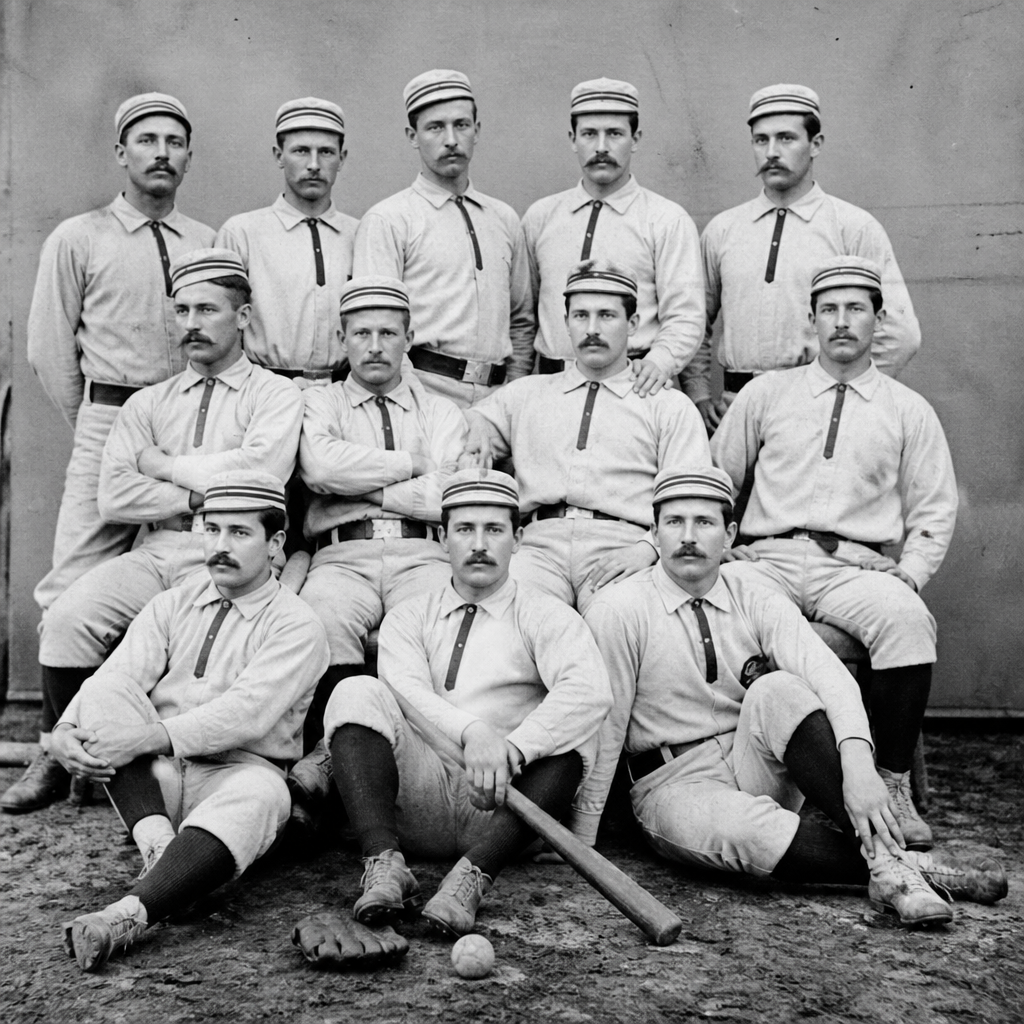
The Excelsior Base Ball Club of Brooklyn stands at the center of any serious account of amateur clubs and early competition because it showed how baseball could expand from a local pastime into a regional and then national spectacle. Founded in 1854, the club emerged during the formative era of organized base ball, when the New York game was still standardizing rules, clubs were largely self-governing associations, and competition depended as much on reputation and travel as on championships. In that setting, Excelsior became baseball’s first great touring team, carrying the game beyond Brooklyn and New York City through ambitious road trips that demonstrated how intercity contests could attract crowds, spread common playing practices, and elevate leading amateur nines into public institutions.
Understanding Excelsior requires a few key terms. An amateur club in the 1850s and 1860s was usually a member-run athletic society whose players were not openly salaried, even though prestige, employment favors, and under-the-table inducements increasingly shaped roster quality. Early competition referred not only to formal match games but also to club challenges, return fixtures, festival events, and high-profile excursions. The “New York game” was the rules code promoted by the Knickerbockers and later governed through the National Association of Base Ball Players, distinct from regional variants such as the Massachusetts Game and the Philadelphia town-ball tradition. Touring, in this context, meant something far more consequential than an ordinary away schedule. It involved organized travel by rail and steamer, civic receptions, newspaper coverage, and contests framed as tests of one city or region against another.
This matters because Excelsior helps explain how baseball moved from neighborhood recreation to a coordinated sporting culture. I have worked through nineteenth-century club records, period newspapers, and rule books often enough to know that many summaries flatten this period into a simple prelude to professionalism. That misses the point. Clubs such as Excelsior built the competitive habits, social rituals, and public expectations that made later leagues possible. Their tours proved that spectators would pay attention to teams from outside their own community; their scheduling practices created demand for recognized elites; and their style of play helped establish what a top club should look like. For a hub article on amateur clubs and early competition, Excelsior is the ideal anchor because its story touches governance, travel, media, rules, rivalry, celebrity, and the blurred line between amateur purity and competitive ambition.
Brooklyn, the New York Game, and the Rise of Organized Clubs
Excelsior did not appear in a vacuum. In the 1850s, Brooklyn was one of the strongest nurseries of organized base ball. Open land, a large population of clerks and craftsmen, and easy ferry access to Manhattan helped athletic clubs flourish. The Knickerbocker Base Ball Club had codified influential rules in 1845, but by the middle of the next decade, Brooklyn clubs were giving the game a wider social base and a more competitive edge. Excelsior, Atlantic, Eckford, and later Mutual all became major names because Brooklyn had both the density and ambition to sustain repeated high-level match play.
The rules environment mattered. The New York game used ninety-foot basepaths, foul territory, three-out innings, and the convention of retiring runners by force or tag rather than by plugging them with a thrown ball, unlike some older bat-and-ball forms. Match games were generally played to 21 aces in the 1850s before the sport shifted toward nine-inning contests in 1857. The National Association of Base Ball Players, founded that same year, became the first governing body for the sport, creating a framework for membership, rules revisions, and dispute resolution. Excelsior operated inside this world of evolving standardization, where club status depended on both adherence to common rules and success against respected opponents.
What made amateur clubs important was that they were social organizations as much as teams. Members elected officers, drafted constitutions, held dinners, and cultivated club identity through uniforms, badges, and public manners. Yet competition quickly sharpened standards. Better clubs practiced more systematically, recruited talented players, and sought notable fixtures to enhance their standing. Excelsior excelled at this transition from gentlemanly recreation to disciplined, visible competition. Its members understood that winning on the field and presenting themselves well off it reinforced each other. That combination made the club unusually effective in an era when reputation traveled through newspaper columns and word of mouth rather than standings pages alone.
Why Excelsior Became Baseball’s First Great Touring Team
Excelsior’s singular claim rests on its 1860 western tour, a journey that brought a leading Brooklyn club through Albany, Rochester, Buffalo, Cleveland, and other stops and is widely recognized as the first extended baseball tour by a major team. Earlier clubs had traveled for isolated matches, but Excelsior treated travel as strategy. The tour expanded the club’s fame, tested it against distant opponents, and showcased the New York game in places where local bat-and-ball traditions still competed for attention. Newspapers followed the expedition with unusual intensity because the team was not just seeking victories; it was representing metropolitan baseball itself.
Travel in 1860 was demanding. Rail connections were improving, but schedules were uneven, baggage cumbersome, and weather unpredictable. Organizing a tour required money, planning, and local contacts who could secure grounds, opponents, and accommodations. Excelsior managed those logistics in a way no previous club had matched. That competence is part of why historians describe it as baseball’s first great touring team rather than simply an early traveler. The club made distance competition routine enough to be imitable.
The tour also changed how people understood sporting hierarchy. When a famous Brooklyn nine arrived in a city, local clubs measured themselves against a recognized standard. Victories by Excelsior validated metropolitan supremacy; close games or local upsets generated enormous civic pride. Either outcome increased interest. In practical terms, touring encouraged standard rules adoption, improved local training, and tied baseball’s growth to transportation networks. This is one reason the club matters within the broader history of amateur clubs and early competition: Excelsior turned travel into a mechanism of national diffusion.
| Factor | What Excelsior Did | Why It Mattered |
|---|---|---|
| Long-distance scheduling | Arranged multi-city match sequences in 1860 | Created a repeatable model for intercity competition |
| Rules promotion | Played under the New York game code | Accelerated standardization across regions |
| Publicity | Generated detailed newspaper reporting | Expanded player and club fame beyond local circles |
| Civic reception | Accepted welcomes, banquets, and ceremonial hosting | Framed baseball clubs as representatives of their cities |
| Competitive benchmarking | Faced leading local nines on their grounds | Raised standards for practice, fielding, and strategy |
The Famous Players and Style of Play That Built the Club’s Reputation
No early club became prominent on logistics alone. Excelsior earned attention because it fielded outstanding players and played an advanced brand of baseball for its time. The best-known figure was Jim Creighton, the game’s first true superstar. Although Creighton became most famous with the Brooklyn Excelsiors and then in broader baseball mythology as a revolutionary pitcher and hitter, his significance is often misunderstood by modern readers. In the underhand pitching rules of the era, the pitcher was expected to initiate action rather than dominate. Creighton pushed those limits with speed, movement, and deception delivered within the letter, or near the edge, of contemporary legality. Observers saw a qualitative difference between ordinary hurling and his method.
Alongside Creighton, players such as Candy Cummings became associated with Excelsior’s strong baseball culture. Cummings later claimed credit for developing the curveball, a story historians debate in its precise details, but his presence underscores an important point: Excelsior attracted innovators. The club prized fielding reliability, tactical hitting, and coordinated team play at a time when many lesser nines still relied on raw enthusiasm. Match reports from the period often highlighted not only the score but also the sharpness of catching, the cleanliness of ground play, and the disciplined handling of pressure innings.
It is also worth noting how different the game looked. Bare hands were standard before widespread glove use. Balls were less lively and less uniform than modern baseballs. Pitchers delivered underhand. Fair-foul expectations, bound catches in some contexts, and evolving scoring conventions shaped tactics. Strong fielding therefore carried exceptional value, and clubs that could travel while maintaining crisp play stood out immediately. Excelsior’s renown came from doing difficult things consistently under variable conditions, against unfamiliar opposition, while under public scrutiny.
Excelsior Within Amateur Clubs and Early Competition
As a hub topic, amateur clubs and early competition must include more than one celebrated team, and Excelsior makes sense only when placed among its rivals and peers. The Atlantic Club of Brooklyn was the era’s other giant, particularly noted for its long winning streak and championship standing in the informal “champion club” culture before fixed leagues. Eckford of Brooklyn, Mutual of New York, and clubs in Philadelphia, Albany, and New England also mattered. Competition worked through challenge culture: a strong club issued or accepted invitations, played home-and-home series, and sought recognition in the sporting press. There was no modern season table to settle everything neatly.
This environment produced several defining features. First, prestige depended on who you beat, not just how often you won. A club could pad a record against weak opposition and gain little standing. Second, return matches were essential because travel was difficult and local conditions mattered. Third, clubs often blended sociability and seriousness. A match might be followed by speeches and a dinner, yet the contest itself could be intensely contested. Fourth, disputes over eligibility, rules interpretation, and scheduling were common because governance was still developing. The NABBP tried to regularize matters, but enforcement remained uneven.
Excelsior navigated this world exceptionally well. It pursued prominent opponents, traveled to prove itself, and capitalized on publicity without abandoning the club model that defined the amateur era. That is why it belongs at the center of this subtopic hub. From Excelsior, readers can branch to articles on Brooklyn rivals, the NABBP, Civil War baseball, early pitching evolution, and the transition from amateur to professional competition. The club connects all of those themes through lived example rather than abstraction.
Media Coverage, Civil War Context, and the Limits of Amateurism
Newspaper culture amplified Excelsior’s significance. In the absence of radio, film, or national league standings, sporting weeklies and city dailies constructed baseball’s public narrative. Editors printed challenge notices, match summaries, player praise, and commentary on rules controversies. A touring club generated ideal copy. Excelsior’s movements could be serialized across cities, giving readers a sense of ongoing drama. This helped create one of baseball’s earliest celebrity ecosystems, with named players and clubs recognized far from home.
The Civil War years complicated but did not erase this growth. Military camps spread familiarity with the New York game, while travel and normal club schedules faced disruption. Excelsior, like other leading clubs, existed within this unstable national context. The war accelerated baseball’s diffusion by bringing men from different states into repeated contact, but it also interrupted the continuity of elite amateur competition. After the war, the sport resumed with even greater geographic reach, and the foundations laid by prewar clubs became more visible.
By then, the ideal of amateurism was under strain. Top clubs denied professionalism in principle, yet talented players increasingly received inducements such as jobs, expenses, or disguised compensation. I always caution readers not to treat “amateur” as meaning economically pure. In practice, the best antebellum and immediate postwar clubs occupied a gray area. Excelsior is a perfect case study because its ambitions, travel costs, and roster quality reveal how serious competition pushed against the old voluntary model. The later open professionalism of the Cincinnati Red Stockings in 1869 did not come from nowhere; clubs like Excelsior had already shown the scale of organization required to sustain elite play.
Legacy: What Excelsior Changed in Baseball History
Excelsior’s lasting contribution was not a single rule or championship but a set of precedents. It proved that baseball clubs could be mobile ambassadors, that intercity matches could generate sustained public interest, and that common rules could spread through prestige as effectively as through formal decree. It also helped define the template for a major club: skilled players, disciplined organization, media awareness, and a willingness to seek the strongest available competition.
For anyone exploring early baseball, the main lesson is clear. Amateur clubs were not quaint side stories before “real” baseball began. They created the competitive map, institutional habits, and audience expectations that made later professional structures viable. Excelsior of Brooklyn stands out because it concentrated those developments in one highly visible example. If you are building a deeper understanding of the early history of baseball, start here, then follow the connections outward to Atlantic, Eckford, the NABBP, and the rise of postwar professionalism. The touring Excelsiors show exactly how a local club helped make baseball a national game.
Frequently Asked Questions
Why is the Excelsior Base Ball Club of Brooklyn considered such an important team in early baseball history?
The Excelsior Base Ball Club of Brooklyn is important because it helped transform base ball from a largely local, club-based pastime into a broader public attraction with regional and national significance. Founded in 1854, the club operated during a period when the sport was still taking shape. Rules were not yet universally fixed, governing structures were limited, and clubs built their standing through challenge matches, personal connections, and public reputation rather than through formal leagues or modern championship systems. In that setting, Excelsior became one of the clearest examples of how a well-organized club could influence the game beyond its home grounds.
What set Excelsior apart was not simply that it was strong on the field, but that it embraced visibility, travel, and competitive ambition at a time when those qualities could redefine a club’s place in the sporting world. The team showed that baseball could draw interest across city lines and state lines, attracting attention from newspapers, rival clubs, and spectators who saw these contests as more than casual recreation. Its prominence reflected the growing seriousness of amateur competition and the increasing importance of public contests in shaping the sport’s identity.
Excelsior also matters because it stood at the center of baseball’s formative culture. It belonged to the era when the “New York game” was spreading, when clubs served as social organizations as well as athletic ones, and when prestige came from proving oneself against respected opponents in multiple places. For historians, the club is significant not only for its record, but for what it represented: an early model of how baseball could expand, standardize, and capture wider public imagination.
What made the Excelsiors baseball’s first great touring team?
The Excelsiors are often described as baseball’s first great touring team because they demonstrated, in a highly visible way, that travel could be central to competitive baseball rather than incidental to it. In the sport’s earliest years, many clubs played close to home, and arranging matches outside one’s immediate area could be difficult. Travel required time, money, coordination, and a willingness to test a club’s reputation away from familiar surroundings. Excelsior embraced those challenges and helped establish the idea that a team could carry its name, style of play, and prestige into distant communities.
This was a major development in the 1850s and 1860s. Baseball was still evolving from a local recreational activity into a more organized and widely followed sport. By going on tour, the Excelsiors did more than seek victories. They introduced the New York style of play to new audiences, strengthened ties between clubs in different places, and created events that newspapers could treat as important sporting occasions. Their trips turned games into spectacles, encouraging civic pride among hosts and helping to build anticipation among spectators who wanted to see elite clubs in action.
The club’s touring reputation also reflected its confidence and stature. A touring team had to be disciplined, adaptable, and respected enough to attract worthy opposition. Excelsior met those conditions. Its journeys helped prove that baseball could sustain interest beyond neighborhood rivalries and that top-level clubs could serve as ambassadors for the game. In that sense, the Excelsiors were not merely travelers; they were pioneers in showing how baseball could grow through movement, publicity, and intercity competition.
How did the Excelsior Club help spread baseball beyond New York and Brooklyn?
The Excelsior Club helped spread baseball by carrying competitive play directly into places where the game was less established or still developing under local variations. During the mid-19th century, baseball did not expand simply because people read about it. It spread most effectively when influential clubs visited other cities, played prominent matches, and provided a living demonstration of how the game should be organized and played. Excelsior was especially important in this process because it combined strong performance with public visibility, making its visits meaningful sporting and cultural events.
When the club traveled, it exposed new audiences to the customs and structure of organized base ball as practiced by leading New York-area teams. That included not only playing techniques, but also matters such as club etiquette, match arrangements, and the competitive spirit associated with elite amateur organizations. Local clubs could measure themselves against a recognized power, and spectators could see firsthand why the New York game was gaining influence. These encounters helped normalize common rules and expectations, which was essential in an era before modern professional leagues created automatic uniformity.
Newspaper coverage amplified this effect. Reports of Excelsior matches reached readers well beyond the ballgrounds, turning individual games into part of a wider baseball conversation. A touring match could inspire local interest, encourage the formation or strengthening of clubs, and connect previously isolated baseball communities to a larger network of competition. In that way, Excelsior contributed to baseball’s expansion not just by winning games, but by helping knit together a broader sporting culture that could sustain growth across regions.
Was the Excelsior Club professional, or was it still part of baseball’s amateur era?
The Excelsior Club belonged to baseball’s amateur era, even though its conduct and influence sometimes resembled what later became associated with professional sport. In the 1850s and much of the 1860s, leading clubs generally described themselves as amateur associations. Players were not yet participating in a fully developed professional league system, and clubs were often organized around membership, social standing, and civic identity as much as pure commercial competition. Excelsior fit within that world.
At the same time, it is important not to mistake “amateur” for casual or insignificant. Top amateur clubs could be intensely competitive, highly organized, and deeply invested in building prestige. Excelsior’s touring activity, scheduling ambition, and public reputation show just how serious elite amateur baseball had become. These clubs cultivated excellence, drew crowds, and generated press attention, even if they did not operate under the openly professional structures that would emerge later. In fact, one reason the Excelsiors are so historically interesting is that they reveal how far the amateur game had already progressed before professionalism formally took hold.
In broader baseball history, teams like Excelsior occupy a transitional space. They belonged to a pre-professional culture, yet they helped create many of the conditions that made professional baseball possible: wider public interest, stronger intercity rivalries, the importance of travel, and the expectation that top clubs should meet strong opposition wherever it could be found. So while the Excelsior Club was fundamentally an amateur club, its example pushed the game closer to the larger, more organized, more commercially visible sport it would soon become.
Why does the Excelsior Club still matter when discussing the origins of modern baseball?
The Excelsior Club still matters because modern baseball did not emerge all at once through a single rule change, league founding, or famous championship. It developed through a series of cultural and organizational shifts, and Excelsior sits at the heart of several of them. The club’s story helps explain how baseball moved from small-scale local recreation to a sport with regional followings, established reputations, and expanding public appeal. If you want to understand how baseball became important in American life, Excelsior provides a particularly useful case study.
Its continuing relevance comes from the fact that it illustrates the mechanics of early baseball growth. The club shows how strong amateur organizations built influence before the age of major leagues, how travel created new markets for the game, and how newspapers helped turn prominent matches into public events. It also demonstrates that early baseball was shaped by clubs that served as both competitors and institutions, representing neighborhoods, cities, and evolving ideas about organized sport. In that environment, Excelsior was not a footnote. It was one of the clubs helping define what prominence in baseball looked like.
For modern readers, the Excelsiors also offer a reminder that baseball’s national reach was earned, not assumed. The sport had to be carried, exhibited, standardized, and popularized. Teams like Excelsior did that work. Their efforts made it easier for later generations to imagine baseball as a truly national game. That is why the club remains central to serious discussions of early competition, amateur club culture, and the origins of baseball’s rise as a major American spectacle.