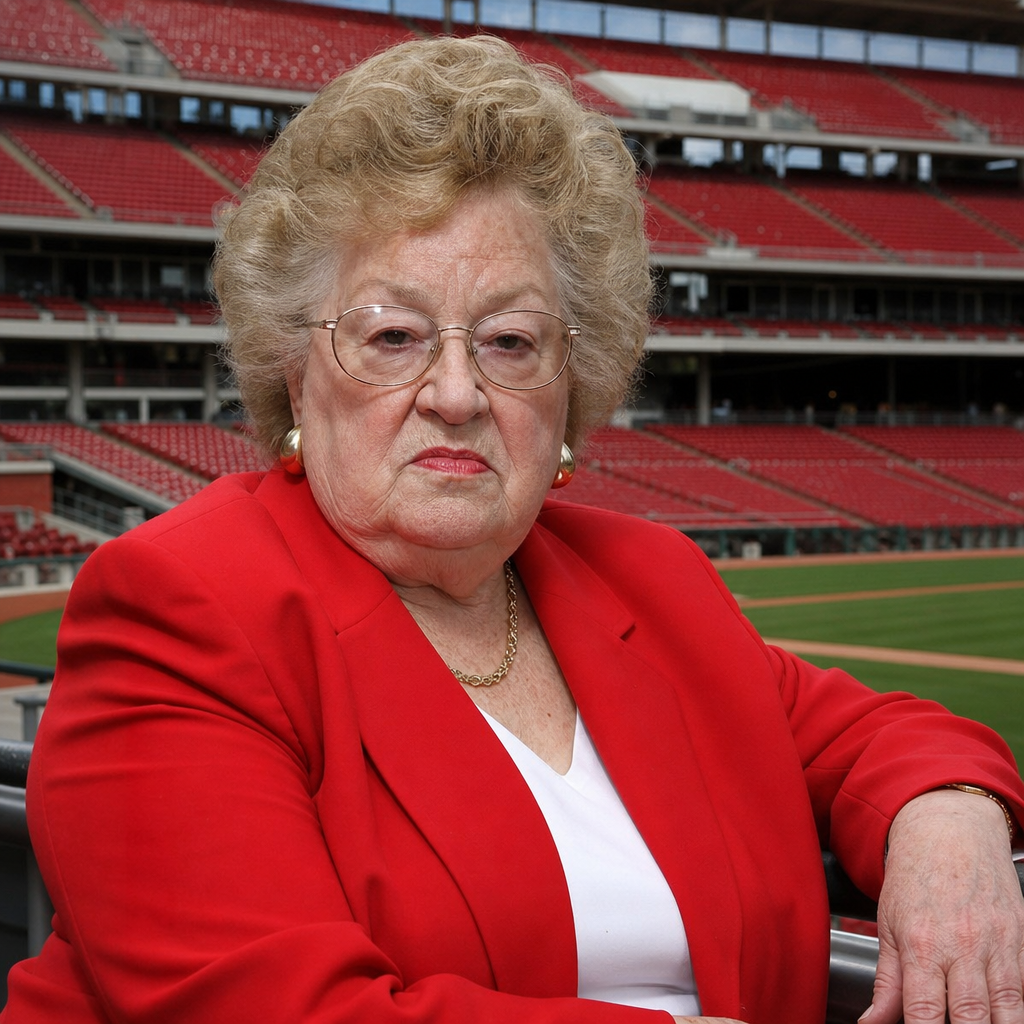
The Marge Schott controversy remains one of the clearest examples of how racism, public speech, and sports ownership can collide in ways that damage a franchise for years. In Major League Baseball, an owner is not just an investor with a title; that person is a public representative of the club, a steward of league standards, and a powerful voice in civic culture. When an owner repeatedly uses racist language, praises dictators, or makes derogatory comments about minorities, the issue moves far beyond personal opinion. It becomes a governance problem, a business problem, and a moral test for the sport itself.
Marge Schott, longtime owner and managing general partner of the Cincinnati Reds, became nationally notorious during the 1990s for a series of remarks and behaviors that many players, fans, sponsors, journalists, and league officials viewed as openly racist, antisemitic, and otherwise bigoted. Her controversy did not emerge from a single isolated mistake. It developed through repeated comments, mounting media scrutiny, internal embarrassment for the Reds organization, and increasing pressure on Major League Baseball to define the limits of acceptable conduct for team owners. That pattern matters because it shows how institutional tolerance can prolong harm when decisive accountability is delayed.
This article serves as a hub for the broader miscellaneous scandals and controversies connected to sports power, public figures, and ownership culture. Within that larger topic, the Schott case is essential because it touches multiple themes at once: racism in leadership, league discipline, reputation risk, labor relations, and the gap between competitive success on the field and ethical failure off it. In practical terms, it also helps explain why modern leagues place greater emphasis on conduct policies, commissioner authority, sponsor sensitivity, and the public responsibilities attached to ownership.
To understand the Marge Schott controversy fully, it helps to define the central issue clearly. Racism in this context was not merely an accusation used loosely in a political argument. It referred to repeated derogatory statements about Black people and other groups, language that reinforced prejudice, and conduct that undermined the inclusiveness a professional sports league depends on. Ownership, meanwhile, meant more than legal control of the Reds. It meant influence over hiring, culture, branding, player trust, and the club’s standing in Cincinnati and across baseball.
Who Marge Schott Was and Why Her Position Carried So Much Weight
Marge Schott became a prominent figure in Cincinnati through her business wealth and eventually her role with the Reds, one of baseball’s oldest and most visible franchises. She gained majority control in the 1980s and became known for an unusually hands-on style. People around baseball often described her as highly visible, outspoken, frugal, and intensely involved in daily operations. That visibility amplified every public statement she made. A team owner can shape clubhouse confidence, front-office credibility, media narratives, and civic identity, especially in a market where the baseball club carries deep historical significance.
Her tenure was not defined only by controversy. The Reds won the 1990 World Series under her ownership, and some supporters argued that she cared deeply about the team and the city. That is part of why the scandal became so consequential. Schott was not a distant owner rarely seen in public. She was central to the franchise’s image. I have worked with crisis case studies in sports governance long enough to know that when the face of the organization is also the source of repeated offense, communications fixes rarely work. The reputational damage becomes structural, not episodic.
Owners also occupy a different category from players or coaches because they are not easily traded, benched, or fired by ordinary internal processes. Removing or restricting an owner requires league-level action, shareholder pressure, or a sale. That makes ownership controversies especially important in any scandals and controversies hub. They reveal how power operates when the person causing the damage sits at the top of the hierarchy. In Schott’s case, the question was not simply whether comments were offensive. The question was whether Major League Baseball had both the authority and the willingness to confront a successful, high-profile owner whose conduct violated the league’s public values.
The Statements and Behavior That Drove the Marge Schott Controversy
The controversy centered on repeated reports that Schott used racial and ethnic slurs, made derogatory comments about Black people, Jews, and other groups, and expressed admiration for Adolf Hitler in terms that horrified observers. One widely cited issue involved accounts that she used the N-word when discussing Black people. Another involved antisemitic remarks and comments that minimized the significance of Hitler’s crimes by complimenting superficial traits such as organizational ability before acknowledging mass murder. In public life, that kind of framing is not a verbal slip. It signals either indifference to historical atrocity or a profound failure of judgment, and often both.
These reports gained traction because they were not random rumors detached from established journalism. Major newspapers, national broadcasters, and baseball writers documented allegations from multiple sources over time. The cumulative weight of those reports made the controversy impossible for MLB to ignore. In ownership scandals, patterns matter more than single headlines. When different people in different settings describe similar conduct, leagues begin to assess not only truthfulness but exposure: legal exposure, sponsor exposure, labor exposure, and public-trust exposure.
Her defenders sometimes claimed she was old-fashioned, blunt, or misunderstood. That defense failed because the issue was repetition and substance, not style. A pattern of racist and antisemitic statements cannot be neutralized by calling someone eccentric. In fact, that kind of excuse often deepens the controversy by suggesting that wealth, age, or local popularity should shield powerful figures from standards that apply to everyone else in the workplace. For players and staff from marginalized backgrounds, such excuses communicate something stark: your dignity is negotiable if the offender signs the checks.
Another factor was Schott’s habit of making herself part of the story. Owners who create controversy but remain largely invisible sometimes give leagues room to isolate incidents. Schott’s public profile made that impossible. Her comments were not detached from the Cincinnati Reds brand; they became entwined with it. Every offensive quote raised the same practical question for baseball: how can the league market itself as national, diverse, and family-oriented while one of its most visible owners keeps generating headlines tied to racism and intolerance?
How Major League Baseball Responded and Why the Discipline Mattered
Major League Baseball eventually acted, and that response is one reason the Schott case still matters in discussions of sports governance. In 1993, after growing criticism over her remarks, Schott agreed to step back from day-to-day operations for a period. Later, in 1996, MLB took stronger action by suspending her for two years and imposing a substantial fine after additional reports about her comments. The league also barred her from managing the Reds during that time. Those measures reflected a critical principle: owners can be disciplined when their conduct harms the integrity and reputation of the sport.
Commissioner authority in baseball has long rested partly on the broad concept of acting in the best interests of the game. That standard can seem vague until a case like Schott’s makes it concrete. The league was not punishing a bad trade, a payroll dispute, or abrasive negotiation tactics. It was responding to conduct that undermined player confidence, offended broad segments of the public, and tarnished the sport’s legitimacy. In governance terms, the league recognized that racist behavior from ownership is not private noise. It is a direct threat to institutional credibility.
| Year | Event | Why It Mattered |
|---|---|---|
| 1984 | Schott gains control of the Reds ownership group | Places a highly visible, hands-on owner at the center of a historic MLB franchise |
| 1990 | Reds win the World Series | Shows competitive success did not erase governance and conduct concerns |
| 1993 | Initial step-back agreement after controversy | Signals MLB pressure without fully resolving the underlying problem |
| 1996 | Two-year suspension and fine by MLB | Establishes meaningful discipline for owner misconduct tied to racist remarks |
| 1999 | Sale of controlling interest in the Reds | Marks the practical end of her power over the franchise |
The discipline also exposed a limitation familiar in many leagues: action often came only after repeated incidents and sustained public pressure. From a modern crisis-management perspective, that delay is as important as the sanction itself. When leaders wait too long, they communicate that standards are negotiable until reputational cost becomes unbearable. Even so, MLB’s eventual penalties created an important precedent. They demonstrated that ownership rights are powerful but not absolute, and that leagues can intervene when conduct crosses clear ethical and reputational lines.
Impact on Players, Fans, Sponsors, and the Cincinnati Reds Brand
The human impact of the Marge Schott controversy extended beyond headlines. For players, especially Black players and other minorities, an owner’s racist language can erode trust at the most basic level. Professional athletes depend on management for contracts, medical support, travel standards, promotion, and workplace respect. If the owner appears hostile or dismissive toward entire groups of people, players naturally question whether decisions will be fair. Even when discrimination is not proven in a specific transaction, the environment becomes contaminated by doubt.
Fans were also forced into a conflict common in sports scandals: loyalty to the team versus rejection of the leader. Many Cincinnati fans loved the Reds, their history, and the 1990 championship club, yet felt embarrassed by Schott’s statements. That tension can weaken long-term brand health because it turns fandom into a moral compromise. A baseball team is supposed to function as a civic unifier. When ownership becomes a symbol of exclusion, the franchise stops feeling like a shared public institution and starts feeling like a contested platform.
Sponsors and business partners watch these situations closely because association risk is measurable. Companies do not want their advertising to appear next to stories about racism, antisemitism, or praise for dictators. In my experience reviewing sports reputation cases, sponsors rarely need perfect certainty before they grow cautious. They respond to the direction of risk. Once a controversy becomes persistent, every activation, premium seating deal, and community event carries downside. That pressure can be more persuasive than public criticism alone because it strikes at revenue, not just image.
For the Reds organization, the scandal overshadowed baseball operations and complicated every effort to project professionalism. Front-office staff had to answer for behavior they did not create. Players fielded questions unrelated to performance. Community outreach lost credibility when the top figure associated with the club kept generating offensive remarks. This is why ownership controversy belongs at the center of any miscellaneous scandals and controversies hub article: it shows how ethical failure at the top cascades through every level of an organization, from ticket sales to clubhouse morale to national media framing.
Legacy, Historical Context, and Lessons for Modern Sports Ownership
Marge Schott eventually sold her controlling interest in the Reds in 1999, effectively ending her formal command of the franchise. By then, her name had become shorthand for a type of ownership scandal in which personal prejudice collides with league authority. Her legacy in baseball is therefore deeply divided. She is remembered not simply as a championship owner, but as a cautionary case about what happens when wealth, visibility, and weak self-restraint combine in a public institution that depends on diverse participation.
Historically, the Schott controversy sits in a larger arc of baseball’s struggle with race. MLB had already lived through segregation, the integration battles surrounding Jackie Robinson, and decades of uneven progress in front offices and ownership circles. Against that background, Schott’s comments were not trivial because they echoed attitudes baseball had spent generations trying to outgrow. That historical context explains why the backlash was so intense. Her words sounded less like isolated eccentricity and more like a reminder that old prejudices still occupied positions of power.
Modern leagues have drawn practical lessons from cases like this. Conduct expectations for owners are now discussed more explicitly. Commissioners understand that silence can be interpreted as tolerance. Crisis-response plans rely on faster fact gathering, clearer public statements, and defined penalties. Teams also invest more in workplace training, media protocols, and stakeholder communication. None of those steps eliminates prejudice, but they reduce the chance that repeated misconduct will be dismissed as personality. Standards work best when they are written, enforced, and applied before a crisis reaches the point of institutional embarrassment.
The key takeaway is straightforward. The Marge Schott controversy was not merely about one owner saying offensive things. It was about whether a major sports league would hold one of its most powerful insiders accountable for racism and related bigotry. MLB eventually acted, but only after the damage was extensive and public confidence had been badly strained. For readers exploring scandals and controversies more broadly, this case offers a durable lesson: when prejudice comes from the top, the real test is not whether outrage appears, but whether institutions respond with meaningful consequences. Use that lens as you explore related cases across the wider hub.
Frequently Asked Questions
Why was the Marge Schott controversy considered such a major issue in Major League Baseball?
The Marge Schott controversy became a major issue because it was not limited to a single careless remark or isolated misunderstanding. It involved repeated reports of racist language, derogatory comments about minorities, and public statements that many people viewed as deeply offensive and incompatible with the responsibilities of a team owner. In Major League Baseball, an owner is more than a financial backer. That person represents the franchise in public, influences organizational culture, and reflects on the league as a whole. When an owner engages in speech that is racist or openly discriminatory, the damage extends beyond personal reputation and begins to affect players, staff, fans, sponsors, and the broader civic identity of the club.
What made the controversy especially significant was the visibility of Schott’s position. As owner of the Cincinnati Reds, she was one of the most recognizable figures associated with the team. Her words carried institutional weight. That meant the issue was not just whether her comments were offensive in a personal sense, but whether MLB could tolerate that kind of conduct from someone entrusted with one of its franchises. The controversy forced baseball to confront a difficult question: how much personal misconduct by an owner becomes a league-wide problem? In Schott’s case, the answer became clear when the ongoing backlash, investigations, and disciplinary actions showed that her conduct threatened the league’s standards, public image, and credibility.
What kinds of comments and behavior fueled the backlash against Marge Schott?
The backlash against Marge Schott was driven by a pattern of reported conduct that included racist remarks, derogatory comments about African Americans, Jews, and other minority groups, as well as statements seen as sympathetic to Adolf Hitler. The controversy escalated because these were not perceived as accidental slips followed by meaningful accountability. Instead, they appeared to many observers as part of a broader pattern of prejudice and insensitivity. That pattern made it harder for the public, the media, and league officials to view the incidents as minor or forgivable public relations mistakes.
Another key factor was the broader meaning of those remarks in the context of professional sports. Baseball clubhouses are diverse workplaces, and MLB markets itself to a broad, multicultural audience. When an owner makes comments that demean or marginalize entire groups of people, it creates an atmosphere that can alienate players and employees who are directly affected. It also sends a message to fans that exclusion or bigotry may be tolerated at the highest level of the organization. The backlash was fueled not only by what Schott said, but by what those comments symbolized: a failure of leadership, a lack of respect for the people who make the sport possible, and a refusal to meet the social responsibilities that come with ownership.
How did Major League Baseball respond to the Marge Schott controversy?
Major League Baseball responded by investigating the controversy and imposing disciplinary action, including suspensions that limited Schott’s role in running the Cincinnati Reds. These steps were significant because leagues have historically been cautious when dealing with owners, who hold powerful financial and institutional positions. By disciplining Schott, MLB signaled that ownership did not provide immunity from scrutiny when conduct threatened the integrity of the sport or undermined public trust.
The league’s response also illustrated the limits and tensions of sports governance. MLB could punish and isolate an owner to some extent, but removing an owner entirely is far more complicated than disciplining a player, manager, or executive. Ownership rights, league rules, and internal politics all make that process difficult. Even so, the penalties imposed in Schott’s case were a public acknowledgment that her behavior had crossed a line. The controversy became an important example of how sports leagues attempt to balance business interests with ethical standards. It also demonstrated that when a public figure at the top of a franchise repeatedly violates those standards, the league may be forced to act not just to protect its image, but to preserve confidence in its leadership structure.
Why does the Marge Schott controversy still matter when discussing racism and sports ownership today?
The Marge Schott controversy still matters because it remains a clear case study in how racism from ownership can affect every level of a sports organization. It shows that discriminatory speech from the top is never just a personal matter. Owners shape workplace culture, influence hiring and leadership norms, and define how a franchise is perceived in its city and across the league. When an owner uses racist language or praises authoritarian figures associated with hatred and violence, the consequences can be long-lasting, even if the comments were made years ago.
The case also remains relevant because modern sports continue to wrestle with questions about accountability, power, and public responsibility. Fans and commentators still ask whether leagues are willing to hold powerful owners to the same standards they expect from players and coaches. Schott’s story is often referenced because it highlights the gap that can exist between formal punishment and deeper institutional change. It reminds people that reputational damage can linger far beyond the original scandal, affecting how a franchise is remembered and how a league defines its moral boundaries. In that sense, the controversy is not simply a historical episode. It is part of an ongoing conversation about who gets to lead major sports institutions and what standards of conduct should come with that privilege.
What lessons did the Cincinnati Reds and Major League Baseball learn from the Marge Schott controversy?
One of the biggest lessons from the Marge Schott controversy is that leadership credibility is inseparable from public conduct. A successful franchise cannot fully separate business operations from the words and behavior of its owner, especially when those words are racist or demeaning. For the Cincinnati Reds, the controversy showed how quickly off-field leadership failures can overshadow on-field achievements and stain the identity of a historic team. Even loyal fan bases can become divided when ownership becomes a source of embarrassment, anger, or distrust.
For Major League Baseball, the lesson was broader and more structural. The league was reminded that its reputation depends not only on the game itself, but also on the conduct of the people who control its franchises. Schott’s case underscored the need for clearer expectations about owner behavior, stronger mechanisms for accountability, and a deeper understanding that public speech by powerful figures can inflict real institutional harm. It also reinforced an important truth about sports as a civic force: teams are not ordinary businesses. They hold symbolic importance in their communities, and their leaders are judged accordingly. The long-term lesson is that racism at the ownership level is not just a controversy to be managed. It is a threat to trust, inclusion, and the legitimacy of the sport’s leadership.