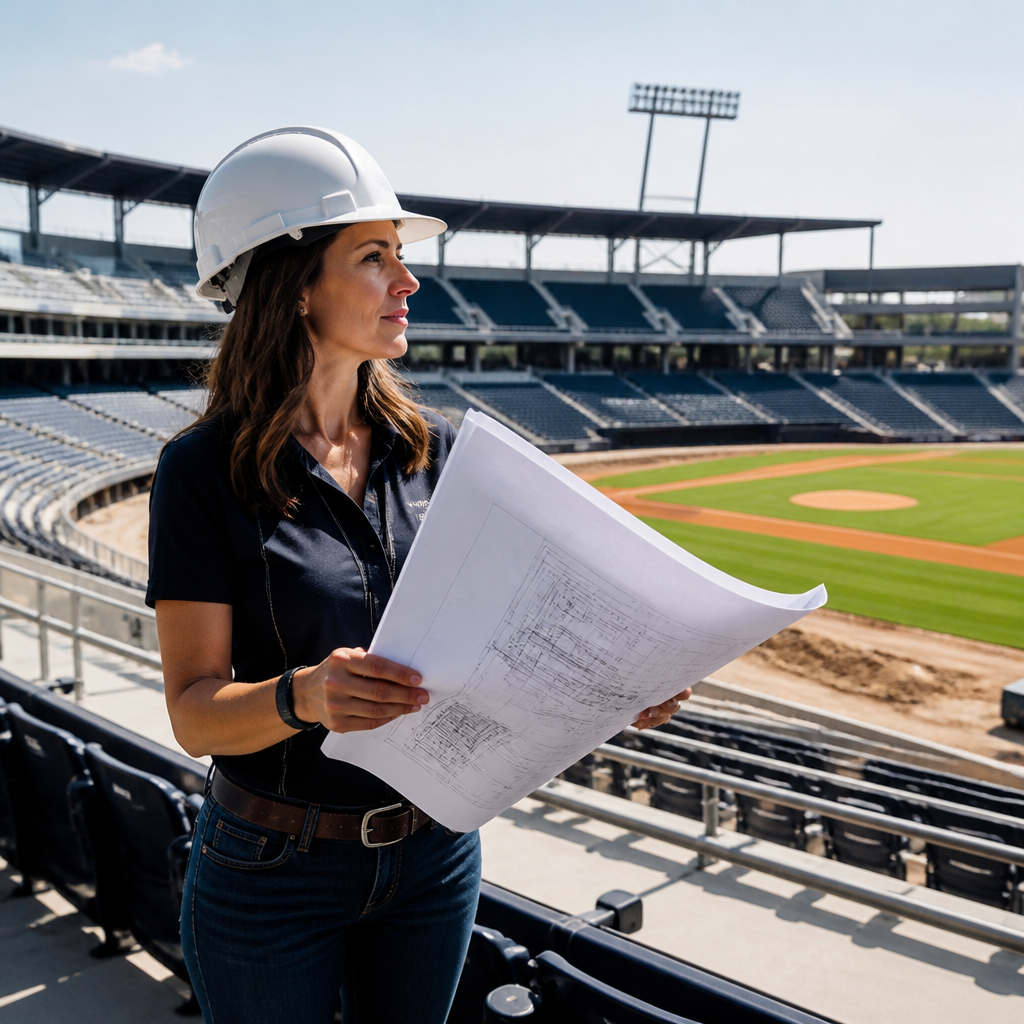
Breaking Ground: Women’s roles in baseball stadium design have moved from the margins to the center of how modern ballparks are conceived, built, and experienced. Stadium design includes architecture, structural engineering, landscape planning, accessibility strategy, fan circulation, lighting, branding, operations, and the many behind-the-scenes decisions that shape game day. For decades, baseball facilities were publicly associated with male owners, male architects, and male construction leaders, even though women contributed as planners, project managers, interior designers, code specialists, historians, and community advocates. Today, that incomplete story is being corrected as more women lead major stadium projects and influence what counts as a successful ballpark.
This matters because a stadium is never just a sports venue. It is civic infrastructure, a transportation node, a hospitality environment, a workplace, a broadcast set, and a public symbol. When women shape those spaces, the results often show a broader understanding of user needs: safer circulation routes, more inclusive restrooms, stronger family amenities, better sightline planning, and a closer fit between neighborhood identity and building form. In my work reviewing sports venues and project briefs, I have seen that the best baseball design teams ask practical questions early: Who moves through the building, where do queues form, how do parents manage children and concessions, what does accessibility mean beyond minimum code, and how will this place feel on a non-game day? Those questions improve projects, and women have been central to asking and answering them.
Baseball stadium design also sits at the intersection of preservation and reinvention. Some projects restore century-old parks under strict landmark rules; others create new mixed-use districts with retail, housing, and transit links. Women working in this space have influenced both approaches. They have led renovation programs that respect historic fabric while upgrading life safety systems, and they have directed new builds that treat sustainability, urban integration, and fan comfort as baseline requirements rather than premium features. Understanding their roles gives readers a clearer picture of how baseball evolves physically and culturally.
As a hub for this part of the women in baseball conversation, this article covers the full landscape: historical barriers, the disciplines involved in stadium creation, notable women and firms, fan-centered design changes, technology, community impact, and where the field is headed. If you want to understand why the next generation of ballparks looks different from the last, start with the people reshaping the blueprint.
How Women Entered and Reshaped Baseball Stadium Design
Women did not begin influencing baseball stadium design only when their names started appearing on project press releases. Their work was often present earlier in less visible roles, especially in interior architecture, planning coordination, code review, and public-sector development. In the mid to late twentieth century, sports architecture was a narrow specialty dominated by a small network of established firms. Entry depended on access to apprenticeships, engineering pipelines, and construction management tracks that were historically less open to women. That limited who could become lead designer or principal-in-charge, even when women were doing essential technical work.
The shift became more visible as architecture schools, engineering programs, and project management pathways diversified. Large firms such as Populous, HOK, Gensler, AECOM, and Perkins&Will expanded multidisciplinary teams, which created more opportunities for women to lead complex venue projects. Baseball stadiums increasingly required expertise beyond the classic architect-engineer pair. Teams needed specialists in acoustics, hospitality, signage, food service design, security planning, digital infrastructure, and universal accessibility. As the project model broadened, women moved into leadership positions across the full delivery process.
A practical example is the rise of renovation-heavy stadium work. Upgrading an active ballpark is operationally harder than designing on a blank site because construction must phase around seasons, broadcasts, team logistics, and existing structural conditions. Women have led these coordination-intensive efforts because success depends on communication discipline, stakeholder management, and rigorous sequencing as much as signature sketches. That leadership has helped normalize the idea that authority in stadium design comes from execution, not only authorship.
The Core Roles Women Hold on Stadium Projects
Baseball stadium design is a team sport. A single project can involve hundreds of specialists, and women now serve in many of the decision-making roles that define the final result. Lead architects establish concept, massing, sightlines, facade language, and spatial hierarchy. Structural engineers solve long-span roof systems, raker beams, seismic loads, and vibration control. Landscape architects design plazas, entry sequences, stormwater features, and neighborhood edges. Interior designers shape clubs, suites, concourses, retail zones, and premium hospitality spaces. Project managers coordinate budget, schedule, procurement, and contractor alignment.
Women are also prominent in less publicized but highly influential functions. Accessibility consultants review circulation, seating dispersion, companion seating, counters, elevators, hearing assistance, and wayfinding against the Americans with Disabilities Act and best practices that go beyond the minimum legal threshold. Code specialists handle egress capacity, occupancy loads, fire separations, and emergency planning. Environmental designers address daylight, material health, energy systems, water performance, and maintenance durability. Community engagement leaders manage meetings with residents, disability advocates, transit agencies, preservation boards, and business groups whose input can change a project substantially.
On baseball projects, these roles interact constantly. A parent room placed too far from family seating affects circulation and concession revenue. A premium club with poor acoustic separation undermines hospitality value. A beautiful outfield plaza without shade can fail in hot weather. In projects I have assessed, the women leading these workstreams often bring a systems view that keeps fan experience, operations, and neighborhood impact connected rather than treated as separate checklists.
| Role | Primary Responsibility | Baseball-Specific Example |
|---|---|---|
| Lead Architect | Overall design concept and stadium layout | Sets bowl geometry to protect sightlines from lower and upper decks |
| Project Manager | Schedule, budget, stakeholder coordination | Phases off-season concourse renovations between homestands |
| Accessibility Specialist | Inclusive seating and circulation strategy | Distributes wheelchair seating across price levels and view types |
| Interior Designer | Hospitality, clubs, suites, public finishes | Creates durable, easy-clean concession areas with local identity |
| Landscape Architect | Plazas, open space, stormwater, arrival experience | Designs shaded entry zones for summer queue comfort |
| Structural Engineer | Long spans, loading, resilience, retrofit design | Strengthens existing stands without closing the full season |
Design Priorities Women Have Helped Bring Forward
It is too simplistic to claim that women design one way and men another. Good stadium design comes from strong teams, evidence, and clear goals. Still, many women leaders in sports architecture have pushed priorities that were once undervalued in baseball facilities. One is holistic accessibility. Older ballparks often met minimum standards late and unevenly, with limited accessible seating locations and poor route clarity. Contemporary women-led teams have treated accessibility as an organizing principle, improving not only compliance but dignity and convenience.
Another priority is fan comfort across demographics. That includes nursing rooms, family restrooms, stroller-friendly circulation, intuitive wayfinding, better lighting in parking and approach paths, and seating areas that account for heat, wind, and sun exposure. These are not cosmetic touches. They affect attendance behavior, concession spending, and whether a venue feels welcoming to occasional fans as well as season-ticket holders. Research across sports venue operations consistently shows that friction points outside the game itself influence return visits.
Women have also advanced the integration of local culture into stadium design. Instead of generic concourses and interchangeable premium spaces, many recent projects use neighborhood materials, regional food programs, historical exhibits, and public art strategies that connect baseball to place. That approach matters in hub planning because a stadium increasingly functions all year, not only on game days. When the venue includes plazas, museums, retail, or event spaces, design choices can support broader civic use and stronger community buy-in.
Notable Women, Firms, and Project Pathways
Any serious discussion of women in baseball stadium design should recognize both individuals and the collaborative firms where they work. Janet Marie Smith is one of the most influential figures connected to baseball venue development, known for leadership roles tied to Camden Yards, Fenway Park renovations, Dodger Stadium improvements, and other landmark projects. Her importance lies not in drafting every detail personally but in shaping the strategic vision of how ballparks honor history, improve operations, and deepen fan connection. She helped prove that baseball facilities could reject the anonymous multiuse concrete model and return to urban character, asymmetry, and memory.
Beyond prominent executives, women architects and designers inside major sports firms have led programming, interiors, planning, sustainability, and delivery for professional venues. Firms such as Populous and HOK have long handled MLB projects, and their baseball work depends on multidisciplinary leaders, many of them women, who manage design packages, client presentations, consultant integration, and construction administration. In practice, the project pathway might begin with market analysis and venue benchmarking, move through schematic design and fan journey mapping, then continue into BIM coordination, mock-ups, procurement, and post-occupancy adjustments. Women are active at every step.
It is also important to include women working outside headline MLB assignments. Minor league parks, spring training complexes, collegiate baseball facilities, and municipal fields often serve as innovation labs. These projects test flexible seating bowls, community-use fields, event lawns, children’s zones, and cost-efficient material systems. Because budgets are tighter, they reward designers who can solve many problems at once. Women leading these projects frequently build the experience that later carries into major league work.
Historic Preservation, Renovation, and the Modern Ballpark
Preserving baseball history while meeting modern expectations is one of the hardest assignments in stadium design. Older parks carry sentimental value, landmark protections, and severe physical constraints. Seats may be undersized, concourses narrow, back-of-house systems obsolete, and vertical circulation inadequate. Women have played a major role in renovation strategies that balance authenticity with safety and revenue needs. This work requires negotiation among team ownership, preservation agencies, contractors, accessibility reviewers, and fans who fear change.
Fenway Park is the clearest example of why renovation leadership matters. Incremental improvements over many years have added wider concourses in key zones, new social spaces, structural upgrades, and improved premium offerings while protecting the park’s identity. Similar tensions appear anywhere teams modernize legacy venues. The challenge is not just technical. Designers must decide what the public experiences as “historic.” Is it the brick facade, the seating rake, the sightline to the field, or the irregular geometry that makes a park memorable? Women working in this area have often excelled because they combine archival respect with operational realism.
Modernization can also include sustainable retrofits. LED sports lighting reduces energy use and improves broadcast consistency. Low-flow fixtures cut water demand. Better envelope performance in enclosed areas lowers operational costs. Native planting and permeable paving improve stormwater management in exterior zones. These measures are increasingly standard because venues face public pressure to justify their environmental footprint, especially when public funding supports construction or upgrades.
Community Impact, Safety, and the Future Pipeline
Baseball stadiums influence more than fans. They affect traffic patterns, local business revenue, public space, property values, and neighborhood identity. Women leading design and planning efforts have been especially effective in community-facing processes because successful projects depend on listening before drawing. Residents want to know about noise, light spill, parking overflow, public transit, job access, and whether new development will serve locals year-round. Good stadium teams respond with measurable commitments: traffic studies, pedestrian improvements, local vendor programs, community meeting records, and event-day operations plans.
Safety is another area where women have shaped better design outcomes. Contemporary ballparks now pay closer attention to lighting uniformity, camera coverage, intuitive exits, crowd flow modeling, and the separation of service traffic from public circulation. Expanded netting in professional baseball illustrates how venue change often follows fan-safety concerns that designers and operators must address quickly. The best teams treat safety as part of comfort and trust, not a hidden technical layer.
Looking ahead, the pipeline matters as much as current leadership. More women are entering architecture, engineering, construction management, and sports business, but advancement still depends on mentorship, sponsorship, and visible credit for project work. Baseball organizations can help by highlighting women in development roles, funding internships tied to venue design, and partnering with universities on sports facility studios. Readers exploring this subtopic should follow the women shaping planning, preservation, accessibility, and operations, because stadium design is one of the clearest places where inclusion becomes tangible. When more women break ground, baseball gains better buildings, stronger communities, and a fuller sense of who belongs in the game. Explore the connected stories in this hub and use them to see every ballpark with sharper eyes.
Frequently Asked Questions
1. How have women influenced baseball stadium design in recent decades?
Women have become central contributors to nearly every phase of baseball stadium design, helping redefine what a modern ballpark should do, how it should feel, and whom it should serve. In earlier eras, public recognition in stadium development tended to focus on male owners, lead architects, and construction executives. But behind that limited narrative, and increasingly in visible leadership roles, women have shaped core decisions involving architecture, structural systems, interior planning, accessibility, public space design, branding, operations, and long-term fan experience strategy.
One of the most important changes has been the expansion of stadium design itself. A ballpark is no longer understood as just a field with seating. It is a complex civic and entertainment environment that must function as a sports venue, public gathering space, transportation hub, hospitality destination, and community landmark. Women working as architects, engineers, project managers, planners, landscape designers, accessibility specialists, and operations leaders have helped push that broader view. Their influence is often seen in designs that prioritize smoother circulation, clearer wayfinding, better connections between concourses and seating areas, more inclusive amenities, improved sightlines, stronger neighborhood integration, and more flexible spaces that can support events beyond baseball.
Women have also helped shift attention toward the lived experience of everyone who uses the stadium, not just premium-ticket holders or broadcast audiences. That includes considering how families move through the venue, how people with disabilities navigate entrances and seating, how staff operate efficiently behind the scenes, how lighting affects safety and atmosphere, and how outdoor areas can create a stronger sense of place. In that sense, women’s growing role in baseball stadium design has not been symbolic. It has been practical, strategic, and deeply influential in moving ballparks from traditional facilities toward more inclusive, high-performing, and community-oriented environments.
2. What kinds of roles do women hold in baseball stadium design and development?
Women work across the full spectrum of baseball stadium design and development, from early concept formation to post-opening operations. On the design side, women serve as architects who shape the overall vision of the ballpark, interior designers who define how lounges, suites, clubs, restrooms, and public areas function, and landscape architects who design plazas, green spaces, and exterior gathering zones. In engineering, women contribute as structural, civil, mechanical, electrical, and lighting specialists, helping ensure that the stadium is safe, efficient, sustainable, and capable of handling major crowds and complex event demands.
They also hold leadership roles in planning and delivery. Women may work as project managers, construction administrators, owner’s representatives, cost consultants, code specialists, and urban planners. These roles are critical because they connect the creative vision to practical execution. They involve coordinating teams, managing schedules, balancing budgets, navigating permits, and solving design challenges that emerge during construction. In large stadium projects, these responsibilities can influence everything from material choices and entry sequencing to premium hospitality layouts and back-of-house logistics.
Beyond design and construction, women are deeply involved in the operational and experiential side of ballparks. They help develop accessibility strategy, crowd flow planning, fan engagement programs, concession layouts, retail planning, security coordination, and branding systems. Their work may affect where family zones are placed, how concession lines are organized, how signage supports intuitive movement, and how service areas function during peak attendance. In other words, women are not limited to a single niche within stadium development. They are active in the technical, creative, managerial, and operational decisions that determine whether a baseball stadium performs well on opening day and continues to serve fans effectively for decades.
3. Why does women’s participation matter in the design of modern baseball stadiums?
Women’s participation matters because baseball stadiums are public spaces used by highly diverse audiences, and better representation within the design process often leads to more responsive, inclusive, and thoughtful outcomes. A successful ballpark must work for longtime fans, first-time visitors, families with children, older adults, people with disabilities, hospitality guests, event staff, vendors, athletes, media teams, and surrounding neighborhoods. When more women are involved in decision-making, the design conversation is often broadened in useful ways, bringing greater attention to experience, comfort, accessibility, flexibility, and real-world usability.
This matters on both a functional and cultural level. Functionally, diverse design leadership can improve how the stadium handles circulation, safety, amenities, restroom planning, stroller access, sensory considerations, multiuse spaces, and public gathering areas. These are not secondary details. They shape whether fans feel welcomed, whether staff can do their jobs efficiently, and whether the venue can adapt to changing expectations over time. Culturally, women’s visibility in stadium design challenges the outdated assumption that sports infrastructure is built only by men and for men. That shift helps expand who sees themselves as belonging in architecture, engineering, and sports business.
Just as important, women’s involvement strengthens the industry by bringing more talent into a demanding and high-impact field. Baseball stadiums are among the most complex building types, requiring collaboration across design, engineering, operations, and public engagement. Excluding or overlooking women limits innovation. Including women at all levels improves the range of ideas, problem-solving approaches, and user perspectives brought to the table. In modern stadium development, that is not simply a matter of fairness. It is a matter of better design.
4. How do women contribute to fan experience, accessibility, and community-focused stadium design?
Women contribute significantly to the parts of stadium design that fans feel most directly, especially in areas related to comfort, accessibility, movement, and connection to place. Fan experience starts long before the first pitch. It begins with arrival, parking or transit access, entry queues, signage, ticket scanning, and the emotional impression created by plazas, gates, and concourses. Women working in architecture, planning, landscape design, and venue operations often help shape these transition points so they feel intuitive, welcoming, and less stressful for large, mixed audiences.
Accessibility is another area where women have played an important role, particularly as the industry has moved toward viewing accessibility as a foundational design principle rather than a compliance checklist. That means thinking carefully about wheelchair seating distribution, companion seating, vertical circulation, route clarity, restroom access, counters and service points, sensory comfort, acoustics, and sightlines for all guests. It also means considering the full fan journey, from drop-off areas and elevators to concessions and emergency egress. Thoughtful accessibility strategy improves the stadium for everyone, not only for guests with identified disabilities.
Community-focused design is equally important. Contemporary baseball stadiums are expected to relate meaningfully to their neighborhoods, reflect local identity, and remain active beyond game days. Women involved in branding, urban design, public-space planning, and stakeholder engagement often help connect the ballpark to its wider civic context. Their influence can be seen in streetscape improvements, mixed-use surroundings, neighborhood-facing entrances, public art integration, and outdoor gathering spaces that invite year-round use. These contributions help transform a stadium from a standalone sports facility into a more connected civic destination, strengthening both fan loyalty and local value.
5. What challenges have women faced in baseball stadium design, and what is changing now?
Women in baseball stadium design have historically faced several overlapping challenges, many of them rooted in the broader male dominance of sports, architecture, engineering, and construction. For years, stadium projects were often framed publicly around male leadership, which made women’s contributions less visible even when they were substantial. In technical and construction-related roles, women have also had to contend with underrepresentation, limited mentorship, assumptions about authority, and fewer opportunities to be recognized as lead decision-makers on high-profile projects. Because stadiums are large, expensive, and symbolically important developments, access to those assignments has often reflected existing industry power structures.
There have also been challenges related to perception. Sports facilities were long treated as a specialized realm associated with masculine expertise, even though stadium design requires many forms of knowledge that extend well beyond the field itself. That narrow perception sometimes minimized the value of work involving user experience, accessibility, interiors, public space, and operations, despite the fact that these areas are essential to a successful venue. Women working in these disciplines were therefore contributing to critical outcomes without always receiving equal visibility or credit.
What is changing now is both representation and recognition. More women are entering architecture, engineering, planning, and sports venue development, and more are advancing into senior roles where they can shape major strategic decisions. At the same time, the definition of successful stadium design has expanded. Owners, teams, cities, and design firms increasingly understand that a ballpark must deliver more than structural performance and spectator capacity. It must offer inclusion, comfort, adaptability, and a distinctive sense of place. That broader understanding has created more space for the kinds of multidisciplinary leadership in which many women have excelled. While barriers have not disappeared, the momentum is clear: women are no longer on the sidelines of baseball stadium design. They are helping lead the future of it.