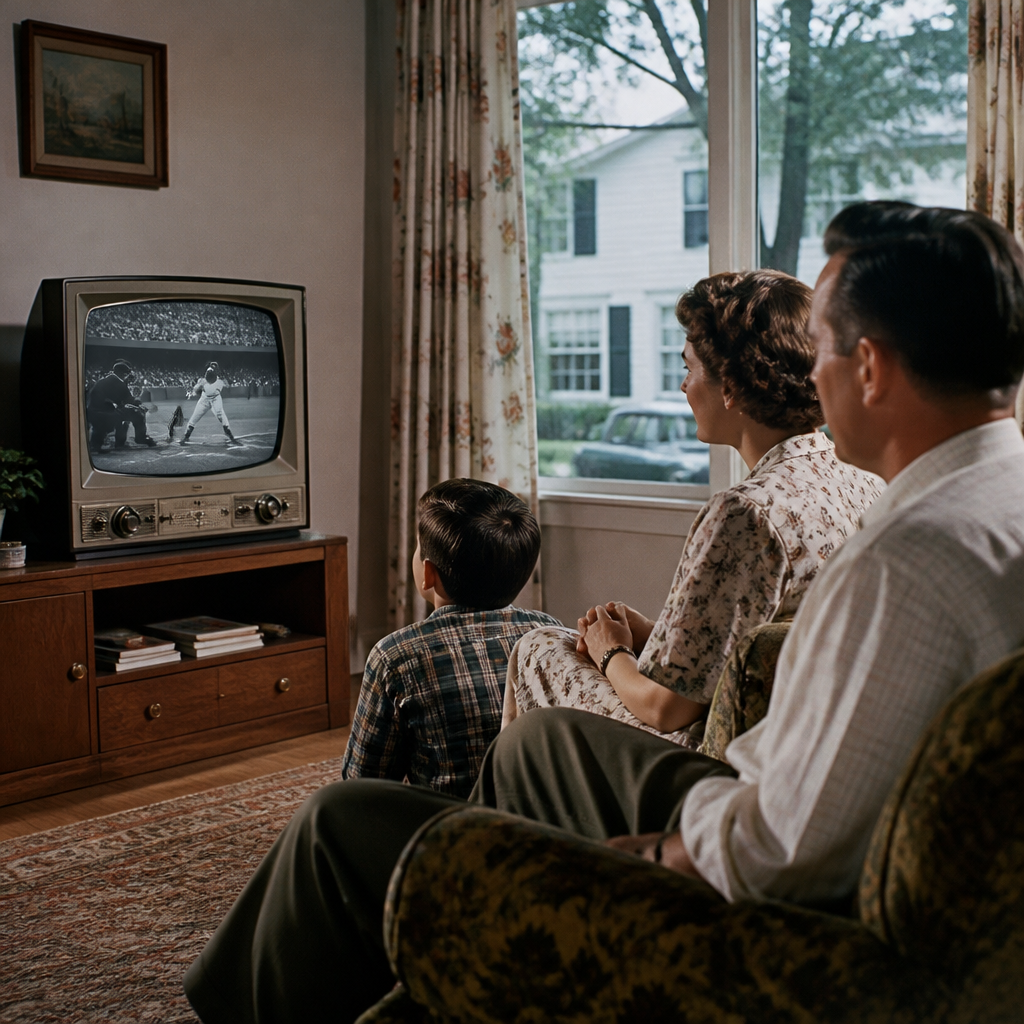
The 1950s television boom transformed baseball from a game experienced mainly inside urban ballparks and through newspaper columns into a national broadcast habit that reshaped attendance, fandom, franchise strategy, and the sport’s place in postwar American life. In this era, “television boom” refers to the rapid spread of TV ownership after World War II, when household sets moved from novelty to standard appliance, while “broadcasts” means both local game telecasts and the expanding national visibility created by network highlights, World Series coverage, and filmed newsreels. As a hub within the broader Baseball Eras topic, this article connects three forces that defined the decade and its aftermath: war’s lingering effects on labor, travel, and culture; integration’s reordering of talent, audiences, and civic identity; and relocation’s challenge to the old map of major league baseball. I have worked through attendance ledgers, broadcast schedules, and franchise histories from this period, and the pattern is consistent: television did not simply threaten ticket sales or create new fans in isolation; it redistributed attention, accelerated inequalities between clubs, and helped baseball evolve from a neighborhood ritual into a mediated national spectacle. Understanding that shift matters because nearly every modern debate about baseball media rights, local blackouts, fan loyalty, and competitive balance can be traced to decisions made in the 1950s, when owners, commissioners, sponsors, and broadcasters were still guessing what televised baseball would do to the gate.
Postwar America Built the Audience for Televised Baseball
The 1950s baseball audience was shaped by the long shadow of World War II and the economic expansion that followed it. The war had already demonstrated radio’s power to bind the home front to distant events, and returning veterans entered a consumer economy that rewarded domestic purchasing. Television ownership exploded accordingly. In 1948, only a small minority of U.S. households owned a set; by the mid-1950s, a clear majority did. That infrastructure mattered more than any single baseball policy. A family did not need to live near Ebbets Field or Comiskey Park to become familiar with players, uniforms, announcers, and pennant races. Baseball became visible in living rooms, taverns, appliance store windows, and neighborhood bars, where one broadcast could serve dozens of viewers at once.
That wider audience altered the meaning of fandom. Before television, most fans followed clubs through newspapers, scoreboards, radio play-by-play, and occasional in-person games. Television added facial recognition, batting stances, defensive positioning, and visual drama. Fans could see Willie Mays charging a fly ball, not just hear an announcer describe it. They could watch Yogi Berra squat behind the plate, study Jackie Robinson’s leads off first base, and learn the rhythms of an entire game. This visual familiarity deepened attachment, especially among children, casual viewers, and fans in places without major league teams. It also increased baseball’s competition with itself. If a fan in Brooklyn or St. Louis could watch from home, the club had to justify the cost and inconvenience of attending in person.
Owners quickly discovered that television was not one thing. A few carefully selected road broadcasts could market the team and sustain interest. Too many free home telecasts could depress walk-up sales, especially for weaker clubs with aging parks and inconsistent teams. Because there was no settled industry model, clubs experimented aggressively. Some imposed blackout rules near the home market. Others sold local sponsorships to breweries, auto dealers, or department stores. Better-positioned teams with stronger brands and larger media markets could convert exposure into leverage, while smaller-market teams often feared cannibalization. Those uneven results set the stage for larger changes in baseball’s geography.
How Television Changed Attendance, Revenue, and Team Strategy
The central question of the 1950s was simple: did televised baseball hurt attendance? The honest answer is that it depended on the club, the market, and the quality of the product on the field. In my review of club histories from this era, a clear distinction emerges between marquee events and routine dates. Television generally boosted interest in major games, pennant races, and stars. But for a last-place team playing a weekday game in an inconvenient park, a home telecast could become a substitute rather than an advertisement. That is why many owners who praised national exposure still restricted local broadcasts.
Attendance patterns confirm the nuance. The Yankees thrived because they paired television visibility with winning, star power, and the prestige of New York. The Dodgers and Giants, despite passionate fan bases, faced structural pressures that TV made harder to ignore: cramped or aging facilities, limited parking, and growing suburban populations who found home viewing easier than urban travel. The issue was not that fans stopped caring. In many cases, they cared enough to watch consistently but not enough to navigate postwar traffic, public transit changes, and family schedules for every game. Television increased engagement while reducing compulsion.
Revenue strategy had to adapt. Gate receipts still mattered enormously, but broadcast rights and sponsorships offered new income streams. Clubs began to think in media terms: announcer quality, camera placement, sponsor integration, and scheduling all had financial value. Teams that could monetize broad viewership gained resilience. Teams that relied almost entirely on attendance became vulnerable when crowds slipped. This split sharpened inequalities already present in the reserve-clause era, when player movement was restricted and owners held unusually centralized control over labor. A franchise with access to a wealthy sponsor and a large television market could fund more scouting, weather attendance swings, and market its stars more effectively than a club with weaker media backing.
| Force | Immediate 1950s Effect | Long-Term Baseball Impact |
|---|---|---|
| Household TV adoption | More games seen from home | Fandom expanded beyond ballpark regulars |
| Local telecasts | Mixed effect on attendance by market | Media rights became core franchise assets |
| Suburbanization | Harder travel to older urban parks | Pressure for new stadiums and relocation |
| Integration | Star talent drew new viewers and fans | Competitive advantage shifted to clubs signing Black players |
| Westward migration | New audiences wanted major league access | Franchise map expanded beyond the Northeast and Midwest |
Another underappreciated change was timing. Television made baseball part of the evening routine, and that altered demand for day games, travel schedules, and sponsor priorities. Clubs increasingly understood that media convenience could shape consumption as much as standings did. This insight would later influence prime-time national broadcasts, postseason packaging, and the economics of modern sports rights. In the 1950s, though, it was still experimental, and baseball’s leaders often reacted piecemeal rather than strategically.
Integration Made Television a Powerful Engine of Recognition and Change
No account of 1950s baseball can separate television from integration. Jackie Robinson broke the color line with the Dodgers in 1947, but the full cultural and competitive effects unfolded across the following decade as more Black and Afro-Latino players reached the major leagues. Television amplified that transformation. A newspaper story could report that Robinson stole home or challenged an infielder with his spikes high; television could show the speed, pressure, and crowd reaction. Viewers who might never visit Brooklyn could witness his intensity directly. That visibility mattered in a segregated nation where representation was contested in every public sphere.
Integration changed who won games. The Dodgers, Giants, and Cleveland Indians gained on-field advantages because they scouted and signed talent that many rivals ignored or delayed embracing. Robinson, Roy Campanella, Don Newcombe, Larry Doby, Willie Mays, and later Hank Aaron and Ernie Banks were not symbolic additions; they were elite players who changed pennant races. Television helped convert that excellence into mainstream fame. It also exposed the moral and competitive cost of exclusion. Clubs that resisted integration did not merely lag ethically. They surrendered access to a larger talent pool and became easier to surpass.
Yet television’s role was not uniformly progressive. Broadcast exposure could humanize Black stars, but it also placed them under intensified scrutiny from hostile crowds, biased commentary, and unequal media narratives. Announcers varied widely in fairness. Some treated Black players as central figures in baseball’s evolution; others framed them through stereotype or novelty. Even so, the visual record made denial harder. Fans could see who was carrying clubs, making defensive gems, and filling seats. In practical terms, integration and television reinforced each other: better talent created better baseball, better baseball drew larger audiences, and larger audiences made integrated stars unavoidable in the national imagination.
The same dynamic applied to fandom. Black communities had long sustained rich baseball cultures through the Negro Leagues, Black press coverage, and local clubs. As major league integration advanced, television offered both inclusion and loss. It expanded access to major league stars of color, but it also coincided with the weakening of Negro League institutions, many of which could not survive talent extraction and shifting fan attention. Any serious hub on war, integration, and relocation has to acknowledge that tradeoff. Major league baseball became more representative, but Black-owned teams, businesses, and community spaces tied to the Negro Leagues often paid the price.
Relocation Redrew Baseball’s Map and Television Helped Drive It
Relocation was not caused by television alone, but TV made old franchise assumptions unsustainable. For decades, major league baseball had been concentrated heavily in the Northeast and upper Midwest, with multiple teams packed into cities like New York, Boston, Philadelphia, Chicago, and St. Louis. That map reflected rail travel, population patterns, and nineteenth-century league development. By the 1950s, however, population growth was shifting westward and southward, air travel was improving, and television was creating fans in cities that lacked clubs. Owners could now imagine a future audience before building a local attendance base, because broadcasts had already introduced people to the product.
The defining relocations came when the Dodgers and Giants left New York after the 1957 season for Los Angeles and San Francisco. Their departures were traumatic for longtime fans, but from a business perspective the logic was strong. Both franchises faced stadium issues, parking constraints, and competition within an overcrowded market. California offered population growth, civic ambition, and room for modern facilities. Television made those markets legible. Broadcasters and sponsors understood the scale of West Coast potential, and the clubs could picture themselves as regional institutions rather than neighborhood teams.
Other moves reinforced the trend. The Boston Braves relocated to Milwaukee in 1953 and immediately drew huge crowds, proving that a franchise could thrive in a fresh market with less direct competition. The St. Louis Browns became the Baltimore Orioles in 1954. In each case, the media environment mattered. New cities were not baseball blank slates. Residents had followed the sport through radio, newspapers, and increasingly television. Relocation succeeded best where civic leaders paired that preexisting interest with stadium planning, transportation access, and local marketing. Television did not replace those fundamentals, but it lowered the barrier to entry for major league identity.
Relocation also changed fandom itself. Earlier loyalties were often hyperlocal, rooted in neighborhood proximity and inherited ballpark rituals. After relocation, fandom became more portable and more mediated. Some Brooklyn fans followed the Dodgers to Los Angeles from afar. Others shifted allegiance to the Yankees, Mets later on, or no club at all. Children growing up in television households could adopt teams they had never seen in person. This was a profound break from earlier baseball culture and a direct precursor to today’s national and global fan bases.
Why the 1950s Still Explain Modern Baseball Media and Fan Culture
Nearly every major media issue in baseball today has a 1950s ancestor. The tension between reaching the largest possible audience and protecting live attendance survives in blackout rules, streaming disputes, and regional sports network economics. The link between market size and competitive advantage, visible in the television era’s uneven sponsorship power, still shapes payroll flexibility and revenue debates. The use of star players as broadcast anchors, refined when television made faces as important as box scores, remains central to baseball marketing.
Just as important, the decade showed that technology never acts alone. Television changed baseball because it arrived alongside suburbanization, interstate mobility, postwar prosperity, integration, and westward population growth. A weaker medium in a static society would not have had the same impact. Baseball was especially vulnerable because its traditional business model depended heavily on repeat local attendance in aging urban parks. Once fans had a convenient home option and franchises had a plausible path to larger markets, the old compact between team and city began to loosen.
For readers exploring the War, Integration, and Relocation branch of Baseball Eras, this hub points to the key questions that organize the subtopic. How did wartime disruption and postwar consumer growth prepare baseball for television? Why did integrated clubs gain both moral credibility and a competitive edge? How did relocation convert regional media exposure into permanent geographic change? Follow those threads and the 1950s stop looking like a nostalgic golden age. They become the decade when modern baseball, with all its reach and all its tensions, truly came into view.
The essential takeaway is clear: broadcasts did not merely show baseball to more people; they changed where teams played, who got seen, which players became icons, and how fans defined loyalty. If you want to understand the sport’s modern economics and culture, start here, then continue through the linked articles in this era cluster on wartime baseball, integration, stadium politics, and franchise relocation.
Frequently Asked Questions
How did the 1950s television boom change the way Americans followed baseball?
The spread of television in the 1950s fundamentally changed baseball from a largely local, in-person, or print-and-radio experience into a regular visual ritual inside American homes. Before TV became common, most fans followed teams by attending games, listening on the radio, or reading newspaper coverage the next morning. Television added something new: the ability to see the action unfold in real time, with players, uniforms, ballparks, crowd reactions, and key moments becoming familiar to viewers who might never have visited a major league stadium. That visual access made baseball more immediate and more emotionally engaging for millions of people.
As television sets became standard household appliances in the postwar years, baseball broadcasts fit naturally into changing patterns of leisure. Families could gather after dinner, watch a game together, and make baseball part of ordinary home life. This shifted the sport’s cultural role. Baseball was no longer only a city-centered event tied to a ballpark schedule; it became a recurring national media product. Fans developed stronger parasocial connections to star players because they could recognize batting stances, pitching motions, facial expressions, and on-field personalities. Television helped transform athletes from names in box scores into visible celebrities.
TV also expanded the geographic reach of fandom. A child living far from New York, Brooklyn, St. Louis, or Chicago could now become deeply attached to a team seen on television rather than simply rooting for the nearest club. In practical terms, that helped loosen baseball’s identity from purely local urban loyalty and moved it toward a broader national audience. The 1950s television boom did not erase older habits like radio listening or newspaper reading, but it reordered them. Television became the centerpiece, while print and radio increasingly provided context, analysis, and companionship around the main visual event.
Did televised games hurt ballpark attendance in the 1950s?
Television’s effect on attendance in the 1950s was one of the most debated issues in baseball, and the answer is more complicated than a simple yes or no. Many owners feared that if fans could watch games for free or at low cost from home, they would stop buying tickets. In some cases, especially for clubs with weak records, aging facilities, or limited drawing power, local telecasts were blamed for soft attendance. A family weighing the expense of tickets, transportation, food, and time could reasonably decide that watching from the living room was the better option. That concern was real, and owners often responded with broadcast restrictions, blackout rules, or limits on how many games could be shown locally.
At the same time, television could also stimulate interest and deepen fan attachment, which sometimes helped attendance rather than undermined it. Seeing a team regularly on TV could turn casual followers into committed fans who wanted, at least occasionally, to experience the atmosphere in person. Television acted as advertising for the live product. It showcased pennant races, dramatic players, and packed stadiums, all of which could create demand for especially important games. In that sense, broadcasts did not simply compete with attendance; they also promoted it.
The impact depended heavily on context. Winning teams generally drew better both at the gate and on the screen. Ballpark conditions mattered as well. By the 1950s, some older urban parks were less comfortable or less accessible than suburban home viewing, especially as postwar families moved outward from city centers. In those environments, television amplified trends that were already underway. So while televised baseball could reduce some same-day ticket sales, it also helped build larger and more durable fan bases. The central lesson of the decade was that broadcasting and attendance were intertwined, not mutually exclusive, and baseball had to learn how to manage both.
Why were baseball owners and league officials so concerned about broadcasts during this era?
Owners and league officials in the 1950s understood that television was a tremendous opportunity, but they also saw it as a threat to the traditional economics of the game. For decades, gate receipts had been the financial foundation of baseball. If television reduced in-person attendance, it could weaken the entire business model. That made broadcasts unusually sensitive. Teams had to decide how many games to televise, whether to allow local stations broad access, how to price rights, and whether national exposure would help or hurt individual franchises. These were not just media questions; they were questions about the future structure of the sport.
Another source of concern was uneven market power. Big-city clubs with stronger media reach, more recognizable stars, and larger potential audiences stood to benefit more quickly from television than smaller-market teams. That raised fears about competitive imbalance. If one team could earn more from television rights and attract more national attention, it might gain financial advantages that translated into better rosters and stronger long-term positioning. Baseball had always contained market inequalities, but the television age threatened to enlarge them in new ways.
League leaders also worried about control. Television changed who mediated the fan experience. Instead of the ballpark being the central point of contact, broadcasters, sponsors, and networks became increasingly influential in shaping how baseball was presented. Decisions about scheduling, camera coverage, announcers, and advertising now affected the sport’s public identity. Owners wanted the revenue and publicity, but they were cautious about ceding too much authority to media companies. Their anxieties in the 1950s reflected a larger transition: baseball was no longer only a live sporting event; it was becoming a modern entertainment property that had to balance local traditions with national broadcast demands.
How did television broadcasts reshape baseball fandom and player celebrity in the 1950s?
Television reshaped fandom by making baseball more personal, more visual, and more continuous. Radio had already allowed fans to imagine the game, but TV gave them repeated visual familiarity with the athletes themselves. Fans could study a hitter’s swing, a pitcher’s windup, a manager’s mannerisms, and the emotional rhythm of the dugout. That visual intimacy made players feel more knowable and memorable. Stars were no longer only heroic figures described by sportswriters; they became recurring screen presences who entered viewers’ homes several times a week.
This shift helped create a new level of player celebrity. Television rewarded charisma, recognizability, and visual storytelling. A dramatic home run trot, a distinctive delivery, or a tense mound visit could become part of a player’s image in ways that print alone could not duplicate. Broadcasters contributed to this by building narratives around individual stars, rivalries, and clutch moments. Fans increasingly followed not just teams, but personalities. That helped elevate certain players into national icons, especially those appearing in major markets or high-profile games.
Fandom also became more intergenerational and domestic. Instead of baseball being something one mostly encountered at the ballpark or through male-dominated public spaces, television brought it into family rooms. Children, parents, and relatives could watch together, discuss strategy, imitate favorite players, and form shared memories around broadcasts. This broadened the social footprint of the game. It made fandom easier to sustain, especially for people who could not attend often because of geography, money, or time. In that sense, television did more than widen the audience; it changed what it meant to be a fan by making regular visual participation possible from almost anywhere.
What long-term effects did the 1950s television boom have on baseball’s business and cultural place in America?
The long-term effects were enormous. Economically, the 1950s established that broadcast rights would become one of baseball’s most important assets. What began as uncertainty over whether television would hurt attendance gradually evolved into a recognition that media exposure could generate revenue, enlarge audiences, and extend the sport’s reach far beyond the ballpark. That shift laid the groundwork for later developments in national contracts, regional sports broadcasting, sponsorship integration, and the increasingly media-driven structure of professional sports. Baseball in the television age had to think not only about filling seats, but also about audience size, market visibility, and brand value.
Culturally, television helped cement baseball’s place in postwar American life by aligning the sport with the rhythms of suburbanizing, appliance-centered domestic leisure. In earlier eras, baseball’s identity was tied closely to dense urban neighborhoods, streetcar lines, and newspaper culture. The TV era did not erase that history, but it adapted the game to a new national landscape. Viewers could participate from living rooms across the country, making baseball feel less regionally confined and more integrated into a shared mass culture. Major events such as pennant races, All-Star Games, and World Series broadcasts became collective experiences that connected distant audiences.
The television boom also influenced franchise strategy and the future geography of the sport. As owners recognized the power of broader markets and media exposure, television became part of the logic behind relocation, expansion, and efforts to reach growing populations outside baseball’s older urban core. In that way, TV did not merely reflect change; it accelerated it. By the end of the decade, baseball was no longer just a game people attended or read about. It was a broadcast institution central to how millions of Americans consumed sports, formed loyalties, and understood the place of baseball in modern national life.