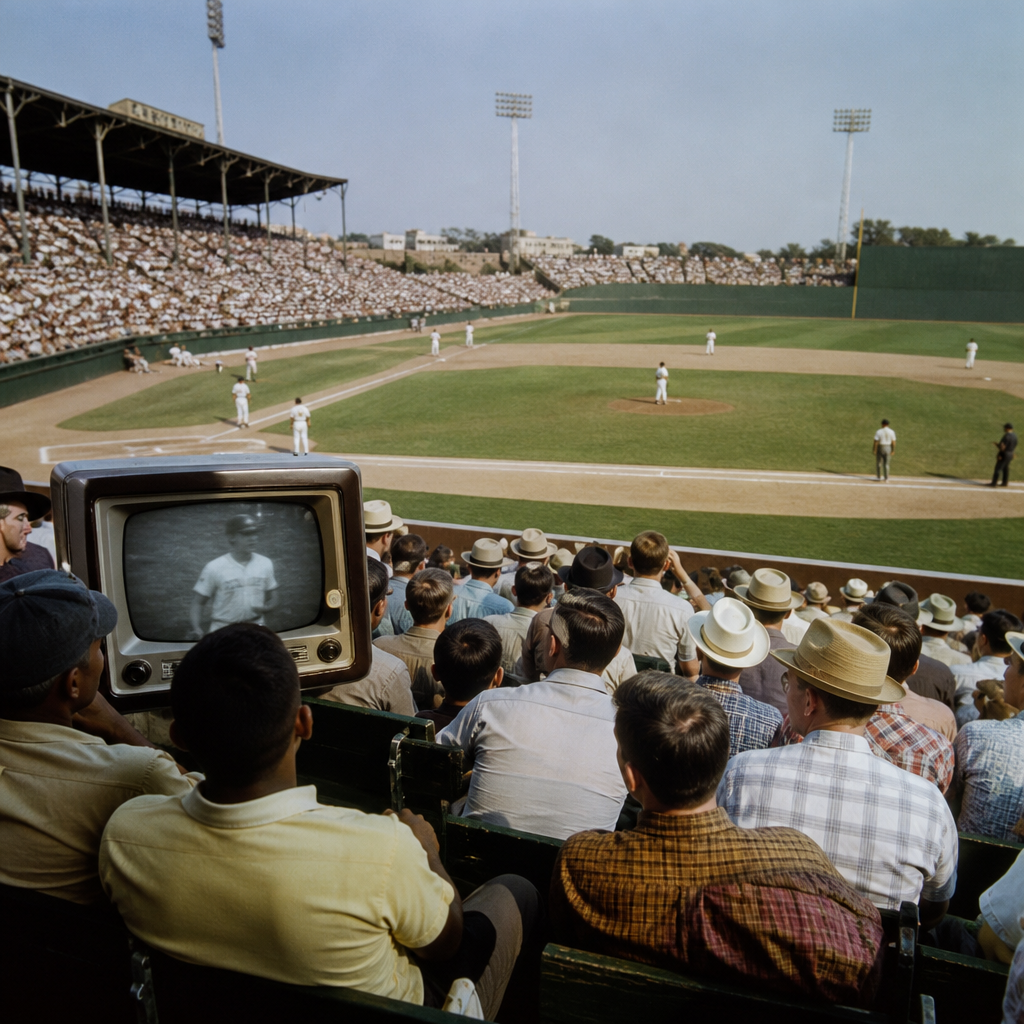
Baseball in the 1950s was transformed by three forces that changed the sport’s identity and business model at the same time: television, racial integration, and franchise relocation. The decade began with major league baseball still carrying the habits of the wartime and immediate postwar years, when train travel, dense urban fan bases, and segregated institutions shaped daily operations. It ended with coast-to-coast expansion in all but name, a national broadcast presence, and a faster, deeper, more competitive talent pool. For anyone studying baseball eras, this period is the hinge between the old two-league city game and the modern national sport.
When historians discuss war, integration, and relocation, they are describing linked developments rather than separate storylines. World War II had already interrupted careers, accelerated social change, and altered local economies. Returning veterans refilled rosters and grandstands, but they also entered a country wrestling with civil rights and suburban migration. Integration refers to the process by which Major League Baseball dismantled its long-standing color line after Jackie Robinson debuted with the Brooklyn Dodgers in 1947. By the 1950s, that process was reshaping scouting, roster construction, clubhouse culture, and pennant races. Relocation refers to franchises leaving long-established cities for new markets, most dramatically the Dodgers and Giants moving from New York to California after the 1957 season.
Television matters because it changed how fans consumed games and how owners thought about reach. Integration matters because it improved competitive quality and forced baseball to confront American inequality in public view. The move west matters because it reoriented the map of the major leagues toward population growth, air travel, and regional media. I have worked through newspaper archives, game footage, and franchise records from this decade, and the pattern is unmistakable: every major baseball question in the 1950s connects to who could play, who could watch, and where teams could profitably live. This hub article explains those connections and provides the foundation for deeper reading across the broader Baseball Eras topic.
Postwar baseball and the pressure for change
The 1950s cannot be understood without the postwar setting inherited from the 1940s. During World War II, hundreds of players served in the military, talent was diluted, and teams operated under travel restrictions and uncertainty. Commissioner Kenesaw Mountain Landis had declared baseball a morale-building institution, helping preserve the majors during wartime, but the conflict exposed how dependent clubs were on local attendance and fragile labor supply. When stars returned, owners hoped for continuity. Instead, they faced new pressures: changing neighborhoods, rising car ownership, suburban growth, and a public increasingly accustomed to electronic media in the home.
Many ballparks were old even by 1950. Ebbets Field, the Polo Grounds, Sportsman’s Park, and Shibe Park carried enormous history but offered limited parking, aging infrastructure, and constrained revenue opportunities compared with later multiuse facilities. Teams still relied heavily on ticket sales, concessions, and radio rights, yet families were moving away from the dense transit corridors that had sustained prewar attendance. Front offices also had to adapt to better organized farm systems, broader scouting competition, and a labor market altered by military service and social mobility. In practical terms, the old assumptions that kept franchises anchored in the same cities for half a century were eroding.
The statistics of the decade reflect both continuity and upheaval. Attendance remained strong in marquee markets, especially for winning teams, but performance gaps widened as integrated clubs gained access to superior talent. The New York Yankees dominated the American League, winning six World Series in the decade, yet even their supremacy was part of a changing environment driven by television exposure and national branding. In the National League, the Dodgers, Giants, and Braves benefited directly from modern scouting and, in Brooklyn’s and New York’s case, from Black stars who would have been excluded a generation earlier. Postwar baseball did not simply resume after 1945; it reorganized itself under pressure.
Television turns baseball into a home product
Television was the decade’s most disruptive business force because it brought the game into living rooms while forcing clubs to rethink gate receipts. Early owners feared that free broadcasts would keep customers away from the park. In some cases, especially with weak clubs and plentiful home dates, that fear was justified. But television also created something baseball had never possessed at scale: repeatable visual intimacy. Fans could now see a pitcher’s motion, an outfielder’s route, or a manager’s argument rather than imagine it through radio description. That changed loyalty, celebrity, and the value of a franchise beyond its turnstiles.
The Yankees provide a clear example. Their success on the field, combined with regular television exposure in the nation’s largest market, helped turn Joe DiMaggio, Yogi Berra, Mickey Mantle, and Whitey Ford into national figures. The 1951 playoff home run by Bobby Thomson, “the Shot Heard ’Round the World,” is often remembered as a radio event, but the early 1950s quickly moved baseball toward a visual culture in which moments could be seen and discussed collectively. The World Series became especially important on television because it gave advertisers a premium audience and gave the sport a national showcase before the National Football League fully matured as a television giant.
Rights structures remained local and uneven. Some clubs embraced broad broadcasting schedules, while others restricted telecasts to protect attendance. The result was an experimental media economy. Executives had to answer practical questions: Should home games be televised? Should rights be sold to a single sponsor? How much inventory was too much for the local market? In cities with strong public transit traditions and winning teams, television could complement attendance by deepening fan habit. In struggling markets, it could undercut walk-up sales. Baseball’s 1950s media strategy was therefore not unified but adaptive, with each club testing how to balance exposure against short-term revenue.
Television also influenced style and public memory. Day games remained common, but prime-time visibility gradually mattered more. Players with dramatic presence benefited, and managers became recognizable personalities. Broadcasters such as Red Barber and Mel Allen developed forms of explanation that helped newer viewers understand tactics and context. The visual medium rewarded clean storylines: pennant races, rookie stars, contentious umpire calls, and record chases. By the end of the decade, baseball was no longer only a ballpark experience narrated secondhand; it was a recurring domestic spectacle, and that shift strengthened the case for larger regional markets and eventually westward relocation.
Integration expands the talent base and changes the standings
Integration was the most important competitive development of the era because it allowed clubs willing to sign Black players to access elite talent long ignored by segregation. Jackie Robinson’s debut in 1947 opened the major league door, but the 1950s revealed the full baseball consequences. The Dodgers built around Robinson, Roy Campanella, Don Newcombe, and later Jim Gilliam. The Giants added Monte Irvin and Hank Thompson, then signed Willie Mays, who became one of the greatest all-around players in history. The Braves brought in Henry Aaron, and the Indians signed Larry Doby and Satchel Paige earlier, proving the American League could benefit as well.
The impact was measurable. Robinson won the National League MVP in 1949 and remained a foundational player into the early 1950s. Campanella won three NL MVP awards, in 1951, 1953, and 1955. Mays combined power, speed, defense, and durability at a level few players have matched, while Aaron emerged by mid-decade as a consistent extra-base threat with extraordinary bat control. These were not symbolic additions. They were franchise-altering stars. Clubs that integrated aggressively improved faster because they drew from the Negro Leagues and Black amateur circuits at a time when several competitors still refused to sign Black players or did so only reluctantly.
Resistance remained intense. Players faced racist abuse from opponents, hotels, restaurants, landlords, and sometimes teammates. Spring training in the South imposed humiliations that white players did not face. Front offices often looked for what they called the “right kind” of Black player, a coded and paternalistic standard that burdened pioneers with impossible expectations of restraint. Yet the strategic truth was obvious to anyone evaluating performance honestly: segregated scouting was self-sabotage. Branch Rickey understood this first and acted decisively. Other clubs paid a competitive price for delay, particularly the Boston Red Sox, who were the last major league team to integrate, in 1959.
The 1950s also marked the decline of the Negro Leagues as independent institutions. That decline was painful and economically damaging for Black team owners and communities that had built rich baseball cultures under exclusion. Integration was morally necessary, but it did not distribute benefits evenly. Major league clubs often purchased contracts cheaply and failed to compensate Black baseball structures proportionately. The result was a paradox: the majors became stronger and more legitimate by ending exclusion, while many Black baseball businesses weakened. Any serious account of baseball integration in the 1950s must hold both truths at once.
Teams, events, and turning points that defined the decade
Several clubs and seasons illustrate how television, integration, and relocation intersected.
| Team or event | Why it mattered | Lasting effect |
|---|---|---|
| 1951 Giants-Dodgers pennant race | Intense media coverage amplified a dramatic finish and Thomson’s pennant-winning homer | Showed baseball’s power as a shared national event |
| 1954 Willie Mays over-the-shoulder catch | Television turned defensive brilliance into a permanent visual memory | Helped define superstar value beyond batting average |
| 1955 Brooklyn Dodgers World Series title | Integrated roster finally beat the Yankees on the biggest stage | Confirmed Brooklyn as a model National League franchise |
| Milwaukee Braves move in 1953 | Relocation to a growing market produced immediate attendance success | Proved franchise moves could be financially transformative |
| Dodgers and Giants move west in 1958 | Baseball entered California, aligning with population growth and air travel | Created the blueprint for modern geographic expansion |
The Milwaukee Braves were especially significant because their move from Boston after the 1952 season demonstrated that relocation could solve attendance problems quickly. In Milwaukee, the Braves drew over 1.8 million fans in 1953, a National League record at the time. That was not a minor improvement; it was proof of concept. A franchise did not have to remain in a legacy city out of tradition if a faster-growing market offered stronger local support, newer civic ambition, and better revenue potential. Other owners noticed immediately.
The Dodgers and Giants then supplied the era’s decisive relocation story. Walter O’Malley wanted a modern ballpark for Brooklyn and clashed with New York power broker Robert Moses, who favored a different site and public terms. Horace Stoneham, facing attendance issues with the Giants at the Polo Grounds, was open to alternatives. Los Angeles officials sought a major league club as a civic prize, and San Francisco pursued one as well. The result was the paired move after 1957: the Dodgers to Los Angeles and the Giants to San Francisco. The two-club shift preserved a natural rivalry while giving Major League Baseball immediate credibility on the West Coast.
Travel logistics had changed enough to make that leap realistic. Air travel reduced the isolation that would have made coast-to-coast scheduling impossible in earlier decades. California’s population boom promised long-term returns, and television markets added another layer of value. The move west was not merely about escaping old parks. It was a decision rooted in demography, infrastructure, and media economics. Once that barrier fell, baseball’s future as a continental enterprise was set.
Relocation, civic identity, and the modern major leagues
Relocation in the 1950s was controversial because teams were treated as public trusts even when privately owned. Brooklyn’s loss remains one of the deepest civic wounds in American sports history. The Dodgers were not just a business; they were embedded in borough identity, immigrant memory, and neighborhood ritual. Fans who had endured years of near misses before the 1955 championship felt betrayed when the team left two years later. Similar emotions surrounded the Giants. Baseball discovered that franchise geography was not only an economic matter but also a political and cultural one.
Owners, however, increasingly judged cities by market fundamentals. Could the city support modern attendance levels? Was there parking? Could a new stadium be built? Was local government cooperative? What did the broadcast market look like? These questions became standard because baseball was shifting from a nineteenth-century urban footprint to a mid-twentieth-century regional one. Cities that had once been perfect for trolley-era baseball were no longer ideal for car-based family entertainment. Relocation therefore reflected structural change more than owner whim, although individual personalities and negotiations still mattered enormously.
The long-term consequences were profound. West Coast baseball changed scheduling, broadened national fan allegiances, and laid groundwork for later expansion. It also intensified the importance of stadium politics, with municipalities competing for teams through land, financing, and infrastructure promises. In that sense, the 1950s created the modern relationship between baseball franchises and city governments. The era taught owners that mobility could produce leverage. It taught fans that history alone would not keep a team in place. And it taught the sport that national growth often came with local heartbreak.
Baseball in the 1950s is the essential hub for understanding war, integration, and relocation because those themes converged into one decisive transformation. Postwar America altered where fans lived, how they spent leisure time, and what kind of civic projects cities would support. Television converted baseball from a mostly local live event into a recurring home experience with national stars and broader commercial reach. Integration improved the quality of play, redefined competition, and forced the major leagues to confront the injustice that had limited both opportunity and excellence. Relocation, first to Milwaukee and then to California, remapped the sport around population growth, air travel, and regional media.
The decade’s lasting lesson is simple: baseball changed fastest when social reality and business reality pointed in the same direction. Teams that recognized talent regardless of race gained a competitive advantage. Clubs that adapted to new media built larger audiences. Franchises that aligned with emerging markets strengthened their finances and influence. At the same time, every gain carried costs, from the erosion of Negro League institutions to the emotional damage done to abandoned cities. That tension is why the 1950s remain so compelling. They are not only a story of progress, but also of disruption, uneven reward, and hard choices.
Use this article as your starting point for the wider Baseball Eras subtopic, then explore deeper pieces on Jackie Robinson and integration, postwar pennant races, the decline of the Negro Leagues, the Milwaukee Braves relocation, and the Dodgers and Giants move west. The 1950s did more than bridge old baseball and modern baseball. They created the structure of the game we still recognize today.
Frequently Asked Questions
How did television change baseball in the 1950s?
Television fundamentally changed how Americans experienced baseball in the 1950s by turning what had long been a local, in-person pastime into a mass home-viewing event. Before TV became widespread, fans primarily followed teams by attending games, reading newspaper coverage, or listening on the radio. Television added a visual layer that made the sport more immediate and accessible, allowing people to watch star players, pitching duels, and pennant races without traveling to the ballpark. This greatly expanded baseball’s reach, especially for families in areas without easy access to a major league team.
The business impact was just as important as the cultural one. Television created new revenue streams through broadcast rights and advertising, but it also introduced anxiety for club owners who feared that free home viewing would cut into ticket sales. In some cities, teams embraced television aggressively, while in others owners limited broadcasts in an attempt to protect attendance. That tension revealed a larger truth about the decade: baseball was no longer simply a gate-driven business dependent on local crowds. It was becoming a media product with national value.
TV also changed the sport’s presentation. Players became recognizable public personalities, not just names in the sports pages. Teams and leagues began to think more carefully about scheduling, image, and marquee events that would attract larger audiences. The World Series and Game of the Week broadcasts helped standardize baseball as a shared national experience. In short, television did not just show baseball to more people; it reshaped the game’s economics, its celebrity culture, and its place in American life.
Why was racial integration such a major turning point for baseball during the 1950s?
Racial integration was one of the most significant developments in baseball history because it changed both the sport’s competitive level and its moral standing in American society. Jackie Robinson broke Major League Baseball’s color barrier in 1947, but the 1950s were the decade when integration spread more broadly across the league. More Black players entered the majors, and their success made it increasingly clear that segregation had denied opportunities to outstanding talent for generations. As integration advanced, baseball became faster, deeper, and more dynamic, exactly because teams were finally drawing from a wider pool of elite players.
The effect on the field was immediate and lasting. Integrated teams gained access to exceptional athletes whose skills transformed roster construction, strategy, and style of play. Speed, defensive range, power, and pitching depth all improved as clubs signed players who had previously been excluded. The Dodgers, Giants, and Braves were among the clubs that benefited from moving more decisively toward integration, while slower-moving organizations often put themselves at a competitive disadvantage. In that sense, integration was not only a social issue; it became a baseball operations issue as well.
At the same time, the process was difficult, uneven, and often hostile. Black players faced discrimination from opposing fans, some teammates, hotels, restaurants, and even segments of the press. Integration was not a smooth triumphal march but a contested change that exposed the contradictions of mid-century America. Baseball occupied a visible place in that national struggle because it was such a prominent institution. By the end of the 1950s, the sport had moved substantially away from its segregated past, though not all barriers had disappeared. The decade matters because it showed that integration improved the game while also making baseball a more credible symbol of democratic inclusion.
Why did teams begin moving west in the 1950s?
Teams began moving west in the 1950s because the traditional geography of Major League Baseball no longer matched the population, transportation, and economic realities of postwar America. For decades, the major leagues were concentrated heavily in the Northeast and Midwest, especially in dense rail-connected cities. That arrangement made sense in an earlier era, but by the 1950s Americans were spreading into the Sun Belt and the Pacific Coast, air travel was becoming more practical for team logistics, and civic leaders in newer markets were willing to offer modern stadium opportunities and stronger financial incentives.
The most famous relocations came in 1958, when the Brooklyn Dodgers moved to Los Angeles and the New York Giants moved to San Francisco. Those moves were historic because they pushed Major League Baseball onto a true coast-to-coast map. Owners were increasingly aware that remaining in older ballparks with limited parking, aging infrastructure, and uncertain public support could restrict future growth. In contrast, western cities promised larger territories, newer facilities, and access to expanding suburban populations. The move west was therefore not just a matter of geography; it was a strategic business decision tied to modern consumer patterns.
These relocations also reflected a broader shift in how baseball franchises were understood. Earlier in the century, teams were often seen primarily as deeply rooted civic institutions. By the late 1950s, they were also clearly mobile entertainment businesses capable of pursuing more favorable markets. That change was emotionally painful for many fans, especially in Brooklyn and New York, but it signaled a new era in which franchise value, media reach, and metropolitan growth patterns could outweigh tradition. The move west helped define modern baseball by proving that the game’s future was national, not merely regional.
How were television, integration, and relocation connected to one another?
These three forces were tightly connected because all of them pushed baseball away from an older, locally bound model and toward a modern national one. Television widened the audience beyond the stadium and beyond the city, making it easier to imagine baseball as a coast-to-coast product. Integration improved the quality of play and expanded the game’s talent base, which made the sport more compelling to larger audiences. Relocation then aligned the league’s map with new population centers and broadcast markets. Together, they transformed baseball’s identity, not in separate tracks but as overlapping developments that reinforced one another.
For example, a franchise entering a new western market was not only gaining local ticket buyers; it was also gaining access to a broader media footprint and to a new regional audience that television could help cultivate. At the same time, teams that integrated more effectively often fielded stronger, more exciting clubs, which improved their appeal on television and increased their ability to compete in a changing league. The game’s national profile rose because fans could see top talent on screen and because the league itself was no longer confined to its older eastern core.
There was also a deeper institutional connection. All three developments forced owners and executives to rethink long-standing assumptions. They had to reconsider where teams should play, who should be allowed to play, and how fans should consume the product. Those are foundational questions, and the 1950s produced new answers to all of them. Baseball did not simply update a few practices during this period; it redefined its structure, audience, and business model. That is why the decade stands out as a moment of genuine transformation rather than routine change.
What did the 1950s ultimately mean for the future of Major League Baseball?
The 1950s ultimately marked the transition from an older version of Major League Baseball into something recognizably modern. At the start of the decade, the game still operated in ways shaped by wartime habits and early twentieth-century assumptions: urban concentration, heavy dependence on live attendance, segregated institutions, and relatively fixed franchise geography. By the end of the decade, those foundations had shifted. Baseball had a much stronger television presence, a more integrated and talented player pool, and a dramatically broader geographic vision that reached to the Pacific Coast.
This mattered because it changed both the sport’s identity and its long-term growth strategy. Baseball was no longer only the game of neighborhood ballparks and local newspaper rivalry, even though those traditions remained emotionally powerful. It had become a national entertainment enterprise with expanding media value, larger markets, and a more competitive on-field product. The decisions made in the 1950s paved the way for later expansion, larger broadcast contracts, increased player celebrity, and the expectation that major league clubs should serve broad regional audiences rather than only compact city populations.
Just as importantly, the decade exposed the costs of modernization as well as its benefits. Fans lost beloved local institutions when teams relocated. Integration advanced justice and improved the sport, but Black players still carried immense burdens. Television made baseball more accessible, yet it also altered the relationship between teams and the communities that had once relied almost entirely on the ballpark experience. So the legacy of the 1950s is not simply one of progress in a simplistic sense. It is the story of baseball becoming bigger, more inclusive, more profitable, and more national, while also becoming less purely local and less tied to its earlier traditions. That tension would shape the game for the rest of the twentieth century.