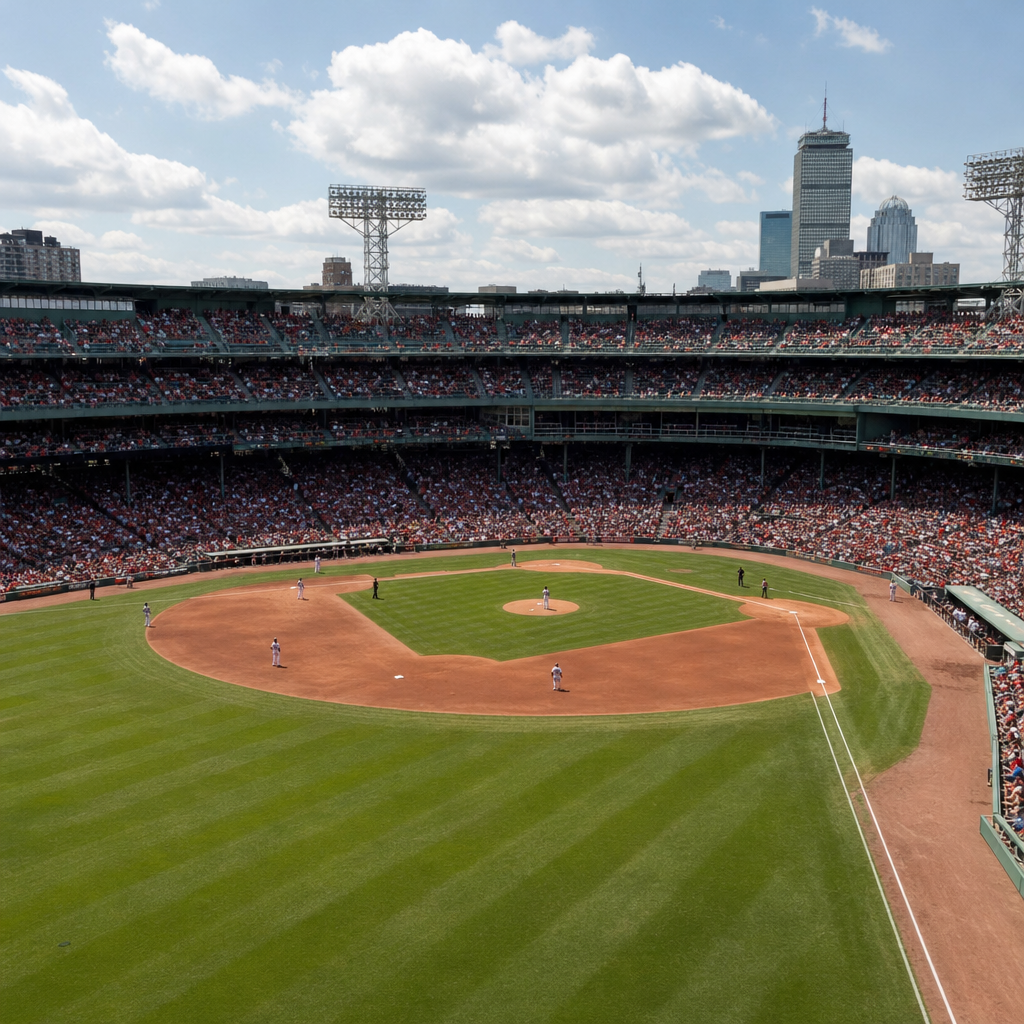
Braves Field was Boston’s great National League ballpark, a vast, windswept stadium built for distance hitting, deep outfields, and enormous crowds, and it remains one of the most revealing case studies in the history of lost MLB ballparks. Opened in 1915 for the Boston Braves, the park stood in what is now Boston University territory and quickly earned a reputation for unusual dimensions that reshaped how baseball was played inside its walls. When people discuss iconic ballparks, they often jump to Fenway Park, Ebbets Field, or the Polo Grounds, but Braves Field deserves equal attention because it shows how architecture, neighborhood growth, ownership ambition, and league economics could define a franchise’s fate. In practical terms, a lost MLB ballpark is a former major league venue that no longer operates in its original baseball role, either because it was demolished, repurposed, or absorbed into later development. Braves Field fits that definition perfectly. Parts of the original structure survive, but the ballpark itself is gone.
That makes this site’s Braves Field guide more than a single-stadium profile. It also serves as a hub for understanding lost MLB ballparks as a category: why they vanished, what made them distinctive, and how fans can still trace them on modern city maps. I have walked former ballpark footprints in Boston, Brooklyn, and Philadelphia, and Braves Field always stands out because the scale is hard to grasp until you are standing where center field once stretched far beyond modern expectations. The park mattered not only for Braves history but for baseball history. It hosted World Series games, All-Star talent, football, and later university sports after the Braves left Boston. To understand Braves Field is to understand a turning point in stadium design, when owners tried to solve overcrowding and cramped urban parks by building bigger, farther, and more specialized venues. The result was dramatic, memorable, and ultimately unsustainable, which is exactly why it belongs at the center of any serious look at lost MLB ballparks.
What made Braves Field unusual
Braves Field opened on August 18, 1915, under owner James E. Gaffney, who wanted a modern home for the Braves after the team’s miracle 1914 pennant and World Series title. The older South End Grounds had burned and been rebuilt more than once, and it no longer represented the scale or prestige Gaffney wanted. Braves Field was planned as a concrete-and-steel stadium at a time when that construction standard represented permanence and safety. Its dimensions were the defining feature. The park was famously huge, with a left field line around 402 feet, right field around 353 feet, and center field extending to roughly 550 feet in its original form, depending on the source and measurement method. The power alleys were cavernous. Inside-the-park home runs, triples, and long chases were more common than cheap homers. That is the simplest answer to why Braves Field was unusual: it was built to suppress home runs and reward gap power, speed, and defense.
The shape reflected both land availability and baseball thinking of the era. In the dead-ball and immediate post-dead-ball years, many executives still valued spacious outfields and strategic hitting. Braves Field’s designers also wanted to avoid the cramped asymmetry seen in older urban parks. The result looked rational on paper but played differently in reality. Sluggers hated watching long drives die in gloves. Pitchers often loved the margin for error, though not every pitcher enjoyed seeing so much open grass behind outfielders. Fans saw a style of baseball built around placement and pursuit rather than constant over-the-fence action. That made Braves Field distinct from parks like Baker Bowl, notorious for its tiny right field, or the Polo Grounds, where absurdly short foul lines gave way to a remote center field. Braves Field was less quirky than those parks in concept, yet just as extreme in effect.
How the dimensions shaped games and roster building
A ballpark’s dimensions are never just an architectural curiosity. They affect roster construction, managerial tactics, and even player reputations. At Braves Field, large outfield spaces increased the value of rangy defenders and line-drive hitters who could split gaps. Singles hitters could stretch balls into doubles, doubles hitters could threaten triples, and outfield mistakes were punished immediately. Home run totals, by contrast, were muted. Hall of Fame outfielder Babe Ruth hit the final three home runs of his career at Braves Field in 1935 after joining the Boston Braves, but the park never played as a natural home run environment in the way Yankee Stadium did for left-handed power. That contrast matters because it shows how context shapes statistics. A hitter who looked merely solid in Boston might have posted far louder home run numbers in a smaller park.
I have found that when modern fans revisit lost MLB ballparks, they often ask a simple question: would this park work today? In Braves Field’s original form, probably not for major league baseball. Contemporary teams optimize around power, and fans expect clearer sightlines, more premium seating, and closer engagement with the field. Yet the old dimensions offer a useful reminder that baseball once tolerated, and sometimes celebrated, dramatically local styles of play. One park rewarded loft; another punished it. One made center fielders stars; another turned right field into a novelty. Braves Field belongs in that conversation because its dimensions were not accidental. They were a theory of baseball made concrete.
| Ballpark | Signature trait | Effect on play | Status |
|---|---|---|---|
| Braves Field | Enormous outfield, very deep center | Fewer homers, more triples and long chases | Mostly lost, partial remnants survive |
| Ebbets Field | Compact urban footprint | Strong park-specific caroms and intimate feel | Demolished |
| Polo Grounds | Short lines, distant center | Odd home run profile and huge outfield gaps | Demolished |
| Baker Bowl | Tiny right field, structural flaws | Home run boost for some hitters | Demolished |
Braves Field in the wider story of lost MLB ballparks
Lost MLB ballparks form one of baseball history’s richest subtopics because each vanished stadium captures a different pressure point in the sport’s development. Some disappeared because of fire, like early wooden parks. Others became obsolete because parking, broadcast demands, and postwar suburban access changed fan behavior. Still others were simply too small, too deteriorated, or too poorly located for modern ownership goals. Braves Field represents a specific pattern: a once-advanced urban stadium that became mismatched with team economics and fan demand. The Boston Braves struggled financially and competitively for long stretches, and the city was effectively dominated by the American League’s Red Sox in terms of broader identity. Even a grand ballpark cannot solve weak attendance on its own.
As a hub for lost MLB ballparks, Braves Field helps organize the subtopic into useful categories. First are demolished parks with almost no physical trace, such as Washington Park in Brooklyn. Second are redeveloped sites with commemorative markers but little structure left, such as many Federal League and Negro League grounds. Third are adaptive-reuse cases, where pieces of the old stadium survive in new settings. Braves Field belongs strongly in that third category. The former right field pavilion became part of Nickerson Field at Boston University, making it one of the better places in baseball history to study how a major league park can persist in fragments. For readers exploring related articles, this is the natural gateway to subjects like Ebbets Field, the Polo Grounds, Forbes Field, Sportsman’s Park, and Shibe Park, each lost in a different way and for different reasons.
From baseball palace to repurposed landmark
The Braves played at Braves Field until moving to Milwaukee after the 1952 season. That relocation was one of the pivotal franchise shifts in modern sports business. Lou Perini, the owner, saw stronger commercial prospects in the Midwest than in a two-team Boston market where the Braves were usually second in attention. Once the team left, the ballpark entered a new phase that says as much about urban land use as baseball memory. Boston University acquired the property and adapted parts of it for athletics. The massive horseshoe grandstand did not survive intact, but the right field stands remained and were incorporated into Nickerson Field, which opened in 1955. If you visit today, you can still identify original Braves Field brickwork and structural elements, a rare physical bridge between major league history and current campus life.
This repurposing is one reason Braves Field remains especially valuable within the lost MLB ballparks category. Demolition can erase context. Adaptive reuse preserves scale, orientation, and material evidence. It lets historians compare old aerial photos, Sanborn maps, and current site plans with unusual clarity. Researchers can locate home plate, trace foul lines, and reconstruct spectator movement through surviving entrances and seating bowls. In practical heritage terms, Braves Field is not merely remembered; it is partially legible. That puts it alongside a small number of former ballparks where architectural residue still teaches something concrete. For fans planning historical trips, this is an important distinction. A plaque on an apartment wall is meaningful, but a surviving section of grandstand explains the lived geometry of the place in a way text alone never can.
Notable events, players, and moments at Braves Field
Braves Field was more than an oversized container for regular-season games. It hosted major events that justify its status among iconic ballparks. The 1915 World Series was played there shortly after the park opened, with the Braves facing the Philadelphia Phillies. Because the new stadium had such a large seating capacity, it was viewed as a major asset for drawing crowds. In 1936, Braves Field hosted the Major League Baseball All-Star Game, bringing the sport’s biggest names to a park already famous for its dimensions. Babe Ruth’s final season unfolded there in 1935, giving the venue a permanent link to the game’s most famous figure. Although Ruth’s time with the Braves ended unhappily, historians still note the symbolism of baseball’s biggest star finishing his career in one of its biggest parks.
The venue also welcomed football, boxing-related activity around the sports scene, civic gatherings, and university competition after the Braves era. That mixed-use history reflects a broader truth about lost MLB ballparks: many survived longer as civic spaces than as baseball homes. Their afterlives can be as important as their major league years. From a player-development perspective, Braves Field also shaped defensive reputations. Outfielders needed reads, speed, and stamina. Visiting teams often commented on how much territory had to be covered. In an era before advanced tracking data, those impressions became part of baseball folklore, but they were grounded in reality. The park played big because it was big. That seems obvious, yet in baseball history many narratives exaggerate dimensions for effect. Braves Field hardly needs exaggeration.
How to study and visit former ballpark sites
If you are using this article as an entry point into lost MLB ballparks, start with methods that combine maps, photographs, and present-day walking routes. Baseball-reference style statistical context helps, but site study adds another layer. For Braves Field, compare period diagrams, team media guides, and Boston University campus maps. Then walk the current grounds at Nickerson Field and nearby Harry Agganis Way. Look for surviving brick arcs, stand geometry, and the orientation of the remaining structure. Historic aerial imagery from local archives or the Library of Congress can help align the old field with today’s campus edges. This same process works for other lost MLB ballparks. Identify the exact footprint, check whether street grids changed, and determine whether any walls, stairways, or retaining structures remain.
The key is to treat former ballparks as urban history, not just sports nostalgia. Ask what transportation served the park, what neighborhoods bordered it, and why ownership believed the site would work. In Braves Field’s case, expansion space was an advantage at first, yet the very scale that made it impressive also made intimacy harder to maintain and later adaptation more complex. That tension appears across many vanished stadiums. They were built for one baseball economy and abandoned in another. For readers exploring the broader Iconic Ballparks topic, Braves Field is the ideal hub because it connects design, strategy, relocation, reuse, and memory in one site. Explore the related lost MLB ballparks in this series, compare their dimensions and afterlives, and use Braves Field as the benchmark for how a park can disappear while still leaving the game a remarkably visible footprint.
Braves Field endures because it explains, in one place, why lost MLB ballparks matter. It was ambitious, oversized, strategically influential, historically significant, and ultimately unable to remain a major league home in changing economic conditions. Its unusual dimensions were not a gimmick but a statement about how baseball could be staged, and that statement shaped lineups, outcomes, and memories for decades. As a sub-pillar hub within Iconic Ballparks, this article should leave readers with a clear framework: some ballparks are remembered for championships, some for architecture, some for neighborhood identity, and a few, like Braves Field, for all three at once. The surviving fragments at Boston University make its story unusually accessible, while the team’s departure and the park’s transformation place it squarely in the central narrative of lost MLB ballparks.
The main benefit of studying Braves Field is perspective. It helps you read other vanished parks more intelligently, with better questions about dimensions, design intent, fan experience, and reuse. It also proves that baseball history is not confined to active stadiums. Sometimes the most instructive parks are the ones you have to reconstruct from remnants, photos, and city blocks. If you want to go deeper into lost MLB ballparks, use this page as your starting point, then continue to the related articles on Ebbets Field, the Polo Grounds, Forbes Field, and other vanished venues that still shape how the game is understood today.
Frequently Asked Questions
What made Braves Field so unusual compared with other early 20th-century ballparks?
Braves Field stood apart because it was designed on a truly massive scale at a time when many ballparks were compact, irregular, and often quite friendly to home run hitters. Opened in 1915 for the Boston Braves, it featured one of the deepest outfields in Major League Baseball, with vast alleys and a general sense of open space that gave the park a completely different style of play. Instead of rewarding routine fly balls that might scrape over a nearby fence in smaller parks, Braves Field favored line drives, speed, gap power, and endurance. Hitters often had to settle for singles, doubles, and triples unless they could generate exceptional distance.
Its size also affected the visual and atmospheric character of games. Braves Field was often described as windswept and expansive, almost more like a broad athletic ground than a cozy urban baseball yard. That openness made it memorable to players, writers, and fans, especially when compared with the tighter dimensions common in the dead-ball and early live-ball eras. In practical baseball terms, it was a park that could suppress one of the sport’s most dramatic outcomes: the home run. In historical terms, that makes Braves Field especially significant, because it serves as a clear example of how architecture could dictate strategy, roster construction, and even a team’s identity.
How did the dimensions of Braves Field change the way baseball was played there?
The dimensions shaped nearly every aspect of the game. Because the outfield was so deep, Braves Field rewarded hitters who could drive the ball into the gaps rather than merely loft it toward the fences. Outfielders had to cover an enormous amount of ground, which increased the value of range, positioning, and strong decision-making. Balls that would be routine outs or home runs elsewhere could become long chases, extra-base hits, or difficult caroms in Boston. This meant that the park didn’t just alter statistics; it changed the rhythm of games and the tactical choices teams made inning by inning.
Pitchers benefited in certain ways because they could challenge hitters with less fear of cheap home runs, but that did not automatically make the park easy on them. A ball put in play had room to travel, and misplayed drives could quickly turn into doubles or triples. Defenses therefore had to be especially alert, and clubs built for speed and contact could thrive in that environment. Braves Field effectively emphasized an older style of baseball built on placement, baserunning, and sustained offensive pressure. For historians, that is one of the most fascinating parts of the ballpark’s legacy: it demonstrates how a stadium’s physical design can create a baseball ecosystem with its own logic, one that rewards some skills while minimizing others.
Why is Braves Field considered such an important lost ballpark in baseball history?
Braves Field matters because it was not just another demolished stadium; it was one of the clearest physical expressions of an era in which ballpark design could profoundly shape the sport. Many old parks are remembered for charm, odd corners, or famous events, but Braves Field is especially revealing because its unusual size made its influence easy to see. It became a living case study in the relationship between dimensions and performance. When historians look back at old National League ballparks, Braves Field stands out as a place where strategy, offense, and even fan expectations were visibly molded by architecture.
Its importance is also tied to geography and memory. The park once occupied land that is now part of Boston University, which means the site remains embedded in the city even though the original ballpark is gone in its full form. That gives Braves Field a unique afterlife: it survives not only in statistics and photographs, but also in the urban landscape of modern Boston. For anyone interested in how baseball parks disappear, adapt, and leave traces behind, Braves Field is a prime example. It tells a story about the rise of ambitious ballpark construction, the changing economics of teams and cities, and the way a stadium can outlast itself as a historical idea long after its grandest days have passed.
Did Braves Field help or hurt hitters, and what kind of players were best suited to it?
Braves Field could be both helpful and punishing to hitters, depending on the type of player. For sluggers who relied heavily on home runs, the park could be deeply frustrating. Long drives that might have cleared a fence in another stadium often stayed in play, turning potential home runs into outs or, at best, extra-base hits. Power numbers could look muted there, which is one reason the ballpark has to be taken seriously when evaluating historical offensive statistics. A hitter’s totals at Braves Field might not fully reflect his ability in a more neutral or hitter-friendly environment.
At the same time, the park could be rewarding for batters with speed, line-drive ability, and smart baserunning instincts. Gap hitters had room to work with, and aggressive runners could stretch hits in ways that were much harder to do in smaller parks. Players who excelled at using the whole field rather than simply lifting the ball could be especially effective. In that sense, Braves Field favored a more diversified offensive skill set. It did not eliminate offense; it redirected it. Instead of compressing action into fence-clearing outcomes, it expanded the importance of contact quality, hustle, and spatial awareness. That made the park a fascinating proving ground for players whose games were built on more than raw home run power.
What remains of Braves Field today, and why does it still capture the imagination of baseball fans?
Although Braves Field no longer exists as a major league ballpark in its original form, parts of the site and remnants of its structure have endured through later uses on what is now Boston University property. That lingering physical presence is one reason the park continues to fascinate historians and fans. It is not merely a vanished name in a record book; it is a place whose footprint can still be traced. For people interested in baseball geography, that is powerful. It allows them to connect the abstract past of box scores and pennant races with a real modern landscape in Boston.
The ballpark also captures the imagination because it symbolizes a version of baseball that feels dramatically different from the contemporary game. Its deep outfield, anti-home-run reputation, and giant scale make it seem almost mythical in retrospect. Fans are drawn to parks that had personality, and Braves Field had personality in abundance. It challenged conventional assumptions about what a baseball stadium should do, and in doing so it left behind one of the sport’s most compelling architectural stories. Even today, when discussions turn to classic lost parks, Braves Field remains memorable not just for being old, but for being distinctive. It was a stadium with a clear identity, and that identity still resonates because it reveals how deeply a ballpark can influence the game played inside it.