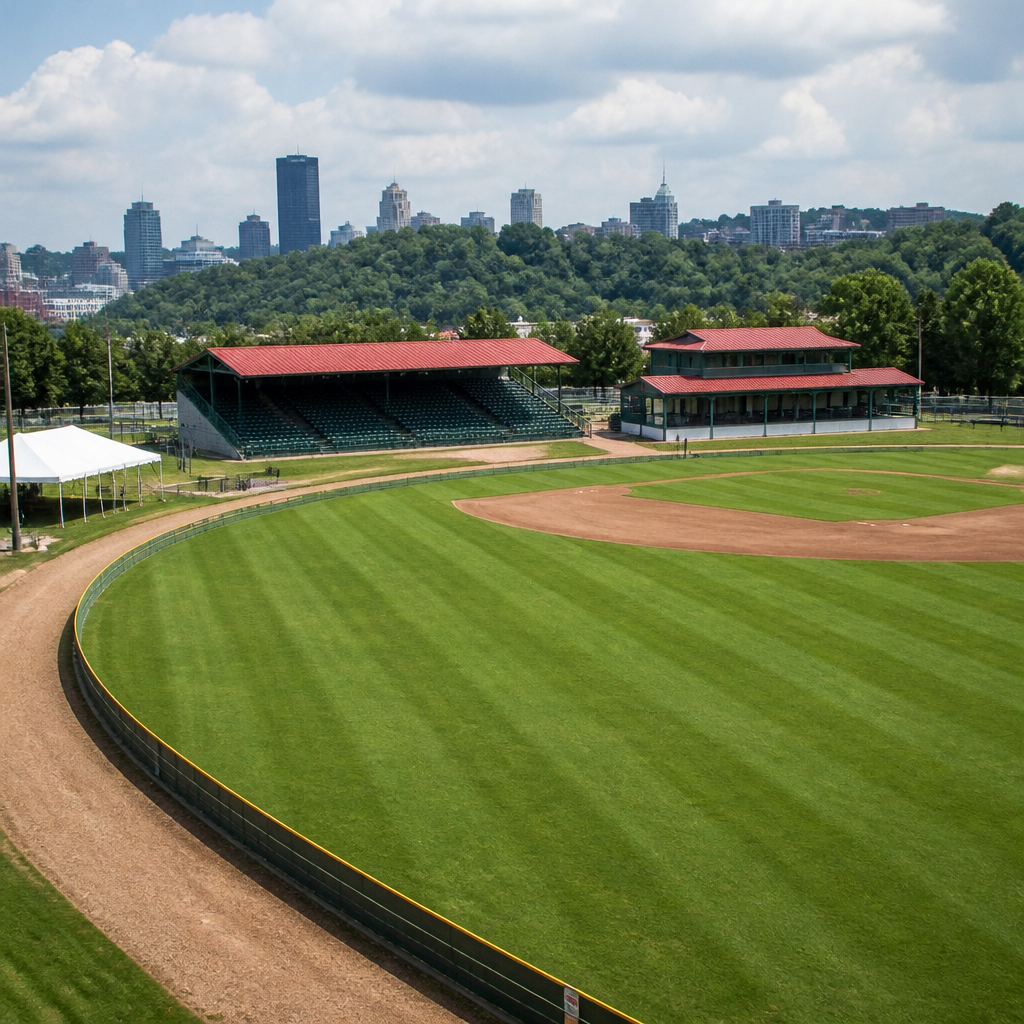
Exposition Park occupies a singular place in baseball history because it was the Pittsburgh ballpark of the 1903 World Series, the first modern Fall Classic, and because it stands as a gateway to understanding lost MLB ballparks more broadly. Located on Pittsburgh’s North Side along the Allegheny River, Exposition Park served the Pittsburgh Pirates during a formative era when professional baseball was still defining its rules, business model, and relationship with urban America. For readers exploring iconic ballparks, this site matters not simply as a vanished structure, but as a case study in why great stadiums disappear, how historians reconstruct them, and what these lost venues still tell us about the game.
When historians refer to a lost MLB ballpark, they mean a former major league venue that no longer stands in its original baseball function and often has been demolished, redeveloped, or absorbed into a changed city landscape. Exposition Park fits that definition perfectly. Nothing about it survives in the way fans experience Fenway Park or Wrigley Field. Yet its legacy remains unusually rich because it hosted the National League Pirates at the moment major league baseball entered a new national stage. As someone who has worked through old maps, newspaper diagrams, and ballpark research archives, I can say Exposition Park is one of the clearest examples of how a seemingly modest park can anchor a major historical narrative.
Its importance begins with timing. The 1903 World Series between Pittsburgh and Boston marked the first championship series recognized as the starting point of the modern World Series tradition. Exposition Park was therefore one of the two original World Series stages. That alone secures its place in baseball memory. But the park also illustrates the practical realities of early twentieth-century stadium design: wood construction, constrained urban sites, asymmetrical dimensions, flood risk, and limited spectator amenities compared with later steel-and-concrete parks. In other words, Exposition Park is not just a place where history happened. It is a lens through which the larger story of lost MLB ballparks becomes easier to understand.
This article serves as a hub for that subtopic. Using Exposition Park as the focal point, it explains where the ballpark stood, what made it significant, why it disappeared, and how it connects to the broader pattern of vanished major league venues such as the Polo Grounds, Ebbets Field, Sportsman’s Park, the Baker Bowl, and Forbes Field. If you want to understand why old ballparks vanish, why some are preserved while others are replaced, and how forgotten sites still shape modern baseball culture, Exposition Park is the right place to start.
What Exposition Park Was and Where It Stood
Exposition Park was the home of the Pittsburgh Pirates before Forbes Field opened in 1909. More precisely, baseball historians often distinguish among several versions of Exposition Park built in Pittsburgh, but the version most associated with major league history is Exposition Park III, used by the Pirates from 1891 through 1909. It stood on the North Side of Pittsburgh, near the Allegheny River, in an area that today sits close to PNC Park. That geographic proximity creates a compelling continuity: Pittsburgh’s current ballpark and one of its earliest major league homes occupy nearly the same civic baseball ground.
The site was both advantageous and problematic. It sat near transit and population centers, helping the club draw working- and middle-class spectators in an era when access by streetcar and foot traffic mattered enormously. At the same time, the riverfront location made flooding a recurring hazard. Contemporary accounts and later research describe outfields and grounds damaged by high water, a major operational problem for a wooden venue with limited drainage technology and little margin for repair delays. In practical terms, the ballpark’s location demonstrates one of the central truths about lost MLB ballparks: many were built where land was available and affordable, not where long-term environmental stability was ideal.
Structurally, Exposition Park belonged to baseball’s transitional age. Before the rise of the classic steel-and-concrete ballparks, many major league teams played in parks built largely of wood. These parks could be intimate and atmospheric, but they were vulnerable to fire, weather, rot, and structural aging. They were also less adaptable to rising attendance demand. As baseball boomed in the early twentieth century, owners increasingly wanted larger, safer, more permanent facilities. Pittsburgh owner Barney Dreyfuss was among the executives who understood this shift, and his push toward Forbes Field reflected not merely ambition, but a practical response to Exposition Park’s limitations.
The 1903 World Series and Exposition Park’s Place in Baseball History
Exposition Park’s defining historical claim is straightforward: it hosted games in the 1903 World Series, the first modern World Series between the Pittsburgh Pirates of the National League and the Boston Americans of the American League. Pittsburgh entered that series with major stars, including Honus Wagner, and with the prestige of a strong National League club. Boston ultimately won the best-of-nine series five games to three, but Exposition Park’s role as one of the original World Series stages gives it enduring significance that exceeds the physical size or architectural grandeur of the ballpark itself.
The 1903 Series also matters because it came after years of conflict and instability between leagues. The National League and the upstart American League had battled over players, markets, and legitimacy. By 1903, the agreement to stage a championship between pennant winners symbolized a new level of order in professional baseball. Exposition Park therefore was not just hosting postseason games. It was hosting the public debut of a national ritual that would become baseball’s defining event. That connection is why any serious history of lost MLB ballparks must include Exposition Park near the top of the list.
From a fan-experience standpoint, the 1903 games would have looked and felt very different from a modern World Series. Seating capacity was smaller, sightlines were shaped by simpler grandstand design, and amenities were sparse. Spectators entered a world without giant scoreboards, luxury suites, ribbon boards, or amplified entertainment. What they received instead was proximity to the field and a more direct relationship to the game itself. Newspaper coverage from the era focused on crowd intensity, local pride, and the novelty of the championship format. Those details matter because they remind us that ballpark history is also social history. Exposition Park was a gathering place where Pittsburghers witnessed baseball becoming a national spectacle.
Why Exposition Park Was Replaced
Exposition Park disappeared for reasons that were common among lost MLB ballparks: environmental vulnerability, structural limits, and changing expectations for major league facilities. The riverfront site was chronically susceptible to flooding. For a professional club trying to maintain a reliable schedule, protect ticket revenue, and preserve field conditions, that was a major liability. Flooding was not a cosmetic inconvenience. It threatened the business of baseball.
The ballpark’s wooden construction also became increasingly outdated. By the first decade of the twentieth century, the sport’s leading owners saw permanent steel-and-concrete parks as the future. These venues could hold more fans, reduce fire risk, and project civic importance. Forbes Field, which replaced Exposition Park in 1909, embodied that next generation. It offered a stronger structure, a different neighborhood setting in Oakland, and a more durable business foundation for the Pirates. In my experience studying ballpark transitions, this pattern is almost universal: an old park rarely vanishes because of one flaw alone. It usually disappears when several weaknesses become impossible to ignore at the same time.
Exposition Park’s replacement also reflected baseball’s growth as urban entertainment. Teams wanted facilities that matched their ambition and their audience size. What had once been adequate quickly looked cramped or obsolete. This is a crucial theme for anyone researching lost MLB ballparks. Demolition often feels regrettable in hindsight, but at the moment of replacement, owners and many fans usually saw the new park as progress. The challenge for historians is to hold both truths together: the old ballpark may have been beloved, and replacing it may still have been rational.
Exposition Park in the Wider Story of Lost MLB Ballparks
Exposition Park is an ideal hub point because it connects neatly to the larger history of vanished major league venues across the United States. Some disappeared because of fire, like early wooden parks. Some were overtaken by neighborhood change or highway construction. Others became economically uncompetitive as attendance patterns shifted and teams demanded parking, larger capacities, and newer revenue streams. Although each site has its own story, the recurring pressures are strikingly consistent.
| Ballpark | City | Primary reason it was lost | What it represents |
|---|---|---|---|
| Exposition Park | Pittsburgh | Flood risk and obsolescence | Transition from wooden riverfront parks to permanent modern venues |
| Ebbets Field | Brooklyn | Relocation and redevelopment pressure | The emotional cost of franchise movement |
| Polo Grounds | New York | Newer alternatives and shifting urban priorities | Multi-era baseball history in one site |
| Baker Bowl | Philadelphia | Structural problems and limited expansion potential | The danger of outdated infrastructure |
| Sportsman’s Park | St. Louis | Team moves and changing ownership economics | How franchise instability reshapes places |
| Forbes Field | Pittsburgh | Capacity, parking, and modernization demands | The later cycle that replaced even landmark concrete parks |
Seen in that company, Exposition Park represents the earliest phase of a repeating cycle. A ballpark opens as a practical solution, becomes historically meaningful through the games played there, then falls behind new commercial and civic expectations. Later generations regret the loss because memory assigns value that the market once ignored. That is not cynicism. It is the normal life cycle of sports architecture in American cities.
How Historians Reconstruct a Vanished Ballpark
Because Exposition Park no longer stands, understanding it requires careful reconstruction from evidence. Reliable ballpark history is built from Sanborn fire insurance maps, team records, city directories, newspaper accounts, photographs, postcards, and the work of researchers who compare conflicting sources. Dimensions can vary across publications, and contemporary reporting sometimes favored approximation over precision. That means a good historian does not repeat a single number blindly. Instead, the historian compares sources and explains uncertainty where necessary.
For Exposition Park, mapping its location relative to today’s street grid and nearby PNC Park helps modern readers grasp the site physically. Photographs and illustrations reveal the modest scale of the grandstand and the utilitarian nature of the construction. Newspaper stories about floods and attendance illuminate operating conditions better than architectural plans alone. I have found that lost ballpark research becomes most persuasive when it combines geography, images, and game context. A stadium was never just boards and seats. It was a working urban place shaped by weather, transit, crowd behavior, and business realities.
This method matters across the entire lost MLB ballparks category. Without disciplined sourcing, myths spread easily. Fans may romanticize every vanished park as perfect, intimate, and unfairly destroyed. The record is more interesting than that. Many old parks were charming and historically important, but they could also be uncomfortable, hazardous, and badly compromised by their sites. Exposition Park deserves respect not because it was flawless, but because it mattered.
What Fans and Researchers Should Take From Exposition Park
Exposition Park teaches three lasting lessons. First, baseball history is deeply tied to place. The 1903 World Series was not an abstract event; it happened in a specific urban riverfront setting with all the local constraints that implied. Second, lost MLB ballparks are essential to understanding how the sport evolved. You cannot explain why teams built the great concrete parks, and later the multipurpose parks, and later the retro-classic parks, without understanding what came before. Third, preservation in baseball is always selective. A few stadiums survive. Many more live only through archives, scholarship, and public memory.
For fans visiting Pittsburgh, the Exposition Park story adds depth to the experience of seeing PNC Park and the surrounding North Side. The modern ballpark offers comfort, beauty, and engineering sophistication, but it also sits in dialogue with the city’s earlier baseball homes. That continuity is one of the pleasures of studying iconic ballparks. Even when a stadium is gone, the ground beneath it still holds meaning if you know what happened there.
Exposition Park remains one of the most important lost MLB ballparks because it links Pittsburgh, the first modern World Series, and the broader evolution of baseball architecture in one compact story. It shows how a wooden riverside park could become nationally significant, why practical limitations eventually forced change, and how historians recover value from places that no longer exist. For anyone building real knowledge of iconic ballparks, this site is the essential starting point for the lost-ballpark branch of the subject. Explore the related stadium histories, compare why each vanished, and you will understand baseball’s past with far greater clarity.
Frequently Asked Questions
Why is Exposition Park so important to baseball history?
Exposition Park is historically significant because it was the Pittsburgh home of the 1903 World Series, the first modern World Series recognized by Major League Baseball. That fact alone gives the ballpark a permanent place in the sport’s national story. The park hosted games between the Pittsburgh Pirates and the Boston Americans at a moment when baseball was transforming from a regional entertainment business into a more organized, commercially powerful major sport. In other words, Exposition Park was not just a venue; it was part of the setting in which modern baseball traditions began to take shape.
Its importance also extends beyond the 1903 championship. Exposition Park helps historians and fans understand what early major league baseball looked and felt like before the construction of the larger, more famous steel-and-concrete parks that would define the next era. It belonged to a generation of ballparks that were more vulnerable to weather, crowding, fire, and flooding, and that were often tightly woven into the industrial neighborhoods around them. Because so few of these early parks survive, Exposition Park serves as a key reference point for understanding how baseball developed physically, economically, and culturally in the early twentieth century.
For Pittsburgh specifically, the park marks an important stage in the rise of the Pirates as a major National League club. It connects the city’s baseball past to a broader civic identity rooted in industry, riverfront geography, and working-class spectatorship. When people study Exposition Park, they are really studying the intersection of sports history, city history, and the evolution of American leisure.
What happened at Exposition Park during the 1903 World Series?
Exposition Park was one of the principal stages for the 1903 World Series, which matched the Pittsburgh Pirates of the National League against the Boston Americans of the American League. This series was groundbreaking because it represented the first modern postseason championship between the two leagues, establishing a model that would eventually become baseball’s premier annual event. Pittsburgh entered the series with star power and high expectations, and Exposition Park became the site where local fans watched their club compete in a contest that carried historic weight far beyond the city.
The ballpark hosted multiple games in the series, bringing unusually intense national attention to Pittsburgh. Newspapers closely followed attendance, strategy, player performances, and the broader implications of the new championship arrangement. The Pirates won the first game of the series, giving Pittsburgh reason for optimism, but Boston ultimately captured the championship in eight games. Even though Pittsburgh did not win the title, Exposition Park’s role in those contests secured its status as one of the most historically meaningful grounds in early baseball.
What makes those games especially compelling today is the atmosphere they suggest: packed wooden stands, a riverside setting, and fans witnessing something entirely new without yet knowing how famous the World Series would become. Looking back, Exposition Park was not merely the location of baseball games; it was the environment in which the concept of a championship spectacle first gained real, lasting form.
Where was Exposition Park located, and what was the ballpark environment like?
Exposition Park was located on Pittsburgh’s North Side near the Allegheny River, a placement that strongly influenced both its character and its challenges. The site reflected the realities of urban baseball at the turn of the twentieth century, when clubs often played in parks squeezed into rapidly developing city landscapes. Rather than being isolated destination complexes in the modern sense, early ballparks were embedded in the everyday life of surrounding neighborhoods, close to factories, homes, streetcar lines, bridges, and commercial corridors. Exposition Park fit that pattern perfectly.
The environment would have felt very different from a contemporary stadium experience. Seating was more modest, the ballpark’s materials were far less permanent, and the boundaries between the city and the game were less sharply defined. Spectators entered a venue that was functional rather than luxurious, and the surrounding riverfront setting gave the park a distinctive sense of place. The Allegheny was an ever-present geographic feature, adding scenic value but also creating practical problems, especially flooding. This is one of the central reasons Exposition Park is so useful to historians: it illustrates how natural geography could shape the daily operation of an early major league club.
That location also helps explain why the park feels so evocative in retrospect. It stood in a Pittsburgh deeply marked by industry and transportation, making it a vivid example of how baseball grew within America’s industrial cities. To imagine Exposition Park properly is to imagine a ballpark that was part of the urban fabric rather than set apart from it. That is a crucial distinction when comparing lost parks of the early era with the purpose-built stadiums fans know today.
Why didn’t Exposition Park survive, and what replaced it in Pittsburgh baseball history?
Exposition Park did not survive because it belonged to a transitional generation of ballparks that were often considered inadequate by the standards of a growing major league game. As baseball became more popular, teams needed larger capacities, better amenities, and more reliable facilities. Wooden parks like Exposition Park could be difficult to maintain and were particularly vulnerable to environmental problems, including flooding in this case. Its riverside location near the Allegheny was memorable, but it was not ideal for the long-term needs of a successful franchise seeking stability and expansion.
The Pittsburgh Pirates eventually moved to Forbes Field in 1909, a much more modern and ambitious ballpark located in Oakland. That move reflected a broader shift in baseball architecture and business strategy. Clubs across the major leagues were beginning to invest in larger, more durable steel-and-concrete stadiums that projected permanence and civic prestige. Forbes Field represented the next phase of baseball’s development, while Exposition Park came to symbolize the earlier, rougher, more improvised chapter of the sport.
Its disappearance is part of what makes it so fascinating now. Many of baseball’s earliest grounds vanished because they were not built to last, and at the time few people imagined the degree to which future generations would value them as historic landmarks. Exposition Park survives mainly through maps, photographs, newspaper accounts, and historical research. That pattern is common among lost ballparks, which is why Exposition Park often serves as a starting point for discussing how baseball preserves memory even when the original structures are gone.
How does Exposition Park help us understand lost MLB ballparks more broadly?
Exposition Park is an ideal case study for exploring lost MLB ballparks because it combines historical significance, geographic specificity, and architectural impermanence. It mattered enormously in its own time, yet it no longer exists in a way modern fans can experience directly. That gap between past importance and present absence is at the heart of ballpark history. By studying Exposition Park, readers can see how much of early major league history unfolded in venues that were essential to the game’s growth but were never preserved as monuments.
It also reveals how different the early baseball landscape was from the one fans often imagine. Today, iconic ballparks are marketed as heritage sites and civic treasures, but in the late nineteenth and early twentieth centuries many parks were pragmatic business properties. They were built quickly, altered frequently, and discarded when teams found better options. Exposition Park demonstrates that process clearly. It shows how ownership priorities, urban land pressures, transportation access, and environmental risk all influenced where teams played and how long a park lasted.
Most importantly, Exposition Park reminds us that baseball history is not limited to surviving landmarks like Fenway Park or Wrigley Field. Much of the sport’s foundational story took place in vanished settings. Recovering those places through research allows historians to reconstruct the lived experience of early fans, players, and cities. In that sense, Exposition Park is more than a lost Pittsburgh ballpark. It is a gateway to understanding how memory, place, and the evolution of professional baseball all intersect.