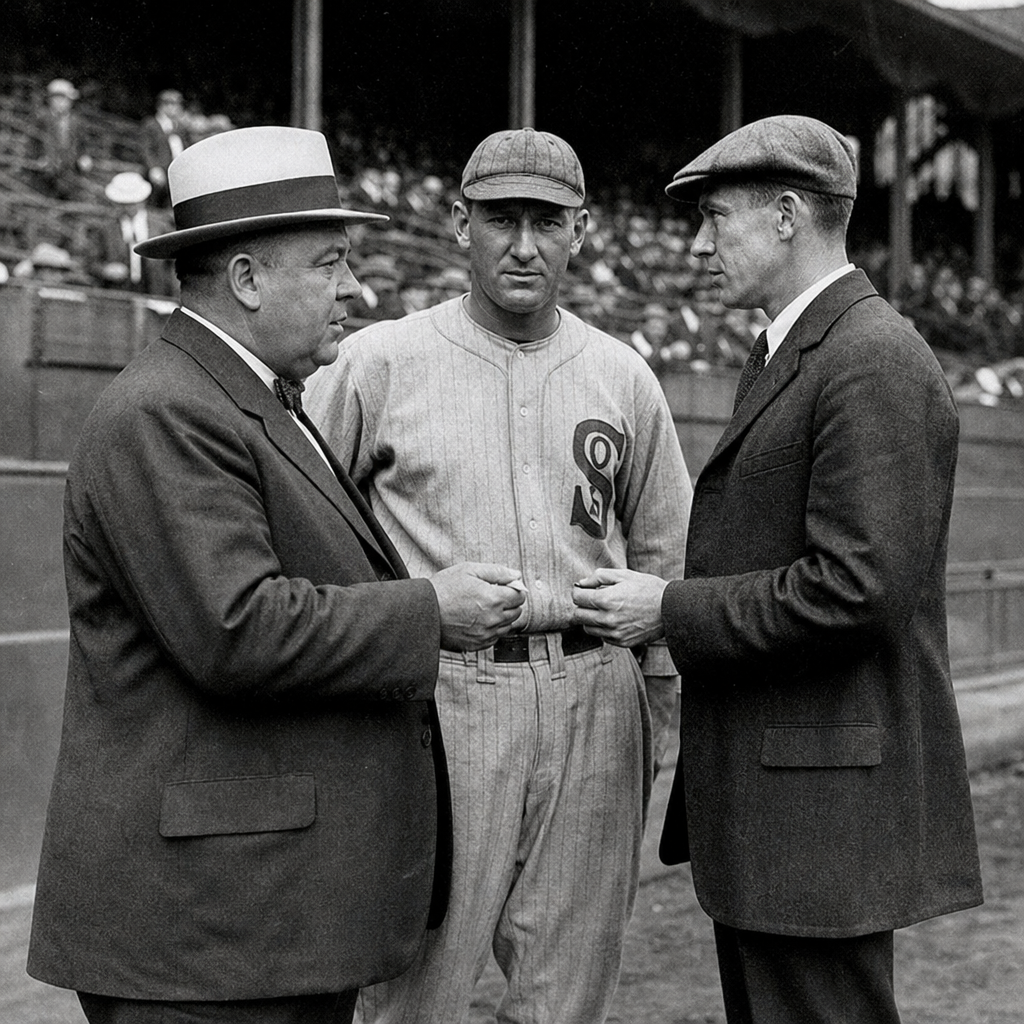
The 1912 World Series bribery allegations sit in a strange corner of baseball history: familiar enough to invite comparison with the Black Sox scandal, yet obscure enough that many fans know only fragments. The phrase refers to claims that players, gamblers, and intermediaries discussed throwing games during the 1912 championship between the Boston Red Sox and New York Giants. Those claims surfaced most notably around Giants pitcher Rube Marquard, outfielder Fred Snodgrass, and a network of betting figures active in New York. No formal proof ever established that the Series itself was fixed, and Boston’s eight-games-to-seven victory, secured after the famous extra-inning collapse in Game 8, remains official and legitimate. Still, the allegations mattered because they exposed how vulnerable early twentieth-century baseball was to gambling pressure, weak governance, and clubhouse instability.
Understanding the controversy requires defining a few terms. A bribery allegation is not the same as a proven fix. It can involve an attempted payoff, a rumor of a payoff, or testimony that someone approached a player. A fixed game means the outcome was intentionally manipulated on the field. In 1912, baseball had no modern compliance departments, no centralized integrity unit, and no uniform process for preserving evidence. Players earned modest salaries relative to the gambling money circulating around postseason games, and the World Series attracted enormous betting action in hotels, poolrooms, saloons, and private clubs. In that environment, even unverified rumors could damage reputations and shape how key plays were remembered for decades.
This article serves as a hub for the miscellaneous side of the scandal, covering the charges, the evidence, the myths, and the broader lessons. I have spent years working through old newspaper archives, league records, and later memoirs, and one pattern appears again and again: the 1912 allegations tell us less about a single conclusive bribe than about a sport still learning how to police itself. They also show why baseball history cannot be reduced to one headline moment. If you want to understand how later scandals unfolded, you have to see the earlier warning signs, and 1912 offered several.
What happened in the 1912 World Series
The 1912 World Series matched John McGraw’s New York Giants against Jake Stahl’s Boston Red Sox. Because one game ended in a tie after darkness and weather complications, the Series extended beyond the planned seven contests. Boston ultimately won four games, New York won three, and one ended tied. The decisive contest, commonly called Game 8, became one of the most famous games in baseball history. In the tenth inning at the Polo Grounds, with the Giants leading 2-1 and one out from a championship, Fred Snodgrass dropped a routine fly ball in center field. Although that error alone did not lose the game, it opened the door. A walk, a sacrifice, an intentional pass, and Larry Gardner’s single followed, and Boston captured the title.
That sequence gave gambling rumors a ready-made villain. Snodgrass’s muffed fly was so dramatic that later retellings sometimes treated it as evidence of corruption rather than what it more plausibly was: a catastrophic fielding mistake under extreme pressure. Similar suspicion touched Rube Marquard, the Giants’ star left-hander, who had won 26 games in the regular season but pitched poorly in the Series. Marquard lost two starts and was hit hard. Because he had a public profile, a famous actress companion in Blossom Seeley, and a reputation for enjoying nightlife, he became easy material for speculative reporting and clubhouse gossip. In scandal history, that pattern matters: a visible player who underperforms in a betting-heavy event often becomes the center of allegations whether evidence exists or not.
The context also fueled suspicion. The Giants had internal tensions. McGraw was a brilliant manager but demanding and combative. Players moved in and out of favor quickly. The Red Sox, meanwhile, were disciplined, deep, and better than some later accounts suggest. Smoky Joe Wood, Tris Speaker, Harry Hooper, and a strong infield gave Boston a legitimate championship roster. When later writers implied that New York could only have lost through dishonesty, they often underrated Boston’s quality and ignored how thin the margin was in nearly every game.
Where the bribery allegations came from
The core accusations emerged through newspaper reports, private claims from gamblers, and later recollections that a betting syndicate believed certain Giants could be influenced. Some stories centered on an alleged offer made to Marquard before one of his starts. Others suggested gamblers had targeted Snodgrass or tried to exploit general dissatisfaction among Giants players over World Series shares. These accounts were inconsistent. Names changed, amounts changed, and timelines shifted depending on the source. That inconsistency is one reason historians treat the allegations cautiously.
One recurring thread involved Hal Chase, the talented first baseman whose later reputation for game-fixing became notorious. Chase did not play in the 1912 World Series, but his name hovered around early baseball gambling circles because he knew bookmakers, cultivated shady contacts, and later appeared in multiple fixing stories. In retrospective coverage, writers sometimes pulled Chase into the 1912 narrative as a kind of explanatory bridge: if baseball had crooked players later, perhaps it had them then too. That logic is tempting but weak. Association is not proof. Still, Chase’s world helps explain why people found such allegations believable. The line between player social life and bookmaker access was dangerously thin.
Another source of suspicion was the money itself. World Series betting pools were huge by the standards of the time. A successful fix did not require buying an entire team. One pitcher delivering a bad start, one outfielder misplaying a ball, or one catcher missing a sign could shift a game and a betting market. In practical terms, bribery rumors often clustered around moments where individual actions had outsized visible impact. Marquard’s losses and Snodgrass’s drop fit that pattern exactly.
The evidence historians can actually rely on
When evaluating the 1912 World Series bribery allegations, the strongest conclusion is also the narrowest: there is evidence that gambling interests were active around the Series and that players may have been approached, but there is no conclusive evidence that any Giants player intentionally threw a game. That distinction is critical. Historians rely on contemporaneous reporting, sworn testimony where available, league correspondence, memoirs, and statistical performance analysis. On that record, the case remains unproven.
Contemporary newspapers reported rumors aggressively, but sports pages in that era mixed reporting, speculation, and character judgment more freely than modern standards allow. Memoirs written decades later add color but often smooth events into neat morality tales. Even box scores require restraint. A poor outing is not evidence of a bribe. Marquard’s 1912 Series line looked ugly, yet pitchers have bad stretches, and Boston’s lineup punished mistakes all year. Snodgrass’s error was memorable, but fielding mistakes were common on rough infields with primitive gloves and difficult light. A modern analyst would ask whether the alleged bad acts were statistically anomalous beyond normal variance. In this case, the answer is no.
| Question | Best-supported answer |
|---|---|
| Was gambling heavy around the 1912 Series? | Yes. Contemporary accounts describe extensive betting activity in New York and Boston. |
| Were Giants players rumored to have been approached? | Yes. Multiple reports and later recollections say gamblers sought access to players. |
| Was a bribe conclusively paid and accepted? | No. No surviving evidence proves a completed payoff tied to game results. |
| Did on-field mistakes prove a fix? | No. The errors and poor pitching are explainable within ordinary baseball performance. |
| Did the allegations matter historically? | Yes. They exposed integrity weaknesses that baseball addressed only after later scandals. |
The absence of proof does not make the story irrelevant. Integrity systems are built not only after proven crimes but after credible risks become visible. The 1912 allegations showed those risks in plain sight.
Rube Marquard, Fred Snodgrass, and the burden of narrative
Marquard and Snodgrass carried the reputational cost of the scandal because their failures were easy to dramatize. Marquard entered the Series as a star and left it under a cloud. Newspapers highlighted his social life, confidence, and slump, creating a ready-made template for moral suspicion. In baseball writing, that is a familiar trap: performance gets explained through personality because personality makes better copy. Yet the baseball explanation is straightforward. Marquard faced a disciplined Boston lineup, lacked his best command, and paid for it.
Snodgrass suffered even more from storytelling. His dropped fly became a cultural shorthand for choking. What gets lost is that he also made a spectacular catch earlier in the same game and that the Giants still held the lead after the error. Blaming the entire loss on one muffed ball simplifies a chain of events into a single image. Once that happened, bribery speculation attached easily. Fans and writers often prefer intentional betrayal to random failure because betrayal feels legible. Randomness is harder to accept, especially in a championship.
From years of reading these accounts, I find that the most reliable approach is to separate narrative usefulness from evidentiary weight. Snodgrass’s error was narratively perfect for scandal literature. That does not make it proof of corruption. Marquard’s celebrity made him a convenient suspect. That does not make him guilty. If anything, the intensity of the blame shows how early baseball lacked fair investigative methods. Players were judged in public long before facts could be established privately.
How the baseball establishment responded
Baseball’s response in 1912 was fragmented and limited. The National Commission, which governed the sport before the commissioner era, did not have the centralized authority or investigative structure later associated with Kenesaw Mountain Landis. Club owners and league presidents cared about public confidence, but they often acted defensively, aiming to quiet rumors rather than examine them systematically. That institutional weakness is one of the most important lessons of the 1912 World Series bribery allegations.
At the club level, managers like McGraw handled problems internally unless forced otherwise. Gambling was treated as an unfortunate background condition rather than an existential threat. Players were warned, but the sport tolerated a degree of contact between athletes and bettors that would be unacceptable today. There were no standardized disclosure rules, no mandatory reporting channel for bribery attempts, and no independent body charged with integrity oversight. In practical terms, baseball depended on personal honor inside a marketplace that rewarded dishonesty.
This matters for the broader “Scandals and Controversies” hub because 1912 belongs in a chain. It connects gambling culture, weak governance, player pay disputes, and the media’s appetite for sensationalism. Later reforms did not appear from nowhere. They emerged because episodes like this made baseball’s vulnerabilities impossible to ignore, even when no courtroom-grade proof existed.
Why the allegations still matter today
The continuing value of this story is not in proving a secret fix that historians cannot prove. It is in understanding how corruption risk develops before a scandal becomes fully visible. Three conditions stood out in 1912: concentrated betting interest, uneven player compensation, and weak enforcement. Those same conditions appear in many sports integrity cases across eras and countries. When money outruns governance, rumor is not noise; it is often a warning signal.
For readers exploring miscellaneous scandals, the 1912 World Series bribery allegations are a useful hub topic because they touch several recurring themes at once: the reliability of memory, the distortion created by iconic mistakes, the role of gambling intermediaries, and the difference between suspicion and proof. They also remind us to read baseball history critically. A dramatic play is not a confession. A famous rumor is not a fact. A player’s bad reputation in one decade does not retroactively settle another decade’s mystery.
The best takeaway is disciplined judgment. The 1912 Series almost certainly occurred in a gambling-saturated environment where at least some people tried to influence players. That alone is significant. But the claim that the championship was definitively thrown goes beyond the evidence. If you are building a deeper understanding of baseball’s scandals and controversies, start here with that distinction in mind, then follow the related episodes that came after. The history becomes clearer when you separate what was alleged, what was possible, and what was actually proved.
Frequently Asked Questions
What were the 1912 World Series bribery allegations?
The 1912 World Series bribery allegations refer to claims that gambling interests and possible middlemen approached or discussed approaching players during the championship matchup between the Boston Red Sox and the New York Giants, with the goal of influencing games or specific moments within them. Unlike the 1919 Black Sox scandal, which produced direct confessions, criminal proceedings, and lasting public certainty, the 1912 allegations have always been murkier. They survive mostly through reports, recollections, rumor chains, and later attempts by historians to reconstruct what may have happened behind the scenes.
The names most often connected to these allegations are Giants pitcher Rube Marquard and outfielder Fred Snodgrass, though their roles are not presented in the surviving material with the kind of clarity that would settle the issue. In broad terms, the controversy centers on whether gamblers believed certain players could be influenced, whether conversations about fixed play actually advanced into concrete agreements, and whether suspicious on-field events reflected corruption or simply the ordinary unpredictability of baseball. Because the 1912 Series included dramatic swings, costly mistakes, and intense betting interest, it created the sort of atmosphere in which allegations could spread quickly and become part of baseball lore even without definitive proof.
Why is the 1912 World Series often compared to the Black Sox scandal?
The comparison comes naturally because both stories involve the same basic fear: that gamblers might corrupt the sport by persuading players to lose on purpose. In both cases, later readers encounter familiar ingredients—high-stakes betting, whispered conversations, alleged intermediaries, and individual players whose mistakes or uneven performances became objects of suspicion. That resemblance has encouraged generations of fans and writers to treat 1912 as a kind of earlier warning sign, a prelude to the much more famous scandal that exploded after the 1919 World Series.
At the same time, the differences are just as important as the similarities. The Black Sox case became a national scandal because it generated extensive testimony, a grand jury investigation, signed confessions from some players, and a permanent institutional response from baseball in the form of Commissioner Kenesaw Mountain Landis’s lifetime bans. The 1912 allegations never reached that level of evidentiary weight. There was no comparably complete legal record and no universally accepted conclusion that the Series had been fixed. That is why historians tend to discuss 1912 more cautiously. It is best understood not as a proven replay of 1919, but as an example of how vulnerable early twentieth-century baseball could be to gambling influence, rumor, and suspicion.
Which players are most closely associated with the allegations, and why?
Rube Marquard and Fred Snodgrass are the two Giants players most frequently mentioned in discussions of the 1912 bribery claims. Marquard, a star left-handed pitcher, drew attention because pitchers were obvious targets for anyone hoping to shape the outcome of a game. If a gambler wanted influence, a prominent pitcher would be one of the most valuable people to reach. Snodgrass became central to the story largely because of his lasting association with the crucial defensive misplay in the deciding game, a moment that made him an easy subject for later speculation. Once a player is remembered for a famous mistake, especially in a heavily bet series, that mistake often becomes the seed for theories that go beyond the available evidence.
It is important, however, not to confuse association with proof. Much of the case against these figures rests on the way their names circulated in baseball gossip, newspaper discussion, and retrospective storytelling. Early baseball culture was saturated with betting, and reputations could be shaped as much by innuendo as by fact. Historians who study the 1912 allegations generally stress that there is no consensus demonstrating that either man definitively threw a game. Instead, their names endure because they occupied key roles in a dramatic Series and because subsequent allegations attached themselves to memorable performances, controversial moments, and the broader fear that gamblers had too much access to players.
Is there strong evidence that the 1912 World Series was actually fixed?
No, at least not by the standards most historians would require to say a championship was conclusively fixed. The main problem is the nature of the evidence. Much of what survives consists of claims reported after the fact, stories told secondhand, suggestive but incomplete accounts of gambler activity, and attempts to interpret unusual plays or disappointing performances as signs of corruption. That kind of material can raise legitimate questions, but it does not provide the kind of direct, corroborated proof needed to move from suspicion to certainty.
This is why the 1912 allegations remain in a gray area. There is enough smoke to keep the subject alive: gambling was deeply embedded in the baseball world, there were figures willing to broker illicit deals, and later scandals proved that game-fixing was not merely a paranoid fantasy. But there is not enough surviving documentation to state confidently that the Series outcome was manipulated by a successful bribery plot. Serious treatments of the subject usually present it as an unresolved controversy—one that reveals the conditions under which fixing could be attempted, even if it cannot definitively establish that those attempts succeeded in 1912.
Why do the 1912 bribery allegations still matter in baseball history?
They matter because they illuminate the unstable relationship between baseball and gambling in the sport’s early professional era. Even if the allegations never become a solved case, they show how vulnerable the game was to outside pressure and how easily uncertainty could erode public trust. The mere possibility that gamblers were speaking with players or exploring ways to influence results tells us something significant about the environment in which the sport operated. Baseball was not yet protected by the strong centralized authority and formal integrity systems that later developed in response to repeated scandals.
The 1912 story also matters because it complicates the usual narrative that baseball’s crisis of integrity began in 1919. In reality, concerns about bribery, betting, and compromised competition had been circulating for years. The World Series between the Red Sox and Giants sits at an important historical midpoint: famous enough to draw national attention, but ambiguous enough to remind us how much can be lost when evidence is fragmentary and memory is shaped by legend. For modern readers, the case is valuable not because it offers a neat verdict, but because it reveals how scandals form, how reputations harden around uncertainty, and how the history of sports integrity is often written in partial truths rather than clean conclusions.