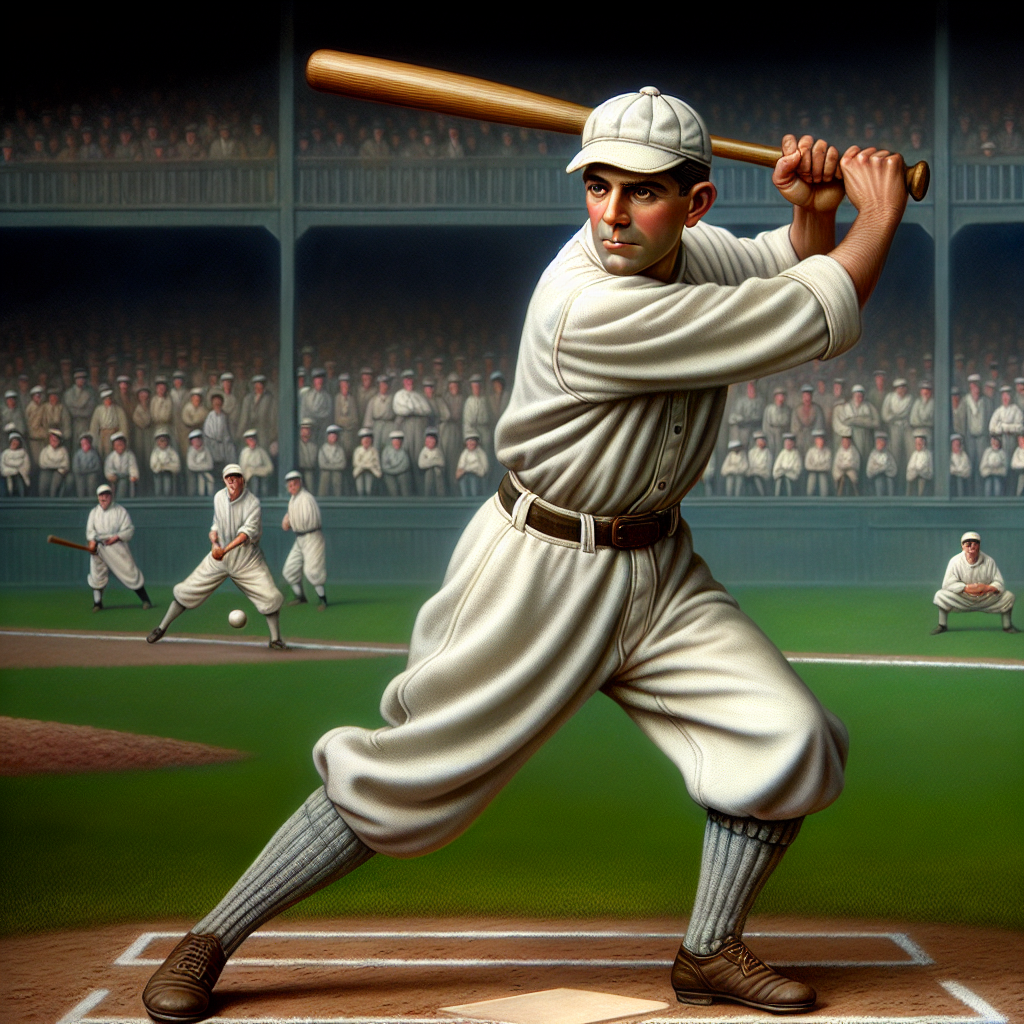
In the annals of baseball history, few names elicit as much reverence as Roger Hornsby. Often referred to as “The Rajah,” Hornsby remains one of the most prodigious hitters the game has ever seen. His career, which spanned from the end of the Deadball Era to the rise of Babe Ruth and beyond, is a testament to his enduring talent and dedication to the sport. With a batting average of .358, the second highest in Major League Baseball history, and a .424 on-base percentage, Hornsby’s offensive prowess is beyond dispute. Over the course of his career, he earned seven National League batting titles, two Triple Crowns, and two MVP awards, solidifying his place among the game’s immortals. But who was Roger Hornsby beyond the statistics? What made him such a formidable player, and how did he influence the game of baseball?
Roger Hornsby was born on April 27, 1896, in Winters, Texas, and grew up in a typical farming household. The youngest of five children, Hornsby showed an early interest in baseball, despite the many demands of farm life. His upbringing instilled in him a work ethic that would later translate into his relentless pursuit of hitting perfection. By the time he entered the minor leagues as a teenager, it was clear that he was no ordinary player. His prodigious talent quickly caught the attention of Major League scouts, leading to his debut with the St. Louis Cardinals in 1915.
In this article, we will delve into Roger Hornsby’s early years, his rise to stardom, his remarkable achievements, and his lasting impact on the game of baseball. Through a detailed examination of his career and contributions, we aim to paint a comprehensive picture of “The Rajah’s Hitting Mastery”.
Early Years and Rise to Stardom
From his earliest days in Winters, Texas, it was clear that Roger Hornsby was destined for greatness. Growing up in a rural environment, Hornsby faced significant challenges, but these obstacles only served to strengthen his resolve and work ethic. By the time he was a teenager, he had developed a deep passion for baseball, and his exceptional talent was readily apparent to those around him.
Hornsby’s professional career began in earnest in 1914 when he joined the Denison Champions of the Texas-Oklahoma League. Although his initial stint in professional baseball was met with mixed results, Hornsby remained undeterred. His work ethic and determination to improve his skills soon paid off, and his performance quickly garnered the attention of Major League scouts. In 1915, at the tender age of 19, he made his Major League debut with the St. Louis Cardinals.
Hornsby’s early years with the Cardinals were marked by steady improvement. Initially used as a utility infielder, he soon found a permanent home at second base. His rookie season provided a glimpse of his potential, but it wasn’t until 1920 that he truly broke out. That year, Hornsby led the league with a .370 batting average and 218 hits, establishing himself as one of the premier hitters in the game. This was just the beginning of what would become a storied career.
The early 1920s saw Hornsby reach new heights. He captured his first National League batting title in 1920, and from 1920 to 1925, he won six consecutive batting titles, a feat that solidified his reputation as an offensive juggernaut. His 1922 season was particularly remarkable, as he posted a .401 batting average and an impressive 42 home runs. These achievements were only a prelude to the peak of his career.
The Peak of Hornsby’s Career
If Roger Hornsby had made his mark during the early 1920s, the mid-decade was when he truly cemented his status as a legend. The 1924 season is often considered one of the greatest individual offensive seasons in baseball history. Hornsby batted an astounding .424, a record that still stands as the highest single-season batting average in the post-1900 era.
Hornsby’s consistency with the bat during this period was unparalleled. He was not just a high-average hitter; he combined power with precision in a way that was rare for his era. In the 1925 season, he earned his second Triple Crown by leading the league in batting average (.403), home runs (39), and RBIs (143). This performance earned him his first MVP award, further validating his legendary status.
Besides his prowess as a hitter, Hornsby was also an adept fielder, often praised for his defensive contributions at second base. His ability to excel in all facets of the game made him an invaluable asset to his team. In 1926, Hornsby took on the dual role of player-manager for the Cardinals and led the team to a World Series championship—a feat that showcased his leadership and strategic acumen.
By the end of the 1920s, Hornsby had established himself as one of the most complete players in baseball history. His combination of batting excellence, fielding skills, and leadership qualities set a standard that few have matched. However, his career was far from over, and the subsequent years would bring new challenges and opportunities.
Transitions and Challenges
The late 1920s and early 1930s were a period of transition for Roger Hornsby. After an illustrious tenure with the Cardinals, a series of trades saw him don different uniforms. In 1927, he was traded to the New York Giants, a move that marked the beginning of a journeyman phase in his career.
Despite the changes in scenery, Hornsby continued to be an offensive force. In 1928, now playing for the Boston Braves, he captured his seventh batting title with a .387 average. His time in Boston, however, was short-lived, and he was traded to the Chicago Cubs in 1929.
While with the Cubs, Hornsby experienced both triumph and adversity. His first season in Chicago was a resounding success, as he led the league in both average (.380) and on-base percentage (.459). The Cubs also reached the World Series that year, although they ultimately fell to the Philadelphia Athletics. Unfortunately, injuries began to take a toll on Hornsby, and his performance in subsequent seasons was hampered by physical ailments.
In 1932, Hornsby returned to the Cardinals for a brief stint before being traded to the St. Louis Browns, the team where he would conclude his Major League career. The Browns, a perennial underdog in the American League, provided Hornsby with a final platform to showcase his hitting skills. Although his numbers declined, his reputation as one of the game’s greatest hitters remained unblemished.
Legacy and Impact on Baseball
Roger Hornsby’s contributions to baseball extend far beyond his impressive statistics. His approach to hitting revolutionized the game and influenced generations of players. Hornsby was a staunch advocate of a disciplined, scientific method to hitting, emphasizing the importance of vision, timing, and balance. He often shared his insights with teammates and aspiring hitters, leaving a lasting impact.
Hornsby’s legacy can also be seen in his role as a mentor and manager. Even after his playing days ended, he continued to impart his knowledge to younger players, helping to shape the next generation of baseball talent. His tenure as a manager, though marked by mixed results, highlighted his deep understanding of the game and his passion for teaching.
Hornsby’s influence extended beyond Major League Baseball. He authored several books on hitting and baseball strategy, providing valuable resources for players and coaches at all levels of the game. His writings emphasized the mental aspects of hitting, offering a holistic approach to mastering the craft.
In recognition of his unparalleled achievements, Roger Hornsby was inducted into the Baseball Hall of Fame in 1942. His plaque in Cooperstown serves as a testament to his enduring impact on the sport. Fans and historians continue to celebrate “The Rajah’s” contributions, and his name remains synonymous with hitting excellence.
Conclusion
Roger Hornsby’s storied career is a shining example of what can be achieved through talent, hard work, and dedication. From his humble beginnings in Winters, Texas, to his emergence as one of baseball’s greatest hitters, Hornsby’s journey is both inspiring and instructive. His remarkable achievements, including seven batting titles, two Triple Crowns, and a legacy of hitting mastery, have left an indelible mark on the sport.
Hornsby’s impact on baseball goes far beyond his playing days. His approach to hitting, his role as a mentor and manager, and his contributions to baseball literature have all helped to shape the game we know today. Players and fans alike continue to draw inspiration from his example, and his teachings remain relevant for those seeking to excel in the sport.
As we look back on the history of baseball, Roger Hornsby’s name stands out as a symbol of excellence and perseverance. His story serves as a reminder of the timeless values of hard work, discipline, and a relentless pursuit of greatness. For anyone with a passion for the game, “The Rajah’s Hitting Mastery” is a legacy worth celebrating and emulating.
Frequently Asked Questions
1. Who was Roger Hornsby and why is he called “The Rajah”?
Roger Hornsby, often lauded as “The Rajah,” is a legendary figure in the world of professional baseball, recognized for his exceptional hitting abilities. His nickname, “The Rajah,” speaks to his commanding presence on the field and his prowess at the plate. Hornsby played during an era known as the end of the Deadball Era, when the game was transitioning to a more high-scoring, power-driven style with figures like Babe Ruth on the rise. Despite the competitive environment, Hornsby distinguished himself with a remarkable career batting average of .358, the second highest in Major League Baseball history. His on-base percentage of .424 further underscores his aptitude for getting on base, whether through earning walks or striking the ball with what’s often described as surgical precision. His career is not just a testament to his talent but also an illustration of his fierce dedication to baseball, solidifying his revered status in the sport.
2. What were some of Roger Hornsby’s most significant achievements in baseball?
Among Roger Hornsby’s most outstanding achievements is his incredible batting average of .358, which ranks only behind Ty Cobb in Major League history. He was also known for his exceptional on-base percentage of .424. During his 20+ year career, Hornsby won seven National League batting titles, with an awe-inspiring six of those being consecutive from 1920 to 1925. His 1924 season remains one of the most remarkable, as Hornsby hit .424, a record that still stands today as the highest batting average in a single season since live-ball play began in 1920. In addition to his prowess at the plate, Hornsby also demonstrated leadership qualities, serving as a player-manager for several teams during his career, a role that was much more common in his era than it is today. This ability to lead while also performing at an elite level underscores why he is so revered in baseball history.
3. Why is Roger Hornsby’s batting technique considered revolutionary?
Roger Hornsby’s batting technique was notable not only for its consistency and impact but also for its form and approach. He had a distinct stance, leaning forward with a level swing that kept his legs steady, allowing him to focus entirely on timing and hand-eye coordination. Hornsby was known for his meticulous nature and work ethic; he intensely studied pitchers and constantly refined his technique through repetition. In an era when a home run was considered less common and batting for average was more emphasized, Hornsby excelled in precision hitting, consistently making contact and driving the ball with precise placement. This was both a mental and physical discipline, reflecting not just raw talent but a deep understanding of the game’s mechanics. His ability to hit effectively against all types of pitchers, under various conditions, and maintaining a high batting average throughout his career earned him a reputation that has endured through generations.
4. How did Roger Hornsby influence the evolution of hitting in baseball?
Roger Hornsby’s influence on the evolution of hitting in baseball is profound and multifaceted. During his time, baseball was undergoing a transition from the so-called “Deadball Era,” characterized by low scores and small-ball tactics like base stealing and bunting, to a new era highlighted by power hitting and higher scoring games. Hornsby played a leading role in this transition with his ability to hit for both average and power. By consistently achieving high batting averages and registering impressive slugging percentages, he proved that a batter could be both strategic and powerful, setting a new standard for what hitters could achieve. Hornsby’s style encouraged future generations to consider a more dynamic approach to hitting, blending the finesse of contact hitting with the power that later characterized players like Babe Ruth. His legacy includes not just the records he set but the methods he championed, which influenced coaching philosophies and training for hitters in subsequent generations.
5. What was Roger Hornsby’s impact on the teams he played for?
Roger Hornsby left a lasting impact on every team he was part of, not just through his individual performance, but also through his roles as leader and mentor. His time with the St. Louis Cardinals was particularly influential; from 1915 to 1926, Hornsby was the linchpin of their offense, leading the team to a World Series win in 1926. As a manager, he instilled a philosophy of hard work and unwavering commitment to practice, which paid dividends both on and off the field. Players under his guidance often noted his intense focus and his ability to analyze and exploit opponents’ weaknesses. This analytic approach, combined with his sheer batting ability, earned him respect and admiration from teammates and rivals alike. Additionally, Hornsby played critical roles in shaping the rosters of the Boston Braves, the Chicago Cubs, and other teams he contributed to throughout his prolonged career. His impact is measured not only in the statistics and championships but also in the enduring influence on team culture and the evolution of the role of player-managers in baseball.