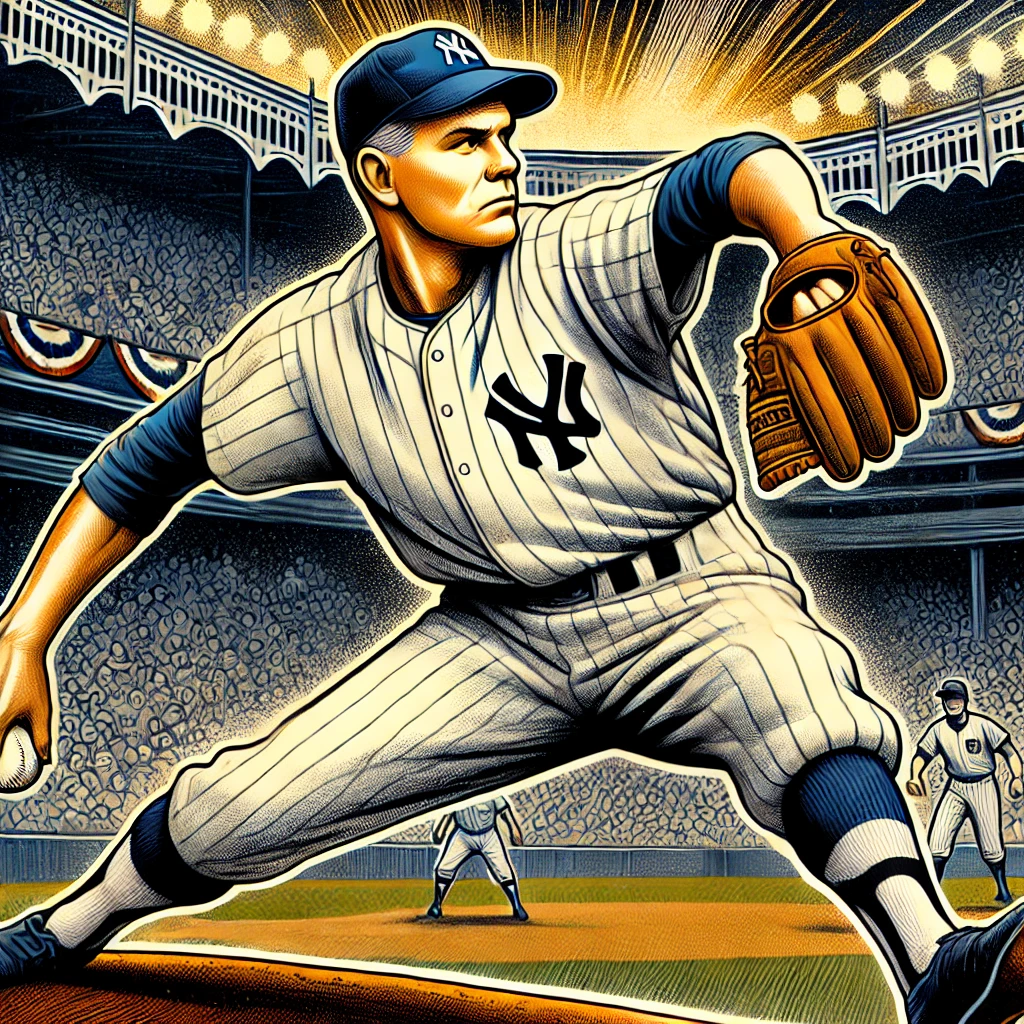
When discussing the legends of baseball, few epitomes shine as brightly as Red Ruffing, whose prowess on the mound and at the plate made him a truly unique figure in the history of America’s pastime. Charles Herbert “Red” Ruffing, who played for the Boston Red Sox, New York Yankees, and the Chicago White Sox, carved out an illustrious career that was marked not just by his exceptional pitching skills but also by his surprising batting talent. His journey through the Major Leagues is one of inspiration and admiration, leaving an indelible mark on baseball historians and enthusiasts alike.
Introduction
Red Ruffing’s career in Major League Baseball spanned from 1924 to 1947, during which he became known for his steadfast reliability and impressive dual-threat abilities. Born in Granville, Illinois, on May 3, 1905, Ruffing faced many challenges from the outset, including losing four toes on his left foot in a mining accident, which makes his achievements on the field all the more remarkable.
The early stages of his career were fraught with adversity. Playing for the Boston Red Sox, Ruffing’s initial seasons hardly hinted at the success that would follow. His turbulent beginnings saw him struggling on the mound, hampered perhaps by the aftermath of his physical impairment. However, his potential was undeniable, and a trade to the New York Yankees in 1930 acted as a catalyst for his transformation into one of baseball’s elite pitchers.
While Red Ruffing’s pitching was stellar, his batting skills were an unexpected supplement to his repertoire. In an era when pitchers rarely excelled with the bat, Ruffing’s competence as a hitter gave the teams he played for an additional edge. The combination of his pitching and batting prowess helped him secure six World Series championships with the Yankees, engraving his name in the annals of baseball history.
Early Years and Challenges
Charles Herbert Ruffing’s journey to baseball stardom was far from conventional. Born into a hardworking family in Illinois, young Charles experienced a life-altering accident that would have discouraged many. At the age of 15, Ruffing suffered a mining accident that resulted in the amputation of several toes on his left foot. The injury significantly altered his gait and mechanics, but his spirit remained unbroken.
Despite the impairment, Ruffing’s passion for baseball remained undeterred. He adapted his playing style and, against all odds, made his debut with the Boston Red Sox in 1924 at just 19 years old. His early years with the Red Sox were challenging, showcasing a record that would have disheartened lesser athletes. From 1924 to 1930, his win-loss record with the Sox stood at a dismal 39-93—a testament to both the team’s struggles and his challenges in adjusting to Major League Baseball’s rigor.
These initial hardships, however, became the bedrock of Ruffing’s tenacity. Each defeat was a stepping stone, each setback a lesson, which would ultimately fuel his later success. Perseverance became the hallmark of his career, setting the stage for a trade that would change his fortunes irrevocably.
The Shift to Success with the New York Yankees
In May 1930, Red Ruffing’s career took a significant turn when the Boston Red Sox traded him to the New York Yankees in exchange for Cedric Durst and $50,000. It was with the Yankees that Ruffing found his stride and began to build his legacy. The change of scenery seemed to rejuvenate him, and he quickly became an integral part of the Yankees’ roster.
Under the tutelage of Yankees’ manager Joe McCarthy, Ruffing flourished. The newfound stability and support of a powerhouse team allowed Ruffing to refine his pitching techniques. He developed a more strategic approach on the mound, relying on an effective fastball and a devastating overhand curve that baffled hitters.
Ruffing’s improved performance was immediate and striking. From 1931 to 1942, his statistics painted the portrait of an elite pitcher: winning records, low earned run averages (ERA), and an uncanny ability to perform under pressure. His excellence on the mound earned him a spot in six consecutive All-Star Games from 1934 to 1939, and he played a vital role in leading the Yankees to six World Series championships during his tenure.

Restrictions and Triumphs During War
Ruffing’s career was not without its interruptions. Like many of his contemporaries, he served in the military during World War II, which saw him trade his baseball uniform for one of the United States Army Air Corps. His service from 1943 to 1945 temporarily halted his career, but his contributions to his country’s war efforts further underscored his resilience and dedication.
Returning to the Yankees after the war, Ruffing faced the task of reestablishing himself in a rapidly evolving sport. Despite the physical toll and the time away, he continued to demonstrate his exceptional skills on the mound. His post-war years, although marked by the inevitability of age and prolonged absences, saw flashes of the brilliance that had defined his prime.
The culmination of his perseverance and skill was evident when he reached several career milestones after the war, including recording his 250th career win. These achievements are a testament to his enduring quality and the profound impact he had on the game of baseball.
Batting Prowess: The Unexpected Asset
While Red Ruffing’s pitching skills often take center stage, his batting abilities add a remarkable layer to his legacy. In an era when pitchers were typically poor hitters, Ruffing stood out with his above-average competence at the plate. His career batting average of .269 remains impressive for a pitcher, highlighting his versatility and value to his teams.
Ruffing’s offensive contributions provided crucial runs, often turning the tide of games and proving decisive in tightly contested matches. His 36 career home runs and a total of 273 runs batted in (RBIs) are numbers that many position players would envy, let alone a pitcher. These statistics are a testament to his dual-threat capabilities, contributing significantly to the Yankees’ success.
His batting prowess was not just a gimmick but an asset that opposing teams had to account for. Managers and players alike acknowledged Ruffing’s aptitude with the bat, which arguably made him one of the most well-rounded players of his time. This rare combination of skills reinforced his reputation as a formidable and multifaceted player in Major League Baseball.
Legacy and Hall of Fame Induction
Red Ruffing’s retirement in 1947 marked the end of an era for one of baseball’s all-time greats. His contributions to the sport were celebrated long after he hung up his cleats, and his influence was felt across generations. The culmination of his career accolades was his induction into the Baseball Hall of Fame in 1967, an honor that recognized his extraordinary contributions to the game.
The Hall of Fame induction ceremony was a fitting tribute to a player whose resilience, versatility, and excellence had left an indelible mark on baseball. The statistics only tell part of the story—his impact went beyond numbers, resonating with fans and players alike. Ruffing’s character, sportsmanship, and dedication to the game exemplified the qualities that the Hall of Fame stands for.
In addition to his Hall of Fame induction, Ruffing’s legacy is perpetuated through various accolades and honors, including the Yankees’ Monument Park, where his contributions to the team’s storied history are forever enshrined. His enduring influence is a source of inspiration for future generations, highlighting the importance of perseverance, adaptability, and excellence in the face of adversity.
Conclusion
Red Ruffing’s journey through Major League Baseball is a story of triumph against the odds, versatility, and a relentless pursuit of excellence. From his humble beginnings and early struggles with the Boston Red Sox to his stellar success and World Series championships with the New York Yankees, Ruffing’s career is a testament to his resilience and skill.
His unique combination of pitching and hitting prowess set him apart in the annals of baseball history, making him a true dual-threat and an asset to his teams. Ruffing’s ability to adapt and excel, even in the face of significant challenges, serves as an enduring example for players and fans alike.
The legacy of Red Ruffing is one of inspiration and admiration. His contributions to the game are remembered not only through his impressive statistics and accolades but also through the lasting impact he has had on the sport. As we look back on the history of baseball, Red Ruffing’s name stands as a shining example of what it means to be a true legend of the game.