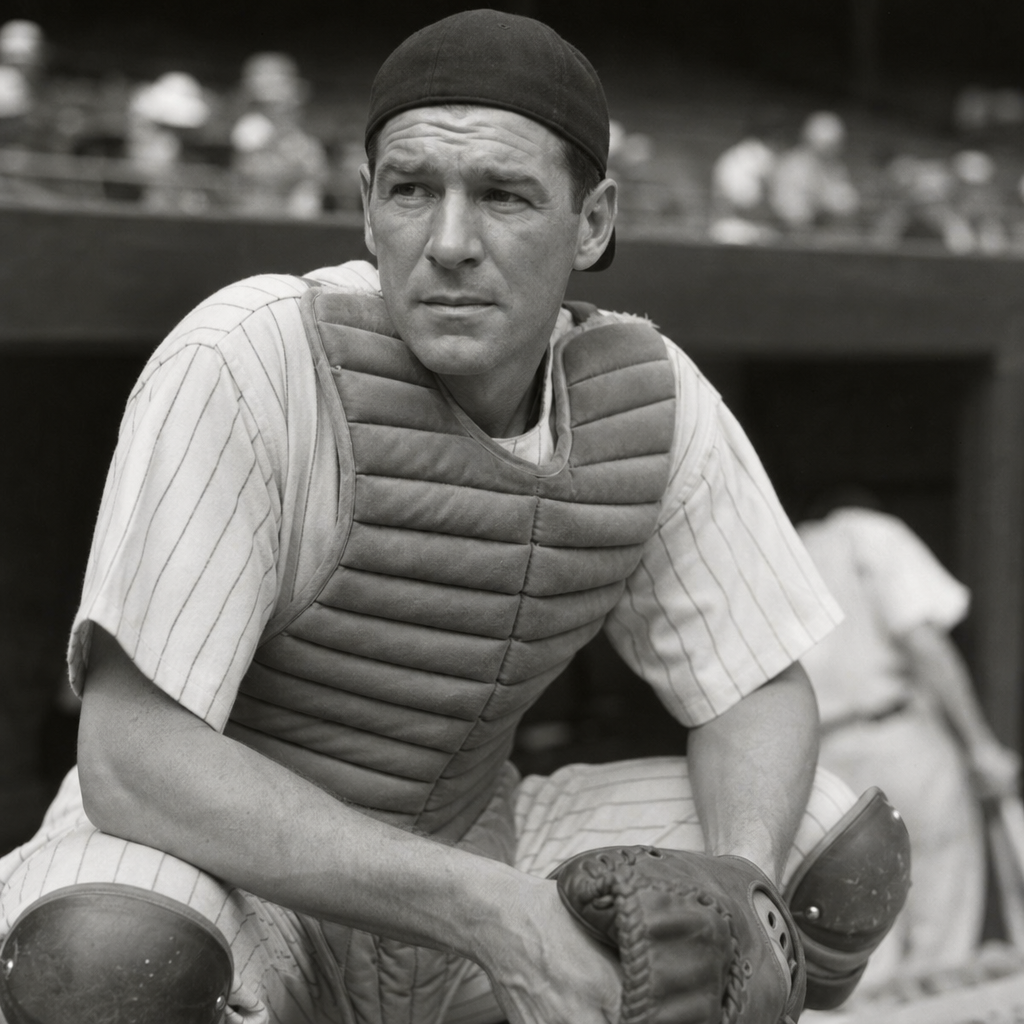
Bill Dickey stands at the center of the New York Yankees dynasty story, yet he is often discussed as supporting cast beside Babe Ruth, Lou Gehrig, and Joe DiMaggio. That view misses his real importance. Dickey was not simply a durable catcher with a strong bat. He was the Yankees catcher who bridged Ruth, Gehrig, and DiMaggio, anchoring the club through overlapping championship eras and shaping the standard for two-way excellence behind the plate. For any reader exploring legendary players, his career offers one of baseball’s clearest examples of how elite catching influences winning, leadership, and continuity across generations.
In player profiles, the key terms matter. A catcher manages pitchers, controls the running game, receives and blocks pitches, guides defensive alignment, and often acts as the emotional governor of the field. A bridge player links distinct team eras, preserving competitive standards while stars rise and fade. Dickey did both. From his debut in 1928 through his final playing years in the mid-1940s, he remained a stabilizing force while the Yankees transitioned from the Ruth-Gehrig machine to the DiMaggio-led powerhouse. That longevity is why his profile belongs near the top of any serious ranking of Yankees icons.
His résumé supports the claim. Dickey was an eleven-time All-Star, a Hall of Famer, and a central contributor to eight World Series championship teams. He hit for average, reached base, handled pressure, and played a premium defensive position at an elite level. His career batting average of .313 is extraordinary for a catcher, especially in an era with rougher equipment, heavier travel, and fewer medical safeguards. He also produced power, batting .300 or better ten times and driving the ball consistently while catching one of baseball’s most physically punishing workloads.
Why does Bill Dickey still matter now? Because modern baseball analysis has actually strengthened his case. Today, front offices value catchers who combine game-calling, durability, strike-zone skill, and lineup impact. Dickey excelled in the core components long before analysts had framing metrics, catcher ERA debates, or advanced workload models. When I review player profiles from the first half of the twentieth century, few hold up better under contemporary scrutiny. Dickey was not famous merely because he wore pinstripes. He was famous because he repeatedly did the hardest catching jobs on the biggest stage, and the Yankees won because of it.
Early Career and Rise in the Yankees System
Born in Bastrop, Louisiana, in 1907, Bill Dickey came from a baseball family and developed in the American South before reaching the majors. The Yankees signed him after strong minor league play, and his path reflected a common pattern for elite catchers: physical tools got him noticed, but his baseball intelligence moved him up. Catchers have to process more information than most positions, and even early reports on Dickey emphasized composure, arm strength, and mature judgment. By the late 1920s, the Yankees saw that he could become far more than a reserve.
Dickey debuted in 1928, joining a club that had already established itself as baseball’s glamour franchise. Breaking into that environment was not easy. The Yankees had veteran stars, immense media attention, and championship expectations every season. Young players on such teams often become specialists or disappear quickly. Dickey instead forced his way into regular duty by showing uncommon balance. He was dependable enough defensively to earn pitchers’ trust, and he hit enough to justify everyday use. That combination is what separates long-term catchers from temporary solutions.
One early turning point came through adversity. In 1932, Dickey was suspended for an altercation with Carl Reynolds after a violent collision. The incident remains a reminder that baseball of that era was harder and more confrontational than nostalgic summaries suggest. Dickey recovered from the setback, refined his on-field discipline, and resumed producing at a star level. What stands out is not the fight itself, but the response. He returned as a better professional, and from there his reputation centered overwhelmingly on steadiness, preparation, and winning baseball.
Offensive Excellence at a Demanding Position
Great catchers are often praised for intangible leadership first and offensive production second, because sustained hitting from that position is rare. Dickey delivered both. He finished his career with 202 home runs, 1,209 runs batted in, and a .382 on-base percentage, numbers that would be impressive for any era and exceptional for a catcher in his. He was not a one-dimensional slugger. He controlled the strike zone, used the whole field, and avoided the feast-or-famine profile that can shorten a catcher’s prime.
Dickey’s left-handed bat also gave the Yankees lineup balance. That mattered on teams built around right-handed thunder and disciplined middle-order pressure. Opponents could not simply navigate around Ruth or Gehrig and expect relief. Dickey extended innings, punished mistakes, and produced in high-leverage spots. He recorded seven seasons with at least twenty home runs, a significant mark for a catcher before the postwar offensive boom. In 1936, he hit .362 with 22 home runs and 107 runs batted in, one of the finest offensive seasons any catcher had produced to that point.
His consistency is even more revealing than his peak. Dickey batted .300 or better in ten different seasons and hit above .330 multiple times. Catchers typically lose offensive sharpness as the position grinds down knees, hands, and reflexes. Dickey resisted that decline longer than most because his swing stayed compact and repeatable. He did not need dramatic mechanical reinvention to remain productive. When historians compare all-time catchers, his name belongs in the same conversation as Mickey Cochrane, Yogi Berra, Roy Campanella, and later Johnny Bench because he met the offensive standard while carrying real defensive responsibility.
Defense, Pitching Staff Management, and Daily Leadership
If offense made Dickey visible, defense made him indispensable. Catching in the 1930s and 1940s demanded toughness that modern fans can underestimate. Masks were cruder, chest protectors offered less coverage, and foul tips carried greater risk. Pitchers also worked deeper into games with broader repertoires and less specialized bullpen support. The catcher’s burden was heavier, and Dickey handled it with unusual polish. Teammates and managers trusted his receiving, his hands, and his feel for game rhythm. Those traits do not always survive in box scores, but they decide pennants.
Dickey was especially respected for handling star pitchers without drama. A catcher on a great club must adapt to multiple personalities, tempos, and pitch shapes. He caught Lefty Gomez, Red Ruffing, Monte Pearson, Spud Chandler, and later a young Phil Rizzuto-led infield behind changing staffs and defensive alignments. That required preparation and credibility. Pitchers throw best when they believe the catcher understands both their strengths and their limitations. Dickey earned that confidence by studying hitters, setting a calm target, and staying emotionally even when innings became chaotic.
His throwing was another asset. While caught-stealing data from the era is incomplete by modern standards, contemporaries consistently described his arm as accurate and strong. More important, base runners respected it. A catcher does not need to throw out every runner to control the running game; he needs to alter behavior. Dickey’s reputation helped suppress stolen-base attempts and protected pitchers from additional pressure with men on base. In practical terms, that meant fewer distraction pitches, fewer compromised deliveries, and more freedom to attack hitters aggressively.
| Player | Primary Yankees Role | Shared Era With Dickey | Why the Connection Matters |
|---|---|---|---|
| Babe Ruth | Transformational slugger | 1928–1934 | Dickey entered during Ruth’s final Yankees years, absorbing championship expectations firsthand. |
| Lou Gehrig | Lineup anchor and captain figure | 1928–1939 | Dickey shared the club’s disciplined offensive core and its relentless daily standard. |
| Joe DiMaggio | Centerpiece superstar of the next dynasty | 1936–1943, 1946 | Dickey remained a veteran constant as the Yankees shifted into a new championship identity. |
The Bridge Between Ruth, Gehrig, and DiMaggio
The title of this article captures Dickey’s unique place in baseball history. Many Yankees stars are linked to a single golden period. Dickey connected several. He played with Ruth at the end of the Bambino era, shared the lineup with Gehrig during the franchise’s mature powerhouse phase, and then caught for teams defined by DiMaggio’s elegance and centrality. Few players in any organization have served as active, productive links across such a visible transfer of leadership. That continuity helped the Yankees avoid decline when other clubs would have started over.
With Ruth, Dickey experienced the end of a revolution. Ruth had already changed the economics, spectacle, and offensive imagination of baseball, and his presence still shaped the clubhouse atmosphere Dickey entered. With Gehrig, Dickey worked beside the consummate professional, a player whose reliability became organizational doctrine. When DiMaggio arrived in 1936, the Yankees did not need to rebuild their habits, because veterans like Dickey carried them forward. That is how dynasties really function. Superstars attract headlines, but holdover leaders preserve standards from one generation to the next.
Dickey’s influence becomes clearer when you look at timing. Gehrig’s career ended tragically in 1939, Ruth had long since departed, and DiMaggio missed time during the war years. Through those disruptions, Dickey remained a reference point for the team’s way of playing. He was not the loudest Yankee, but he was one of the most trusted. In clubhouse ecosystems, trust matters more than volume. When a catcher with championship credibility speaks about preparation, pitcher handling, or game situation, players listen because he affects every inning directly.
Championship Impact and October Performance
Dickey’s profile would be incomplete without the postseason record. He played on eight World Series winners: 1932, 1936, 1937, 1938, 1939, 1941, 1943, and 1947, though his role in 1947 was as a coach rather than a player. As an active catcher, he appeared in multiple Fall Classics and generally met the moment. October exposes weaknesses because opponents game-plan relentlessly and every base matters. Catchers feel that pressure doubly because they must hit, defend, and direct a staff under scrutiny. Dickey’s teams kept winning because he kept performing his full job.
His World Series batting line, while not as mythologized as DiMaggio’s or Ruth’s signature moments, reflected useful offensive contribution and calm under pressure. Just as important, Yankees pitching staffs repeatedly executed well in championship settings with Dickey behind the plate. That does not happen by accident. Sequencing, confidence, mound communication, and defensive alignment all start with the catcher’s decisions. In my experience evaluating postseason baseball, the quiet value of elite catchers becomes most visible when every mistake is magnified. Dickey passed that test year after year.
Legacy, Mentorship, and Place Among Legendary Players
Dickey’s legacy extends beyond his own statistics because he helped shape the next great Yankees catcher, Yogi Berra. After his playing career, he worked with Berra on receiving and defensive polish, and Berra himself credited Dickey’s guidance as foundational. That mentorship is one of the strongest legacy markers any player can leave. It means Dickey did not just represent a standard; he transmitted it. The Yankees effectively moved from one Hall of Fame catcher to another with a direct instructional line connecting them, a rare advantage for any franchise.
Within the broader Legendary Players hub, Dickey’s profile shows how to evaluate greatness beyond fame alone. He was less theatrical than Ruth, less tragic than Gehrig, and less effortlessly iconic than DiMaggio, yet his total contribution was immense. He combined technical skill, offensive production, durability, institutional memory, and postseason value in one career. That package is why historians consistently rank him among the greatest catchers ever and among the most important Yankees of any position. If you are building a serious understanding of player profiles, Bill Dickey is not optional reading; he is a cornerstone case study.
The clearest takeaway is simple: Bill Dickey was the Yankees catcher who bridged Ruth, Gehrig, and DiMaggio because he was good enough, smart enough, and steady enough to keep a dynasty coherent through change. He excelled at the game’s most demanding position, hit like a middle-order force, and helped define championship habits that outlasted individual stars. Explore the rest of this Legendary Players series with that lens in mind. The best player profiles do more than celebrate names; they explain how greatness actually works, and Dickey remains one of baseball’s best answers.
Frequently Asked Questions
Why is Bill Dickey called the Yankees catcher who bridged Babe Ruth, Lou Gehrig, and Joe DiMaggio?
Bill Dickey earned that description because his career connected multiple defining phases of the New York Yankees dynasty. He debuted in the late 1920s while Babe Ruth and Lou Gehrig were still the towering stars of the lineup, then remained a central figure as the club evolved into the Joe DiMaggio era of the late 1930s and early 1940s. That kind of continuity matters. Teams change personalities, strategies, and leadership structures over time, but Dickey stayed behind the plate as a stabilizing force through those transitions. He was not just present for different championship teams; he helped give them a sense of consistency.
As catcher, Dickey occupied one of the most demanding and influential positions on the field. He handled pitchers, controlled the pace of games, managed defensive communication, and contributed significantly as a hitter. Because he served in that role across overlapping superstar eras, he became a living link between the Ruth-Gehrig Yankees and the DiMaggio-led powerhouse that followed. In other words, he was one of the few players who did more than witness the dynasty’s evolution. He actively anchored it. That is why describing Dickey as the bridge between Ruth, Gehrig, and DiMaggio is not a poetic flourish. It is a historically accurate way of explaining how central he was to the Yankees’ long run of dominance.
What made Bill Dickey more than a supporting player on those great Yankees teams?
It is easy to view any player standing near Ruth, Gehrig, and DiMaggio as a secondary figure, but that does not fit Bill Dickey’s actual value. He was one of the finest all-around catchers in baseball history, and his importance went far beyond durability or reputation. Offensively, Dickey was a remarkably productive hitter for a catcher, especially in an era when the position often emphasized toughness and defense over sustained offensive impact. He hit for average, drove in runs, and consistently gave the Yankees strong middle-of-the-order production from a demanding defensive spot. That alone separated him from many of his contemporaries.
Defensively, he was just as influential. Catcher is often described as an extension of the manager on the field, and Dickey excelled in the cerebral parts of the job. He worked with pitching staffs, called games, and helped maintain order in high-pressure environments. Championship teams need stars, but they also need players who can absorb responsibility every single day. Dickey did that for years. He was not simply a familiar face around legendary teammates; he was one of the players who made their success more sustainable. When historians talk about the Yankees standard of excellence behind the plate, Dickey stands near the top because he combined leadership, technical skill, and offensive production in a way that gave the team a dependable edge.
How good was Bill Dickey as a hitter for a catcher?
Bill Dickey was exceptional at the plate, especially when measured against the historical expectations for catchers. Long before offense from the catching position became more common or more celebrated, Dickey was delivering elite production. He was not a novelty hitter who had one or two standout seasons. He was consistently dangerous, posting strong batting averages and run production while carrying the physical burden of catching. That combination is a major reason he remains such an important figure in baseball history.
What made Dickey’s offense so impressive was its balance. He was not merely a contact hitter, nor was he just a power threat in short bursts. He gave the Yankees dependable, high-level at-bats year after year. For a team loaded with headline stars, having that caliber of offense from the catcher position deepened the lineup and made opponents deal with pressure from almost every spot. His hitting also helped redefine what a great catcher could be. Rather than treating offense from behind the plate as a luxury, Dickey made it look like part of the standard. That legacy would influence how later generations evaluated elite catchers, particularly those expected to contribute on both sides of the ball.
What was Bill Dickey’s impact on the Yankees beyond statistics?
Bill Dickey’s legacy cannot be captured by numbers alone because so much of his value came through game management, steadiness, and influence within a winning culture. Catchers shape games in subtle ways that often do not show up in traditional box scores. Dickey guided pitchers, calmed difficult moments, coordinated defenses, and provided leadership from one of the most physically and mentally demanding positions in sports. For a club with championship expectations every season, that reliability was immensely important.
He also represented continuity in a franchise defined by transition at the top. Ruth, Gehrig, and DiMaggio each symbolize a different phase of Yankees history, but Dickey’s presence helped tie those phases together into one larger story of sustained excellence. Teammates and successors benefited from his understanding of how the Yankees operated when everything mattered. His influence also extended into the development of future catching talent, most notably through the standard he set for professionalism and complete play. When people describe certain players as foundational, they mean athletes whose effect goes beyond their own at-bats or fielding chances. Dickey fits that description perfectly. He helped preserve the identity of a dynasty while contributing directly to its victories.
Why does Bill Dickey still matter in discussions of the greatest catchers in baseball history?
Bill Dickey still matters because he helped define the model for the modern elite catcher: strong defensively, highly intelligent, durable, and dangerous offensively. In historical conversations, some players remain famous because they were attached to iconic teams, but Dickey endures because his individual excellence holds up even when removed from the glow of the Yankees brand. He was a central performer on championship clubs, but he was also a standard-setting player at his position. That distinction is crucial.
His career invites a broader understanding of baseball greatness. Catchers are often underrated because their contributions are dispersed across every inning rather than concentrated in a single visible skill. Dickey’s case reminds readers that leadership behind the plate, management of pitchers, and sustained offensive output can make a player indispensable even if louder stars dominate the headlines. He remains relevant not just as a historical footnote between bigger names, but as one of the true architects of winning baseball. For anyone studying the evolution of the catcher position, the history of the Yankees dynasty, or the meaning of two-way excellence, Bill Dickey belongs near the center of the conversation.