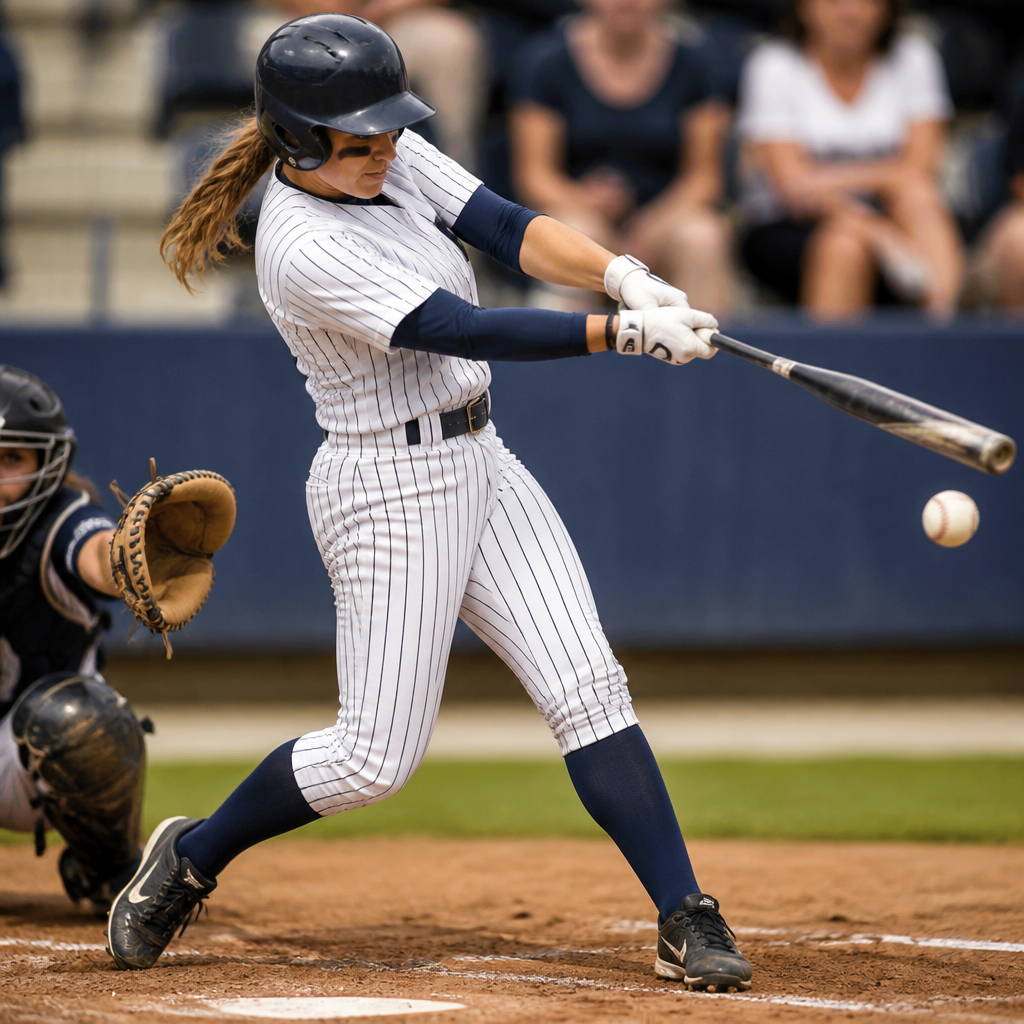
Power at the plate has never belonged to men alone. Across baseball history, female hitters have produced elite bat speed, advanced strike-zone judgment, and game-changing slugging in barnstorming tours, industrial leagues, international tournaments, the All-American Girls Professional Baseball League, college showcases, and modern professional circuits. In the broader Women in Baseball landscape, this Miscellaneous hub article brings those stories together, showing how female hitters shaped the sport even when official records were fragmented or ignored. Understanding that history matters because hitting is baseball’s most visible test of skill: timing, recognition, mechanics, and nerve. When women excelled there, they disproved the old claim that they lacked the strength, discipline, or competitive edge for high-level baseball. They also widened the sport’s tactical imagination for generations of players, coaches, and fans.
To celebrate female hitters in baseball history, it helps to define the terms clearly. A hitter is not simply a batter who makes contact. In baseball language, strong hitting includes on-base ability, situational awareness, contact quality, gap power, home-run power, and the repeatable mechanics that let a player adjust to different pitch types and game states. Power at the plate does not always mean towering home runs; it also means driving balls into alleys, forcing outfielders deep, controlling counts, and creating pressure every inning. Over the years, I have found that women’s baseball history becomes much richer when you evaluate hitters with the same serious lens used for men’s baseball: isolated power, walk rate, bat path, launch angle tendencies, opposite-field capability, and performance under travel-heavy schedules. Once you use that lens, the record is unmistakable. Female hitters were not novelties. They were offensive threats.
How female hitters built offensive reputations in baseball history
Female hitters earned respect under conditions that often worked against offense. Many played on rough fields, traveled long distances by bus, used inconsistent equipment, and faced public skepticism before stepping into the batter’s box. Yet strong hitters emerged in nearly every era. In the late nineteenth and early twentieth centuries, Bloomer Girls clubs and barnstorming teams drew paying audiences by featuring women who could line balls over infielders, bunt for hits, and punish pitchers who underestimated them. Newspaper descriptions were often patronizing, but buried inside that language were genuine baseball observations: quick wrists, hard line drives, extra-base hits, and smart baserunning after contact.
The same pattern appeared in industrial and local semipro baseball. Women who stood out as hitters usually did so because they mastered the entire plate appearance. They knew when to attack early-count fastballs, when to spoil pitcher’s pitches, and when to prioritize a productive out over a risky swing. Coaches trusted them in run-scoring situations not because of symbolism, but because they could execute. That distinction matters. Historical recognition frequently focused on novelty, while teammates and opponents remembered results. In oral histories, the most respected female hitters are described with baseball verbs: drove, laced, turned on, worked, adjusted, carried. That vocabulary reflects skill proven on the field.
When organized opportunities expanded during the 1940s and 1950s, especially through the All-American Girls Professional Baseball League, offensive evaluation became easier. League schedules were longer, competition was more standardized, and contemporary coverage preserved more statistics. Even then, context is essential. Rule changes shifted the game from a softball-influenced style toward full baseball, affecting mound distance, overhand pitching, and therefore hitting environments. Players who maintained production across those changes showed true adaptability. In modern analysis, that adaptability is one of the clearest indicators of hitting quality.
The All-American Girls Professional Baseball League and the rise of complete hitters
The AAGPBL remains the best-known chapter in women’s baseball history, and it produced some of the clearest examples of complete offensive players. While popular culture often emphasizes uniforms and wartime novelty, the baseball reality was tougher and more interesting. Hitters had to adapt as the league evolved from underhand delivery and larger balls toward a game closer to men’s professional baseball. Those changes affected timing windows, swing decisions, and how much damage a batter could do on contact. Players who thrived through multiple rule environments were genuine baseball talents.
Dottie Kamenshek is a central example. Best known as a first baseman for the Rockford Peaches, she built a reputation as one of the league’s most dangerous and disciplined hitters. Kamenshek combined a compact left-handed swing with exceptional contact ability and command of the strike zone. She routinely hit for average, reached base, and put pressure on defenses with line drives. Contemporary observers, including major league figures, praised her glove, but her bat was equally important to her value. A hitter like Kamenshek demonstrates that offensive excellence is not only about home-run totals; in lower-slugging environments, repeated hard contact and relentless on-base production can dominate games.
Others brought different offensive profiles. Sophie Kurys became famous for speed, but speed enhanced her hitting rather than replacing it. By slapping balls into space, bunting with precision, and forcing rushed throws, she transformed contact into constant scoring opportunities. Dorothy Harrell offered more visible power and run production, showing that women’s professional baseball included hitters capable of driving the ball with authority. Then there was Toni Stone, whose path crossed men’s professional baseball in the Negro Leagues. Although remembered primarily as a barrier-breaker, Stone was also a serious competitor who handled top-level velocity and game pressure. That ability to compete against elite pitching is a direct measure of hitting legitimacy.
| Player | Era or League | Offensive strength | Why she matters in a hitting discussion |
|---|---|---|---|
| Dottie Kamenshek | AAGPBL | Contact, on-base skill, line-drive consistency | Proved that elite bat control and plate discipline can anchor a championship offense |
| Sophie Kurys | AAGPBL | Placement hitting, bunting, pressure offense | Showed how speed and precise contact create run expectancy without conventional power numbers |
| Dorothy Harrell | AAGPBL | Run production, extra-base impact | Represented visible offensive force in a league often mischaracterized as light-hitting |
| Toni Stone | Negro Leagues | Competitive at-bats against elite pitching | Demonstrated that a woman could handle professional baseball speed and pressure |
| Mamie Johnson | Negro Leagues | Athletic all-around offensive contribution | Part of a generation proving women belonged in high-level Black baseball spaces |
What power at the plate really looked like for women players
One common mistake is measuring female hitters only by men’s major league home-run standards. That distorts history. Power is context dependent. In dead-ball conditions, spacious parks, and leagues with uneven field maintenance, doubles into gaps and hard one-hoppers through drawn-in infields could be as valuable as home runs. Scouts and coaches I have worked with always return to the same question: how hard and how often does a player impact the baseball? Historical accounts show many women passed that test, even when scorebooks failed to capture exit velocity or advanced metrics.
Power also showed up through mechanical efficiency. Strong female hitters often generated force from sequencing rather than sheer upper-body effort. They loaded into the rear hip, kept the barrel in the zone a long time, and used rotational acceleration to backspin the ball. That pattern appears in film of modern women’s baseball and in descriptions of earlier stars who “snapped” the bat through contact or “drove” pitches to the fence. In practical terms, that meant they punished mistakes. Pitchers who tried to sneak inside fastballs were turned on; those who lived away risked doubles to the opposite field.
The importance of this broader definition cannot be overstated. If you reduce power to home runs only, you miss the offensive value created by hitters who controlled innings. A leadoff batter who consistently reaches and takes extra bases after contact can be as disruptive as a cleanup hitter. A two-strike specialist who sprays line drives with runners on base changes the emotional tone of a game. Female hitters have filled all of those roles, from table-setters to middle-order run producers. Their contributions deserve to be measured by run creation, not stereotypes.
Global women’s baseball and the modern generation of dangerous bats
Women’s baseball is now unmistakably global, and that matters for any hub article covering Miscellaneous history. Japan, Canada, the United States, Australia, Hong Kong, Chinese Taipei, Cuba, Venezuela, and several European programs have all developed hitters worth studying. International competition, especially the Women’s Baseball World Cup organized under the World Baseball Softball Confederation, has made offensive skill easier to compare across countries. The best hitters in these events are not surviving on novelty. They are facing structured scouting, specialized pitching plans, and tournament pressure that tests every part of an approach.
Japan has set the standard for offensive precision. Its women’s national teams have repeatedly combined disciplined swing decisions, elite bat-to-ball skill, and relentless situational execution. Rather than waiting for one big swing, Japanese lineups often string together quality plate appearances that exhaust pitchers and expose defensive weaknesses. Canada and the United States have produced hitters with more visible physical impact, including gap power and occasional over-the-fence threat, while also investing in strength training and bat-speed development. In recent years, players such as Kelsie Whitmore have shown that women can bring genuine two-way athleticism and advanced hitting mechanics into professional environments that attract broader public scrutiny.
Modern technology has sharpened the conversation. HitTrax, Blast Motion, Rapsodo, and high-speed video now allow coaches to measure attack angle, rotational acceleration, contact point, and batted-ball outcomes with real precision. In my experience, these tools have helped women hitters receive fairer evaluation because the discussion shifts from assumption to evidence. When a player consistently produces top-end bat speed, square contact, and strong on-base results, old arguments about whether women can hit at a high level collapse under measurable data. That is one reason the current era is so important: it is preserving proof.
Why many great female hitters remain underrated
If female hitters were this capable, why are so many still overlooked? First, recordkeeping was inconsistent. Box scores disappeared, local newspapers folded, and exhibitions were documented unevenly. Second, many women played across mixed formats, including softball, baseball, semipro tournaments, and barnstorming games, which makes career totals difficult to standardize. Third, cultural bias affected what observers chose to emphasize. Reports often discussed appearance, novelty, or crowd reaction before mentioning on-base percentage or slugging output.
Another reason is that baseball history has traditionally organized prestige around official male pathways: major leagues, affiliated minors, and college pipelines tied to men’s programs. Women who excelled outside those structures were treated as exceptions rather than as participants in a parallel baseball tradition. That framework hides offensive excellence. A hitter does not become less skilled because her league lacked television contracts or stable archival support. In fact, many female hitters developed under harsher conditions than male prospects: fewer reps, less coaching continuity, and less access to quality pitching machines, weight rooms, and analytics.
Correcting that record requires deliberate research. The best women in baseball coverage now combines archival newspapers, museum collections, league statistics, oral histories, and modern biomechanics. Institutions such as the National Baseball Hall of Fame, the International Women’s Baseball Center, SABR researchers, and documentary filmmakers have all helped recover missing context. For readers exploring this Women in Baseball hub, that is the central takeaway: Miscellaneous does not mean marginal. It means the stories were dispersed across places, leagues, and formats, and now need to be connected into one coherent baseball history.
How to use this hub to explore women in baseball further
This hub works best as a starting point for deeper reading across female hitters, women’s professional leagues, Negro Leagues pioneers, international tournaments, coaching methods, and modern development pathways. If you are building internal topic authority on Women in Baseball, begin with the offensive question because hitting offers the clearest evidence of transferable baseball skill. From there, branch into profiles of individual stars, analyses of league rule changes, examinations of training access, and comparisons between baseball and softball development systems. That structure helps readers move from broad curiosity to specific knowledge without losing the thread.
The bigger lesson is simple. Female hitters in baseball history were real offensive players, not symbolic participants. They adjusted to evolving rules, hit against quality pitching, created runs in multiple ways, and inspired future generations by proving what disciplined mechanics and competitive instincts can do. From Kamenshek’s precision to Kurys’s pressure game, from Toni Stone’s professional resilience to today’s data-backed international hitters, the evidence points in one direction: women have always brought power at the plate. Use this hub to continue exploring the names, leagues, and moments that deserve a permanent place in baseball history. Read deeper, follow the connections, and keep these hitters in the conversation where they belong.
Frequently Asked Questions
What does “power hitting” mean in the context of women’s baseball history?
In women’s baseball history, “power hitting” refers to far more than home run totals alone. It includes the ability to drive the ball with authority to all fields, generate extra-base hits, force defensive adjustments, and change the shape of a game with one swing. Female hitters throughout baseball history have demonstrated the same foundational traits associated with elite offensive production anywhere in the sport: quick hands, strong lower-half mechanics, excellent timing, disciplined pitch recognition, and the confidence to attack hittable pitches.
That matters because many historical discussions about women in baseball have centered on novelty, access, or exclusion rather than skill. A closer look shows that female hitters excelled in barnstorming teams, industrial leagues, international competition, the All-American Girls Professional Baseball League, collegiate development spaces, and modern professional settings by producing real offensive value. Some were classic sluggers who punished mistakes, while others created “power” through gap hitting, hard contact, and relentless extra-base production in eras when ballparks, equipment, and league rules differed significantly from the modern men’s game.
So when this article celebrates female hitters, it is recognizing a complete offensive tradition. These athletes did not simply participate; they hit with authority, adapted to different competitive environments, and proved that power at the plate has always existed in the women’s game.
Who are some of the most important female hitters to know when studying baseball history?
Several names stand out, and each helps tell a different part of the larger story. Toni Stone is essential because she broke barriers in men’s professional baseball while proving she belonged through performance, not symbolism alone. Mamie “Peanut” Johnson and Connie Morgan are also key figures from the Negro Leagues era whose presence helps expand the conversation beyond a narrow, single-league history of women in baseball.
From the All-American Girls Professional Baseball League, players such as Dorothy Kamenshek deserve serious attention. Kamenshek is often remembered as a great all-around player, but that should not obscure her offensive excellence. She was one of the league’s most feared hitters and a central figure in demonstrating that women’s baseball contained advanced, high-level offensive talent. Other AAGPBL stars also contributed to the image of women as complete hitters capable of combining contact skill, patience, speed, and impact power relative to their era.
In the international game, players connected to national teams and global tournaments are equally important. As women’s baseball expanded through World Cup play and other international events, elite hitters from countries such as the United States, Japan, Canada, Australia, and others helped redefine public expectations for what women could do offensively. Their production came against stronger pitching pools, more advanced scouting, and rising competitive standards.
In more recent decades, female hitters in college showcases, independent circuits, baseball academies, and professional opportunities abroad have carried the tradition forward. Even when institutional support lagged behind softball or men’s baseball, these hitters built résumés through persistence and performance. Studying the full history means looking not only at the most famous pioneers, but also at the many women whose bats forced respect in leagues and tournaments that were often under-documented.
How did female hitters develop power and offensive skill despite limited opportunities and recognition?
One of the most impressive aspects of women’s baseball history is that elite hitters emerged even when training systems, scouting pipelines, and professional opportunities were inconsistent or actively exclusionary. Many female players developed their swings in mixed environments, learning against boys, local men’s teams, semi-pro competition, or informal community baseball settings. That often meant facing velocity, skepticism, and fewer second chances from a young age, which sharpened competitiveness and approach.
They also developed through repetition in nontraditional spaces. Instead of moving cleanly from youth travel ball to high-visibility amateur circuits to professional development systems, many women had to piece together careers from industrial leagues, regional clubs, barnstorming schedules, instructional camps, national team programs, and independent tournaments. That kind of path demanded adaptability. Hitters had to adjust to changing levels of competition, inconsistent game volume, uneven coaching resources, and limited medical or strength-training support compared with male counterparts in better-funded systems.
Even so, many succeeded by mastering the universal elements of hitting: balance, barrel control, strike-zone judgment, mental preparation, and an understanding of how to attack pitchers strategically. Some hitters built strength-based power. Others became dangerous by consistently squaring up the baseball, using leverage efficiently, and turning mistakes into doubles, triples, and line-drive damage. In every era, offensive excellence came from technical skill and baseball intelligence as much as raw force.
The lack of recognition also created a distorted historical record. Because women’s baseball was often undercovered, many great hitting performances were not preserved with the statistical depth or media attention given to men’s baseball. That should not be mistaken for a lack of quality. In many cases, it means historians and fans have to work harder to recover and appreciate the evidence that remains: newspaper accounts, league records, oral histories, photographs, scorebooks, and firsthand testimony from teammates and opponents.
Why is it important to include female hitters in the broader history of baseball offense and slugging?
Including female hitters in baseball history is important because it produces a more accurate account of how offensive excellence has developed across the sport. If baseball history is told only through Major League Baseball or men’s professional leagues, then many legitimate contributors to hitting culture, swing innovation, competitive strategy, and public imagination disappear from the narrative. Women have long been part of baseball’s offensive story, whether through organized leagues, touring teams, wartime competition, international play, or modern pro and amateur circuits.
It also challenges old assumptions about athletic capability. For decades, cultural narratives often framed women in baseball as exceptions, promotional figures, or defensive specialists rather than complete offensive threats. The record shows otherwise. Female hitters have displayed plate discipline, bat speed, situational awareness, pull-side power, opposite-field authority, and clutch production in meaningful games. Recognizing that helps shift the conversation from “Could women hit?” to the more historically grounded question: “Why has this hitting tradition been overlooked for so long?”
There is also a developmental reason this matters. When younger players see women represented as dangerous hitters rather than merely participants, it broadens what they imagine possible. It validates baseball, not just softball, as a space where girls and women can cultivate a serious offensive identity. For historians, coaches, and fans, including female hitters strengthens the entire story of baseball by showing that slugging, run creation, and offensive innovation have never belonged to one gender alone.
How does this article connect past female sluggers to the modern Women in Baseball conversation?
This article serves as a bridge between early pioneers, mid-century stars, international standouts, and today’s women pursuing baseball at increasingly visible levels. Rather than treating female hitters as isolated curiosities, it places them within a continuous offensive lineage. That lineage runs from barnstorming performers and industrial league standouts to AAGPBL stars, national team players, collegiate prospects, and athletes in modern professional or semi-professional baseball spaces.
The modern Women in Baseball conversation is about access, visibility, infrastructure, and respect, but it is also about skill. Power hitting is one of the clearest ways to show that women have always contributed meaningful baseball excellence. By highlighting female hitters across eras, the article reinforces that the present moment did not emerge from nowhere. Today’s players are building on generations of women who already proved they could drive the baseball, command the strike zone, and alter games offensively.
That historical continuity is especially valuable in a miscellaneous hub article because it helps readers connect scattered stories into one coherent theme. Instead of viewing a few famous names as isolated breakthroughs, readers can understand female hitting as an enduring tradition with many chapters. The result is a richer picture of baseball history—one in which women are not footnotes to power at the plate, but central participants in shaping it.