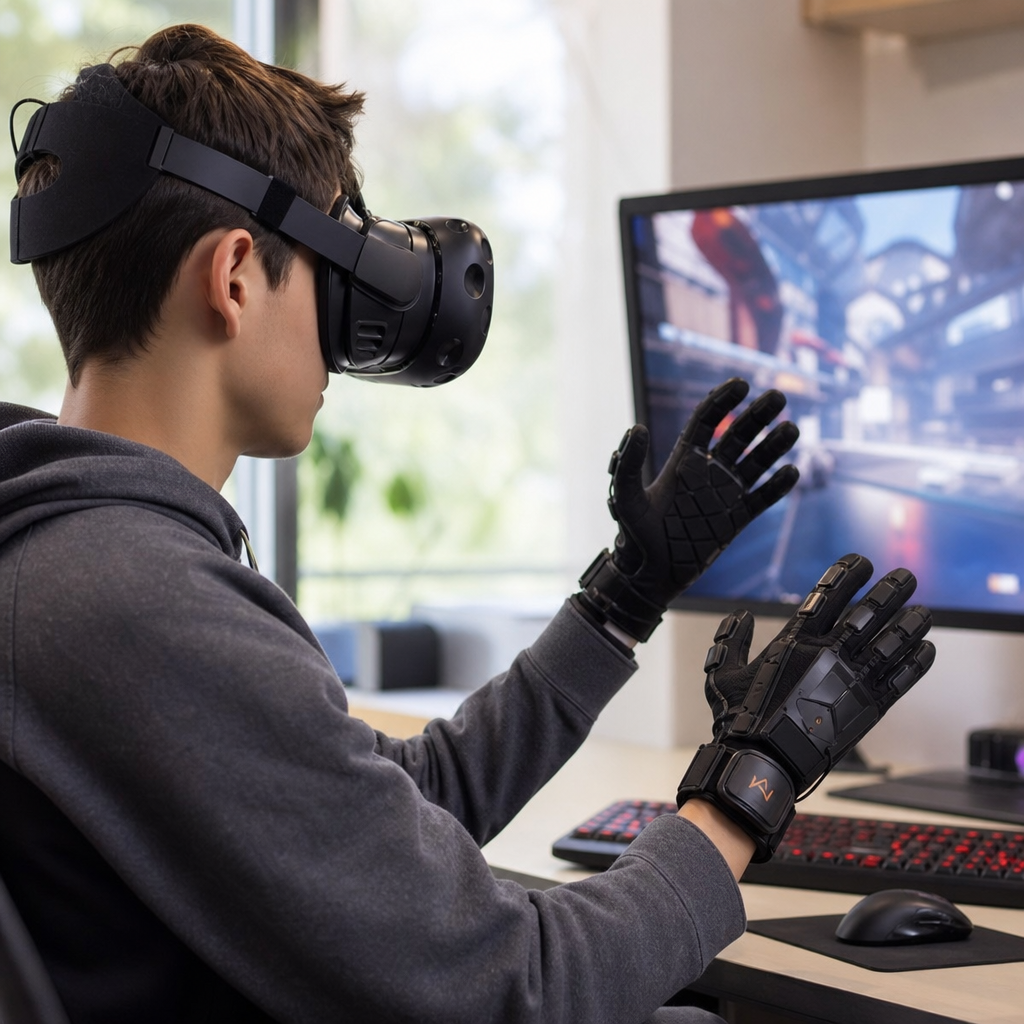
Haptic feedback gloves are changing how baseball players learn, because they turn invisible mechanics into sensations athletes can feel in real time. In baseball, “haptic feedback” means touch-based signals such as vibration, pressure, or resistance delivered through wearable equipment. When built into gloves, these systems can guide hand position, reinforce catching mechanics, measure impact, and connect physical movement to data. As part of broader technological advancements in equipment, haptic gloves matter because player development increasingly depends on tools that shorten learning cycles without replacing coaching. I have seen athletes understand wrist angle, pocket presentation, and transfer timing faster when they can literally feel the correction. For youth programs, college labs, and professional organizations, this technology sits at the intersection of biomechanics, sensor design, and skill acquisition, making it one of the most promising categories in modern baseball equipment.
What Haptic Feedback Gloves Are and How They Work
A haptic feedback glove combines traditional glove structure with embedded electronics that detect movement and deliver tactile cues. Most systems use inertial measurement units, including accelerometers and gyroscopes, to track orientation, speed, and rotation. More advanced prototypes add pressure sensors in the palm and fingers, flex sensors along the joints, and microactuators that vibrate when a player misses a target position. In baseball terms, that means a catcher can receive a quick signal if the thumb drifts too high during receiving, an infielder can be cued to soften the glove at contact, or a hitter using a training glove can feel whether top-hand pressure is arriving too early.
The design challenge is balancing data collection with playability. Gloves must remain lightweight, breathable, and durable under repeated impacts from high-velocity baseballs. Engineers usually place sensor modules near the wrist or back of the hand to avoid interfering with the pocket. Power systems depend on compact rechargeable batteries, while wireless transmission typically uses Bluetooth Low Energy for training environments. In my experience testing wearables across batting and fielding sessions, the best products are not the ones with the most sensors; they are the ones that deliver clear cues without distracting the athlete from the ball. That usability standard is what will separate novelty from lasting adoption.
Why Baseball Development Benefits From Touch-Based Coaching
Baseball instruction has always relied on verbal feedback, video review, and repetition. Those methods remain essential, but they all have timing limits. A coach may explain that a young infielder is stabbing at the ball, yet the player often does not know what “soft hands” should feel like. Video can confirm the mistake after the rep, but it cannot guide the body during the movement. Haptic feedback fills that gap by adding immediate physical reinforcement. Motor learning research consistently shows that timely feedback improves skill acquisition, especially when it directs attention to one controllable action instead of overwhelming the athlete with multiple corrections.
This matters across positions. Catchers need stable glove presentation to improve framing and receiving consistency. Infielders need efficient hand path, secure pocket alignment, and a quick transfer. Outfielders benefit from better glove-angle awareness at different approach speeds. Even first basemen can use haptic cues to train stretch timing and pocket orientation on throws from varying arm slots. The practical value is not that gloves “teach themselves.” The value is that they compress the space between error and correction. Over a full season of practices, that reduction in wasted reps can be significant, particularly in youth baseball where limited field time and uneven coaching access slow development.
Applications Across Catching, Infield, Outfield, and Hitting
The strongest use case today is catching development. Receiving a baseball cleanly involves subtle control of wrist stability, glove tilt, forearm tension, and pocket quietness. Haptic training gloves can flag excessive pre-pitch glove movement or reinforce ideal target positioning during bullpen work. For catching instructors, that creates an objective bridge between movement standards and player feel. It also pairs well with high-speed video and ball-tracking systems because coaches can compare glove behavior, pitch location, and tactile cues in the same session.
For infielders, the glove becomes a tool for patterning cleaner hand actions. A system can cue a player when the glove opens too early, when the wrist collapses on the backhand, or when transfer time exceeds a set threshold after ball contact. Outfielders can use similar technology on route-based drills where the glove must transition from running posture to catch posture smoothly. Hitting applications are slightly different but still relevant within equipment innovation. A sensor-enabled training glove on the lead or top hand can track grip pressure and bat-connection timing, then use vibration to indicate inefficient hand loading. That makes haptic equipment part of a larger baseball technology ecosystem rather than a niche fielding accessory.
Key Features Teams Should Evaluate Before Buying
Not every smart glove is useful, and buyers should judge these products by coaching value, not marketing claims. Accuracy comes first. If hand-position data drifts or impact readings vary widely between identical reps, coaches will stop trusting the feedback. Latency is next. Signals should arrive fast enough to influence learning during or immediately after a movement. Comfort matters more than many vendors admit; if bulk at the knuckles or wrist changes normal mechanics, the data loses practical meaning. Durability is equally important because baseball gloves experience repeated shock, dirt exposure, sweat, and temperature changes that can degrade electronics.
Teams also need interoperable software. Useful platforms export session data, allow drill tagging, and integrate with video or athlete management tools. Battery life should support full practice blocks, not just short demos. Finally, the feedback logic must be adjustable by age and skill level. A high school infielder and a professional catcher should not receive the same cue thresholds. The best systems let coaches set tolerances, review trendlines, and disable nonessential alerts so athletes focus on one priority at a time.
| Evaluation Factor | Why It Matters in Baseball | What Good Looks Like |
|---|---|---|
| Sensor accuracy | Bad data creates bad coaching decisions | Consistent readings across repeated reps and impact speeds |
| Latency | Delayed cues weaken motor learning | Feedback arrives instantly or within seconds of the rep |
| Comfort and fit | Bulky hardware changes natural glove action | Minimal interference with pocket, closure, and transfer |
| Durability | Baseball gear absorbs ball strikes, sweat, and dirt | Reinforced housing and field-tested construction |
| Software integration | Coaches need context, not isolated numbers | Data exports, drill tagging, video sync, athlete profiles |
| Custom cue settings | Players develop at different rates and positions | Adjustable thresholds by skill, age, and drill type |
How Haptic Gloves Fit Into the Broader Equipment Technology Stack
Haptic feedback gloves should not be viewed in isolation. They belong to a broader category of technological advancements in equipment that includes smart bats, bat sensors, force plates, markerless motion capture, high-speed cameras, and pitch-tracking systems. In a modern player development setting, each tool answers a different question. Bat sensors such as Blast Motion quantify swing metrics. Systems like Rapsodo and TrackMan capture ball flight and pitch characteristics. Force plates measure how players create and transfer force. Haptic gloves add something those platforms cannot provide on their own: real-time tactile communication during the skill itself.
This is why the glove works best as a hub technology in fielding instruction. A coach can use video to show that a catcher’s glove drifts upward during receiving, use ball-tracking data to match that movement to specific pitch locations, then use haptic cues to train a correction on the next rep. That closed feedback loop is powerful. It also creates useful internal linking opportunities within a larger baseball innovation content hub, because readers exploring smart wearables will naturally want connected information on analytics platforms, sensor accuracy, biomechanics, and training design. The equipment story is no longer about isolated products. It is about integrated development systems.
Limitations, Costs, and Adoption Challenges
Haptic gloves are promising, but they are not frictionless solutions. Cost remains a major barrier, especially for youth organizations and public schools. Advanced wearable systems require hardware, software subscriptions, maintenance, and staff time to interpret results. Coaches also need onboarding. If a staff cannot distinguish between useful tactile prompts and noisy overcorrection, players may become dependent on cues or confused by conflicting signals. In my work with training technology, this is a recurring issue: the bottleneck is often implementation, not invention.
There are also technical limits. Baseball gloves must flex naturally, and adding electronics can reduce feel if the design is poor. Sweat, repeated impacts, and weather exposure challenge long-term reliability. Data privacy matters as well when athletes are minors or when organizations collect individualized performance profiles. Teams should ask who owns the data, how long it is stored, and whether it can be exported if the vendor relationship ends. Most importantly, tactile feedback cannot replace contextual coaching. A glove may tell a player that hand angle is off, but it cannot fully explain why footwork, posture, or anticipation created the problem. The best programs use haptic equipment to sharpen instruction, not automate it.
What the Next Generation of Baseball Players Will Learn Differently
The next generation of players will likely experience skill development as a blend of feel, feedback, and quantified evidence. That shift starts early. Young athletes already train with video clips, radar-based pitch metrics, and app-driven homework. Haptic gloves extend that environment into one of baseball’s hardest teaching areas: subtle hand action. Instead of waiting months for natural repetition to build consistent glove presentation, players can receive structured tactile reinforcement from the start. That does not eliminate creativity or instinct. It gives athletes a faster route to sound fundamentals, which then frees them to react athletically in games.
At higher levels, the benefit becomes precision. College and professional organizations increasingly look for marginal gains in receiving efficiency, transfer speed, and ball security. A half-step improvement in clean fielding mechanics can change innings, pitch counts, and roster decisions over a long season. As battery life improves, sensor miniaturization advances, and software becomes easier to use, haptic gloves will move from experimental tools to practical training equipment. The programs that gain the most will be the ones that pair this technology with skilled coaches, clear drill design, and honest evaluation of what the data actually means. If you are building a serious baseball equipment strategy, start tracking wearable glove technology now and connect it to the rest of your development system.
Frequently Asked Questions
What are haptic feedback gloves, and how do they work in baseball training?
Haptic feedback gloves are wearable training tools that use touch-based signals to help players feel what correct mechanics are supposed to be in real time. In baseball, that feedback can come through vibration, localized pressure, or controlled resistance built into the glove or connected training equipment. Instead of relying only on verbal coaching, video review, or repetition, players receive immediate physical cues while they move. That matters because many baseball skills happen too quickly for athletes to consciously process every detail in the moment.
For example, a glove may be programmed to signal when a player’s hand position drifts out of an ideal catching path, when grip pressure becomes inconsistent, or when impact occurs outside a target zone. Some systems also pair with motion sensors and software platforms that capture timing, angle, force, and hand orientation. The result is a training environment where athletes do not just see or hear corrections later; they experience them instantly through the glove itself.
That immediate loop between movement and sensation can accelerate motor learning. Young players often struggle with “invisible mechanics,” meaning subtle movements they cannot easily detect on their own. Haptic feedback makes those mechanics more tangible. It helps bridge the gap between instruction and execution by translating data into physical awareness. As baseball equipment becomes more technologically advanced, haptic gloves stand out because they do more than measure performance; they actively guide it.
How do haptic feedback gloves help players develop better catching and fielding mechanics?
Haptic feedback gloves can improve catching and fielding by reinforcing the small, repeatable hand actions that lead to cleaner defensive play. In many cases, players know the general goal, such as presenting the glove well, receiving the ball softly, or maintaining the right hand position, but they do not always know exactly when they are drifting away from proper form. Haptic technology addresses that problem by delivering cues at the moment the mistake happens, not several reps later.
During fielding drills, a glove might alert a player if the hand is arriving late, if the glove face is angled poorly, or if the athlete is stabbing at the ball instead of receiving it smoothly. That kind of feedback is especially valuable for catchers and infielders, where glove presentation, framing movements, transfer efficiency, and reaction timing all matter. A slight vibration or pressure cue can help train a more stable glove path, better pocket awareness, and more controlled hand positioning through the catch.
Another advantage is consistency. Traditional instruction often depends on how well a coach can observe and communicate a movement pattern. Haptic gloves add another layer by standardizing what the athlete feels when the mechanic is correct or incorrect. Over time, players begin to associate proper movement with a physical sensation, which can improve retention and make those actions more automatic under game-speed pressure. Rather than replacing coaching, the glove strengthens it by making coaching points measurable, repeatable, and easier for the athlete to internalize.
Are haptic feedback gloves mainly for elite athletes, or can youth and developing players benefit too?
Haptic feedback gloves are not just for elite players. In fact, younger and developing athletes may be some of the biggest beneficiaries because they are still building foundational movement patterns. When players are new to the game, they often lack body awareness and have difficulty translating instruction into action. A coach might say, “keep the glove quiet,” “receive through the ball,” or “improve hand positioning,” but those concepts can feel abstract to beginners. Haptic systems make them more concrete by turning coaching language into sensations the athlete can recognize and repeat.
For youth players, that can shorten the learning curve and reduce the amount of guesswork built into early development. Instead of repeating a flawed mechanic until someone notices it on video or in a drill, the player gets immediate feedback and can adjust on the spot. That kind of guided repetition is useful for forming sound habits before bad ones become deeply ingrained. It can also build confidence, since athletes often improve faster when they clearly understand what correct execution feels like.
At the same time, advanced players and professionals can use the same technology in more refined ways. For them, haptic gloves may support micro-adjustments in receiving, transfer speed, grip consistency, or impact tracking. So while the applications may differ by age and skill level, the underlying value is broad. The best way to think about haptic feedback gloves is not as luxury equipment for top-tier athletes, but as a scalable training tool that can support development from fundamentals to high-performance optimization.
What kind of data can haptic feedback gloves provide, and why is that useful for coaches and players?
Depending on the system, haptic feedback gloves can collect a wide range of performance data related to hand movement and ball interaction. Common metrics may include hand orientation, glove angle, reaction timing, grip pressure, impact location, force of contact, and movement efficiency during catching or transfer actions. When paired with connected apps, sensors, or team analytics platforms, the glove can transform those measurements into visual reports and training benchmarks.
This matters because baseball development is increasingly driven by objective information, but numbers are most useful when they connect back to the athlete’s physical experience. Haptic gloves do both. They gather measurable data and then translate it into real-time touch cues. That allows coaches to identify patterns that might otherwise go unnoticed, such as repeated instability in the glove at impact, delayed hand preparation, or inconsistent receiving mechanics across different drill types.
For coaches, the benefit is more precise instruction. Instead of offering broad corrections, they can target specific movement issues with evidence to support the adjustment. For players, the advantage is clarity. They can compare what they felt during a rep with what the data shows, which improves self-awareness and helps make corrections stick. Over time, that combination of measurement and sensation can create smarter practice sessions, better progress tracking, and more individualized development plans. In an era where equipment is becoming more connected and performance-oriented, that integration of feel and data is one of the strongest arguments for using haptic training technology.
Do haptic feedback gloves replace traditional coaching, or are they best used as a supplement?
Haptic feedback gloves are best viewed as a supplement to strong coaching, not a replacement for it. Baseball skill development still depends on expert instruction, context, drill design, and the ability to adapt training to the individual athlete. A glove can provide instant physical cues and useful data, but it cannot fully replicate a coach’s judgment about game situations, mental approach, biomechanics, or long-term progression. The technology is most effective when it supports a clear training plan rather than trying to act as a stand-alone solution.
What haptic gloves do exceptionally well is enhance the feedback loop. Coaches often face a common challenge: they can see a problem and explain it, but the athlete may not immediately feel the difference between the wrong move and the right one. Haptic technology helps close that gap. It reinforces coaching points in the exact moment the body is moving, which can improve understanding and speed up adjustment. That makes practice more efficient and can reduce the number of repetitions needed to establish a better pattern.
There is also a practical advantage in terms of consistency. During individual work, team drills, or at-home practice, the glove can continue reinforcing key movements even when a coach is not standing directly beside the player. That said, interpretation still matters. Data needs context, and feedback cues need to be programmed around sound technique. The strongest training environments will combine knowledgeable coaching, video analysis, structured repetition, and haptic equipment. Used that way, these gloves become a powerful extension of the coaching process and a meaningful step forward in how the next generation of baseball players learns.