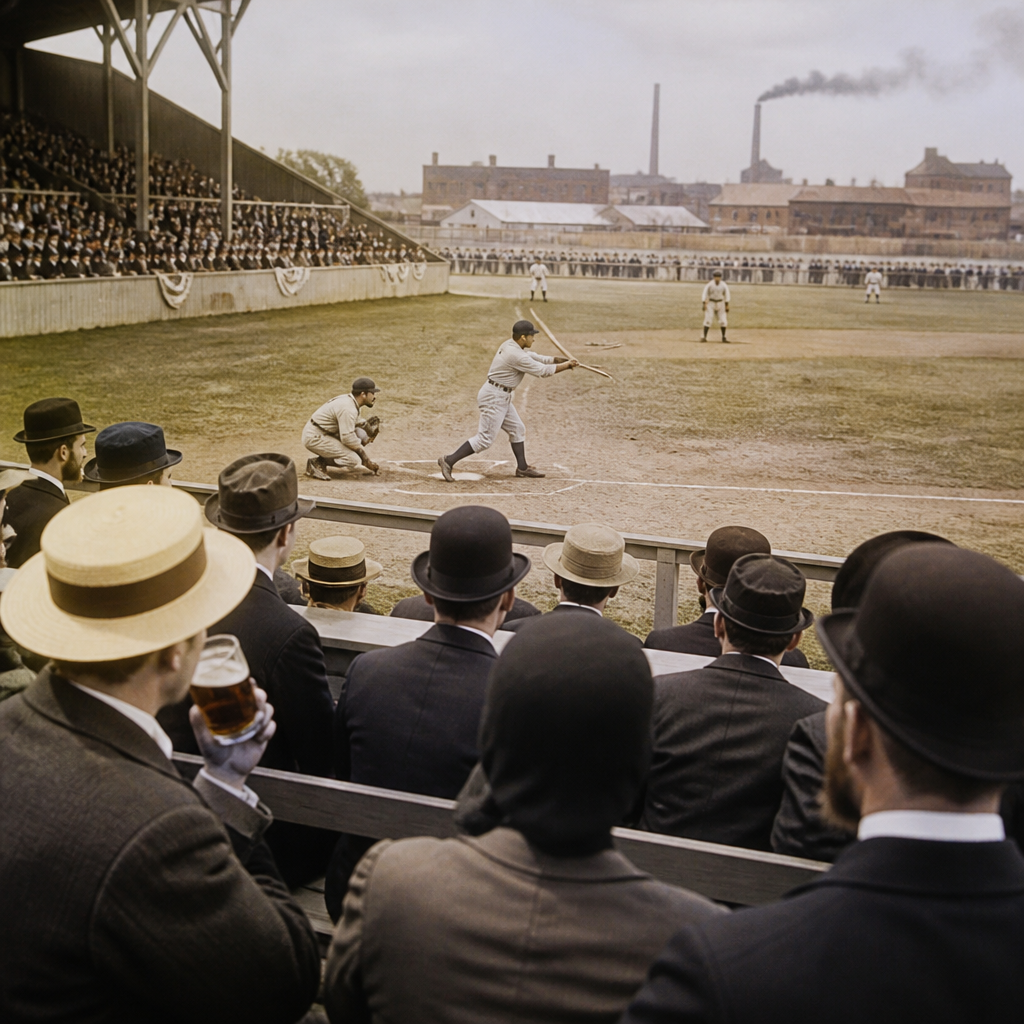
Baseball in the 1880s transformed from a loosely organized professional pastime into a fast-growing national business, and that decade’s fiercest debates over rival leagues, beer sales, Sunday games, and labor control shaped the entire 19th century game. In practical terms, the 1880s were the years when club owners, players, sportswriters, and fans fought over what professional baseball should be: a respectable weekday entertainment for middle-class patrons, or a mass-market urban spectacle built for working people. To understand 19th century baseball, this is the essential hub, because nearly every major theme of the era converges in these ten years.
Several key terms define the period. The National League, founded in 1876, was the dominant major circuit at the start of the decade and promoted centralized control, territorial rights, and stricter business discipline than earlier leagues. The American Association, launched in 1882, became its principal rival and was widely nicknamed the “Beer and Whiskey League” because it allowed alcohol sales at parks and scheduled Sunday games. The reserve clause, still primitive but increasingly powerful, bound players to clubs and limited salary competition. Barnstorming, black baseball, minor leagues, and short-lived unions also mattered, because the sport’s growth reached far beyond two major leagues.
Why does this matter? Because baseball’s explosive growth in the 1880s established the commercial template that later generations inherited. Gate receipts became more dependable, schedules lengthened, newspapers expanded coverage, and clubs learned that rulemaking, transportation, and urban demographics could decide pennants as surely as batting and pitching. I have worked through season records, league constitutions, and contemporary reporting from this era, and one conclusion always stands out: the 1880s were not a side story before “modern” baseball. They were the decade in which modern baseball economics, fan culture, and league warfare first took durable shape.
The professional landscape at the decade’s opening
At the beginning of the 1880s, professional baseball was still stabilizing after the turbulent 1870s. The National League had survived the collapse of the National Association and tried to present itself as orderly, reliable, and respectable. That meant fixed schedules, stronger enforcement of contracts, and tighter behavior standards for both clubs and spectators. Yet the league was hardly serene. Franchises folded, moved, or struggled financially, and the map of professional baseball remained concentrated in northeastern and midwestern cities connected by rail. Travel mattered because clubs needed train access to maintain viable schedules, and cities needed enough population, disposable income, and newspaper infrastructure to support a team.
The league’s leaders, especially Chicago owner William Hulbert before his death in 1882, believed strict governance was the antidote to instability. Admission prices were generally higher than in rival ventures, and the National League banned Sunday games and beer sales in many contexts to preserve an image acceptable to civic elites. That strategy did attract certain audiences, but it also left money on the table in industrial cities filled with wage earners who were free mainly on Sundays and who did not object to drinking at the ballpark. Those fans became the foundation for a competing vision of baseball.
The American Association and the working-class market
The American Association debuted in 1882 with a business plan that directly challenged the National League. Its clubs charged lower admission, commonly fifty cents or less, embraced markets the National League ignored, and treated Sunday baseball and beer concessions as revenue sources instead of moral hazards. In cities such as St. Louis, Cincinnati, Louisville, and Philadelphia, that formula worked immediately. The Association was not simply a weaker copy of the National League. It was a deliberate response to unmet demand, especially from urban working-class spectators who wanted affordable entertainment on their day off.
Beer and Sunday games were not trivial details. They were central to attendance economics in the 19th century. Owners understood that a full grandstand on Sunday could outdraw a weekday crowd several times over, especially when factory workers could not leave their jobs to attend afternoon games. Selling beer increased per-capita spending and made the park experience more social. The National League viewed those practices as threats to its public image, but the American Association treated them as practical business tools. This difference explains why the rivalry mattered so much: it was a battle over customer segmentation and league identity.
The strongest American Association franchise was the St. Louis Browns under owner Chris von der Ahe, one of the most vivid entrepreneurs in baseball history. Von der Ahe promoted his club aggressively, staged spectacles, and built fan loyalty with flair that often looked excessive to eastern baseball authorities. His Browns won four straight Association pennants from 1885 through 1888 and proved that a club outside the National League’s cultural model could become a powerhouse. In that sense, St. Louis was more than a successful team; it was evidence that baseball’s future lay in scale, promotion, and broad popular appeal.
League warfare, talent raids, and championship claims
Competition between the National League and American Association quickly extended beyond attendance. The leagues fought over players, territories, schedules, and legitimacy. Contracts were contested, clubs raided each other’s rosters, and the reserve system became more important precisely because owners feared bidding wars. In some years, the two circuits cooperated through agreements; in others, they acted like hostile neighbors sharing a fence. Their relationship was unstable because each needed the other just enough to avoid mutual ruin, yet each wanted to be recognized as the superior major league.
Postseason championship series between league pennant winners began to appear in the 1880s, though they were not equivalent to the modern World Series. The 1884 meeting between Providence of the National League and the New York Metropolitans of the American Association is often cited as the first interleague championship set. These contests varied in rules, financial arrangements, and seriousness, but they mattered symbolically. They offered a public answer to the question everyone asked: which league actually played better baseball? Results were mixed, but the National League generally maintained a stronger reputation for depth, even while the American Association often matched it in drawing power and local enthusiasm.
The decade also saw the brief rise of the Union Association in 1884, a third major-league claimant that collapsed after one season. Its failure is instructive. Launching a league required more than ambition; it required capital, strong urban markets, enforceable contracts, and enough talent to sustain credibility across all clubs. The Union Association had flashes of quality but lacked balance and staying power. Its existence nevertheless reveals how attractive baseball had become as a business. Investors were willing to risk money because the sport’s audience was expanding rapidly.
The reserve clause, player unrest, and the business of control
As revenues rose, owners sought tighter control over labor. The reserve clause, first modest in scope in the late 1870s, became a foundational mechanism in the 1880s. By reserving players to their current clubs, teams limited free bidding and suppressed salary inflation. Owners defended the system as necessary for competitive stability and survival. Players experienced it as a restraint that denied them market value. Both views had logic, but the power imbalance was obvious. Clubs could release a player, blacklist him, or trade his rights with little consultation.
I always advise readers to treat the reserve issue as central, not peripheral, to 19th century baseball. It affected roster building, competitive balance, and league politics in every season. The most dramatic pushback came with the Brotherhood of Professional Base Ball Players, organized under John Montgomery Ward. Ward was not merely a star shortstop and later pitcher; he was one of the game’s sharpest labor thinkers. The Brotherhood criticized salary classifications, contract restrictions, and owner hypocrisy, arguing that clubs talked about order while exploiting the very athletes who created the product fans paid to see.
Those grievances did not fully explode until the Players’ League of 1890, but the roots were unmistakably in the 1880s. Salary limits, fines, contract jumping, and blacklisting created a climate in which players increasingly thought in collective terms. The decade therefore belongs in any broad discussion of baseball labor history. Long before free agency, arbitration, or union certification, the core dispute was already visible: who controlled baseball’s income, and who had the right to move where opportunity was best?
Rules, strategy, and the on-field game
Baseball in the 1880s was not only growing commercially; it was changing on the field. Pitching evolved rapidly. Underhand delivery had given way to more forceful styles, and by the middle of the decade pitchers were working from a box with expanding freedom that increased speed and deception. The distance was still shorter than the modern sixty feet six inches, and workloads were enormous. Ace pitchers routinely threw hundreds of innings, often on minimal rest, because teams carried small staffs and expected stars to shoulder complete games.
Offense reflected the equipment and rules of the time. Fielding gloves existed but were less protective than later models, leading to more errors and rougher defensive play. Bats, balls, and grounds varied. Strategy leaned heavily on bunting, hit-and-run tactics, stolen bases as then defined, and aggressive baserunning designed to exploit defensive mistakes. The foul strike rule was not yet in universal use, so hitters could spoil pitches differently than in the modern game. Walk totals, strikeout rates, and batting averages from the era need careful context because the rule environment kept shifting.
| Issue | National League Approach | American Association Approach | Why It Mattered |
|---|---|---|---|
| Ticket pricing | Higher admission | Lower admission | Expanded access for working-class fans |
| Sunday games | Often restricted | Commonly allowed | Drove attendance on workers’ day off |
| Beer sales | Limited or discouraged | Openly permitted | Raised in-park revenue and social appeal |
| Public image | Respectability and control | Popular entertainment and flexibility | Defined each league’s audience and brand |
Stars gave the decade its personality. Cap Anson remained a dominant offensive force and influential figure in Chicago, though his legacy is inseparable from his role in enforcing baseball’s color line. Tim Keefe, John Clarkson, Charles “Old Hoss” Radbourn, Buck Ewing, Roger Connor, and King Kelly were among the most important talents of the era. Radbourn’s 1884 season for Providence, with an astonishing workload under disputed counting conventions, remains one of the most extreme pitching campaigns in baseball history. These players were not primitive prototypes. They were elite competitors adapting to a game whose standards were hardening in real time.
Expansion beyond the majors: minors, black baseball, and national reach
A true 19th century hub must look beyond the recognized major leagues. The 1880s saw serious growth in minor league organization, most notably with the formation of the Northwestern League and, in 1885, the original Western League. The National Agreement between leagues helped define relationships between majors and minors, including player contracts and territorial respect. Although the minor league structure was still unstable, the underlying principle was durable: baseball needed an interconnected professional ecosystem, not just a few top circuits. Smaller cities could support clubs, develop talent, and sustain local interest even when they lacked major league status.
Black baseball also formed an essential part of the decade, despite exclusion from the white major leagues. Exceptional Black players and teams competed independently and in integrated contexts that narrowed as segregation hardened. Moses Fleetwood Walker and his brother Weldy Walker appeared in the major leagues in the early 1880s, most notably with Toledo in the American Association in 1884. Their presence demonstrated that the color line was not yet fully codified, but racism from players, owners, and influential figures like Anson helped close that door. Any honest account of baseball in the 1880s must treat this not as a footnote but as a defining injustice of the era.
The sport’s national reach widened through rail travel, telegraph reports, and newspaper syndication. Fans who never saw an eastern club in person could still follow pennant races through box scores and game summaries. Sporting papers such as The Sporting News, founded in 1886 in St. Louis, accelerated that process. Standardized reporting made baseball more legible across regions and helped turn players into recognizable public figures. In modern terms, the 1880s were when baseball became truly scalable as media content.
Why the 1880s define 19th century baseball
If you are exploring the broader “Baseball Eras” topic, the 1880s should anchor your understanding of the 19th century because this decade connects the sport’s early professional experiments to the more formal systems of the 1890s and early 20th century. Rival leagues proved that baseball could support multiple business models. Beer and Sunday games showed that fan demand, not just owner preference, shaped league success. The reserve clause and player activism exposed labor tensions that would recur for generations. Rule changes and tactical evolution made the game faster, sharper, and more recognizable.
The decade also teaches an important caution. Growth did not mean fairness. Baseball expanded while excluding Black players, restricting worker freedom, and allowing owners to define morality in ways that often masked commercial self-interest. Yet that same decade produced stronger competition, better infrastructure, and broader public engagement than anything the sport had previously seen. In short, the 1880s were baseball’s first great growth market and its first fully modern argument about money, access, and power.
For readers using this page as a 19th century hub, the key takeaway is simple: start here when tracing the path from early professionalism to the entrenched leagues of the 1890s. The rival circuits, the fights over Sunday baseball and alcohol, the emergence of player resistance, and the rapid spread of clubs and coverage explain why the game survived its chaotic beginnings and became a permanent national institution. Use this overview as your foundation, then continue into deeper articles on the National League, the American Association, Black baseball, labor conflict, and rules evolution to see how the era fits together.
Frequently Asked Questions
Why was the 1880s such a turning point for baseball?
The 1880s were a turning point because baseball stopped looking like a loose collection of city clubs and started operating like a major commercial industry. Earlier professional baseball had already taken root, but during this decade the game expanded more aggressively, drew larger urban crowds, and developed a much sharper conflict over who controlled its future. Owners wanted stable profits, disciplined players, and orderly league structures. Players wanted better pay, more freedom, and less arbitrary control. Fans wanted accessible entertainment, which often meant cheaper tickets, Sunday games, and amenities that more “respectable” baseball men disliked. Those competing priorities gave the decade its energy and its instability.
What makes the 1880s especially important is that nearly every major issue of 19th-century baseball became impossible to ignore at the same time. Rival leagues challenged established power. The question of whether beer could be sold at ballparks became a symbol of class tensions and urban leisure culture. Sunday baseball raised disputes about religion, municipal law, and the business need to attract working people who had few days off. At the same time, labor control hardened through mechanisms that tied players to clubs and limited open competition for salaries. In other words, the sport’s explosive growth did not happen in a calm or orderly way. It happened through constant argument over money, morality, competition, and authority.
What were the rival leagues of the 1880s, and why did they matter so much?
The rival leagues mattered because they broke the idea that one organization should define professional baseball for everyone. The National League entered the decade as the leading circuit and presented itself as orderly, disciplined, and respectable. But that model left room for challengers. The American Association, founded in 1882, became the most famous rival. It positioned itself as a more accessible alternative, often with lower ticket prices and policies that appealed to working-class urban audiences. In practical business terms, it was not just another league; it was a direct competitor for cities, players, press attention, and fan loyalty.
The decade also saw other challenges, including short-lived leagues and ambitious attempts to reorganize the sport’s power structure. Even when these rival organizations did not last, they influenced the market. They forced established owners to defend their territories, negotiate with players more seriously, and think harder about attendance, scheduling, and public appeal. Competition between leagues drove salary disputes, franchise movement, and raiding of talent. It also made baseball feel bigger and more national, because different cities were now connected through overlapping commercial and media battles.
Most importantly, rival leagues exposed a basic disagreement about what kind of business baseball should be. Should it cater to elite ideals of discipline and respectability, or should it embrace broader popular demand? The answer in the 1880s was never simple, but the challengers proved that a profitable baseball league could thrive by courting the mass market. That lesson shaped the future of the sport long after individual leagues rose and fell.
Why were beer sales and Sunday games such controversial issues in 1880s baseball?
Beer sales and Sunday games were controversial because they touched much deeper anxieties than refreshments or scheduling. They became shorthand for class, religion, public morality, and the identity of baseball’s audience. Many established baseball leaders preferred to market the game as respectable entertainment, suitable for middle-class patrons and in harmony with reform-minded social values. In that vision, the ballpark was supposed to be orderly, sober, and carefully controlled. Selling beer or openly promoting Sunday recreation seemed to some critics like a surrender to rowdy commercialism.
But from a business standpoint, beer and Sunday baseball made enormous sense. Working-class fans often could not attend weekday afternoon games because they were on the job. Sunday was one of the few realistic opportunities for many people to see professional baseball. Likewise, beer sales aligned with urban leisure culture, especially in immigrant-heavy cities where saloons, gardens, and public recreation were central parts of social life. Clubs that embraced those realities could draw larger crowds and create a more festive atmosphere. Owners who opposed such policies were not just making moral arguments; they were also choosing a different target audience.
That is why these issues became so heated. They were really debates over whether baseball would remain limited by older ideals of propriety or fully commit to becoming a mass-market entertainment business. The American Association, in particular, became associated with a more flexible and commercially minded approach. Even where laws restricted Sunday play or local politics complicated enforcement, the pressure for broader access kept growing. In hindsight, these arguments reveal how tightly baseball was bound to the social life of industrial cities, not merely to what happened on the field.
How did labor control affect players during the 1880s?
Labor control affected players by sharply limiting their freedom even as the sport’s revenues and popularity expanded. As baseball grew into a more profitable enterprise, owners became determined to prevent salary wars and maintain control over rosters. The most important tool in this effort was the reserve system, which allowed clubs to claim continuing rights over players and restrict their ability to sign freely elsewhere. That meant a player could be valuable to the success of a club and still have very little leverage over where he worked or how much he was paid.
For owners, labor control was framed as necessary for stability. They argued that unrestricted competition for players would create financial chaos, weaken clubs, and threaten the survival of leagues. From their perspective, discipline and centralized authority protected the game. For players, however, the system often felt one-sided and coercive. Contracts were not negotiated in anything like a modern free market, and a club’s power could extend far beyond a single season. Players faced blacklisting, pressure to accept salary cuts, and a general imbalance in bargaining power.
These tensions helped produce early player resistance and laid the groundwork for future labor conflict. Even when players lacked the organizational strength to fully defeat ownership control, they increasingly understood themselves as workers inside a business, not merely athletes grateful for employment. That shift matters historically because it shows that baseball’s labor struggles were not a 20th-century invention. Their roots were already visible in the 1880s, when the business of the game expanded faster than its fairness to the men who played it.
How did the explosive growth of baseball in the 1880s shape the sport’s long-term future?
The explosive growth of the 1880s shaped baseball’s long-term future by proving that the game could function as a durable national entertainment business, not just a regional curiosity or seasonal pastime. The decade widened baseball’s audience, intensified media coverage, expanded league competition, and made club ownership a more clearly commercial enterprise. Larger crowds, stronger city identities, and more elaborate league structures all pushed the sport toward permanence. Baseball was no longer simply being played professionally; it was being marketed, debated, defended, and consumed on a much larger scale.
Just as important, the decade established patterns that would define baseball for generations. The struggle between exclusivity and accessibility never really disappeared. Owners kept searching for stable profits and centralized control. Fans continued to shape the game through attendance and public opinion. Players increasingly pushed back against restrictions on their mobility and compensation. The press amplified every dispute, helping turn baseball into a regular subject of civic conversation. Many of the institutions and habits that later seemed natural in professional sports were forged in this period of rapid expansion and open conflict.
In historical terms, the 1880s gave baseball its modern tensions as much as its modern momentum. It taught club owners that mass audiences could transform the economics of the sport. It taught players that popularity did not automatically bring freedom. And it taught everyone involved that professional baseball would always be about more than wins and losses. It would also be about law, labor, class, culture, and the business decisions that shaped who got to participate in the national pastime and on what terms.