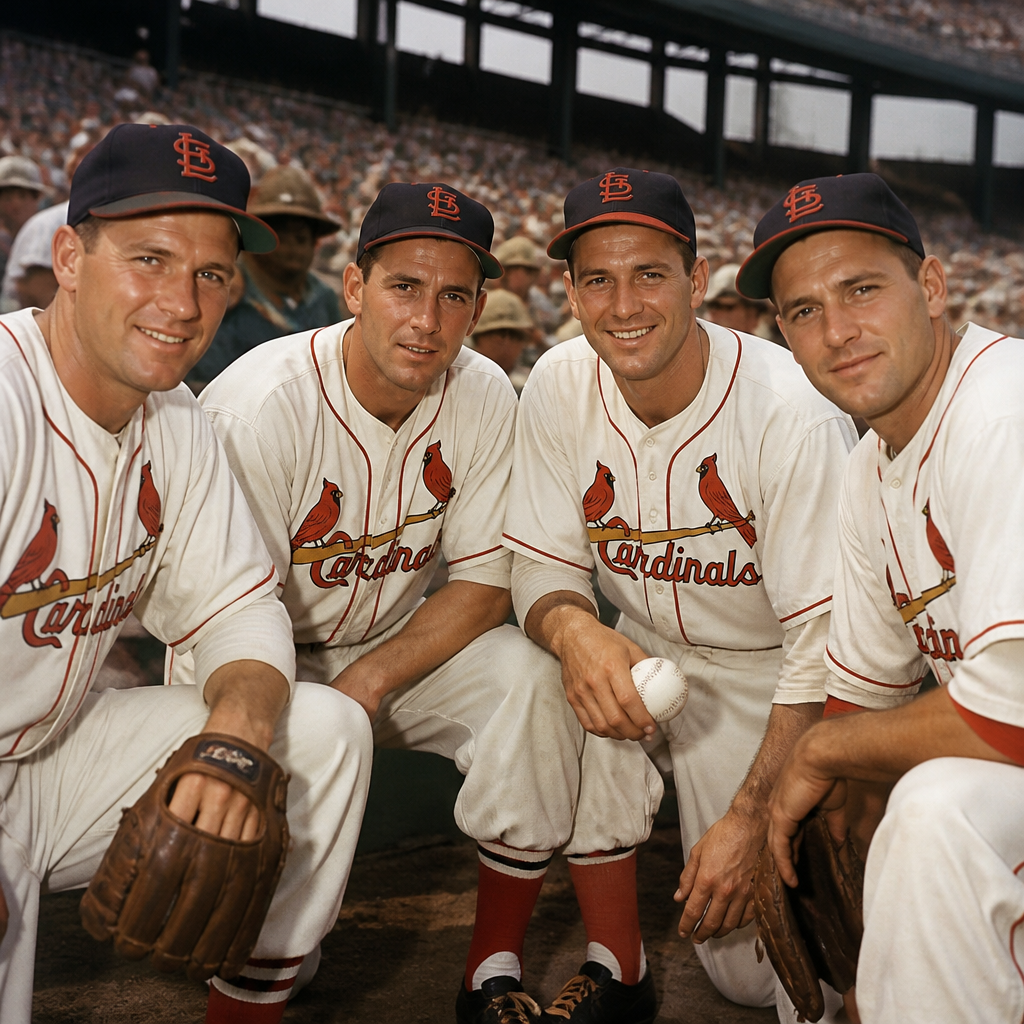
The 1942-1946 St. Louis Cardinals stand as baseball’s clearest wartime dynasty, a team that combined elite scouting, relentless player development, tactical depth, and uncommon resilience to dominate the National League during one of the most disrupted periods in American sports history. In five seasons, St. Louis won three World Series titles, captured four National League pennants, and posted a level of sustained excellence that few clubs in any era have matched. Calling them a dynasty is not promotional shorthand; it is an accurate description of a club that established competitive control over its league while the sport, and the nation around it, were being reshaped by World War II.
To understand why the 1942-1946 Cardinals matter, it helps to define two terms. A dynasty in baseball is not simply one championship team. It is a multi-year run in which a franchise repeatedly contends, converts talent into titles, and withstands roster turnover better than rivals. A hub topic in the history of great teams works the same way: it connects championship results to the systems that produced them. The Cardinals are central to any discussion of famous baseball teams because their success was built less on one supernatural superstar and more on an organizational model that later powers such as the Yankees, Dodgers, and Braves would echo.
I keep coming back to this club when evaluating great teams because the Cardinals won in different ways across these seasons. They could overwhelm opponents with speed, suppress runs with deep pitching, or grind out close games behind fundamentally sound defense. Their dominance also unfolded under unusual constraints. Hundreds of major leaguers entered military service, travel conditions were tighter, and rosters changed quickly. Those conditions complicate evaluation, but they do not erase achievement. If anything, the Cardinals’ ability to absorb disruption and still finish first illustrates why this team belongs in any serious examination of baseball dynasties and great teams.
Their story is also inseparable from the broader architecture of the franchise. Branch Rickey had built the Cardinals’ farm system before leaving for Brooklyn, and St. Louis remained one of the best organizations in baseball at converting minor league talent into major league wins. By the early 1940s, that machine produced stars like Stan Musial, Mort Cooper, Walker Cooper, Enos Slaughter, Marty Marion, and Whitey Kurowski, while also supplying useful replacements when wartime service thinned the talent pool. In practical terms, the Cardinals had what every dynasty needs: stars at the top, competence at the bottom, and a repeatable method for refilling the roster.
Why the Cardinals became baseball’s wartime powerhouse
The single best explanation for the Cardinals’ run is organizational depth. While other clubs relied heavily on aging veterans or a narrow core, St. Louis entered the war years with a strong farm network, athletic position players, and pitchers who fit the club’s run-prevention identity. The Cardinals did not accidentally stumble into success between 1942 and 1946. They had been building toward it for more than a decade through aggressive scouting, widespread minor league affiliations, and a willingness to trust younger players in important roles.
Manager Billy Southworth deserves direct credit. Southworth, who led the club from 1940 through 1945, was one of the era’s most effective field leaders. He handled personalities well, emphasized fundamentals, and rarely let the team beat itself. His clubs were disciplined on the bases, strong on defensive positioning by the standards of the time, and flexible enough to win low-scoring contests. Southworth’s calm authority mattered in wartime, when uncertainty around player availability could have fractured less stable teams.
St. Louis also benefited from balance. Musial was the offensive centerpiece, but the lineup was not one-dimensional. Slaughter brought energy and all-around production. Marion was an elite defensive shortstop and useful hitter. Kurowski delivered power from third base. The Cooper brothers gave the roster impact at pitcher and catcher, and when one player was absent or less effective, the Cardinals usually had another capable contributor ready. Dynasties are often remembered through stars, but they are sustained by the seventh, eighth, and fifteenth men on the roster. This club understood that before most franchises did.
The five-season run, year by year
The 1942 season announced the dynasty. St. Louis won 106 games and defeated the New York Yankees in the World Series, ending the Yankees’ run of championships from 1936-1941. That pennant race remains one of the great finishes in National League history. The Cardinals chased the Brooklyn Dodgers relentlessly, then overtook them late with superior pitching and execution. Mort Cooper won 22 games and the National League Most Valuable Player Award, while Musial hit .315 as a rookie. A team good enough to catch Brooklyn and then beat the established American League power was no fluke.
In 1943, the Cardinals were even better in the standings, finishing 105-49 and winning the pennant again. This time they lost the World Series to the Yankees, but reaching consecutive Fall Classics confirmed that 1942 was the beginning of something larger. Southworth’s club allowed only 500 runs, a remarkable figure over 154 games. The defense behind the pitchers was exceptional, and Musial advanced from outstanding young hitter to one of the best players in baseball.
The 1944 season produced an all-St. Louis World Series between the Cardinals and Browns, the only Fall Classic contested entirely within one city. The Cardinals won 105 games again and captured the championship in six games. Wartime manpower shortages clearly affected the competitive landscape, and any honest evaluation should say so. Even with that caveat, St. Louis still had to convert opportunity into wins, and it did so through superior infrastructure. Many clubs faced diluted rosters; the Cardinals were simply better prepared to function under those conditions.
In 1945, St. Louis won 95 games but finished behind the Chicago Cubs in the pennant race. That season is useful because it shows the dynasty was not invincible. Wartime baseball remained volatile, injuries and absences mattered, and other strong National League teams still posed real threats. The Cardinals were excellent, not automatic. That distinction actually strengthens their historical case, because it keeps the analysis grounded in performance rather than mythology.
The club returned to the top in 1946, winning 98 games and defeating the Boston Red Sox in a seven-game World Series remembered for Enos Slaughter’s “Mad Dash” on Harry Walker’s hit in Game 7. By then Southworth had left and Eddie Dyer managed the team, yet the structure still held. That continuity is one of the strongest dynasty indicators. Great teams can survive managerial change because their identity is embedded at the organizational level.
| Season | Regular-Season Record | National League Finish | World Series Result |
|---|---|---|---|
| 1942 | 106-48 | 1st | Defeated Yankees |
| 1943 | 105-49 | 1st | Lost to Yankees |
| 1944 | 105-49 | 1st | Defeated Browns |
| 1945 | 95-59 | 2nd | Did not qualify |
| 1946 | 98-58 | 1st | Defeated Red Sox |
The stars who defined the dynasty
Stan Musial is the first name any serious account must feature. During this five-year span, he developed into the franchise’s defining player and one of the greatest hitters in baseball history. Musial combined bat control, extra-base power, and consistency in a way that translated across changing wartime conditions. He won the National League MVP Award in 1943 and 1946, and his presence gave the Cardinals a dependable offensive anchor every day. What made Musial especially valuable was that he did not need a particular game script. He could fuel rallies, clear the bases, or simply keep innings alive.
Mort Cooper was equally important at the front of the pitching staff, especially in the early phase of the run. His 1942 season, when he went 22-7 with a 1.78 ERA, was the work of a true ace. In an era before modern bullpen usage, that kind of reliability changed a club’s weekly rhythm. Teammates knew the Cardinals had an excellent chance to win every time he started. Walker Cooper, meanwhile, gave the club unusual offensive value at catcher, a position where most teams were happy merely to survive defensively.
Enos Slaughter embodied the club’s competitive style. He ran hard, threw well, hit for average, and played with constant pressure. His “Mad Dash” in 1946 became the signature play, but reducing Slaughter to one sprint undersells him. He was a complete right fielder whose intensity matched the Cardinals’ identity. Marty Marion brought similar value in a different form. As a shortstop, Marion had range, hands, and poise that stood out even in a strong defensive era. He won the National League MVP in 1944, a reminder that the Cardinals’ greatness was not confined to conventional slugging numbers.
How St. Louis won: defense, depth, and pressure baseball
The Cardinals’ style can be summarized simply: prevent runs, create action, and force mistakes. They were not built solely around home-run power, which was sensible in Sportsman’s Park and in an era with different offensive patterns. Instead, they emphasized contact, baserunning, situational hitting, and dependable fielding. They turned games into tests of execution, and over a 154-game season they usually executed better than everyone else.
Defensively, the club was outstanding up the middle. Catching, shortstop, center field support, and pitching all aligned. Marion’s work at short stabilized the infield, and the Cardinals generally converted balls in play into outs at a high rate relative to their contemporaries. Before modern defensive metrics, observers relied on range, reliability, and team results. By those measures, St. Louis passed every test. The low run totals allowed in 1942, 1943, and 1944 were not accidents; they reflected a roster designed to support pitchers efficiently.
On offense, the Cardinals pressured opponents from first pitch to last. Slaughter and Musial could sustain long innings in different ways, and role players consistently moved runners, hit behind them, or took extra bases. This matters when comparing great teams across eras. Some dynasties overpower; others suffocate. The wartime Cardinals did more of the latter. They made opponents play clean baseball for nine innings, and most opponents eventually failed.
Depth may be the most underrated element of all. Because players left for military service and later returned at different points, clubs needed replacement value before the phrase existed. The Cardinals had it. Their farm system supplied usable pitchers, infielders, and outfielders who could step into roles without collapsing the team structure. Modern analysts would call this roster resilience. In plain terms, St. Louis always seemed to have another competent player ready.
Wartime context and the debate over legacy
Any accurate article about the 1942-1946 Cardinals must confront the wartime question directly: how much should World War II alter our judgment of the dynasty? The answer is that context matters, but dominance still counts. Talent depletion was real. Stars across baseball served in the armed forces, and the level of play was uneven compared with full-strength seasons. That is a legitimate qualification, not an attack on the Cardinals.
At the same time, the Cardinals did not create the wartime environment; they mastered it. Every franchise worked under the same broad national conditions, yet St. Louis separated itself through preparation and development. The fairest historical reading is that wartime circumstances shaped the field, but the Cardinals’ sustained superiority within that field remains impressive and meaningful. Historians routinely make similar adjustments in other sports and eras. The key is balance, not dismissal.
This is also why the Cardinals serve so well as a hub example within dynasties and great teams. They show that greatness can come from systems as much as singular celebrity. They also show that context should refine evaluation, not erase it. If you are mapping famous baseball teams, this club links naturally to larger conversations about the Yankees’ long-running empire, the Big Red Machine, the late-1990s Yankees, and modern development-driven powers.
Why this team still belongs near the top of baseball history
The 1942-1946 St. Louis Cardinals belong near the top of baseball history because they paired results with structure. They won 509 regular-season games in five years, reached four World Series, and claimed three championships. Just as important, they demonstrated how an organization can turn scouting, player development, tactical clarity, and clubhouse steadiness into a repeatable edge. That formula is the common thread running through nearly every later baseball dynasty.
For readers exploring dynasties and great teams, the lesson is straightforward. Judge a famous team not only by rings, but by how it sustained contention, adapted to change, and imposed a recognizable style on its era. By that standard, the wartime Cardinals clearly qualify. They were deep, disciplined, and relentlessly prepared, with Musial’s brilliance and Southworth’s leadership elevating an already strong foundation. Their record deserves close study, not nostalgic shorthand.
If you are building out your understanding of famous baseball teams, use the 1942-1946 Cardinals as a starting point for comparing dynasties across generations. Measure their peak, their continuity, and their context. Few teams will hold up better under careful examination, and that is exactly why St. Louis remains baseball’s wartime dynasty.
Frequently Asked Questions
Why are the 1942-1946 St. Louis Cardinals considered baseball’s clearest wartime dynasty?
The case begins with sustained results. From 1942 through 1946, the Cardinals won four National League pennants in five seasons and captured three World Series championships, an extraordinary run in any era and even more impressive during a time when baseball was being reshaped by World War II. This was not a one-year spike or a fortunate stretch. St. Louis built a repeatable model of winning that held up year after year despite roster disruption, military service, travel strain, and the uncertainty that affected every major league club during the war years.
What makes the Cardinals stand out is that their dominance was structural, not accidental. They had one of the most advanced scouting and farm systems in the game, allowing them to replace lost talent more effectively than most rivals. Instead of collapsing when key players left for military service, St. Louis kept producing contributors from within its organization. The club also had unusual depth, smart tactical management, strong pitching, aggressive defense, and a style of play built around pressure and consistency rather than dependence on one or two superstars.
Just as important, the Cardinals were not merely surviving a weakened league; they were consistently outperforming everyone around them. Their success included a 1942 championship, another title in 1944, and a third in 1946, along with a 1943 pennant and another National League title in 1946 after the war had ended and competition had begun normalizing. That last point matters. Their excellence bridged both the heart of the wartime period and the immediate postwar transition, which strengthens the argument that this was a true dynasty rather than a temporary wartime anomaly.
What made the Cardinals so effective during World War II when so many teams struggled to stay competitive?
The Cardinals succeeded because they were better prepared than almost anyone else for baseball’s wartime instability. While other clubs were hit hard by military enlistments and had trouble filling holes, St. Louis had a development pipeline capable of feeding major league talent to the roster on a constant basis. This advantage came from a strong organizational commitment to scouting and player development, which had been built before the war and paid enormous dividends once the player pool became unpredictable.
The club also benefited from a baseball identity that emphasized complete team play. The Cardinals did not need to rely exclusively on a single offensive star or one dominant pitcher. They could win with pitching depth, speed, defense, timely hitting, and adaptable lineup construction. That flexibility was critical in wartime conditions, when rosters could shift suddenly and clubs often had to rethink roles on the fly. St. Louis handled those changes better than most because its system produced players who were fundamentally sound and ready to contribute in multiple ways.
There was also a mental and cultural component. The wartime Cardinals developed a reputation for toughness, energy, and relentlessness. They played with a sense of confidence that came from organizational stability and repeated success. In an era defined by disruption, St. Louis had continuity in approach, standards, and expectations. That continuity helped the club maintain elite performance while many rivals became inconsistent. In short, the Cardinals were not simply the beneficiaries of wartime conditions; they were the team best built to master them.
Who were the most important players and figures behind the Cardinals’ success from 1942 to 1946?
Several major names define this dynasty, and any serious discussion starts with Stan Musial. Even early in his legendary career, Musial was becoming one of baseball’s most complete hitters, and his presence gave the Cardinals a foundational offensive force. He combined average, power, discipline, and consistency in a way that stabilized the lineup. Around him, St. Louis featured a strong supporting cast that changed somewhat from year to year but consistently delivered high-level production.
On the mound, Mort Cooper was a central figure, especially in the early part of the run. He emerged as one of the National League’s top pitchers and helped anchor a staff that gave St. Louis a chance to win almost every day. The Cardinals also drew major value from Max Lanier and other dependable arms who provided quality innings during seasons when reliable pitching was often difficult to find. This was not a one-man rotation; it was a deep and resilient staff backed by a defense built to convert opportunities into outs.
Managerial and organizational leadership mattered just as much. Billy Southworth, who managed most of this period, deserves enormous credit for blending talent, discipline, and tactical intelligence. He guided a club with high expectations and kept it focused through years of unusual pressure and constant roster change. Above him, the front office and scouting network supplied the raw material for sustained success. The Cardinals’ dynasty was powered by stars, but it was made possible by an organizational machine that kept identifying, developing, and deploying talent at a championship level.
Did wartime conditions make the Cardinals’ achievements less impressive, or do they still fully qualify as a dynasty?
The wartime context should be understood, but it should not be used to diminish what the Cardinals accomplished. Yes, World War II altered major league rosters across the sport. Star players from many teams entered military service, and the overall talent distribution changed. But those conditions affected everyone. The real historical question is not whether the game was different during the war; it clearly was. The question is which team best adapted to that environment and sustained excellence over time. The Cardinals were the clear answer.
In fact, the wartime disruption actually highlights the strength of the Cardinals’ organization. A dynasty is not only about winning when conditions are ideal. It is about building a system that can withstand pressure, absorb losses, and continue to perform at the highest level. St. Louis did exactly that. The club won repeatedly in a period when stability was rare, and it did so through depth, preparation, and smart baseball operations rather than mere luck. Those are hallmarks of a legitimate dynasty.
The strongest rebuttal to the “wartime asterisk” argument is the team’s continuity of success into 1946. By then, the war had ended, rosters were shifting again, and competition was moving toward a more normal footing. Yet the Cardinals still won the National League pennant and the World Series. That season helps confirm that their dominance was not just a product of a temporary wartime vacuum. It was the culmination of a five-year run by one of the best-organized and most consistently excellent teams baseball has ever seen.
How does the 1942-1946 Cardinals dynasty compare with other great runs in baseball history?
Measured by concentration of success, the Cardinals belong in the company of baseball’s most impressive multi-year powers. Winning three World Series titles and four pennants in five seasons puts them in rare territory. Very few clubs have maintained that level of year-to-year superiority, especially while dealing with a national crisis that reshaped the player pool and everyday life across the United States. Their run may not always receive the same popular attention as more famous dynasties, but historically it deserves serious respect.
What distinguishes the Cardinals from some other great teams is the way they won. Certain dynasties are remembered for overwhelming star power, massive payroll advantages, or iconic headline names. The 1942-1946 Cardinals were more of an organizational dynasty. Their edge came from scouting, development, roster depth, sharp management, and the ability to keep replenishing talent. That gives their run a different flavor from later powerhouse clubs, but not a lesser one. In some ways, it makes their success even more impressive because it was rooted in institutional strength rather than short-term concentration of talent.
They also occupy an important place in baseball history because they define the standard for excellence during the World War II era. When historians discuss how the sport functioned under wartime strain, the Cardinals are the central example of a team that turned preparation into sustained dominance. Whether one ranks them alongside the Yankees’ classic dynasties, the postwar Dodgers, or other elite stretches across eras, the 1942-1946 Cardinals unquestionably deserve recognition as one of baseball’s great championship machines.