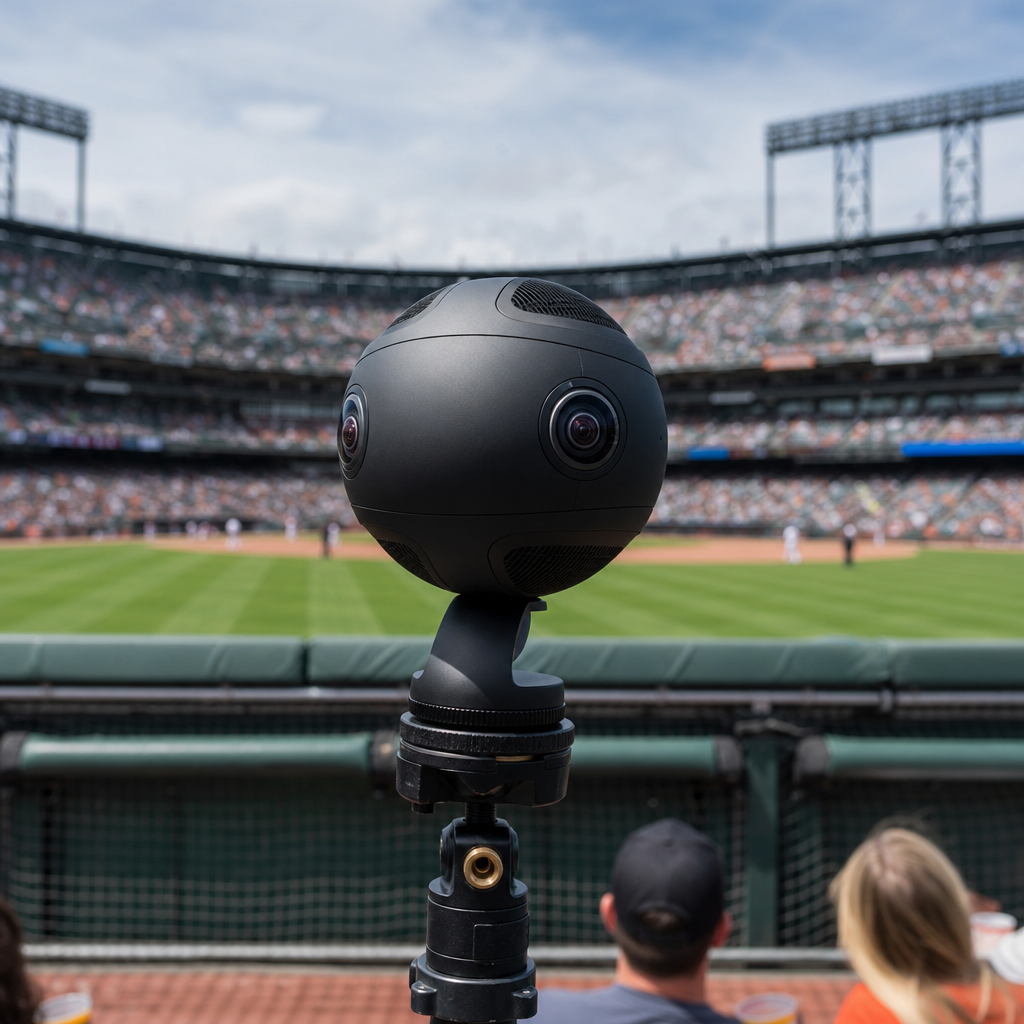
Baseball broadcasting has moved far beyond the center-field camera, the high home angle, and the standard replay package. Today, 360-degree cameras and immersive baseball viewing experiences are redefining how fans watch games, how networks package live coverage, and how clubs extend the ballpark beyond its physical walls. In the broader conversation about innovations and changes in baseball, modern media and broadcasting techniques now include volumetric capture, virtual reality streams, augmented overlays, spatial audio, player-tracking graphics, alternate broadcasts, and mobile-first interactive feeds. Together, these tools shift baseball coverage from passive viewing to active exploration.
A 360-degree camera captures a scene in every direction at once, allowing a viewer to pan around on a phone, tablet, headset, or web player. An immersive baseball viewing experience goes further: it combines panoramic video, low-latency streaming, synchronized audio, real-time data, and interface design so a fan can feel placed inside the game environment. I have worked with live sports video workflows long enough to know that the promise sounds simple, but execution depends on stitching accuracy, camera placement, bandwidth, metadata synchronization, and editorial discipline. When those pieces work together, viewers do not just watch a pitch sequence; they choose an angle, follow defensive positioning, inspect baserunner leads, and absorb crowd energy in a way flat video cannot replicate.
This matters because baseball is uniquely suited to immersive coverage. The sport has natural pauses, discrete events, and a playing field where positioning tells a story before and after every pitch. Traditional broadcasts still excel at narrative control, but many fans now expect second-screen data, personalized highlights, and digital experiences that mirror gaming interfaces. Leagues, broadcasters, and technology vendors are responding with new production models built around richer capture and more flexible distribution. For a sub-pillar hub on modern media and broadcasting techniques, 360-degree production is the connective thread: it touches camera hardware, streaming infrastructure, fan engagement, sponsorship integration, accessibility, archive strategy, and the future economics of baseball media.
How 360-Degree Baseball Production Works
In practical terms, a 360-degree baseball setup begins with camera systems that use multiple ultra-wide lenses to record overlapping fields of view. Software then stitches those feeds into a seamless spherical image. In baseball, common placements include behind home plate, near first- or third-base dugouts, in premium seating sections, on concourse overlooks, and occasionally in bullpen or batting-practice environments. Because game action unfolds across a large diamond, placement is more critical than in smaller-arena sports. A beautiful panoramic image is useless if the ball becomes unreadable at release or if protective netting dominates the frame.
Production teams also have to solve for latency, since immersive streams fail when social media clips or neighboring televisions reveal the outcome before the live panoramic feed catches up. Modern workflows typically rely on high-efficiency codecs such as HEVC, adaptive bitrate streaming, cloud transcoding, and content delivery networks tuned for mobile delivery. Audio is equally important. Spatial or ambisonic audio lets crowd noise, bat cracks, and announcer positions change naturally as the viewer turns perspective. In testing, I have seen fans forgive minor visual softness faster than they forgive audio that feels disconnected from the scene.
Immersive coverage rarely stands alone. The strongest baseball implementations combine 360-degree video with Statcast-style data, scorebug integration, on-demand replays, and alternate commentary options. That hybrid model is important for this subtopic hub because modern media and broadcasting techniques are converging rather than replacing one another. A network might use standard cameras for the main telecast, a 360-degree rig for premium digital access, player-tracking graphics for analysis, and vertical video clips for social distribution. The strategic value lies in designing one production ecosystem that supports many audience behaviors.
Why Baseball Fits Immersive Viewing Better Than Many Sports
Baseball rewards anticipation. Before a pitch, a fan can study infield shift depth, outfielder alignment, catcher targets, pitcher tempo, and baserunner intent. In a traditional directed broadcast, the producer decides which of those details deserves attention. In an immersive environment, the viewer can investigate independently. That is especially powerful for knowledgeable fans who understand situational baseball and want context beyond the close-up shot. A 2-1 count with a runner on first becomes richer when the viewer can watch the first baseman hold the runner, the middle infield prepare for a double-play ball, and the bullpen stir in the background.
The geometry of the game also helps. Baseball action starts from fixed reference points: mound, plate, bases, foul lines, dugouts, bullpens. That makes orientation easier in 360-degree environments than in continuous-field sports where play can spin rapidly away from the viewer. The pace gives platforms time to surface overlays without overwhelming the audience. This is why modern baseball broadcasting increasingly experiments with data layers, probability graphics, and explanatory annotation. The immersive model is not only cinematic; it is educational. Newer fans can learn positioning and strategy visually instead of relying solely on commentary.
There is a commercial reason as well. Baseball has 162 regular-season games per club, plus spring training, postseason, and ancillary events. That volume creates many opportunities to test and refine new broadcast products. A club does not need every game to become a fully immersive showcase. It can trial premium seat views on weekends, sponsor batting-practice experiences, or offer headset-accessible archives for marquee matchups. Repetition lowers operational risk and gives broadcasters time to understand what fans actually use rather than what sounds innovative in a pitch deck.
Core Technologies Shaping Modern Media and Broadcasting Techniques
Anyone evaluating immersive baseball coverage should look beyond the camera itself. The current stack includes panoramic capture, 5G or robust venue connectivity, edge processing, cloud production, computer vision, graphics rendering, and analytics platforms that measure engagement by interaction type rather than simple view count. Baseball organizations commonly pair these tools with Hawkeye tracking systems, digital asset management platforms, and automated clipping software. The result is a broader transformation in modern media and broadcasting techniques, not a single gadget upgrade.
| Technology | What it does in baseball coverage | Practical example |
|---|---|---|
| 360-degree cameras | Capture panoramic live or recorded views | Fans look around from behind home plate during a key at-bat |
| Spatial audio | Matches sound direction to viewer orientation | Crowd noise swells from left field after a home run lands there |
| Player tracking | Adds movement and positioning data | Overlay shows outfielder route efficiency on a deep fly ball |
| Cloud production | Processes feeds remotely for scale and flexibility | Regional broadcasts create alternate digital streams without a full extra truck |
| AR graphics | Places digital information into the viewing environment | Strike zone, pitch type, or defensive alignment appears in-context |
| Low-latency streaming | Reduces delay between field action and viewer playback | Mobile viewers react in near real time instead of trailing social clips |
These tools create better baseball viewing experiences when they are used with restraint. Too many overlays clutter the field and fatigue the viewer. Too little guidance leaves users unsure where to look. The most effective productions identify the key fan question for each moment and answer it clearly: Where should I focus? What changed on that pitch? Why was the fielder positioned there? In my experience, the winning formula is not maximum technical complexity but well-timed context layered onto dependable video.
Use Cases for Fans, Teams, Broadcasters, and Sponsors
For fans, the value is choice and presence. A remote viewer can revisit a walk-off celebration from inside the crowd, watch bullpen routines that a standard telecast ignores, or follow a star shortstop’s pre-pitch movement over a full inning. For out-of-market supporters, these options narrow the emotional gap between attending and streaming. Teams benefit because immersive products can support premium subscriptions, in-app upgrades, and season-ticket retention campaigns. A club can market access to exclusive ballpark perspectives the same way it markets hospitality areas or member-only events.
Broadcasters gain inventory and differentiation. Regional sports networks and direct-to-consumer platforms need reasons for viewers to stay within their ecosystems. Alternate camera feeds, multilingual commentary, youth-focused broadcasts, and data-rich streams all extend session length and create more targeted sponsorship opportunities. A 360-degree feed from a branded rooftop section or an immersive pregame batting-practice stream can attract advertisers looking for association with innovation rather than standard in-game spots.
Sponsors should care because immersive environments offer contextual placements that feel less interruptive than conventional ad breaks. A digital overlay tied to launch angle analysis, a branded panoramic replay zone, or a virtual clubhouse tour linked to a team partner can feel additive when executed carefully. The limit is obvious: baseball audiences are sensitive to clutter and forced gimmicks. If sponsorship degrades usability, fans abandon the experience. The lesson from successful deployments is straightforward: utility first, branding second.
Challenges, Tradeoffs, and Standards That Matter
Immersive baseball viewing is not automatically superior to traditional production. Resolution remains a challenge because spherical video spreads pixels over a full environment; what looks sharp in a headset may still struggle to show a small fast-moving baseball clearly. Camera placement can raise safety, sightline, and competitive concerns. Rights agreements may limit where feeds can be distributed, especially when local, national, and international packages overlap. Accessibility also needs more attention. Interfaces must work for users who do not want headsets, and commentary should remain useful when visual attention shifts around the scene.
There are operational constraints too. Crews need predictable workflows for calibration, stitching, quality control, and metadata timing. Storage costs rise quickly with high-resolution panoramic archives. Live sports also demand reliability standards that entertainment VR projects can sometimes avoid. Broadcasters typically benchmark against established streaming metrics such as startup time, rebuffer rate, bitrate stability, and end-to-end latency. If those fundamentals fail, no amount of novelty saves the product. This is one reason many teams start with highlights, special events, or postseason activations before expanding to full-game availability.
Industry standards help keep experimentation grounded. SMPTE guidance around media workflows, adaptive streaming conventions such as HLS and MPEG-DASH, and maturing practices in cloud production all shape what is feasible. The broader lesson for modern baseball broadcasting is that innovation succeeds when it respects production discipline. Fans may remember the wow factor, but they return for consistency.
The Future of Baseball Broadcasting in an Immersive Era
The next phase will likely blend immersive video with personalization and intelligent automation. Viewers will be able to choose a preferred mode: tactical, social, educational, betting-adjacent where legal, or family-friendly. AI-assisted production tools will tag moments automatically, generate multilingual summaries, and recommend viewpoints based on what a user tends to watch. Volumetric capture may eventually enable free-viewpoint replays that let fans rotate around a stolen-base attempt or home-plate collision without waiting for a producer-selected angle. As headsets become lighter and mobile processors improve, more of this experience will move from novelty to routine option.
Even then, the standard broadcast will remain essential. Baseball storytelling still depends on commentary rhythm, selective replay, and editorial judgment. The most realistic future is a layered one in which the main telecast anchors the experience while immersive modules serve distinct audience needs. That is the central takeaway for this hub on modern media and broadcasting techniques: the industry is not choosing between television and immersion. It is building a flexible media stack that lets every fan engage with the same game in different ways.
For teams, media operators, and readers tracking innovations and changes in baseball, 360-degree cameras are best understood as infrastructure for deeper engagement rather than a standalone trend. They connect capture, data, distribution, sponsorship, and fan education into one strategy. If you are mapping this subtopic, start with the use case, then match the technology, workflow, and monetization model to it. Done well, immersive baseball viewing makes the sport more legible, more personal, and more valuable for everyone involved. Use this hub as the starting point for evaluating the tools, partnerships, and production choices that will define the next generation of baseball media.
Frequently Asked Questions
1. What are 360-degree cameras, and how are they changing the way baseball games are viewed?
360-degree cameras are multi-lens camera systems designed to capture the full environment around them rather than a single fixed frame. In baseball, that means viewers are no longer limited to the traditional center-field, dugout, or high-home broadcast angles that have defined the sport for decades. Instead, fans can explore the stadium visually, look around key moments, and experience the game from perspectives that feel much closer to actually being in the ballpark. This shift matters because baseball is a sport built on atmosphere, spacing, and anticipation as much as action. A towering fly ball, a pickoff attempt, a close play at the plate, or the crowd reaction after a home run all gain added dimension when the viewer can engage with the entire scene.
These systems are changing baseball viewing by making coverage more interactive and immersive. Rather than passively watching a director’s selected camera feed, the fan can often choose where to look during a replay or special viewing mode. That creates a stronger sense of presence, especially when paired with virtual reality headsets, mobile apps, or interactive streaming platforms. For broadcasters, 360-degree technology opens the door to premium alternate feeds, sponsored immersive content, and new storytelling formats. For teams and leagues, it extends the in-stadium experience to remote audiences in a way traditional television never could. In short, 360-degree cameras are transforming baseball from a linear viewing product into a more participatory media experience.
2. How do immersive baseball viewing experiences work with virtual reality and augmented reality?
Immersive baseball viewing experiences typically rely on a combination of 360-degree video capture, spatial audio, advanced graphics processing, and interactive software platforms. In a virtual reality setup, fans wear a VR headset and enter a digital viewing environment that simulates being inside the stadium. They may be placed behind home plate, near first base, in the outfield seats, or even in premium locations that would be difficult or expensive to access physically. Because the feed is captured in 360 degrees, users can turn their heads naturally and take in the game environment as if they were present. Spatial audio enhances the effect by making crowd noise, bat cracks, umpire calls, and player chatter feel directionally realistic.
Augmented reality works a little differently. Rather than placing the viewer inside a fully virtual environment, AR layers digital information onto a live or real-world view. During a baseball broadcast, that can include pitch tracking, launch angle overlays, player positioning graphics, batting statistics, defensive alignment visuals, or interactive score elements appearing in a more dynamic way. On a mobile device or AR-capable headset, a fan might point a screen at a live game or a companion display and see contextual graphics appear over the action. This makes the viewing experience richer without fully replacing the standard broadcast format.
Together, VR and AR give baseball media producers multiple ways to deepen fan engagement. VR emphasizes presence and immersion, while AR enhances understanding and interactivity. Both technologies are especially valuable in a sport like baseball, where strategy, positioning, and situational context are central to appreciating the game. As production tools improve and hardware becomes more accessible, immersive viewing is likely to become a more regular part of how baseball is packaged, consumed, and monetized.
3. What are the biggest benefits of immersive baseball broadcasts for fans, teams, and networks?
For fans, the biggest benefit is a more engaging and personalized viewing experience. Traditional baseball broadcasts are carefully produced, but they remain one-directional: viewers watch what the director chooses to show. Immersive broadcasts offer more agency. A fan can explore the stadium atmosphere, revisit a dramatic play from different positions, or experience moments with a greater sense of scale and realism. That makes the game feel more immediate, especially for viewers who cannot attend in person. It also appeals to younger audiences and digitally native fans who are used to interactive media and expect more than a static screen experience.
For teams, immersive technology creates powerful opportunities for brand extension and fan relationship building. A club can use 360-degree content to bring fans inside batting practice, clubhouse tours, ballpark events, or special behind-the-scenes moments that deepen loyalty. It can also enhance premium membership packages, remote fan experiences, and international outreach by making the ballpark more accessible to supporters who live far away. In an era where teams are increasingly media brands as much as sports organizations, immersive content helps create value beyond the nine innings of live play.
Networks and streaming platforms benefit because immersive baseball coverage introduces new content formats and revenue models. They can create premium subscription tiers, sponsored interactive segments, branded replay experiences, or exclusive VR game packages. It also gives broadcasters new ways to differentiate their product in a competitive sports media environment. Importantly, immersive tools can support better storytelling by highlighting defensive positioning, base-running decisions, bullpen activity, and crowd energy in more compelling ways. The result is a broadcast ecosystem that serves casual viewers, hardcore fans, advertisers, and rights holders more effectively than traditional one-size-fits-all production alone.
4. What technical challenges come with using 360-degree cameras and immersive media in baseball broadcasting?
While the potential is enormous, immersive baseball production is technically demanding. One of the biggest challenges is camera placement. Baseball is a large, open-field sport with action that can move quickly from the pitcher’s mound to the outfield wall, so placing 360-degree cameras in locations that feel useful, immersive, and unobtrusive requires careful planning. Cameras must capture meaningful perspectives without interfering with players, officials, sightlines, or standard television operations. A placement that works beautifully for atmosphere may not be ideal for tracking the ball, and a position that captures a dramatic field-level view may be difficult to secure safely during live play.
Another major challenge is data processing and transmission. 360-degree video, especially in high resolution suitable for VR, requires substantial bandwidth and computing power. The footage must often be stitched together from multiple camera lenses in real time or near real time, which adds complexity to live production. Maintaining image clarity is also critical. If resolution drops too low, especially in VR, the experience can feel blurry or disorienting. Latency is another concern because sports fans expect live action, and delays can diminish the excitement or create spoilers through social media and second-screen activity.
User comfort and accessibility are important as well. Not every fan owns a VR headset, and not every viewer wants a fully immersive experience for an entire game. Producers therefore have to design flexible products that work across devices, from smartphones and tablets to connected TVs and headsets. There are also editorial challenges: baseball broadcasts still need narrative structure, and too much freedom can overwhelm viewers if the interface is confusing or the experience lacks clear guidance. The most successful immersive baseball products balance technical sophistication with usability, making the experience intuitive rather than experimental for its own sake.
5. What does the future look like for 360-degree cameras and immersive baseball viewing experiences?
The future is likely to be defined by deeper integration rather than novelty. 360-degree cameras and immersive baseball tools are moving from experimental add-ons toward a more established role within the broader sports media ecosystem. As camera technology improves, volumetric capture becomes more practical, and streaming infrastructure grows more robust, fans can expect higher-quality interactive experiences that feel smoother, sharper, and more natural. Instead of simply offering a 360 replay as a special feature, broadcasters may build entire alternate viewing modes around immersive presentation, allowing fans to choose between traditional coverage and more interactive formats depending on preference.
Volumetric capture is especially promising because it goes beyond panoramic video and creates three-dimensional representations of players and action. That could eventually allow fans to view a swing, a diving catch, or a close tag play from nearly any angle in a spatially realistic way. Combined with advanced analytics, immersive baseball experiences could also become more informative. Viewers may be able to see defensive shifts develop in real space, understand pitch tunneling from the batter’s perspective, or examine base-running decisions with layered visual context that is far more intuitive than flat graphics alone.
From a business standpoint, the future will likely include more personalized and tiered content offerings. Teams, leagues, and networks can package immersive experiences for remote season-ticket holders, international audiences, sponsors, and younger fans looking for more interactive forms of sports entertainment. As hardware adoption increases and user interfaces improve, these experiences may become less of a niche feature and more of a standard option alongside conventional live broadcasts. Baseball, with its rich atmosphere, strategic depth, and strong sense of place, is particularly well suited to immersive media. That makes 360-degree and extended-reality coverage not just an interesting experiment, but a meaningful part of where the game’s viewing experience is headed.