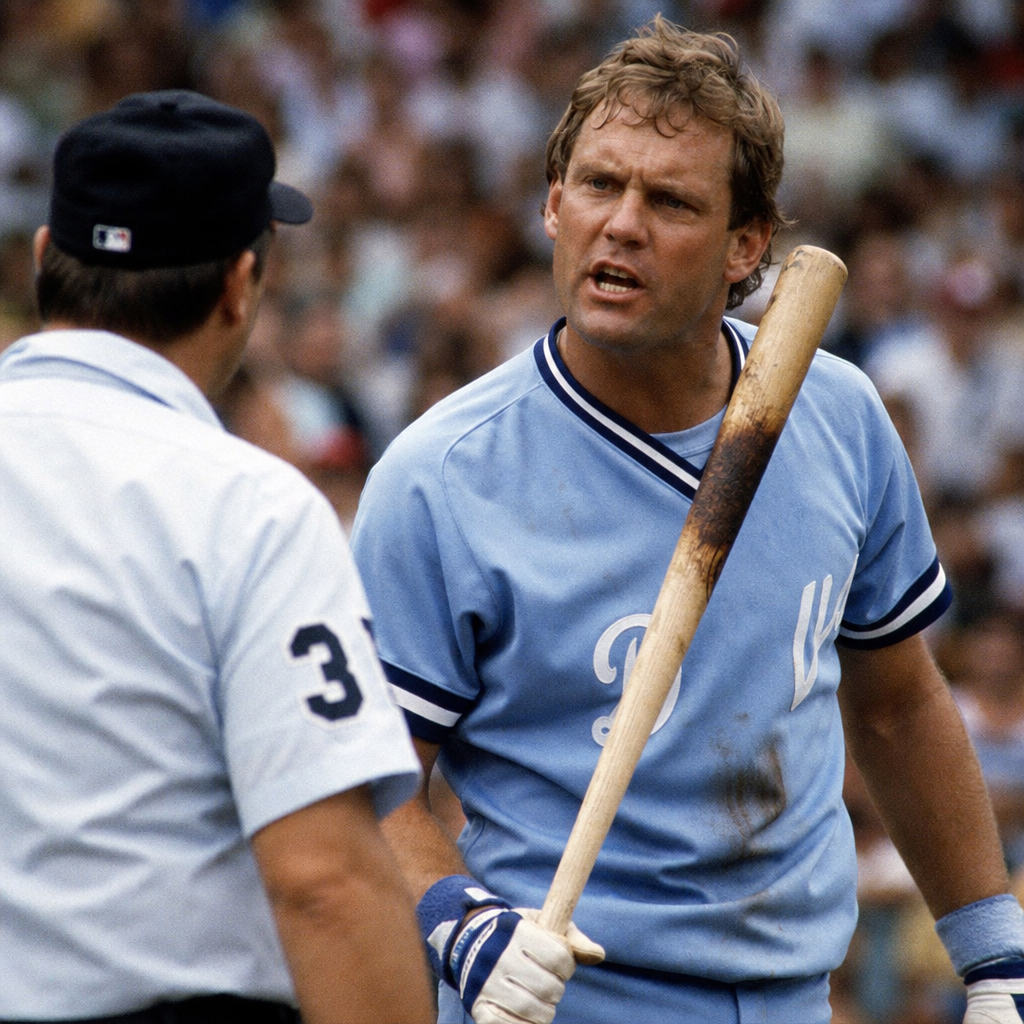
Few moments in baseball history capture the mix of rules, emotion, and spectacle better than the Pine Tar Incident: George Brett’s Controversial Homer. On July 24, 1983, Kansas City Royals star George Brett appeared to hit a go-ahead home run against the New York Yankees, only to watch the umpires erase it after a protest over excess pine tar on his bat. Brett’s furious charge from the dugout became one of the sport’s defining images, but the episode mattered for far more than one dramatic outburst. It exposed how equipment regulations work, how protests can overturn on-field rulings, and how a seemingly minor technical violation can become a national sports controversy.
In baseball, pine tar is a sticky substance hitters apply to the handle of a bat to improve grip. At the time of the incident, Rule 1.10 limited how far up the handle such a substance could extend, setting the maximum at eighteen inches from the knob. The purpose of that restriction was practical, not competitive. Excess pine tar could discolor baseballs and affect their condition, especially if transferred during contact. It was not designed as an anti-cheating rule in the same sense as corked bats or doctored baseballs. That distinction became central when Brett’s homer was nullified.
The incident matters because it sits at the crossroads of sports law, gamesmanship, officiating authority, and media mythology. Fans often remember the image of Brett raging toward home plate, but the larger story is about interpretation. Did the rule require an automatic out? Could a manager strategically save an objection until a crucial moment? How should leagues balance technical compliance against common sense? I have worked through enough baseball rule disputes to know that the most explosive controversies rarely come from hidden complexity alone. They come from a visible play colliding with an obscure rulebook provision at exactly the wrong time.
As a hub article within the broader Scandals and Controversies topic, this piece treats the Pine Tar Incident as both a self-contained scandal and a gateway into baseball’s wider “miscellaneous” controversies: equipment disputes, protest procedures, manipulation of loopholes, and league intervention after public backlash. The game itself involved the Royals, the Yankees, home plate umpire Tim McClelland, Yankees manager Billy Martin, and American League president Lee MacPhail. Yet its lasting significance reaches well beyond those names. It shows why controversial rulings become enduring case studies, why baseball’s written rules do not always match their intended purpose, and why this singular homer still belongs in any serious discussion of sports controversy.
What Happened on July 24, 1983
The essential facts are straightforward. The Royals trailed the Yankees 4-3 in the top of the ninth inning at Yankee Stadium. With two outs and U L Washington on base, George Brett came to the plate against reliever Goose Gossage. Brett drove a pitch into the right-field seats, a two-run homer that appeared to give Kansas City a 5-4 lead. As Brett crossed the plate, Billy Martin emerged to challenge the bat, arguing that pine tar extended beyond the legal limit. Tim McClelland examined the bat, measured the substance against the seventeen-inch width of home plate, and determined that the pine tar exceeded the allowed length. He called Brett out, erased the home run, and ended the game with New York still ahead 4-3.
Martin’s role was crucial. He did not discover an unknown violation in real time; he was exploiting a known detail. According to multiple retellings from players and coaches, Martin had noticed the bat earlier and waited for a high-leverage spot to raise the issue. That tactical delay is one reason the incident is remembered as controversy rather than routine enforcement. The Yankees did not claim Brett’s bat had altered the ball’s flight or created unfair hitting power. The argument was entirely procedural: the rulebook set a limit, and the bat exceeded it.
Brett’s reaction gave the play instant immortality. After McClelland signaled him out, Brett exploded from the dugout in a sprint that looked almost airborne. Teammates and coaches restrained him before the confrontation escalated further. Television replay turned that burst of anger into a permanent part of baseball culture. It was not staged emotion. In that moment, Brett believed he had won the game cleanly, only to have a bureaucratic interpretation take it away. The clip still circulates because viewers immediately understand the injustice he felt, even before they know the rule involved.
The Rule, the Protest, and the Reversal
The controversy did not end with the final out because the Royals filed a formal protest. Under the rules in place, clubs could protest when they believed umpires had misapplied a rule, as opposed to merely exercising judgment. Kansas City argued that while the bat technically violated the pine tar limit, the proper remedy was not to declare Brett out and cancel the home run. Lee MacPhail, president of the American League and son of Hall of Fame executive Larry MacPhail, reviewed the case and agreed.
MacPhail’s ruling turned on purpose and proportionality. The pine tar provision existed to keep the ball clean enough for normal play, not to wipe away otherwise legal batted-ball results. He reinstated Brett’s home run and ordered the game resumed from the point immediately after it, with Kansas City leading 5-4, Brett having touched all bases, and two outs in the top of the ninth. This was a textbook example of higher-level review correcting an umpire’s enforcement that matched the letter of one rule but missed the larger structure of the rules as a whole.
Baseball later clarified the treatment of excessive pine tar. The violation could lead to the bat being removed from play, but not to an out unless another rule independently applied. That clarification matters because it reveals how controversies improve governance. A scandal does not need criminal behavior to reshape a sport. Sometimes a single absurd ruling exposes a drafting flaw, prompting leagues to align written rules with intended outcomes. The Pine Tar Incident became a model for that process.
Why the Pine Tar Rule Existed
Pine tar was never banned from bats outright because hitters genuinely need grip assistance, especially in humid weather or under pressure when sweat affects control. A secure grip can reduce the chance of a bat slipping and improve a hitter’s ability to check a swing or drive through the strike zone. The issue was excess residue. When pine tar extends too far up the barrel, it can mark baseballs, forcing more frequent ball changes and affecting the look and handling of the equipment.
That context is the key to understanding why MacPhail reversed the call. If a rule is housekeeping in nature, the penalty should fit that purpose. Baseball already treated more serious equipment violations differently. A corked bat, for example, raises direct questions about altered performance and can produce ejection and discipline. Foreign substances on baseballs affect pitch movement and are punished accordingly. Excess pine tar belongs in another category: improper preparation of legal equipment, not fraudulent manipulation of competition.
In practical terms, everyone on the field in 1983 understood Brett was using a standard bat with too much sticky material above the limit. No one argued the extra pine tar turned a fly ball into a home run. That is why the original ruling felt so disconnected from common sense. The law was real, but the remedy was wrong.
Billy Martin, Gamesmanship, and Baseball’s Gray Areas
Billy Martin’s protest sits in the long tradition of baseball managers weaponizing the rulebook. Martin was brilliant at finding procedural edges, and this episode showed both the value and the risk of that instinct. From a purely competitive standpoint, he acted within his role. Managers are expected to protect advantages, challenge irregularities, and test opponents’ compliance. If an opposing bat violates a rule, raising the issue is not inherently dishonorable.
But there is an ethical gray area when a manager appears to bank a technical violation until the most damaging possible moment. Many players and fans saw Martin’s tactic as legal opportunism rather than fair enforcement. That distinction explains the emotional residue around the incident. Baseball tolerates gamesmanship, yet it also prizes a certain unwritten sense of proportionality. Martin won the immediate ruling, but the public largely treated him as the villain because the objection felt engineered to overturn a result no one thought was competitively tainted.
This pattern recurs across miscellaneous baseball controversies. Teams challenge lineup card errors after innings have passed. Managers appeal batting-order mistakes only when runs score. Clubs scrutinize glove laces, mound visits, or substitution notices when leverage peaks. The Pine Tar Incident remains the most famous example because the strategic protest collided with a superstar, a pennant race atmosphere, and a visual reaction impossible to forget.
How the Incident Fits Baseball’s Miscellaneous Controversies
Not every scandal involves gambling, steroids, or sign stealing. Baseball also produces a distinct class of miscellaneous controversies rooted in technicalities, paperwork, field conditions, and unusual interpretations. The Pine Tar Incident belongs at the center of that category because it shows how small details can create outsized consequences. These stories are often memorable precisely because they feel both trivial and enormous at the same time.
Other examples help define the category. The 1975 World Series saw debate over Carlton Fisk’s famous waving gesture and fair-foul drama, though that was judgment rather than rule interpretation. The 1983 “Pine Tar Game” was about equipment regulation. The 1999 “Grand Slam Single” involved scoring and baserunning oddities after Robin Ventura’s postseason hit was celebrated before he completed all bases. More recently, discussions around sticky substances, pitch timer disengagements, and replay boundary calls show that administrative rules can shape major outcomes just as strongly as athletic performance.
For a hub page on miscellaneous scandals and controversies, the lesson is clear: sports history is not made only by grand conspiracies. It is also made by narrow clauses, inconsistent enforcement, and moments when officials apply a rule without enough regard for why it exists. That is exactly what turned Brett’s homer into more than a strange footnote.
Key Facts From the Pine Tar Incident
| Element | Detail | Why It Matters |
|---|---|---|
| Date | July 24, 1983 | Places the incident in a heated Yankees-Royals rivalry period |
| Teams | Kansas City Royals vs. New York Yankees | Both clubs were contenders with established tension |
| Player | George Brett | A future Hall of Famer at the center of the disputed play |
| Manager Protest | Billy Martin challenged excess pine tar on Brett’s bat | Shows deliberate use of a technical equipment rule |
| Original Ruling | Home run erased; Brett called out | Created the immediate controversy and iconic reaction |
| Review Outcome | American League president Lee MacPhail reinstated the homer | Established that the rule had been misapplied |
| Resumed Game | Royals returned later and finished the win, 5-4 | Confirms the reversal changed the official result |
The Resumption of the Game and Its Lasting Image
One of the lesser-known details is that the game did not simply vanish into abstract legal history. It was resumed on August 18, 1983, from the exact point specified in MacPhail’s ruling. The Yankees protested the resumption conditions, even checking whether Brett or U L Washington would appear despite concerns about being played under protest-related restrictions. When the game finally resumed, the Royals protected their 5-4 lead and recorded the final out. That follow-through mattered. The controversy changed the official standings, not just the talk-show conversation.
Still, the enduring image is Brett charging out of the dugout. In sports memory, visuals often outrank legal nuance. Fans may forget the text of Rule 1.10, but they remember the sheer force of Brett’s disbelief. The image survives because it expressed a universal sports fear: having a decisive achievement nullified by an unexpected technicality. It has been replayed in documentaries, highlight packages, and rule-explanation segments for decades because it dramatizes the tension between human competition and institutional control.
What the Pine Tar Incident Changed
The incident changed baseball in three concrete ways. First, it encouraged clearer drafting around equipment violations, separating bat removal from game-changing penalties. Second, it strengthened awareness that protests hinge on rule misapplication, not disagreement with judgment. Third, it entered baseball education. Umpires, broadcasters, coaches, and front offices still cite the Pine Tar Incident when explaining why rule purpose matters as much as rule text.
Its broader legacy is cultural. The Pine Tar Incident proved that a controversy can be famous without involving corruption or dishonesty. George Brett did not cheat in the way most fans understand cheating. Billy Martin did not break procedure by filing his claim. Tim McClelland did not invent a rule. Yet the sequence still produced outrage because the result felt wrong. That is why this episode remains indispensable in any map of baseball’s controversies, especially the miscellaneous cases that reveal the sport’s obsession with detail.
For readers exploring this subtopic, the main takeaway is simple: the most instructive scandals are often the ones that expose how a system really works. The Pine Tar Incident explains baseball’s rulebook, protest process, and culture of gamesmanship in one unforgettable play. It also reminds us to look beyond the viral image. Underneath Brett’s charge was a serious governance question, and baseball answered it by correcting itself. If you are building a deeper understanding of sports controversies, start here, then follow the related cases that show how technical rulings, equipment disputes, and procedural loopholes continue to shape the game.
Frequently Asked Questions
What was the Pine Tar Incident involving George Brett?
The Pine Tar Incident was a famous Major League Baseball controversy that took place on July 24, 1983, during a game between the Kansas City Royals and the New York Yankees at Yankee Stadium. In the top of the ninth inning, George Brett hit what appeared to be a two-run home run off Yankees closer Goose Gossage, giving Kansas City the lead. Immediately after the play, Yankees manager Billy Martin asked the umpires to inspect Brett’s bat, arguing that it had too much pine tar applied above the legal limit on the handle. Under the rules in place at the time, pine tar was only supposed to extend 18 inches up from the knob of the bat. After measuring the bat against the width of home plate, the umpires ruled Brett out, erased the home run, and restored the Yankees’ lead.
What turned the moment from a simple rules dispute into one of baseball’s most unforgettable scenes was Brett’s reaction. Furious over the decision, he stormed out of the dugout toward home plate in visible disbelief, creating one of the most replayed outbursts in sports history. The incident became iconic not just because of the emotion involved, but because it highlighted the tension between the literal wording of the rulebook and the spirit of fair competition. It remains one of the clearest examples of how a technical equipment issue can dramatically alter the outcome of a game—at least temporarily.
Why was pine tar on George Brett’s bat such a big issue?
Pine tar itself was not illegal. In fact, hitters commonly used it to improve grip, especially in humid or slippery conditions. The controversy centered on how much of it was on Brett’s bat and where it was located. At the time, baseball rules limited the application of pine tar and similar substances to the lower 18 inches of the bat’s handle. The purpose of that rule was not to prevent hitters from gaining a competitive advantage in hitting the ball farther. Instead, it was largely intended to protect baseballs from becoming discolored or damaged by sticky substances higher up on the bat.
That distinction is a major reason the incident became so controversial. Billy Martin recognized the rule and used it strategically, waiting until after Brett homered to challenge the bat. The umpires enforced the rule as written, but many observers felt the punishment did not fit the violation. Excess pine tar did not help Brett hit the ball over the fence in any meaningful way, so taking away the home run seemed overly harsh. In that sense, the issue became bigger than the substance itself. It became a debate over whether rules should be applied strictly in all circumstances or interpreted in light of their actual purpose.
Did George Brett’s home run eventually count?
Yes, George Brett’s home run was ultimately restored. After the game, the Royals formally protested the umpiring decision, and American League president Lee MacPhail reviewed the case. MacPhail concluded that while Brett’s bat did violate the pine tar placement rule, the penalty assessed on the field was improper. Because the rule was intended to regulate bat maintenance and prevent damage to baseballs—not to nullify hits or call batters out after the fact—MacPhail ruled that Brett should not have been declared out and that the home run should stand.
As a result, the game was ordered resumed from the point after Brett’s home run, with the Royals leading 5-4. When the teams reconvened weeks later to finish the final outs, Kansas City successfully held the lead and won the game. That ruling turned the Pine Tar Incident into more than a famous argument; it became an important precedent in baseball governance. It showed that league officials were willing to look beyond a narrow reading of a rule and consider its intent, preserving competitive fairness in the process.
Why is George Brett’s reaction so famous in baseball history?
George Brett’s reaction is famous because it captured raw, unfiltered competitive emotion at the highest level. When the umpires called him out and erased the home run, Brett exploded from the dugout in disbelief, charging toward the field with a level of fury that was impossible to ignore. The image is unforgettable: a star player convinced he had delivered a dramatic go-ahead home run, only to see it wiped away on a technicality. His outburst instantly became part of baseball folklore because it visually expressed what so many players and fans were thinking in that moment—that something deeply unfair had just happened.
Beyond the theatrical value, the reaction mattered because it humanized the rule dispute. Fans did not remember the Pine Tar Incident only as a legal argument over bat measurements; they remembered it as a moment of passion, outrage, and high stakes. Brett’s anger underscored how much the call meant in the context of a close game and a heated rivalry. Over time, video of his charge from the dugout has been replayed endlessly, turning it into one of the defining emotional snapshots in sports. It endures because it combines drama, personality, controversy, and consequence in a single unforgettable scene.
What lasting impact did the Pine Tar Incident have on baseball?
The Pine Tar Incident had a lasting impact because it helped clarify how baseball should handle equipment violations and interpret rules according to their purpose. The reversal of the original call reinforced an important principle: not every technical infraction should carry a game-altering penalty, especially when the violation has little to no effect on competitive balance. In practical terms, the incident encouraged a more sensible understanding of bat-related rules and influenced how similar disputes would be approached in the future.
Its legacy also extends well beyond the rulebook. The incident remains one of the most cited examples of baseball’s unique ability to produce drama through its dense, sometimes quirky regulations. It is remembered as a collision of gamesmanship, umpire authority, player emotion, and league oversight. For historians and fans alike, the episode symbolizes how baseball can turn a small detail—like the placement of pine tar—into a defining chapter of the sport’s story. George Brett’s home run, Billy Martin’s protest, and the eventual reversal together created a moment that still shapes conversations about fairness, rules interpretation, and the culture of the game.