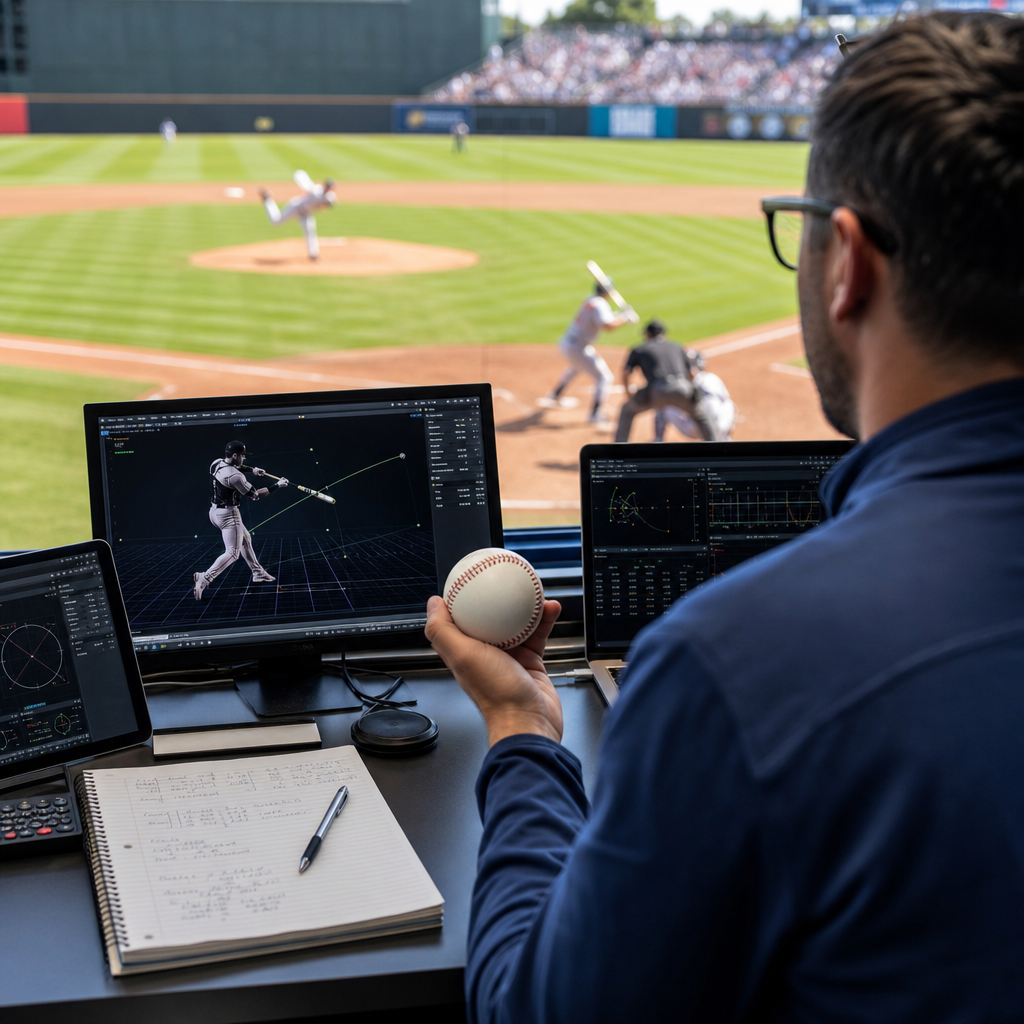
Baseball looks timeless on the surface, but every pitch, swing, throw, and sprint is governed by measurable scientific principles. The intersection of baseball and science spans physics, biomechanics, materials engineering, data analysis, neuroscience, and sports medicine, turning a traditional game into one of the most studied performance environments in modern sport. When coaches talk about launch angle, spin efficiency, kinetic sequencing, bat speed, or workload management, they are using scientific concepts to explain why a ball carries over the wall, why a pitcher gains velocity, or why an elbow breaks down under stress. This matters because baseball outcomes are often decided by tiny margins: a few degrees of bat path, a few hundred revolutions per minute of spin, or a few milliseconds of reaction time can separate an out from a home run.
In practical terms, baseball science means applying tested methods to understand movement and improve decisions. Physics explains how forces act on the ball and bat. Biomechanics studies how the body creates and transfers energy through joints, muscles, and connective tissue. Exercise physiology examines conditioning, fatigue, and recovery. Technology supplies the measurement layer through tools such as high-speed cameras, motion-capture systems, force plates, Hawkeye, TrackMan, Rapsodo, and bat sensors. I have seen players make faster progress when these disciplines are connected rather than treated as isolated specialties. A hitter does not just need stronger hands; he may need a better ground-force pattern, more efficient pelvis rotation, and a bat path that matches pitch plane. A pitcher chasing velocity does not simply throw harder; he must produce force efficiently, tolerate stress safely, and repeat mechanics under fatigue.
As a hub for special focus topics within innovations and changes in baseball, this article maps the core scientific areas shaping the sport today. It explains how aerodynamics changes pitch movement, how biomechanics informs safer and more powerful mechanics, how bat and ball design influence performance, how vision and cognition affect decision-making, and how injury prevention has become a data-driven process. It also highlights where science has limits. Models improve understanding, but baseball remains a human skill sport played in changing weather, under pressure, against adaptive opponents. The most useful baseball science does not replace coaching feel; it sharpens it. Understanding that balance is essential for players, coaches, parents, and analysts who want to make sense of how the modern game is evolving.
Physics on the Field: Why the Ball Moves, Carries, and Breaks
The physics of baseball begins with force, momentum, collision, and aerodynamics. When a pitcher releases the ball, its velocity, spin rate, spin axis, seam orientation, and release height determine how it travels. Gravity pulls the ball downward, drag slows it through the air, and lift forces created by spin alter its path. The Magnus effect is the most cited explanation for pitch movement: backspin can resist drop on a four-seam fastball, topspin can increase drop on a curveball, and sidespin can contribute to horizontal break on sliders and sweepers. Seam-shifted wake adds another layer. Researchers and pitch-design coaches now understand that seams can disturb airflow in ways that move the ball beyond what spin alone predicts. That is one reason two sinkers with similar velocity and spin can behave very differently.
Hitting is also a physics problem. The quality of contact depends on bat speed, attack angle, point of contact, pitch location, and how efficiently collision energy transfers from bat to ball. Exit velocity rises when a hitter squares the ball near the bat’s sweet spot, where energy loss and unwanted vibration are minimized. Modern player development places heavy emphasis on optimizing the relationship between attack angle and incoming pitch plane, because matching the bat path to the pitch increases the margin for solid contact. That is the scientific basis behind the game’s launch-angle era. It was never simply about hitting the ball in the air; it was about producing batted-ball combinations that generate the most run value, especially hard-hit line drives and well-struck fly balls.
Environmental conditions matter more than casual fans often realize. Air density changes with altitude, temperature, and humidity, affecting how far the ball travels and how much pitches break. Coors Field is the clearest example: Denver’s altitude reduces air resistance, often leading to increased carry on contact and altered pitch movement profiles. Wind direction can turn warning-track fly balls into home runs or suppress offense across an entire series. Even the baseball itself introduces variation. Small differences in seam height, leather tension, coefficient of restitution, and drag profile can influence carry and pitch shape. Major League Baseball has repeatedly faced scrutiny over year-to-year ball behavior because subtle manufacturing changes can produce noticeable league-wide effects on offense.
Biomechanics: How Players Create Speed and Reduce Risk
Biomechanics translates baseball movement into measurable joint actions, force production patterns, and timing sequences. In both pitching and hitting, elite performance depends on kinetic chain efficiency, meaning energy is generated from the ground and transferred upward through the legs, pelvis, trunk, shoulder complex, arm, and hand or bat. When that chain is sequenced well, players create more speed with less wasted motion. When it breaks down, velocity, command, and contact quality suffer, and injury risk rises. In pitching labs, motion-capture systems can measure shoulder external rotation, elbow torque, trunk tilt, hip-shoulder separation, lead-leg blocking, and stride characteristics with remarkable precision. The purpose is not to create one perfect model for every athlete. It is to identify movement signatures that support performance while respecting individual anatomy and mobility.
Pitching mechanics are especially demanding because overhand throwing places enormous stress on the elbow and shoulder. During late cocking and acceleration, the ulnar collateral ligament must tolerate valgus stress, while the shoulder experiences extreme rotational velocity. Studies have shown professional pitchers can reach internal rotation speeds above 7,000 degrees per second. That helps explain why arm health cannot be addressed with generic advice alone. In my experience, the athletes who sustain gains best are not the ones who simply chase radar-gun numbers; they are the ones who improve lower-half force production, thoracic mobility, scapular control, and recovery habits at the same time. Velocity without structural capacity is a short-term plan.
Hitting biomechanics has undergone a similar transformation. Coaches now analyze pelvis rotation speed, torso connection, hand path, bat lag, and time to contact using video and sensor data. The best hitters are not all built alike, but they generally share efficient rotational patterns and the ability to make late adjustments. Aaron Judge, Mookie Betts, and Shohei Ohtani do not swing identically, yet each demonstrates elite segmental sequencing and exceptional bat control. Good biomechanics also explains why “keep your hands back” or “swing level” can be misleading cues when used too literally. High-level swings are dynamic three-dimensional actions, not rigid textbook positions. The task is to deliver the barrel on time, in the right plane, with adjustability.
| Scientific area | What teams measure | Common tools | Why it matters |
|---|---|---|---|
| Pitch physics | Velocity, spin rate, spin axis, induced vertical break, release traits | Hawkeye, TrackMan, Rapsodo | Shapes pitches, improves pitch design, supports scouting |
| Hitting performance | Bat speed, attack angle, exit velocity, swing decisions | Blast Motion, high-speed video, bat sensors | Improves contact quality and plate production |
| Movement quality | Joint angles, sequencing, force output, asymmetries | Motion capture, force plates, markerless systems | Guides mechanical changes and reduces injury risk |
| Workload and recovery | Acute load, fatigue markers, readiness, sleep trends | Wearables, wellness tracking, strength testing | Helps manage overuse and maintain performance |
Equipment, Materials, and the Science of Bat and Ball Design
Baseball equipment is shaped by engineering constraints as much as tradition. Wood bats used in professional baseball are governed by material properties such as density, grain structure, hardness, and flex. Ash, maple, and birch each behave differently. Maple is dense and hard, often preferred for durability and hard contact, while ash has historically offered more flex. Bat geometry matters too. Barrel size, handle thickness, length-to-weight ratio, and mass distribution all affect swing feel and collision efficiency. A bat can be technically legal yet perform very differently in the hands of two hitters depending on strength, bat speed, and swing style. That is why individualized bat fitting has become more common.
At amateur levels, bat standards are designed to control performance and safety. BBCOR certification in college and high school limits trampoline effect compared with older aluminum designs, reducing exit speeds and aligning metal-bat outcomes more closely with wood-bat play. Youth leagues use additional standards such as USA Baseball and USSSA rules, each with different performance limits. Understanding these rules matters because the same hitter may post very different outcomes when changing bat types. A parent or coach who ignores certification, length, and swing weight may unintentionally put a young player in a poor developmental environment.
The baseball itself is equally technical. Core composition, yarn winding tension, leather quality, seam height, and manufacturing consistency all affect how the ball comes off the bat and moves through the air. Higher seams can improve pitcher grip and alter movement characteristics, while smoother surfaces may reduce drag. Teams also pay attention to footwear, gloves, and surface interaction. Cleat design influences traction and rotational stability; mound slope and firmness affect force transfer for pitchers; infield surface composition changes hop quality and player movement. Science in baseball is not limited to obvious moments of action. It extends to every material interface between athlete, equipment, and environment.
Vision, Reaction Time, and the Cognitive Side of Performance
One reason baseball is so difficult is that players must solve fast perceptual problems under pressure. A major league fastball can reach the plate in roughly 400 milliseconds, leaving a hitter only a fraction of that time to identify pitch type, location, and probable movement, then decide whether and how to swing. The swing itself takes around 150 to 200 milliseconds, which means the decision window is extremely small. This is why pitch recognition, visual acuity, and anticipatory skill are central to performance. Hitters do not literally watch the ball the entire way and then consciously compute a swing. They use early cues from arm action, release, spin, and flight pattern to make probabilistic decisions.
Teams increasingly train these processes with stroboscopic eyewear, occlusion drills, virtual reality, and machine-learning-supported video review. These methods are most useful when tied to game-relevant tasks rather than gimmicks. For example, a hitter may train by picking up seam orientation on a breaking ball or by making swing decisions from shortened video clips that end just after release. Catchers and infielders also benefit from cognitive training. Receiving, framing, transfer speed, pre-pitch positioning, and first-step reactions all depend on rapid information processing. The same applies to base running, where players read pitchers, outfield trajectories, and relay positioning in real time.
Neuroscience and psychology matter as well. Stress alters attention, decision quality, and motor control. A player with strong mechanics may still underperform if arousal levels are too high or too low. Breathing routines, pre-pitch processes, attentional cues, and sleep quality all influence performance. In clubhouse settings, the most effective organizations now treat mental skills as integrated performance science rather than an optional add-on. That change has helped normalize support around confidence, focus, failure recovery, and competitive consistency.
Injury Prevention, Recovery, and the Future of Baseball Science
Injury prevention in baseball is no longer built only on pitch counts and ice bags. It is a multidisciplinary process that includes workload monitoring, strength assessment, mobility screening, medical imaging, force testing, and return-to-play progression. For pitchers, the challenge is balancing adaptation with tissue tolerance. Throwing volume, high-intensity effort, rest patterns, mound exposure, and mechanical stress all interact. Pitch counts still matter, especially for younger athletes, but they are only one piece of a larger workload picture. A low pitch count paired with high-effort showcases, poor sleep, and inadequate recovery can still create risk. The American Sports Medicine Institute and other research groups have repeatedly emphasized that overuse, year-round play without rest, and throwing while fatigued are major contributors to youth arm injuries.
Recovery science has become more precise too. Instead of relying on guesswork, teams use force plates, countermovement jumps, grip strength, range-of-motion testing, and wellness questionnaires to estimate readiness. Nutrition and hydration support tissue repair and neuromuscular function, while sleep remains one of the strongest recovery variables in all of sport. Surgical advances such as ulnar collateral ligament reconstruction and internal brace procedures have improved return-to-play outcomes, but surgery is not a performance plan. The better path is building resilient athletes through progressive strength training, individualized throwing programs, and mechanical efficiency.
Looking ahead, baseball science will become more integrated, not less. Markerless motion capture will make biomechanical assessment easier in everyday settings. Computer vision will expand automated pitch and swing analysis. More teams will combine biomechanics, scouting, coaching, and sports medicine into shared decision systems rather than isolated departments. The key benefit is clarity. Science helps explain why a skill works, why it fails, and what change is most likely to produce improvement. For a sport built on repeatability and adjustment, that is powerful. If you want to understand the future of baseball, start with the evidence behind the game’s smallest movements, then follow how those findings shape coaching, player development, and competition at every level.
The intersection of baseball and science is not a niche topic anymore; it is the framework behind modern performance. Physics explains pitch movement and batted-ball outcomes. Biomechanics shows how athletes generate force, sequence movement, and protect vulnerable joints. Engineering shapes bats, balls, and surfaces. Vision science and cognitive training improve pitch recognition and decision-making. Sports medicine and workload management turn injury prevention into a measurable process instead of a hopeful guess. Together, these disciplines reveal that baseball success is rarely accidental. It is usually the product of repeatable physical laws, trained movement patterns, and informed choices.
For readers exploring special focus topics within innovations and changes in baseball, this hub provides the foundation. Each subtopic connects to larger questions facing the sport: how teams develop pitchers, why hitters adjust swing profiles, how technology changes scouting, and where health and performance intersect. The most important takeaway is simple. Science does not remove the artistry of baseball; it gives that artistry structure, language, and evidence. Players still compete with instinct and feel, but the best programs support those qualities with data, observation, and sound training principles.
If you coach, play, analyze, or simply follow the game closely, use this scientific lens to ask better questions. Why does this pitch miss bats? Why did that hitter’s contact quality change? Why is one athlete durable while another breaks down? The answers are increasingly knowable. Continue through the rest of this sub-pillar topic to explore the special focus areas in greater detail and see how scientific thinking is reshaping baseball from youth development to the major leagues.
Frequently Asked Questions
1. How does physics influence what happens on a baseball field?
Physics shapes nearly every visible action in baseball, from the flight of a fastball to the path of a home run. When a pitcher releases the ball, forces such as gravity, drag, and lift immediately begin affecting its movement. Velocity matters because a faster pitch gives the hitter less reaction time, but spin also plays a major role. Backspin can help a fastball resist drop more than hitters expect, while sidespin and topspin contribute to different breaking-ball shapes. The same principles apply after contact. The exit velocity of the ball, the launch angle off the bat, and the spin imparted during collision all influence whether the result is a ground ball, line drive, fly ball, or home run.
Bat-ball collisions are also a clear example of applied physics. The transfer of energy depends on bat speed, point of contact, swing path, and the properties of the bat and ball. Even small changes in timing can alter the angle and efficiency of the collision. On defense, throwing mechanics are governed by momentum, leverage, and force production, while baserunning relies on acceleration, friction, and body control. In short, baseball may appear simple, but it is really a live demonstration of mechanics, aerodynamics, and energy transfer happening in real time on every play.
2. What role does biomechanics play in pitching and hitting?
Biomechanics is the study of how the body moves, and in baseball it is central to both performance and injury prevention. In pitching, biomechanical analysis looks at how force travels from the ground up through the legs, hips, torso, shoulder, arm, and hand. This is often described as the kinetic chain or kinetic sequencing. Efficient pitchers do not rely only on arm strength; they generate power with the lower body, transfer it through rotational movement, and release the ball with precise timing. If one link in that chain is inefficient, the pitcher may lose velocity, command, or both, and the stress on the elbow and shoulder can increase significantly.
For hitters, biomechanics helps explain bat speed, swing efficiency, balance, and contact quality. A good swing is not simply a matter of moving the hands quickly. It involves posture, hip-shoulder separation, weight transfer, rotational acceleration, and barrel control through the hitting zone. Coaches and performance specialists often use video analysis, motion capture, and force plates to evaluate these movements in detail. That information can reveal whether a player is rotating too early, leaking energy, losing stability, or creating unnecessary joint stress. The value of biomechanics is that it turns movement into measurable information, helping athletes refine technique in a more precise and individualized way.
3. Why are metrics like launch angle, spin rate, and spin efficiency so important in modern baseball?
These metrics matter because they connect directly to how baseball actions produce results. Launch angle refers to the vertical angle at which the ball leaves the bat. On its own, it is not enough to guarantee success, but paired with strong exit velocity it can help explain why some balls become hard line drives or home runs while others become routine outs. Teams study this closely because certain combinations of launch angle and exit speed are associated with much better offensive outcomes. For hitters, the goal is usually not just to hit the ball hard, but to hit it hard at useful angles.
Spin rate and spin efficiency are especially valuable for pitchers. Spin rate measures how fast the ball rotates, while spin efficiency describes how much of that spin actually contributes to movement. A pitch can have high raw spin but not use it effectively if the spin axis does not support the desired shape. For example, a fastball with efficient backspin may appear to “ride” more, while a breaking ball with the right spin direction can create sharper drop or sweep. These measurements help pitchers understand why a pitch is effective, how to improve it, and how it tunnels with other pitches. In modern baseball, advanced metrics are not replacing coaching intuition; they are giving players and coaches a clearer scientific language for understanding cause and effect.
4. How do science and technology help prevent baseball injuries?
Injury prevention in baseball has become increasingly science-driven because the sport places repeated stress on specific joints, muscles, and connective tissues, especially in the shoulder, elbow, lower back, hips, and hamstrings. Sports medicine professionals now use workload monitoring, biomechanical assessments, strength testing, mobility screening, and recovery data to identify risk factors before they become serious problems. For pitchers, this may include tracking pitch counts, high-intensity throws, recovery times, changes in arm slot, and signs of fatigue. The goal is not just to reduce workload, but to manage it intelligently based on the athlete’s age, mechanics, conditioning level, and competitive demands.
Technology also plays a major role. Motion capture can identify movement inefficiencies that increase joint stress, while force plates can reveal asymmetries in how players generate power. Wearable sensors and high-speed cameras provide more detailed feedback on throwing and hitting patterns. Combined with strength and conditioning programs, nutrition planning, sleep monitoring, and return-to-play protocols, these tools support a more complete view of athlete health. The most effective injury-prevention strategies recognize that injuries rarely result from a single cause. They usually emerge from a combination of mechanical stress, fatigue, poor recovery, mobility limitations, and overuse. Science helps teams address those factors systematically rather than react only after pain appears.
5. How are neuroscience and data analysis changing the way baseball players train and compete?
Neuroscience and data analysis are expanding baseball beyond physical skill alone by focusing on decision-making, perception, and reaction. Hitting a pitch is one of the most difficult tasks in sports because the brain must identify pitch type, speed, and location in fractions of a second. Researchers and coaches study visual tracking, reaction time, anticipation, and motor learning to improve a player’s ability to recognize patterns and make faster, more accurate decisions. Training may include vision drills, pitch-recognition exercises, occlusion training, and simulation tools that sharpen the brain’s ability to process information under game-like pressure.
Data analysis complements this by turning large amounts of performance information into actionable insights. Teams examine swing decisions, chase rates, contact quality, pitch usage patterns, defensive positioning, baserunning efficiency, and matchup tendencies. This does not just help front offices evaluate talent; it also helps players build smarter game plans. A hitter can learn which zones produce his best contact, a pitcher can see which pitch combinations generate weak contact, and a defender can position himself based on hitter tendencies supported by thousands of batted-ball events. The result is a more informed version of baseball in which instinct still matters, but it is increasingly supported by evidence. The science behind the sport is not taking away its human element; it is helping players understand their bodies, sharpen their skills, and compete more effectively.