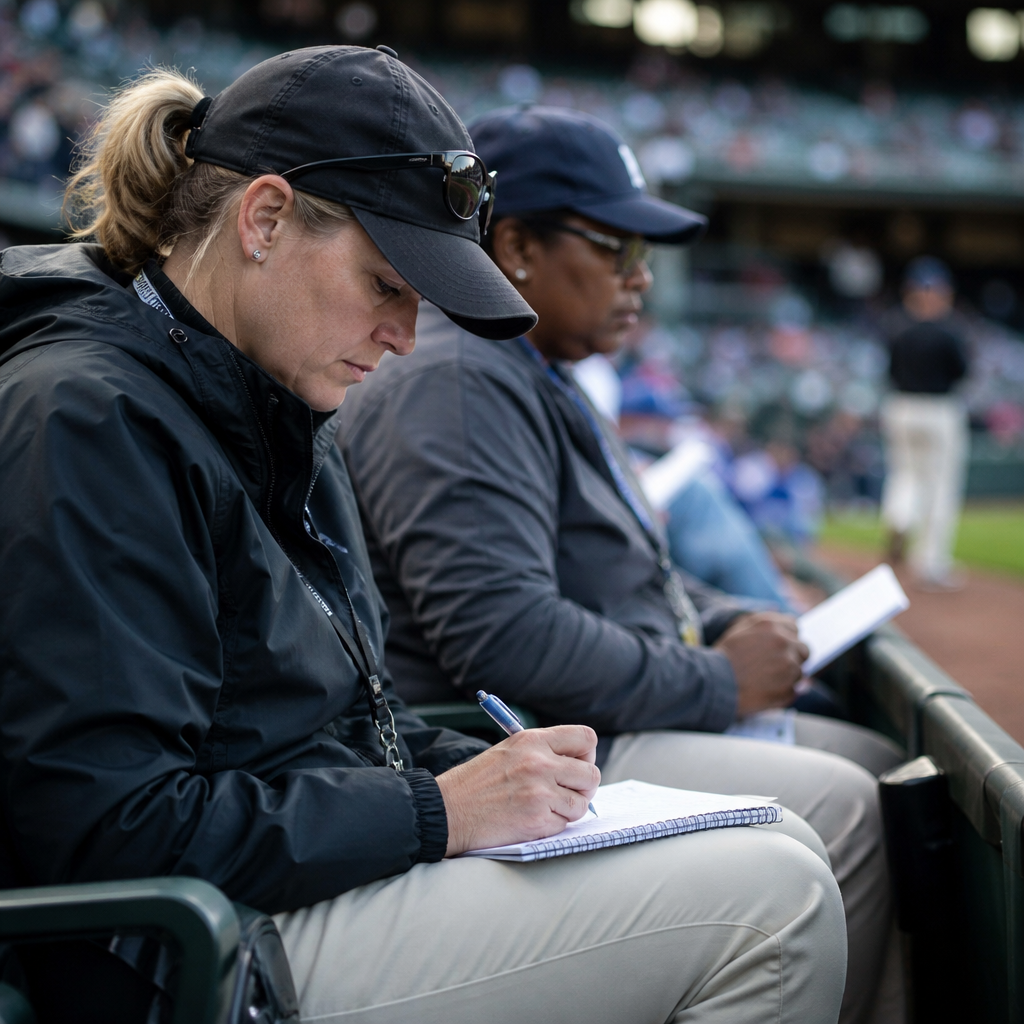
Baseball history is usually told through box scores, pennants, and Hall of Fame plaques, but some of its most important evaluators worked in shadows, shaping rosters without receiving public credit. Women scouts are among the hidden figures of baseball, and their legacy reaches far beyond a few isolated hiring milestones. In professional baseball, a scout is the talent evaluator who watches amateur, minor league, international, or professional players and projects future performance. Scouting combines observation, statistical context, makeup assessment, medical risk awareness, and organizational fit. When women entered that world, they had to prove not only that they could identify talent, but that they belonged in clubhouses, backfields, draft rooms, and boardrooms long reserved for men.
This subject matters because scouting sits upstream from almost every baseball outcome fans care about. Draft successes, international signings, trade targets, and player development pipelines all begin with informed judgment. If women were excluded from those judgments, baseball narrowed its own field of vision. If women were included, even in small numbers, the game gained perspectives that could challenge groupthink. I have worked around baseball research and player evaluation conversations long enough to know that good scouting is not folklore; it is disciplined pattern recognition under uncertainty. The best organizations blend area reports, crosschecks, analytics, biomechanics, and makeup interviews. Women who broke into scouting did that work while also carrying the extra burden of scrutiny, skepticism, and often isolation.
As a hub within the broader women in baseball topic, this article covers the miscellaneous but essential landscape around women scouts: the pioneers, the barriers they faced, the methods they used, the teams and leagues that opened doors, and the legacy they leave for modern front offices. It also addresses a common question directly: were women scouts rare exceptions, or did they materially influence baseball operations? The answer is clear. They were rare because the industry excluded them, but their influence was real wherever clubs allowed them to evaluate, report, and advocate. Understanding that legacy gives a fuller picture of baseball history and a more accurate view of how talent identification has evolved.
Pioneers Who Forced Baseball to Expand Its Definition of Expertise
Any serious discussion of women scouts starts with pioneers who broke procedural and cultural barriers, not just symbolic ones. Edith Houghton is one of the earliest and most significant names. A former player and journalist, she was hired by the Philadelphia Phillies in 1946 as a scout, making her one of the first women to hold that role in Major League Baseball. Her work was not ceremonial. She covered amateur and professional talent, reported on players, and contributed to the same talent pipeline that male scouts influenced. In the context of the 1940s, that appointment was extraordinary. Baseball was a male-dominated business where credibility often depended on access to spaces and networks women were denied.
Another landmark figure was Allison Gordon, who in 1981 became the first woman to serve as a full-time major league scout when the Los Angeles Dodgers hired her. Gordon’s career matters because it arrived in a more modern era, when the scouting profession was becoming increasingly structured and travel-intensive. She evaluated players across the United States and internationally, proving that women could handle the full logistical and analytical demands of the role. Her reports carried weight because she built expertise the old-fashioned way: by seeing players repeatedly, comparing tools over time, and understanding that one good game or one bad workout never tells the whole story.
These women did more than accept jobs; they normalized competence where baseball had expected novelty. That distinction is crucial. Early coverage often framed women scouts as curiosities, but clubs do not retain scouts who cannot help them find players. A scout’s reputation is built on the quality of future outcomes. If a player signs cheaply and becomes a contributor, or if a team avoids an expensive mistake because a scout identified a fatal flaw, trust follows. Pioneers such as Houghton and Gordon earned credibility in that results-driven environment, and their presence made later hires imaginable.
What Baseball Scouts Actually Do and Why Women Succeeded in the Role
Scouting is often romanticized as stopwatch work and gut instinct, but the real job is more rigorous. Scouts grade tools, build projection models in narrative form, compare present ability to likely future ability, and communicate risk in a language decision-makers can act on. For position players, traditional categories include hitting ability, power, running speed, arm strength, and fielding. For pitchers, scouts assess velocity, movement, command, delivery, durability indicators, pitch shapes, and competitive poise. Modern reports also account for age relative to level, TrackMan or Hawk-Eye data where available, biomechanics, injury history, and psychological resilience.
Women succeeded in scouting for the same reason effective men did: they learned to separate surface impressions from predictive indicators. I have seen how strong evaluators focus on repeatable details others miss. A scout might note how a shortstop’s first step works against elite velocity off the bat, whether a hitter recognizes spin early, or whether a pitcher’s delivery creates deception without sacrificing command. Those observations are not gendered. They are trained judgments. In fact, organizations that hired women often found that the best evaluators were the ones least attached to old myths about body type, machismo, or conventional baseball pedigree.
Scouting also depends on communication. A report must be concise, specific, and honest. It should explain what a player is now, what he may become, what must improve, and how much risk is attached to that projection. Women who advanced in this field demonstrated exactly that professional discipline. They were not succeeding because clubs wanted headlines. They succeeded because a good area scout can save a draft, because a credible crosschecker can prevent expensive errors, and because a clear-eyed evaluator is valuable in every era of baseball operations.
Structural Barriers That Limited Women Scouts for Decades
The scarcity of women scouts was never evidence of limited ability; it was evidence of limited access. For decades, baseball hiring ran through informal networks: former players, coaches, family connections, and regional relationships built over years in male-only environments. That structure favored continuity over openness. If a scouting director filled openings by calling former teammates and trusted lifers, women rarely entered the candidate pool. Even when clubs claimed meritocracy, the gatekeeping happened earlier, through exclusion from internships, travel circuits, and credibility-building assignments.
Daily work conditions created additional barriers. Scouts spend long stretches on the road, attend games in places with limited amenities, file late-night reports, and build rapport with coaches, parents, trainers, and front office supervisors. Women entering that environment often faced hostility, condescension, or the assumption that they were not legitimate evaluators. Access to clubhouses, batting practice areas, or amateur showcases could become a negotiation rather than a given. That friction matters because scouting quality depends partly on repeated exposure and trust-based information gathering. If a scout is challenged at every step, the job becomes harder than it is for peers doing the same work.
There was also a credibility trap. Because women hires were so rare, each woman was often treated as a referendum on all women in baseball operations. Men were allowed to be average, improve, fail, or move on without representing an entire gender. Women often had to be exceptional simply to remain. That distorted standard slowed progress for years. It also helps explain why the legacy of women scouts is larger than their raw numbers suggest. Each breakthrough changed who could be imagined in the role, and that shift influenced later hiring in scouting, analytics, development, and executive leadership.
Milestones, Roles, and Legacy Across Baseball Operations
Women scouts did not all follow one path, and that variety is part of their legacy. Some entered through playing backgrounds, some through journalism, some through statistical analysis, and others through player development or front office internships. Over time, baseball also expanded the range of evaluation jobs beyond the traditional area scout. Organizations now use crosscheckers, pro scouts, international scouts, advance scouts, analysts embedded with scouting departments, and hybrid roles that connect video, biomechanics, and in-person evaluation. As women entered these functions, their influence extended beyond handwritten reports into the architecture of decision-making itself.
A useful way to see that evolution is to map major patterns rather than only isolated names.
| Era | Typical barrier | Common entry path | Legacy impact |
|---|---|---|---|
| 1940s-1960s | Open skepticism about women in pro baseball jobs | Playing, journalism, or personal baseball networks | Established that women could hold formal scouting titles |
| 1970s-1990s | Limited full-time hiring and travel access | Independent evaluation work and club-specific opportunities | Proved women could handle nationwide and international assignments |
| 2000s-2010s | Pipeline bottlenecks into decision-making rooms | Internships, analytics, player development, college baseball operations | Expanded scouting into blended evaluation and data-informed roles |
| 2020s | Retention, promotion, and equal authority challenges | Integrated baseball operations departments | Normalized women as evaluators, coordinators, and executives |
This broader legacy matters because scouting no longer sits alone. When a modern club evaluates a high school pitcher, the process may involve live looks, wearable data, high-speed video, medical review, and model-based aging curves. Women who entered scouting helped force organizations to think beyond narrow identity-based assumptions and toward evidence-based process. That is a durable institutional contribution.
How Women Scouts Changed the Culture of Evaluation
Baseball scouting has always mixed art and science, but culture determines which observations are respected. One hidden contribution from women scouts was cultural calibration. In departments where loud certainty had long been mistaken for expertise, women often had to present cleaner reasoning, tighter evidence, and more defensible projection logic. That pressure was unfair, yet it improved standards. Decision-makers hearing a strong report grounded in repeatable mechanics, athletic indicators, performance context, and makeup detail could not dismiss it as sentiment. Over time, that changed what a persuasive scouting argument looked like.
Women scouts also challenged the lazy shortcuts that sometimes distort evaluation. The game has a long history of overvaluing traditional appearance markers, from body stereotypes to assumptions about leadership style. Better evaluators ask narrower, more predictive questions. Can the hitter cover velocity at the top of the zone? Does the catcher receive well enough to steal strikes? Can the pitcher repeat his delivery under stress? When departments elevate those questions over inherited biases, scouting improves. That shift has influenced how clubs discuss prospects internally and how they design player development plans after signing them.
Real change is visible in today’s front offices. Women now work not only as scouts but as assistant general managers, research directors, player development leaders, and coaching staff members. That progress did not happen separately from scouting history; it grew out of it. Scouting is where baseball decides whom to trust with judgment. Once women proved they could identify players accurately and communicate value under pressure, the argument against women in broader baseball operations weakened. Their legacy is therefore both practical and symbolic: better evaluation methods and a wider definition of who gets to shape the sport.
Why This History Matters for the Future of Women in Baseball
The hidden figures of baseball remain relevant because representation alone does not complete the job. The next challenge is authority: who makes the final recommendation, who receives developmental resources, and who gets promoted from field evaluation to departmental leadership. Clubs that want stronger scouting should widen pipelines intentionally. That means internships with meaningful assignments, mentorship from senior evaluators, standardized report training, clear travel policies, and promotion criteria tied to quality of judgment rather than comfort with old boys’ networks. Those are not diversity slogans; they are operational improvements.
For readers exploring the wider women in baseball landscape, women scouts form a connective subject. Their story links pioneers, executives, coaches, players, broadcasters, and analysts because scouting touches every part of roster construction. It also reminds fans that progress in baseball is rarely linear. Breakthrough hires can be followed by long plateaus. Public celebration can mask private exclusion. Still, the historical direction is unmistakable. Women scouts proved that baseball expertise is learned, tested, and demonstrated through work, not inherited through tradition.
The key takeaway is simple. Women scouts were never side notes to baseball history. They helped build the talent pipelines that feed the sport, improved how organizations think about projection and risk, and opened doors for later generations across baseball operations. If you are building a deeper understanding of women in baseball, start here and keep going: study the pioneers, follow the modern evaluators, and look closely at who gets to decide which players become the game’s future.
Frequently Asked Questions
Who were the women scouts in baseball, and why have they often been overlooked?
Women scouts in baseball were talent evaluators who identified players, assessed skills, projected long-term potential, and helped shape recruiting and roster decisions, often without receiving the public recognition given to managers, executives, or star players. Their work could include attending amateur games, following minor league prospects, evaluating international talent, filing reports, and making recommendations that influenced who organizations signed, promoted, or released. Despite the importance of that role, women who worked in scouting were frequently overlooked because baseball’s public storytelling has long centered on on-field heroes, front-office figureheads, and major milestones rather than the quieter labor of evaluation and player development.
They were also overlooked because scouting itself has historically operated behind the scenes. Many scouts, regardless of gender, worked in relative anonymity, but women faced an additional barrier: they entered a profession shaped by longstanding assumptions about who was “supposed” to understand baseball authority. In many eras, women were treated as exceptions rather than as professionals with serious expertise. That meant their observations might be undercredited, their opportunities more limited, and their place in baseball history less documented. As a result, their impact often survived in organizational memory, player success stories, or scattered archival references rather than in mainstream histories. Recognizing women scouts today helps correct that imbalance and broadens the understanding of how baseball talent has actually been discovered and developed over time.
What does a baseball scout actually do, and how did women contribute to that work?
A baseball scout is responsible for evaluating players not just as they are in the moment, but as they might become in the future. That requires a mix of observation, technical knowledge, projection, relationship-building, and judgment. Scouts study hitting mechanics, defensive actions, arm strength, running ability, pitch quality, athleticism, maturity, competitiveness, adaptability, and health history. They compare tools, assess consistency, and decide whether a player’s current performance can translate to higher levels of competition. Good scouting is not just about finding the obvious standout; it is about identifying future value before everyone else sees it.
Women contributed to this work in the same essential ways as any strong evaluator: by building expertise, developing reliable eyes for talent, and making informed recommendations grounded in experience and analysis. Some women scouts worked through traditional in-person observation, while others brought value through meticulous reporting, organizational knowledge, and a willingness to challenge conventional wisdom. In a field where subtle judgments can determine whether a club signs a future star or misses an opportunity, that kind of insight matters enormously. Their contributions also underscore a larger truth about scouting: success depends on accuracy, discipline, and baseball intelligence, not on fitting an old stereotype about who belongs in the stands with a radar gun and notebook.
Why is the legacy of women scouts important to baseball history?
The legacy of women scouts matters because it reveals that baseball’s history was shaped by more people than the standard version of the sport usually acknowledges. When fans think about baseball history, they often focus on championships, legendary players, and famous executives. But every roster is the result of countless decisions made before a player ever reaches the major leagues. Scouts help determine who gets a chance, who is worth investing in, and who may develop into a cornerstone player years down the line. If women were part of that process, then leaving them out distorts the story of how baseball organizations actually built success.
Their legacy is also important because it challenges the myth that expertise in baseball has always followed a narrow demographic path. Women scouts demonstrated that deep baseball knowledge, evaluative skill, and long-term vision were never limited to one gender. That historical reality has significance beyond symbolism. It helps modern readers understand that inclusion in baseball is not a new invention but part of a longer, often underrecognized continuum. By bringing women scouts into the historical record, the sport gains a more accurate, richer account of its own evolution, one that acknowledges both the barriers they faced and the value they delivered despite those barriers.
What challenges did women scouts face in professional baseball?
Women scouts often faced a combination of structural, cultural, and professional obstacles. Structurally, baseball networks were historically built through relationships that often excluded women from the most influential spaces, whether in hiring, mentorship, travel culture, or informal recommendation channels. Culturally, they had to operate in an environment where authority in baseball was frequently coded as male, meaning they could be forced to prove their competence repeatedly in ways their male peers did not. Even when their evaluations were sound, they sometimes encountered skepticism simply because they did not match the sport’s traditional image of a scout.
Professionally, the demands of scouting itself could amplify those challenges. Scouting requires extensive travel, long hours, frequent observation in male-dominated settings, and the ability to establish credibility with coaches, players, and front-office decision-makers. Women in those roles often had to navigate resistance while still producing strong reports, maintaining professional relationships, and staying ahead in a highly competitive field. In many cases, they also confronted historical invisibility: even meaningful contributions might not lead to broad recognition, promotions, or a lasting public record. That is why their legacy is so significant. It is not just a story of participation; it is a story of persistence, expertise, and influence exercised in a system that did not always make room for acknowledgment.
How does the story of women scouts influence the future of baseball?
The story of women scouts influences baseball’s future by expanding the sport’s understanding of who can evaluate talent and contribute at a high level. When teams, fans, and historians recognize the work women have already done in scouting, it becomes harder to treat inclusion as a novelty. Instead, it frames diversity in baseball operations as a practical strength rooted in the sport’s own history. That shift matters because organizations benefit when they draw from the widest possible pool of evaluators, perspectives, and experiences. Better scouting often comes from sharper questions, broader coverage, and a willingness to notice value where others have overlooked it.
This history also serves as a model for the next generation. Young women interested in baseball operations, player development, analytics, and scouting can see that there is a lineage behind their ambitions, even if it was not always visible. At the same time, teams and media outlets are encouraged to document contributions more carefully so that future pioneers are not left in the shadows. In that sense, the legacy of women scouts is both historical and forward-looking. It honors overlooked baseball professionals while helping shape a more accurate, inclusive, and competitive future for the game.