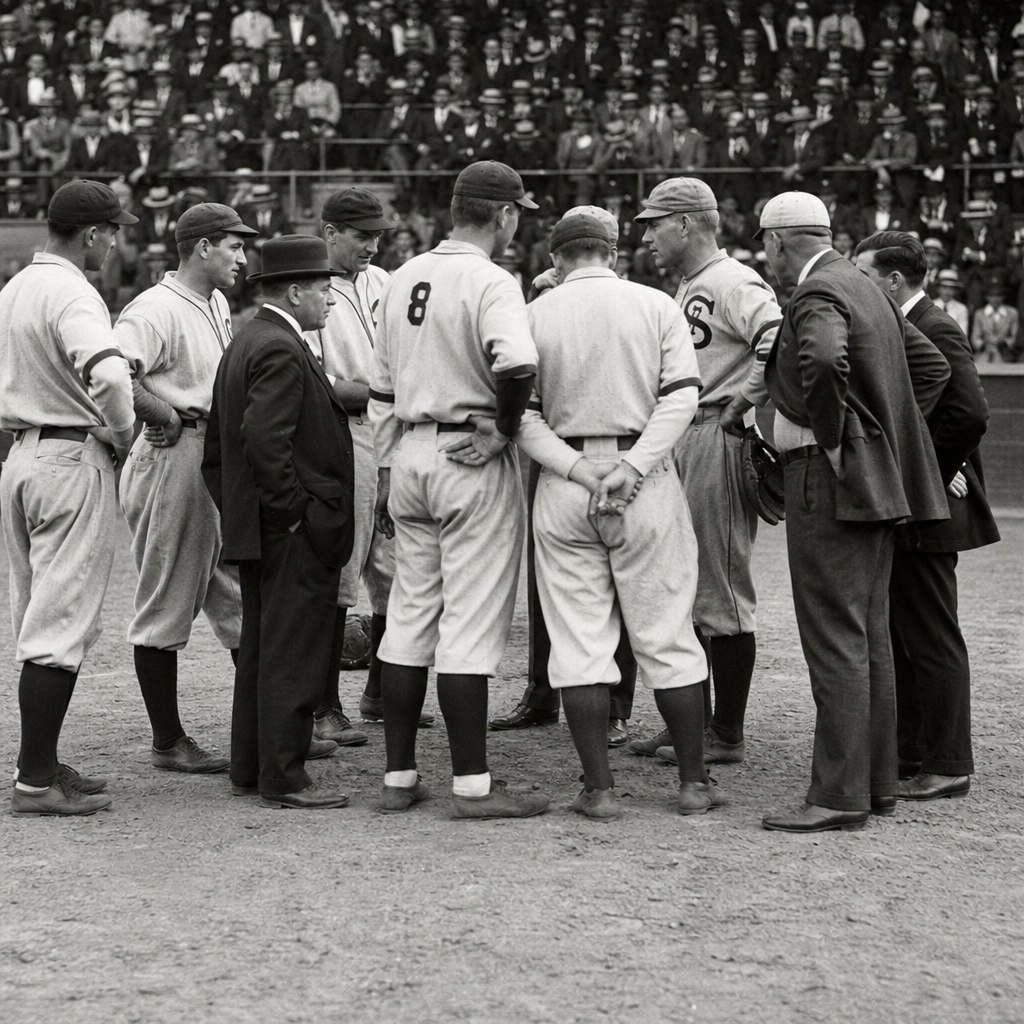
Baseball’s earliest gambling scandals shaped the sport long before the 1919 Black Sox case fixed public memory on one notorious conspiracy. In the nineteenth and early twentieth centuries, professional baseball developed alongside betting markets, saloons, horse racing culture, and weak league governance. That mix created repeated opportunities for players, managers, gamblers, and even club officials to influence results for money. The era is often treated as a hazy prelude to modern baseball, yet it was foundational. Rules about player conduct, the office of the commissioner, bans on associating with gamblers, and the sport’s language of integrity all emerged from these conflicts. Understanding the early baseball gambling scandals means looking beyond one famous World Series and examining a broader pattern of game fixing, suspicious play, bookmaker influence, rumor, and institutional failure.
In this context, a gambling scandal means more than a player placing a casual bet. It refers to any arrangement in which participants or connected outsiders sought profit by manipulating or exploiting the outcome of games. That included deliberate losing, selective underperformance, advance sharing of strategic information, payoff schemes, and tolerated relationships with betting intermediaries. The forgotten era matters because baseball was becoming a national business. Gate receipts, newspaper coverage, and league reputations depended on fans believing contests were honest. When that belief weakened, clubs lost attendance, writers attacked league leadership, and owners demanded stronger control. I have worked through this material in old sporting papers, league histories, and biographical studies, and one pattern is unmistakable: baseball did not stumble into reform after a single crisis. It was pushed there by decades of recurring scandal.
This article serves as a hub for the miscellaneous side of baseball scandals and controversies by connecting the major early gambling episodes, the systems that enabled them, and the reforms they triggered. If you want to understand why baseball became so obsessed with appearances, why certain names remained stigmatized for generations, and why anti-gambling rules were written so broadly, this is the place to start. The stories of the Louisville Grays, Hal Chase, the 1877 Louisville and St. Louis conspiracies, the 1918 Cubs, and lesser-known betting suspicions reveal the same central truth: when oversight is weak and money flows around the game, credibility becomes fragile.
The gambling culture surrounding early professional baseball
Professional baseball emerged in a nineteenth-century sporting world where gambling was common, visible, and socially entangled with spectatorship. Betting on baseball did not exist at the margins. Bookmakers operated near ballparks, newspapers printed odds, and players lived in cities where saloons and poolrooms connected athletes with local gamblers. Salaries were modest, contracts restrictive, and player mobility limited by the reserve system. That combination made some players financially vulnerable and easy to approach. Owners were not uniformly moral reformers either; many tolerated betting so long as it did not become a public embarrassment. The problem was not simply illegal wagering. It was a culture in which the line between fan interest, bookmaker activity, and participant corruption was poorly defended.
The National League, founded in 1876, promised cleaner administration than earlier associations, but it inherited the same environment. Teams traveled constantly, supervision was light, and local fixers knew which players drank heavily, carried debt, or resented management. In practical terms, a gambler did not need to buy an entire roster. Convincing one pitcher to throw hittable balls, one shortstop to misplay key chances, or one catcher to relay strategy could be enough in low-scoring nineteenth-century baseball. Because statistical analysis was primitive, suspicious underperformance could hide inside ordinary bad play. That ambiguity protected conspirators and made public accusations difficult to prove, which is why rumor became such a powerful part of baseball’s early scandal history.
The 1877 Louisville Grays scandal and baseball’s first major integrity crisis
The first major professional baseball gambling scandal exploded in 1877 with the Louisville Grays of the National League. Louisville had been a strong club, but unusual losses triggered concern. Eventually, an investigation tied several players to gamblers and to fixed games. The central figures were pitcher Jim Devlin and outfielder George Hall, with Al Nichols and Bill Craver also implicated. Evidence included telegrams and financial links suggesting that players had agreed to lose specific games in exchange for payments. At a time when league authority was still forming, the scandal struck at the heart of baseball’s claim to legitimacy.
League president William Hulbert responded forcefully. Devlin, Hall, Nichols, and Craver were permanently expelled from organized baseball. Devlin later admitted wrongdoing in a letter asking for leniency, claiming he had tried only to influence particular games and had not intended to betray the sport completely. That distinction persuaded nobody. From a governance perspective, the Louisville case established a decisive principle: conspiring with gamblers could mean a lifetime ban. It also showed that league survival required visible punishment. Newspapers covered the case intensely, and the public understood the stakes. If pennant races could be sold, every result became suspect.
The Louisville Grays scandal remains essential because it set patterns repeated for decades. Warning signs included abrupt performance drops, player debts, unusual betting activity, and insiders reluctant to report teammates. The league’s response also previewed future limits. Hulbert could ban players, but he could not eliminate the larger gambling economy surrounding baseball. In later years, reformers would rediscover the same lesson: punishment deters individuals, yet structural risk persists when access, incentives, and weak oversight remain unchanged.
Other nineteenth-century fixes and the spread of suspicion
The 1877 scandal did not end corruption. That same year, players linked to Louisville and St. Louis were accused of fixing additional games, reinforcing the sense that gambling influence crossed club boundaries. Over the next two decades, allegations surfaced in multiple leagues, including the American Association and various minor circuits. Some cases were substantiated, others remained murky, but the effect on public confidence was cumulative. Baseball’s expanding map created more opportunity for local fixers to exploit visiting teams and underpaid players. In many cities, the people who ran betting rooms also knew club associates, journalists, and politicians, making investigations uneven and sometimes compromised.
One reason this era is forgotten is that many incidents lacked the documentary clarity of later scandals. Owners often preferred quiet dismissals to public trials that damaged attendance. Writers hinted at “crooked ball” or “hippodroming,” a period term for prearranged or thrown contests, without always naming sources. Modern readers may be tempted to dismiss these stories as moral panic, yet contemporary administrators repeatedly treated the threat as real because they had internal evidence unavailable to the public. The sheer persistence of anti-gambling warnings in league meetings, club rules, and newspaper editorials shows that the sport’s leadership considered corruption a recurring operational problem, not a one-off anomaly.
Hal Chase and the culture of plausible deniability
No figure better represents baseball’s gray zone before the Black Sox than Hal Chase. A gifted first baseman active in the 1900s and 1910s, Chase was admired for his defensive skill and repeatedly accused of undermining games. He was connected by rumor and testimony to betting circles, to attempts to recruit teammates into fixes, and to suspicious play while with New York, Chicago, and Cincinnati. Yet he was never punished as decisively as later stars because the evidence seldom produced the airtight public case owners wanted. Chase exploited baseball’s fragmented authority, moving between teams and leagues while his reputation darkened.
From an integrity standpoint, the Chase story is crucial. It demonstrates that baseball’s leadership knew serious gambling risk persisted after the nineteenth century, but lacked both investigative tools and unified enforcement. Managers could bench him, owners could release him, and rival executives could complain, yet no single office possessed undisputed power over the entire sport until the commissioner system emerged. Chase’s case also reveals how skill protected suspect players. Teams tolerated risk when talent seemed to outweigh the danger. That tradeoff was one of baseball’s deepest governance failures: credibility was treated as negotiable when a star could still help win games.
| Scandal or Figure | Approximate Date | What Happened | Lasting Impact |
|---|---|---|---|
| Louisville Grays | 1877 | Players accepted money to lose games | Established lifetime bans for fixing |
| St. Louis and related accusations | 1877 | Broader fixing suspicions across clubs | Showed corruption was not isolated |
| Hal Chase controversies | 1908–1919 | Repeated accusations of game manipulation | Exposed weak investigative authority |
| Cubs betting allegations | 1918 | Claims of World Series-related gambling influence | Foreshadowed 1919 integrity collapse |
| Black Sox scandal | 1919 | White Sox players conspired with gamblers | Led to commissioner rule and harsh central control |
The 1918 Cubs, wartime baseball, and rising alarm before 1919
The Black Sox case did not appear out of nowhere. In 1918, baseball operated under wartime pressure, shortened schedules, labor uncertainty, and financial strain. The Chicago Cubs, who won the National League pennant, later became associated with allegations that some games late in the season and aspects of the World Series atmosphere were touched by gambling interests. Historians differ on the strength of the evidence, and no consensus places the 1918 Cubs scandal on the same level as the confirmed 1919 conspiracy. Still, the episode matters because it shows how deeply suspicion had spread by the late 1910s. Fans, reporters, and club insiders were primed to believe that high-stakes games could be influenced.
That environment was dangerous. Once gambling networks believed players might be reachable, they expanded their efforts. Low salaries compared with owner profits, resentment over the reserve clause, and the absence of a respected independent authority made players more willing to listen. I think this is the most underrated link between miscellaneous early gambling scandals and the better-known disasters that followed: corruption grows when participants feel exploited and conclude that management’s moral rules are selective. Owners denounced gamblers publicly while sometimes ignoring warning signs privately. That hypocrisy weakened deterrence.
Why early baseball was so vulnerable to gambling schemes
Several structural conditions made early baseball unusually vulnerable. First, player compensation lagged behind the revenue and cultural value clubs generated. A talented player could still face seasonal instability, debt, and little bargaining power. Second, travel and communication limits reduced oversight. Teams were often far from league headquarters, and investigations moved slowly. Third, scorekeeping and analysis were not advanced enough to flag improbable patterns reliably. Today, integrity units can study betting markets, error distributions, and communication records; early baseball relied on observation, gossip, and confessions. Fourth, club discipline was inconsistent. A player might be fined on one team, quietly released on another, and signed elsewhere if his ability justified the risk.
Just as important, baseball’s public image was unsettled. The sport wanted middle-class respectability, but many of its everyday business practices were still tied to rougher commercial entertainment culture. Ballparks sold access, newspapers sold drama, and gambling sold action. Those ecosystems reinforced one another until scandal became too costly to ignore. This is why moral lectures alone never solved the problem. Effective reform required institutional redesign.
From recurring scandal to commissioner power
By 1920, accumulated gambling controversies had made piecemeal enforcement untenable. The Black Sox trial and the revelation of earlier tolerated misconduct convinced owners that league credibility required centralized authority. Judge Kenesaw Mountain Landis became baseball’s first commissioner in 1921 and immediately signaled that the sport would value public trust over courtroom technicalities. His lifetime bans of the eight White Sox players, despite their acquittal in criminal court, reflected lessons first learned in 1877: baseball’s standard for protecting integrity would be stricter than the state’s burden for proving crime.
Landis also targeted the culture that had enabled earlier scandals. He discouraged player contact with gamblers, punished clubs for lax discipline, and emphasized that even discussing fixes threatened the game. Modern observers can criticize his autocratic style, and fairly so, but his rise only makes sense when placed against the forgotten era of chronic betting suspicion. Owners had tried softer methods for decades. They failed. The commissioner system was baseball’s answer to a long emergency, not merely to one famous World Series betrayal.
What this forgotten era still teaches fans and researchers
The early baseball gambling scandals matter today because they explain why the sport reacts so strongly to betting issues even in the legal wagering age. The core lesson is simple: confidence in competition is easier to lose than to restore. Baseball learned that from Louisville in 1877, from the unresolved anxieties around Hal Chase, from wartime rumors in 1918, and from every smaller case where suspicion spread faster than proof. For readers exploring scandals and controversies across baseball history, this miscellaneous hub shows the connecting thread. These were not isolated curiosities. They were the testing ground for the game’s ethics, enforcement, and public messaging.
If you continue deeper into this topic, focus on patterns as much as personalities. Ask who benefited, what safeguards were missing, why contemporaries hesitated to act, and how each scandal changed policy. That approach reveals the real significance of this forgotten era. It was the period in which baseball discovered that talent and tradition were not enough; only credible rules and consistent enforcement could protect the sport. Explore the linked controversies in this subtopic with that lens, and the history becomes clearer, sharper, and far more relevant to the modern game.
Frequently Asked Questions
Why are early baseball gambling scandals considered so important if most people only remember the 1919 Black Sox case?
Early baseball gambling scandals matter because they reveal that corruption in the sport did not suddenly appear in 1919; it had been embedded in professional baseball’s environment for decades. Long before the Black Sox fixed public attention on one dramatic conspiracy, the game existed in close proximity to betting culture, saloons, racetracks, and loosely regulated business practices. In the nineteenth century and the early years of the twentieth, baseball was still defining itself as a commercial sport, and league structures were often too weak, fragmented, or inconsistent to effectively police conflicts of interest. That made gambling not a shocking exception, but a recurring threat woven into the daily life of the game.
These earlier scandals are important because they show how vulnerable baseball was when players were underpaid, contracts were unstable, and owners or league officials lacked the tools or will to enforce standards. They also explain why later reforms became so severe. The sport’s eventual emphasis on integrity, centralized authority, and strict anti-gambling rules did not emerge in a vacuum. It developed in response to years of damaged credibility, public suspicion, and repeated episodes in which outcomes could be influenced by money off the field. In that sense, the Black Sox scandal was not the beginning of baseball’s moral crisis; it was the most famous expression of a much older problem.
What conditions in nineteenth-century and early twentieth-century baseball made gambling scandals so common?
Several conditions made early baseball especially susceptible to gambling influence. First, the sport grew up during a period when wagering on public events was commonplace and often socially visible. Betting on horse racing, prizefights, and baseball games was part of the broader entertainment culture, and gambling networks operated openly in many cities. Baseball clubs, players, reporters, and fans all lived within that ecosystem. Because the game attracted spectators and money, it naturally attracted gamblers looking for predictable patterns, inside information, or direct control over outcomes.
Second, league governance was often weak. Early professional baseball did not always have a strong centralized authority capable of conducting investigations, imposing uniform discipline, or preventing repeat offenders from moving between teams and leagues. Rival leagues appeared and disappeared, club finances were unstable, and enforcement could be inconsistent or politically motivated. In that environment, even when suspicious behavior was noticed, punishment was not always swift or decisive.
Third, players often faced financial pressure. Salaries were modest by modern standards, careers could be short, and contract systems left many players with little leverage. A player tempted by a bribe or approached by gamblers may have seen easy money as more reliable than a fragile baseball income. Managers and club officials could face similar pressures if attendance fell or debts mounted. That financial insecurity did not excuse corruption, but it helps explain why the temptation persisted.
Finally, communication and recordkeeping were less sophisticated than they are today. Rumors spread quickly, but proof was harder to establish. Suspicious errors, odd lineup choices, or strange betting activity might generate outrage without producing definitive evidence. That ambiguity allowed some guilty parties to escape accountability and also created an atmosphere in which the public often suspected the worst. The result was a sport repeatedly forced to defend its legitimacy while lacking modern systems of oversight.
Who was typically involved in these early gambling scandals, and how did they usually work?
Early baseball gambling scandals rarely involved just one type of participant. Players were often at the center because they directly influenced what happened on the field, but they were not the only figures involved. Gamblers and betting intermediaries were essential, since they supplied money, identified vulnerable targets, and placed wagers designed to profit from manipulated outcomes. Managers could also become involved by setting lineups, directing strategy, or quietly tolerating suspicious conduct. In some cases, even club officials were accused of behavior that compromised the integrity of competition, whether through financial entanglements, deliberate neglect, or direct influence.
The mechanics of these scandals varied. Sometimes the goal was an outright fixed game, where players intentionally underperformed to lose a contest. In other cases, the manipulation could be subtler. A pitcher might not throw his best, a fielder might commit a conveniently timed error, or a team might ease off in a game with important betting implications. There were also concerns about inside information being used for gambling advantage: knowledge of injuries, clubhouse disputes, fatigue, travel problems, or lineup changes could be valuable to bettors even if no fix had been arranged. That gray area made early baseball gambling especially difficult to police, because not every suspicious wager depended on a player deliberately throwing a game.
Another complication was that many arrangements were informal and secretive. Deals might be made through personal contacts in saloons, hotels, or social circles surrounding teams. Cash could change hands without leaving a clear paper trail. When accusations emerged, participants often denied everything, blamed rumors, or pointed to the ordinary unpredictability of baseball itself. Because even honest teams lose games and players make mistakes, proving intentional corruption was a major challenge. That uncertainty helped gambling scandals persist and contributed to the sport’s reputation problem for years.
How did early baseball authorities respond to gambling scandals before the modern commissioner system?
Before baseball adopted stronger centralized leadership, responses to gambling scandals were often uneven, reactive, and shaped by local power rather than universal policy. League presidents, club owners, and other officials did sometimes investigate allegations, suspend players, or issue public condemnations. But these responses were not always coordinated, and different leagues could apply different standards. A player banned in one context might find another opportunity elsewhere, especially during periods when rival leagues competed for talent and authority was divided.
In many cases, baseball’s leadership was caught between two goals: protecting the sport’s reputation and preserving its business interests. Owners and league executives understood that fans would not pay to watch games they believed were dishonest. At the same time, they were often reluctant to expose the full extent of corruption if doing so threatened attendance, newspaper coverage, or club finances. That tension could produce half-measures: public statements about integrity without deep structural reform, discipline in especially visible cases without consistent prevention, or quiet handling of accusations to avoid scandal.
The limitations of these early responses are a major reason the issue continued to resurface. Without a powerful independent office to impose broad anti-gambling rules, investigate across team lines, and deliver punishments that all clubs had to honor, baseball remained vulnerable. This history helps explain why the later establishment of a commissioner with sweeping authority was seen as necessary. The sport had learned, through repeated embarrassment, that fragmented oversight was not enough to restore public confidence once gambling suspicions became deeply rooted.
What lasting impact did these forgotten scandals have on baseball’s culture and rules?
The lasting impact of early baseball gambling scandals was profound, even if the individual episodes are less famous today than the Black Sox case. These scandals shaped the game’s culture by teaching owners, league officials, writers, and fans that competitive integrity was not a secondary concern but the foundation of the sport’s legitimacy. Baseball could survive poor weather, weak teams, and financial instability, but it could not thrive if the public believed outcomes were for sale. That realization gradually pushed the sport toward stricter rules, clearer moral boundaries, and a more serious understanding of institutional responsibility.
One major legacy was the hardening of baseball’s anti-gambling stance. Over time, the game moved toward a zero-tolerance ethic, especially regarding betting by players and personnel on baseball itself. The severity of later rules did not come only from the shock of one World Series scandal; it reflected decades of accumulated fear that even limited gambling contact could undermine trust. Baseball’s warnings about protecting the integrity of the game were built on long historical memory, including many episodes that no longer dominate popular conversation.
These scandals also influenced how baseball tells its own history. The sport often prefers neat turning points and iconic cautionary tales, which is one reason 1919 stands out so dramatically. But the forgotten era before that is crucial because it shows corruption as a systemic challenge rather than a single moral collapse. Understanding those earlier scandals gives a fuller picture of how baseball matured: not cleanly or quickly, but through repeated confrontations with the risks created by money, weak governance, and public doubt. In that sense, the forgotten scandals were not side notes. They were central to the making of modern baseball.