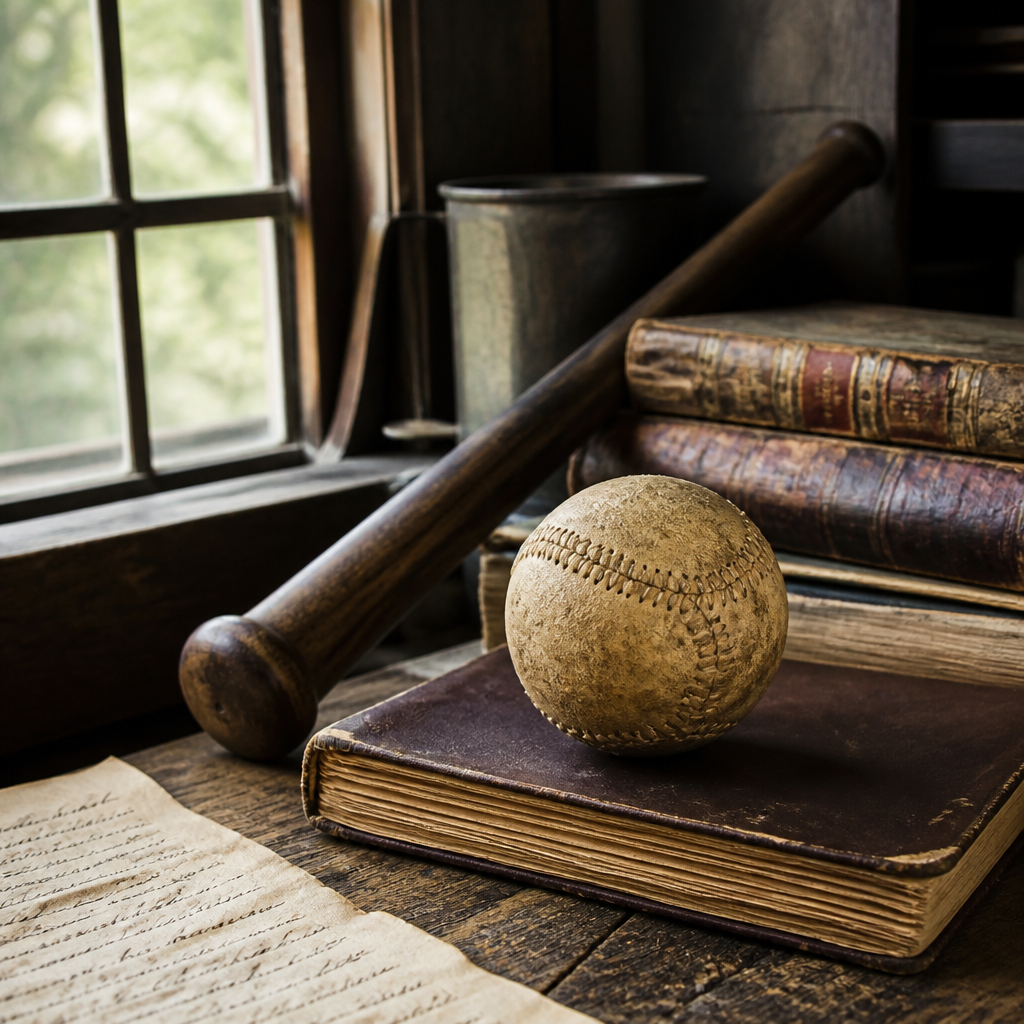
The earliest known references to baseball in colonial America sit at the intersection of language, leisure, migration, and memory. To understand them, you have to start with a basic distinction: “baseball” in the eighteenth century did not mean the fully codified sport recognized today, with nine innings, fixed foul lines, and professional leagues. It referred instead to a family of bat-and-ball games that shared certain core features—hitting a thrown or tossed ball, running to marked goals or bases, and trying to retire runners by catches, tags, or striking targets. In my own work tracing early game references across newspapers, diaries, legal records, and school texts, that distinction is the first thing that clears up confusion. When a colonial source mentions “base ball,” it is evidence of a recognizable game concept, but not proof that modern baseball already existed.
This matters because the history of baseball is often flattened into myths. One old story credited a single inventor. Another implied the game arrived complete and unchanged. The documentary record shows something far more interesting: baseball emerged gradually from older British and European bat-and-ball traditions, then took on distinct American forms during and after the colonial period. The earliest references are valuable not because they settle every origin debate, but because they anchor the timeline. They show when the term appeared, who was playing, and how contemporaries understood the activity. For readers exploring bat-and-ball origins, these sources form a hub topic because they connect children’s play, schoolyard recreation, military movement, urbanization, and later rule standardization.
Colonial America offered fertile ground for such games. English settlers brought with them familiar recreations, including stoolball, rounders-like running games, cricket, trap-ball, and various local contests with bats and balls. Communities adapted games to available space, season, and social class. Rules were usually unwritten, changing from village to village or even from one afternoon to the next. That is why historians treat early references cautiously. A single word in a diary can suggest continuity, but context determines whether the source points toward baseball specifically, a related game, or a broad recreational category. The best evidence comes from references that mention bases, running, or a named game clearly called base ball. Taken together, they reveal not a sudden invention, but an evolving culture of play that colonial Americans already recognized.
What counts as an early baseball reference
A reliable early baseball reference usually falls into one of four categories: a printed mention of the game by name, a diary or letter describing people playing it, a moral or educational text listing it among common recreations, or a legal and institutional source that regulates play. Historians prefer contemporaneous records over later recollections. That preference is practical. Memories recorded fifty years afterward tend to import later terminology and later rules. A boy who played a running game in 1760 might call it baseball in an 1830 memoir because that became the accepted label, even if his childhood version had different customs.
The terminology itself requires care. Eighteenth-century writers used forms such as “base ball,” “base-ball,” and occasionally “goal ball” or related labels. Spelling was not standardized, and printers regularized words inconsistently. Even the presence of “ball” in a title does not prove close kinship with modern baseball. Cricket, stoolball, and trap-ball were all prominent. The strongest references are those combining the name with structural details: bases, circuits, batting turns, dismissals, or teams. This method is standard in sports history because game families overlap. It is more accurate to speak of baseball’s bat-and-ball origins than to force an artificial moment of invention.
British roots that shaped colonial play
Before looking at American references, it helps to identify the games colonists already knew. Stoolball, documented in England from the early modern period, involved striking a ball and defending a target. Cricket, by the seventeenth and eighteenth centuries, was becoming organized and widely discussed. Rounders is often invoked in baseball histories, though the relationship is complicated because many running-base games coexisted before formal naming settled. Children and laborers also played simpler regional bat-and-ball games with improvised equipment and flexible teams. In practice, colonists did not import one neat ancestor. They imported a culture of bat-and-ball recreation.
That culture mattered more than any single rulebook. In seaport towns, military posts, and farming communities, games traveled with people. English, Irish, Scottish, and Caribbean influences all contributed to local variation. A game requiring little equipment—a stick, a stitched or wound ball, open ground, and markers for bases—spread easily. I have found that when historians compare these traditions, the most persuasive through line is not identical rules but recurring mechanics: batting, running, and retirement before completing a circuit. Those mechanics appear again and again in descriptions that later generations would recognize as baseball-like.
The strongest eighteenth-century references in America
The most frequently cited eighteenth-century American evidence comes from a 1791 bylaw in Pittsfield, Massachusetts, prohibiting the playing of baseball within eighty yards of the town meeting house. This is a crucial source because it is not nostalgic and not literary. It is administrative. Town officials acted because a game called baseball was common enough, and apparently vigorous enough, to threaten windows near a civic building. The bylaw does not explain the rules, but it proves the name was in local use in the early federal period and that players needed open space. Because Pittsfield had colonial roots and inherited British recreational culture, the record stands very close to the end of the colonial era.
Another major source is the diary of Princeton student George Ewing, who recorded playing “base” in 1786. Scholars debate exactly how closely Ewing’s game matches baseball, but the entry is important because it places a running-ball game in a collegiate American setting before formal codification. Educational settings matter in bat-and-ball history. Schools and colleges were transmission hubs where boys from different regions exchanged local versions, simplified disputes, and spread terminology back home. In my view, Ewing’s reference is most useful when read alongside the Pittsfield bylaw and later early republic school references, not in isolation.
Even earlier evidence often comes from British publications known in America. John Newbery’s A Little Pretty Pocket-Book, first published in London in 1744, included “base-ball” among children’s games. The work circulated widely in the Atlantic world and is often cited because it demonstrates that the term existed before the United States did. It does not prove the same game was played in every colony, but it establishes vocabulary that colonists could recognize and adopt. That transatlantic print connection is one reason baseball’s colonial story cannot be told as purely domestic creation.
How historians rank the evidence
| Source | Date | Why it matters | Main limitation |
|---|---|---|---|
| A Little Pretty Pocket-Book | 1744 | Earliest widely cited printed use of “base-ball” in the English-speaking world | British source, not direct proof of colonial play |
| George Ewing diary | 1786 | Personal American reference to playing “base” | Description is brief and not fully rule specific |
| Pittsfield bylaw | 1791 | Official American record using “baseball” by name | Near-postcolonial rather than strictly colonial |
This ranking shows why origin arguments rarely end with one “first” reference. Different sources prove different things. A children’s book proves terminology. A diary proves actual play. A bylaw proves social visibility. When these forms of evidence converge, historians become more confident that baseball, as a named running-base bat-and-ball game, was established in North America before the nineteenth century’s famous clubs and rule committees. Precision matters here because broad claims collapse important distinctions between name, practice, and standardization.
Colonial society, space, and the spread of bat-and-ball games
Why did these games take root in colonial America? The answer lies in environment and routine. Colonists worked hard, but they also observed holidays, militia musters, market gatherings, and school recesses that created moments for recreation. Open commons, pastures, roadsides, and schoolyards offered playing space. Equipment was simple to improvise. A hand-carved bat or stick worked. Balls could be made from leather scraps, yarn, or wound material. Unlike bowling greens or specialized courts, baseball’s ancestors required very little permanent infrastructure, which encouraged widespread informal play.
Age also mattered. Many early references imply that children and adolescents were central participants. Adults often mentioned the game only when it broke windows, distracted students, or offended moral discipline. That pattern is common in recreational history: authorities notice ordinary play when it becomes disorderly. But youthful play should not be treated as historically trivial. Informal childhood games often preserve older customs while also generating innovation. In towns where cricket needed more organization and manpower, a looser base-running game could thrive because it fit shorter play periods and uneven numbers. That practicality helps explain survival and spread.
Regional variation likely existed from the start. New England towns, middle-colony schools, and southern communities did not share identical calendars, land use, or cultural mixtures. Still, the persistence of the name and concept suggests broad familiarity. Baseball’s early history was not a straight line from one village to the nation. It was a web of local games gradually becoming legible to one another through migration, print, and repeated play.
Why these references do not prove a single inventor
The colonial and early national records undermine the idea that baseball sprang fully formed from one person’s design. No eighteenth-century source presents a formal inventor, official field diagram, or universal rule code. Instead, the evidence shows accretion. Terms circulated in print, players adapted familiar customs, communities regulated troublesome games, and schools helped spread common habits. By the time Alexander Cartwright’s Knickerbocker rules were written in 1845, many underlying elements were already old. What changed in the nineteenth century was not the birth of play itself but the push toward standard dimensions, fixed team structures, and reproducible governance.
That distinction is essential for anyone studying bat-and-ball origins. In sports history, codification is often mistaken for invention. The same mistake appears in soccer, rugby, and cricket. Rules committees usually formalize practices that have already matured through repeated use. Baseball fits that pattern. Colonial references reveal a recognizable precursor culture; nineteenth-century clubs converted that culture into a standardized game suited to interclub competition, newspapers, statistics, and eventually commerce.
How this hub connects to the wider early history of baseball
As a sub-pillar hub within early baseball history, colonial references link outward to several deeper subjects. One branch examines British antecedents such as stoolball, cricket, and rounders-like games. Another explores documentary sources from the early republic, including schoolbooks, diaries, and municipal regulations. A third follows codification in New York and other urban centers, where clubs turned flexible local customs into published rules. Still another investigates material culture: handmade balls, bats, and the spaces where people played. Each topic answers a different question, and together they explain how a loose family of games became America’s national pastime.
For readers trying to orient themselves, the key takeaway is simple. The earliest known references to baseball in colonial America do not offer a single dramatic origin scene. They provide something better: a layered record showing that named base-running bat-and-ball games were known in the English Atlantic world, present in North America by the late eighteenth century, and rooted in older recreational traditions. That record is strong enough to dismiss invention myths and precise enough to support serious historical study.
Understanding these references changes how you see baseball’s beginnings. The sport was not born overnight, and it was not detached from colonial life. It grew out of ordinary play, transatlantic exchange, and the gradual habit of organizing games around bases, bats, and running. The best early sources—the 1744 printed term, the 1786 diary entry, and the 1791 Pittsfield bylaw—each illuminate one part of that process. Together they mark the transition from inherited custom to distinctly American development.
If you are building a deeper picture of baseball’s past, start here with the documentary trail, then follow the connected topics on British game ancestors, early American school play, and nineteenth-century rule making. The origins become clearer when you read the sources in sequence and let the evidence, rather than legend, tell the story.
Frequently Asked Questions
What did the word “baseball” mean in colonial America?
In colonial America, the word “baseball” usually did not refer to the modern sport people know today. It pointed instead to a broader family of bat-and-ball pastimes played in informal settings, often with local rules that could vary from one community to another. The common thread was simple: a ball was struck or put into play, and runners moved toward designated goals or bases. What mattered most in the earliest references is that the term described a recognizable type of game, not a single standardized code.
That distinction is essential when reading eighteenth-century sources. If a diary, letter, or recollection mentions “baseball,” historians do not assume the writer was watching nine players per side, a diamond with fixed dimensions, or a game divided into nine innings. Those features belong to later codification. In the colonial period, recreation was often local, seasonal, and flexible, so the same name could cover multiple related versions. This is why scholars treat early references carefully: they reveal that a game called baseball existed in language and practice, but not yet in its fully modern form.
Why are the earliest references to baseball in colonial America so important?
The earliest references matter because they help trace how a familiar American pastime emerged out of older, less formal traditions. They show that baseball was not suddenly invented in one moment by one person. Instead, the game developed gradually through custom, adaptation, and transmission across generations. These references also push the story of baseball backward in time, placing it within the everyday social life of colonial and early American communities rather than only in the better-documented nineteenth century.
They are also important because they connect sport history to larger historical themes. References to baseball can reveal how people spent leisure time, how children and adults used open space, how British cultural practices crossed the Atlantic, and how language preserved activities before formal rulebooks existed. In that sense, an early mention of baseball is never just about a game. It is evidence of migration, social memory, and the way communities named and repeated shared forms of recreation. For historians, these references are valuable precisely because they illuminate both the origins of a sport and the broader culture that made it possible.
What kinds of sources contain the earliest known mentions of baseball in colonial America?
The earliest known mentions of baseball usually appear in scattered documentary sources rather than in official sporting records. Historians look at diaries, letters, memoirs, school writings, newspapers, legal notices, and later recollections that preserve older memories. Because colonial games were rarely governed by national organizations or preserved in formal archives, the evidence often survives indirectly. A casual line in a personal journal or a passing comment in a family reminiscence can become extremely important when it captures the use of the word “baseball” or describes a game that clearly belongs to that tradition.
These sources must be interpreted with caution. A document may mention the game by name without explaining the rules, or it may describe play in ways that overlap with related bat-and-ball games. Historians therefore compare wording, date, place, and context. They ask whether the source is contemporary or retrospective, whether the writer is recalling childhood play from decades earlier, and whether the term is being used literally or loosely. The earliest references are significant not because they provide a complete rulebook, but because they offer fragments of evidence that, taken together, show baseball-related play was known in colonial America well before the modern game was standardized.
Was colonial baseball brought from England, or did it originate independently in America?
Most historians view colonial baseball as part of a transatlantic tradition rather than a game invented independently in a single American moment. Many bat-and-ball games existed in the British Isles long before the United States emerged as an independent nation, and colonists carried those recreational habits with them. The language surrounding baseball, along with similarities to English children’s games and running games, strongly suggests that early American baseball grew out of older British precedents. That does not mean the colonial version was merely copied unchanged. Once in America, local communities adapted games to available space, regional customs, and the preferences of the people playing them.
This is one of the most important points in understanding the subject. Baseball’s deeper roots may be English, but its development in America was still historically meaningful and distinctive. Colonial and early national players reshaped inherited forms over time. Informal play gradually gave way to clearer conventions, and eventually those conventions were codified into something much closer to the modern sport. So the best answer is not either-or. Colonial baseball was neither a pure American invention nor a fixed English import. It was an evolving game tradition shaped by migration, memory, and local reinvention in the American context.
How should readers interpret early colonial references to baseball without confusing them with the modern sport?
Readers should approach early references with both curiosity and restraint. It is tempting to see every mention of “baseball” as proof that the modern national pastime already existed in recognizable form, but that would flatten the historical record. The safer interpretation is that these references document an ancestral stage in baseball’s development. They tell us that people in colonial America knew and played games called baseball, or games closely related to what later became baseball, but they do not prove the existence of the modern professional sport as it would be understood in the nineteenth and twentieth centuries.
A helpful way to read these references is to focus on continuity and change at the same time. There is continuity in the presence of a bat, a ball, running, goals or bases, and communal play. There is change in rules, organization, field layout, and competitive structure. By keeping that balance in mind, readers can appreciate why the earliest colonial references are so fascinating. They are not trivial curiosities, and they are not exact snapshots of today’s game. They are windows into an earlier recreational world in which baseball existed as a living, flexible tradition long before it became a codified American institution.