
The 1997 Florida Marlins were a team that defied expectations and achieved one of the most remarkable feats in Major League Baseball history. Founded in 1993, the Marlins were an expansion team with a mix of young talent and seasoned veterans. No one had pegged them as serious contenders this early into their existence. However, the making of a championship team was evident under the guidance of manager Jim Leyland and ownership that was ready to invest in winning. This underdog team not only clinched a playoff berth but went on to win the World Series in spectacular fashion.
This article aims to provide a detailed look at the 1997 Marlins’ incredible journey. From their entry into the playoffs as a wild card team to their riveting World Series victory, every moment, player contribution, and strategic decision will be scrutinized to offer a full picture of their unforgettable season. The Marlins’ run to the championship is a tale of determination, strategy, and a bit of good fortune that captivated baseball fans worldwide. Let’s dive into the intricacies of how this team emerged victorious against all odds.
Building a Championship Team
The journey for the 1997 Marlins began long before the season started. The team was meticulously built through a combination of strategic draft picks, savvy trades, and free-agent signings. At the heart of this team were notable acquisitions made in the offseason. Players like Bobby Bonilla, Jim Eisenreich, and Alex Fernandez were added to bring experience and skill to the roster.
The Marlins also boasted a formidable pitching rotation led by Kevin Brown, Liván Hernández, and Al Leiter. Kevin Brown, the ace of the staff, was particularly instrumental, bringing his years of experience and a no-nonsense approach to the mound. Additionally, the team’s bullpen was anchored by closer Robb Nen, who was lights out in key moments.
Offensively, the team had a balance of power and speed. Gary Sheffield, Moisés Alou, and Charles Johnson were integral to the heart of the batting order. Sheffield’s combination of power and plate discipline made him a formidable presence, while Alou’s clutch hitting was invaluable in tight situations. The blend of veteran leadership and youthful energy created a dynamic and resilient lineup. This confluence of talent, experience, and strategic planning set the stage for an extraordinary season.
The Road to the Playoffs
The Marlins’ regular-season performance was noteworthy. Finishing with a 92-70 record, they clinched the National League wild-card spot. The team displayed a level of consistency and resilience throughout the season. Despite playing in a division with formidable opponents like the Atlanta Braves, the Marlins managed to secure crucial wins down the stretch.
A pivotal series against the New York Mets in September solidified their wild-card position. Stellar pitching performances, combined with timely hitting from players like Edgar Rentería and Devon White, ensured the Marlins stayed in contention. Manager Jim Leyland’s experience and calm demeanor were instrumental in guiding the young team through the ups and downs of the regular season.
The Marlins’ entry into the playoffs was met with both excitement and skepticism. As a wild-card team, they were considered underdogs. However, their balanced approach, strong pitching, and strategic acumen gave them a fighting chance against more established teams. The stage was set for a fascinating and unpredictable postseason run.
NL Division Series (NLDS)
In the National League Division Series, the Marlins faced the San Francisco Giants. The series was a best-of-five, and the Marlins wasted no time in making a statement. They took the first game with a 2-1 victory, thanks to a stellar performance by starting pitcher Kevin Brown. The second game saw another tight contest, but Liván Hernández’s pitching and Moisés Alou’s heroics at the plate ensured a 7-6 win in extra innings.
As the series moved to San Francisco, the Marlins maintained their momentum. A convincing 6-2 win in Game 3, highlighted by strong contributions from both the offense and the bullpen, completed the sweep. The Marlins’ combination of clutch hitting and dominant pitching overwhelmed the Giants. Fans and analysts alike began to take notice of this wild card team’s potential.
The NLDS sweep not only sent the Marlins to the National League Championship Series (NLCS) but also demonstrated their ability to perform under pressure. The team’s unity and focus were palpable, setting the tone for the challenges ahead.
NL Championship Series (NLCS)
Next up for the Marlins were the formidable Atlanta Braves, a team with a rich postseason pedigree. The best-of-seven NLCS was expected to be a stern test for the Marlins. The Braves, led by their dominant pitching staff featuring Greg Maddux, Tom Glavine, and John Smoltz, were heavy favorites.
However, the Marlins were undeterred. They won Game 1 in Atlanta, stunning the Braves with a 5-3 victory. The spotlight was on Liván Hernández, who pitched masterfully and would later be named the series MVP. The Braves bounced back in Game 2 with a close 7-3 win, but the Marlins reclaimed the series lead with a 5-2 victory in Game 3.
Games 4 and 5 saw intense battles, with the Braves winning Game 4 by a razor-thin margin, 4-3. The Marlins, showing their resilience, took Game 5 with a 2-1 victory, showcasing their ability to win tight games. With the series back in Atlanta for Game 6, the Marlins sealed their World Series berth with a convincing 7-4 win. Liván Hernández was again the hero, delivering another stellar performance.
The Marlins’ triumph over the Braves was a testament to their blend of skill and tenacity. The team’s ability to compete at the highest level against a seasoned opponent signaled that they were more than just a wild card entry – they were legitimate contenders for the World Series.
The World Series: Marlins vs. Indians
The 1997 World Series pitted the Marlins against the Cleveland Indians. The Indians were a powerful offensive team, known for their potent lineup featuring star players like Jim Thome, Manny Ramirez, and David Justice. The Marlins faced yet another formidable challenge.
Game 1 saw the Marlins clinch a 7-4 victory, with Moisés Alou hitting a crucial home run. Game 2, however, went to the Indians, who leveled the series with a 6-1 win. As the series moved to Cleveland, the Marlins’ resilience was once again on display. They took Game 3 in a high-scoring affair, winning 14-11 in extra innings. Liván Hernández earned his place in Marlins lore with a complete game 14-strikeout performance in Game 5, giving the Marlins a crucial 2-1 series lead.
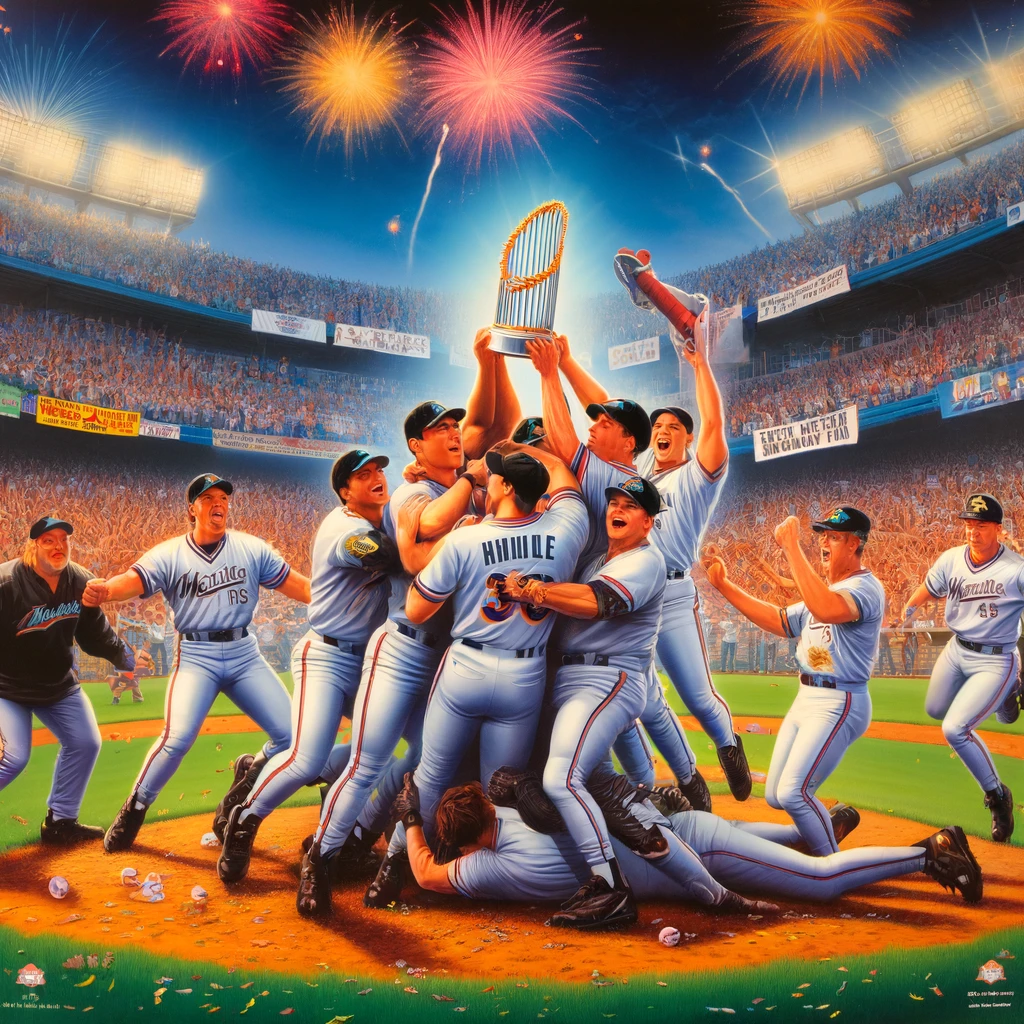
Game 6 saw the Indians force a decisive Game 7 with a 4-1 victory. The stage was set for a dramatic finish. Game 7 was a nail-biting affair. The Marlins found themselves down 2-1 in the bottom of the ninth inning. Edgar Rentería’s walk-off single brought home the winning run, sealing a 3-2 victory and crowning the Marlins World Series champions.
The series was a thrilling conclusion to a season full of surprises and clutch performances. The Marlins’ journey from wild card entry to World Series champions had captivated the baseball world, cementing their place in Major League Baseball history.
Key Players and Moments
The 1997 Marlins’ success was a collective effort, but several key players and moments stood out. Liván Hernández was undoubtedly the breakout star, earning NLCS and World Series MVP honors for his dominant pitching. His performances in high-stakes games were crucial to the team’s success.
Kevin Brown’s leadership on the mound, particularly in close games, set the tone for the pitching staff. Offensively, Moisés Alou’s clutch hitting and Gary Sheffield’s consistent contributions were vital. Edgar Rentería’s walk-off single in Game 7 of the World Series remained one of the most iconic moments in Marlins’ history.
Manager Jim Leyland’s strategic acumen cannot be overstated. His ability to manage egos, maintain team morale, and make crucial in-game decisions played a significant role in the Marlins’ remarkable run. The front office, led by General Manager Dave Dombrowski, also deserved credit for assembling a balanced and resilient roster. The synergy between management, coaching, and player performance was evident throughout the season.
Conclusion
The 1997 Florida Marlins’ journey from wild card entrants to World Series champions is a narrative richly deserving of its place in baseball lore. Their story is one of meticulous team-building, strategic brilliance, and extraordinary resilience. The Marlins defied expectations and showed that in baseball, anything is possible with the right mix of talent, strategy, and determination.
The team’s success also demonstrated the potential of expansion teams to achieve greatness. It offered hope and inspiration to fans and organizations alike that new teams can rise to prominence quickly with the right approach and investment. The Marlins’ 1997 season remains a benchmark for wild card teams aspiring to win it all.
As we look back on their incredible season, it’s essential to remember the individual and collective efforts that made it possible. From standout performances in pivotal moments to the strategic decisions of the management, every piece of the puzzle contributed to their historic achievement. The 1997 Marlins are a testament to the unpredictable and thrilling nature of baseball, where dreams can become reality against all odds.
Frequently Asked Questions
1. Who were the key players that contributed to the 1997 Marlins’ success?
The 1997 Florida Marlins were a blend of young stars and experienced veterans, creating a potent mix that led them to victory. Among the top performers was their pitcher Liván Hernández, who earned the National League Championship Series (NLCS) Most Valuable Player (MVP) award and turned in an unforgettable World Series performance. Charles Johnson, the standout catcher, demonstrated defensive excellence and was key in guiding the pitchers through crucial games. Gary Sheffield, known for his fierce batting skills, added power to the lineup, while Moisés Alou consistently delivered both in the outfield and at the plate. Edgar Rentería, the young shortstop, made his mark with a clutch hit in Game 7 of the World Series that will be long remembered in Marlins’ lore. Contributions from veterans like Bobby Bonilla and Kevin Brown provided stability and experience, crucial in high-pressure postseason situations. The team’s success wasn’t a result of one standout player but rather the collective efforts of a group determined to win against all odds.
2. What was the significance of the manager, Jim Leyland, in the Marlins’ 1997 season?
Jim Leyland’s role as manager was integral to the 1997 Marlins’ unprecedented success. With a wealth of baseball knowledge and previous managerial experience, Leyland was adept at motivating players and maximizing their potential. His strategic acumen enabled him to make crucial in-game decisions that often swayed games in the Marlins’ favor. Leyland understood how to blend youth and experience, balancing the exuberance of young talent with the wisdom of seasoned veterans. His managerial style fostered a resilient team spirit, instilling a belief that they could compete against and beat the best. This leadership was more crucial during the tense and tightly contested playoffs, where tactical adjustments and deft handling of the roster became the cornerstone of their path to victory. Leyland’s leadership not only helped the Marlins achieve postseason success but also solidified his reputation as one of the premiere managers in Major League Baseball.
3. How did the Marlins become serious contenders so soon after their establishment in 1993?
For a franchise just four years old, the 1997 Marlins’ rapid ascent to champions was remarkable, driven by a combination of shrewd roster moves, investments by ownership, and strategic management. Owner Wayne Huizenga demonstrated a strong commitment to winning, investing significant resources to acquire top-tier talent through both free agency and trades. This included high-profile acquisitions like Moisés Alou and Bobby Bonilla, who brought proven performance and playoff experience to the squad. The development of homegrown talent like Edgar Rentería and Charles Johnson, combined with key trades that brought in players ready to contribute immediately, ensured that the team’s foundation was solid both in the short and long term. The blend of promising young prospects and experienced players created a perfect storm of capability and drive that propelled them from obscurity to championship contenders far more swiftly than what is typically expected from an expansion team. This investment in talent, along with Leyland’s leadership, catalyzed their transformation into a formidable team in a remarkably short time.
4. What was the impact of the Marlins’ winning the World Series as a Wild Card team?
The 1997 Marlins’ World Series victory was a watershed moment for Major League Baseball, showcasing the potential for Wild Card teams to achieve ultimate success in the postseason. By capturing the championship as a Wild Card team, the Marlins demonstrated that once a team secures a playoff berth, anything is possible. This victory challenged traditional perceptions that only division winners possessed the prowess and grit to go all the way. The Marlins’ success inspired future underdog stories in baseball, proving that even the most unlikely contenders could defy odds when it mattered most. Their win also sparked more robust discussions on the value of the Wild Card format, which many initially criticized. The Marlins turned skeptics into believers by emphasizing that the depth and dynamics of a team, not just regular-season performance, could secure playoff glory. This landmark achievement added another layer of excitement and unpredictability to MLB’s postseason narrative, encouraging teams of all standings to aim for playoff contention.
5. How does the 1997 Marlins’ season continue to influence the team’s legacy?
The unprecedented success of the 1997 Florida Marlins left a lasting legacy that resonates with the team and its fans to this day. It provided a cornerstone moment for the franchise, creating a cultural and historical touchstone from which the team’s identity would draw inspiration in subsequent years. For fans, the memory of the ’97 season is a nostalgic triumph, often referenced as a benchmark for what the Marlins aim to achieve in future seasons. This remarkable storyline of achieving greatness against all odds has set a high standard and serves as a motivational legacy for players who join the organization. Furthermore, this legacy has cemented the Marlins’ place in baseball history as a team capable of achieving greatness despite facing considerable challenges. The ’97 season is consistently celebrated by the franchise in ceremonies and anniversaries, serving as a unifying and proud moment for all associated with the club. It emphasizes the franchise’s potential to inspire, no matter how steep the odds, a narrative that captivates players and fans alike.