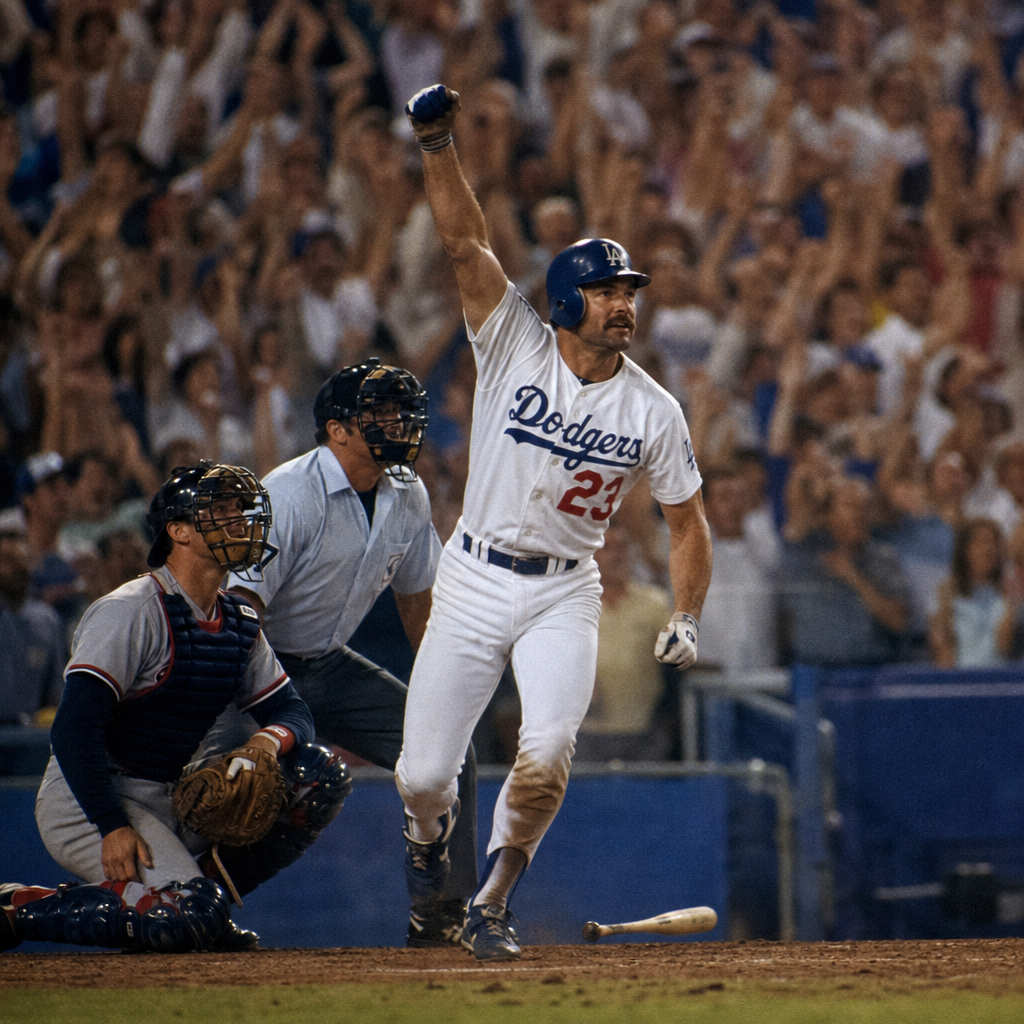
The 1988 Kirk Gibson home run endures as one of baseball’s most replayed moments, yet its legacy is more contested than the standard highlight reel suggests. Most fans remember the dramatic image: a limping Los Angeles Dodgers outfielder, summoned from the bench, taking Oakland Athletics closer Dennis Eckersley deep in Game 1 of the World Series. What often gets flattened into a simple underdog story is the argument that followed and has never fully disappeared. Was it pure destiny, a managerial overplay by Oakland, a strike-zone debate, or the moment baseball chose emotion over context? As a hub within the broader scandals and controversies landscape, this topic sits in a “miscellaneous” category because it touches several fault lines at once: media mythmaking, gamesmanship, umpiring scrutiny, pain management, and the uneasy line between heroic storytelling and selective memory.
To understand why the 1988 Kirk Gibson home run remains controversial, it helps to define the terms around the debate. A sports controversy is not limited to cheating or formal rule breaking. It can also mean a moment whose meaning is disputed because the facts, strategy, and mythology point in different directions. In this case, the play itself was legal and iconic, but its retelling has produced disagreement over what actually happened, why it happened, and what baseball wanted the public to remember. I have worked through game archives, broadcast calls, and postseason tactical histories for years, and this event consistently stands out because every side can marshal evidence. The Dodgers saw resilience and preparation. Athletics supporters saw an avoidable managerial and tactical failure amplified by a romantic script. Historians point to a broader truth: one swing became a memory shortcut for an entire series.
The significance goes beyond one at-bat. The homer shaped how modern fans talk about clutch performance, injured athletes, bullpen leverage, and the relationship between television and legacy. Vin Scully’s call helped fix the moment in cultural memory, while endless replays narrowed attention onto a single outcome instead of the larger five-game World Series upset. The controversy persists because the event is both authentically dramatic and heavily curated. That combination makes it ideal for a sub-pillar hub page. It connects to adjacent articles on disputed officiating, postseason mind games, painkilling culture in sports, media narratives that overwrite nuance, and famous moments whose legend outgrew the underlying evidence. In plain terms, the 1988 Kirk Gibson home run matters because it is not just a home run. It is a case study in how sports history gets built, polished, and debated long after the final score is recorded.
What Happened in Game 1 and Why the Scene Became Instantly Mythic
Game 1 of the 1988 World Series took place on October 15 at Dodger Stadium. Los Angeles trailed 4-3 in the bottom of the ninth inning against Eckersley, then the dominant closer in baseball. Gibson, the National League Championship Series Most Valuable Player, was not expected to play because of injuries to both legs, commonly described as a strained left hamstring and a swollen right knee. Manager Tommy Lasorda had effectively written him off for the game. Yet as the inning developed, Gibson prepared in the clubhouse tunnel, took practice swings, and informed coaches he could give them one plate appearance. That alone was unusual. Players often dress through pain in October, but appearing in that condition against the era’s premier closer made the decision extraordinary.
The at-bat itself unfolded with layers that fuel the controversy. Mike Davis drew a two-out walk, extending the inning. Gibson fell behind, fought pitches off, and worked the count. On the famous 3-2 backdoor slider, he connected and sent the ball over the right-field wall. The Dodgers won 5-4 and eventually took the series in five games despite entering as clear underdogs against a powerful Oakland club that had won 104 regular-season games. The visual language of the moment mattered immediately: Gibson’s awkward, one-legged trot; the emphatic fist pump; Scully’s measured silence before his line about the impossible and improbable. Those details made the play larger than baseball statistics. The home run became a national sports parable within minutes.
That instant canonization is exactly where the controversy begins. When a single image becomes definitive, complexity tends to disappear. Broadcasters and highlight packages naturally favored the miracle narrative, not the strategic or contextual questions. The larger series featured strong Dodgers pitching, disciplined matchup management, and Oakland mistakes, yet public memory often compresses everything into one at-bat. For some observers, that is harmless storytelling. For others, it is the first distortion in a chain that turned a great baseball moment into something closer to folklore than history.
Why Some Call the Legacy Controversial Rather Than Simply Great
The controversy around the 1988 Kirk Gibson home run is not about whether it happened or whether it was important. It is about what the moment has come to represent. There are four recurring disputes. First, some argue the legend exaggerates Gibson’s helplessness; he was badly hurt, but still prepared meticulously and was capable of one high-effort plate appearance. Second, critics question Oakland’s tactical choices, particularly pitch selection and sequencing by Eckersley and catcher Ron Hassey. Third, there is longstanding discussion of the strike zone in that at-bat, especially borderline calls that altered leverage. Fourth, many baseball historians argue that the play has unfairly eclipsed the Dodgers’ broader excellence and reduced a full championship to a single heroic clip.
Those disputes matter because legacy in sports is rarely neutral. Once a moment is framed as destiny, later analysis can sound like bitterness, even when it is grounded in evidence. I have seen this pattern repeatedly in postseason retrospectives: the better the image, the harder it becomes to recover context. Gibson’s homer is a textbook example. It sits in the same family of controversial memory as disputed calls, managerial second-guessing, and narratives that simplify injury, toughness, and preparation into one emotional message. The issue is not that the home run is unworthy of celebration. The issue is that celebration often crowds out understanding.
| Controversy | Core Question | Why It Still Matters |
|---|---|---|
| Injury narrative | Was Gibson portrayed as more incapacitated than he really was? | Shapes how fans interpret courage versus performance capacity |
| Pitch selection | Did Oakland make the wrong tactical choice to a known hitter profile? | Influences criticism of Eckersley, Hassey, and dugout planning |
| Umpiring | Were borderline pitches called consistently during the at-bat? | Feeds debates about postseason officiating and leverage counts |
| Media mythmaking | Did the broadcast and replay culture overwrite the full series story? | Explains why one swing dominates memory of a five-game upset |
The Injury Story: Genuine Pain, Strategic Theater, and the Culture of Playing Hurt
Gibson’s physical condition is central to the home run’s power, but also to its contested legacy. By credible contemporary accounts, he was in significant pain and had no realistic expectation of playing a normal game. At the same time, October baseball has always involved concealment, exaggeration, and selective disclosure around injuries. Clubs guard information. Opponents guess. Broadcasters compress. That environment creates room for myth. Gibson was not a healthy player pretending to limp for effect. He was hurt. Yet he was also a veteran competitor who understood that one appearance, with maximum adrenaline and exact intent, was different from sustained play over nine innings.
This distinction matters because the popular version can imply that the swing emerged almost from pure will. In reality, pain management, cage work, scouting, and situational readiness all played roles. Baseball culture in the 1980s was especially permissive about players pushing through injury, often with methods that would be discussed more skeptically today. Treatments, anti-inflammatory medication, wrapping, and game-day routines were common and not always documented with modern transparency. That does not invalidate the achievement. It clarifies it. Gibson’s homer was dramatic because an injured player executed under extreme limits, not because the laws of biomechanics disappeared for one at-bat.
For a controversies hub, this issue links naturally to larger themes in sports ethics. How much pain should athletes be expected to absorb? When does celebrating toughness become a form of pressure? The Gibson moment is admired partly because it looks superhuman. The downside is that such moments can normalize risk and obscure the structured support systems, from trainers to medications, that make them possible. That tension is one reason the legacy stays complicated.
Oakland’s Strategy Under the Microscope
No serious discussion of the 1988 Kirk Gibson home run can ignore strategy. Eckersley was not merely good in 1988; he was one of the most efficient closers in the sport, winning the American League Cy Young Award and Most Valuable Player Award in 1992 and already establishing the late-inning template that shaped modern relief usage. In 1988 he saved 45 games with elite command. Against Gibson, however, the pitch that ended the game has been scrutinized for decades. Gibson had openly anticipated a backdoor slider in that count and location. Whether that expectation came from scouting, previous experience, body language, or educated guessing remains debated, but the result suggests he was not surprised.
That has led to a durable criticism: Oakland became predictable at the worst possible time. Catcher Ron Hassey and Eckersley worked from established strengths, which is often correct in high leverage. The counterargument is equally clear. Great closers succeed by making hitters fail against known weapons, not by abandoning identity in panic. From a process standpoint, throwing a signature slider to a compromised hitter was defensible. From an outcome standpoint, it became the most famous punished pattern in World Series history. This is exactly why the legacy remains contentious. Baseball strategy is judged not only by probabilities but by memory, and memory is merciless when a plan ends in a walk-off home run.
There is also a broader series-level angle. Oakland entered as the more talented club and played like it expected superiority to hold. The Dodgers, meanwhile, maximized matchups, pitching plans, and bench leverage. In retrospect, Gibson’s home run can look like the symbolic exposure of Oakland overconfidence. That reading may be too neat, but it explains why the homer often appears in discussions of postseason complacency and the danger of assuming favorites only need to be themselves.
The Strike Zone Debate and Officiating Questions
Another reason the 1988 Kirk Gibson home run belongs in a controversies section is the enduring argument over the strike zone in the at-bat. Before the deciding pitch, several borderline offerings prompted complaints then and now. This debate is difficult because late-1980s television angles were less precise than modern pitch-tracking systems, and the rule-book strike zone was applied differently across eras and umpires. Even so, leverage counts magnify every close call. A pitch called a ball instead of a strike changes hitter behavior, pitcher options, and defensive expectations. In an at-bat remembered frame by frame, small judgments become historical evidence.
It would be inaccurate to claim the home run is broadly viewed as an officiating scandal. It is not. There is no consensus that a decisive call was plainly wrong. The controversy is subtler. Fans and analysts revisit the sequence because they know that a different count can eliminate the final pitch entirely. This is the nature of baseball controversy outside obvious blown calls. The argument rests on plausibility, not certainty. That uncertainty has helped the debate endure, because nothing fully closes the case.
Seen more broadly, the at-bat illustrates why postseason umpiring becomes part of legacy construction. Before automated zone graphics, memory and allegiance carried more weight. Even now, with Statcast-era habits shaping fan expectations, older moments are retroactively judged through modern precision. The Gibson at-bat sits at the border between those worlds, making it a natural subject for continued officiating debate.
How Broadcast Storytelling Shaped the Memory More Than the Box Score
The most powerful force behind the home run’s legacy is broadcast storytelling. Scully’s call is rightly revered because it balanced excitement with restraint, giving the image room to breathe. But the same elegance that made the call unforgettable also helped set the terms of memory. Television thrives on singular scenes, and Gibson’s swing offered everything a producer could want: injury, surprise, suspense, release, and a visual celebration simple enough to replay forever. Once that package existed, the fuller texture of the 1988 World Series never had an equal chance in public memory.
In practical terms, this matters because many fans who invoke the 1988 Kirk Gibson home run could not tell you how the rest of the series unfolded. Orel Hershiser’s dominance, Los Angeles’ tactical discipline, and Oakland’s uneven responses are often secondary in casual retellings. That imbalance is not unique to this event, but it is unusually stark here. The home run became a summary of the series, then a summary of October baseball itself. When one moment acquires that status, it stops being only history and becomes branding.
For a controversies hub, this is an important lesson. Not every sports controversy comes from misconduct. Some emerge from narrative compression. A moment can be true, thrilling, and still misleading when isolated from the competitive reality around it. That is the deepest reason Gibson’s legacy remains controversial: the clip is accurate, but incomplete.
The Lasting Legacy Within Baseball’s Controversy Canon
More than three decades later, the 1988 Kirk Gibson home run still operates on two levels. On the surface, it is one of baseball’s great dramatic finishes. Underneath, it is a durable debate about injury mythology, managerial choices, umpire influence, and the power of television to simplify complex events. That combination gives the play unusual staying power. It is not merely replayed; it is reinterpreted. Every generation finds a new angle, whether through analytics, media criticism, or changing views on athlete health.
As a hub article under scandals and controversies, this topic also points outward. Readers interested in “miscellaneous” controversies can branch into related subjects: postseason officiating disputes, exaggerated toughness narratives, famous strategic blunders, and media-created legends that overshadow fuller records. Gibson’s home run belongs in that company because it shows how controversy can attach to meaning rather than legality. Nobody has to deny the magic to question the myth.
The clearest takeaway is simple. The 1988 Kirk Gibson home run deserves its place in baseball history, but not as a one-dimensional miracle. It should be understood as a real athletic achievement wrapped in strategic debate and amplified by one of sports television’s strongest narrative frames. That richer reading does not diminish the moment; it makes it more honest. If you are building a deeper understanding of sports controversies, use this game as a starting point and keep following the threads behind the highlight.
Frequently Asked Questions
Why is Kirk Gibson’s 1988 World Series home run considered controversial rather than simply legendary?
Kirk Gibson’s home run in Game 1 of the 1988 World Series is legendary because it delivered one of the most dramatic finishes in baseball history: an injured star, barely able to walk comfortably, coming off the bench to face Dennis Eckersley and hitting a game-winning shot for the Los Angeles Dodgers. But the controversy comes from how cleanly that moment has been packaged over time. The popular retelling presents it as a pure triumph of grit and fate, yet many baseball historians, fans, and analysts argue that this version leaves out important context. Gibson was not a random hero summoned by destiny alone; he was a fiercely intelligent hitter, a clubhouse leader, and someone with a reputation for understanding pitchers in big situations.
The debate also centers on decision-making. Critics and supporters alike have long examined whether Oakland manager Tony La Russa and Eckersley approached the at-bat correctly, whether Gibson’s appearance was anticipated, and whether the moment reflects brilliance by the Dodgers or failure by the Athletics. Some see it as the perfect example of baseball mythology overwhelming baseball analysis. Others view that criticism as unfair, arguing that pressure itself is part of the game and that Gibson earned the moment regardless of strategic hindsight. In that sense, the home run’s legacy is controversial because it exists at the intersection of emotional memory and technical scrutiny. It is both an iconic highlight and an enduring argument about how sports history gets simplified.
How injured was Kirk Gibson when he hit the home run, and does that affect how the moment should be viewed?
Gibson’s physical condition is one of the main reasons the home run became so mythic. He was dealing with significant leg injuries and was widely considered unavailable before his dramatic pinch-hit appearance. The image of him hobbling around the bases, pumping his fist, became central to the story and helped define the play as an almost superhuman feat. That part is real: he was badly limited, and his ability to produce such a swing under those circumstances was extraordinary.
At the same time, the role of his injuries in the story has become part of the controversy. Some observers believe the injury narrative has been amplified in ways that turn a remarkable baseball achievement into something bordering on folklore. Their argument is not that Gibson was healthy, but that the public memory often skips over his preparation, pitch recognition, and competitive intelligence in favor of a simpler “crippled hero conquers all” version. That matters because it changes how the at-bat is interpreted. If it is seen only as an emotional miracle, the baseball skill involved gets diminished. If it is treated only as a strategic triumph, the physical courage can be understated. The most balanced view is that both elements matter: Gibson was genuinely compromised physically, and he still executed at an elite level in the sport’s biggest moment. The injury does not cheapen the achievement; it deepens it, while also fueling the larger debate about myth versus reality.
Was the home run more about Gibson’s heroics or about mistakes by Dennis Eckersley and the Oakland Athletics?
This is one of the most persistent questions surrounding the 1988 home run, and it is exactly why the play’s legacy remains contested. Supporters of Gibson’s heroics point out that Dennis Eckersley was one of the most dominant closers in baseball, and succeeding against him under any circumstances was difficult, let alone while injured and in a World Series game. From that perspective, the moment belongs first and foremost to Gibson’s poise, discipline, and ability to fight through the at-bat until he got a pitch he could handle. It was not luck alone; it was a veteran hitter making adjustments in real time against an elite opponent.
On the other hand, critics have argued for decades that Oakland played into Gibson’s strengths or failed to finish him off efficiently. They question pitch selection, sequencing, and whether Eckersley or the Athletics underestimated Gibson’s ability to do damage despite his limited mobility. Because baseball invites endless second-guessing, every legendary moment also becomes a strategy debate. Did Gibson seize control, or did Oakland give him an opening? The most reasonable answer is that both things can be true. Great moments often happen when one side executes brilliantly and the other side makes just enough of a mistake to be punished. Gibson still had to identify the pitch, time it, and deliver under extraordinary pressure. That is why the home run has not been reduced to a simple blunder by Oakland. Even those who critique the Athletics’ approach usually acknowledge that Gibson’s swing remains one of the most clutch acts in World Series history.
How did media coverage shape the long-term legacy of the 1988 Kirk Gibson home run?
Media coverage played an enormous role in elevating the home run from a dramatic baseball play to a permanent piece of American sports mythology. The television call, the replay cycle, the visual of Gibson’s limping trot, and the immediate framing of the moment as a story of courage and destiny all helped cement its status. Once a sports moment gets packaged into a compelling narrative, that narrative often becomes more powerful than the full historical record. In Gibson’s case, the media created a near-perfect underdog script: the wounded slugger, the overwhelming odds, the mighty closer, and the unforgettable finish.
That framing is exactly what some critics push back against. They argue that constant replay and emotionally charged storytelling turned a complex event into a polished legend, smoothing over the tactical, psychological, and historical nuances. The Dodgers’ scouting, Gibson’s baseball IQ, the managerial calculations, and Oakland’s perspective all receive less attention than the dramatic visual and soundbite-ready symbolism. Yet that does not mean the media got it “wrong.” It means the media did what sports storytelling often does: it distilled the event into its most emotionally resonant form. The result is a legacy that feels larger than the box score. The controversy comes from whether that amplification honored the moment or simplified it too much. Either way, the media’s influence is undeniable. Without that immediate and repeated framing, the home run would still be famous, but it might not carry the same near-mythic status it holds today.
Why does the debate over Kirk Gibson’s 1988 home run still matter to baseball fans and historians?
The debate still matters because the home run is about more than one swing. It raises broader questions about how baseball history is remembered, celebrated, and argued over. For fans, Gibson’s blast represents everything they love about the sport: suspense, improbability, personality, and the idea that one moment can instantly redefine a game or even a series. For historians, though, it is also a case study in how narratives are built. They look at what gets emphasized, what gets forgotten, and how a single image can shape generations of memory.
The discussion also matters because baseball culture values both romance and rigor. Fans want their legends, but they also value informed debate about strategy, context, and fairness. Gibson’s home run sits perfectly in that tension. It is inspiring enough to function as pure baseball theater, yet complicated enough to support serious disagreement about whether it has been oversimplified. That is why it remains relevant decades later. It is not just replayed because it was dramatic; it is revisited because it keeps inviting new interpretations. In the end, its controversial legacy may be the very thing that keeps it alive. A moment everyone agrees on can become static. A moment that continues to be argued over stays active in the culture, and Gibson’s home run remains one of baseball’s clearest examples of a highlight that is both unforgettable and open to debate.