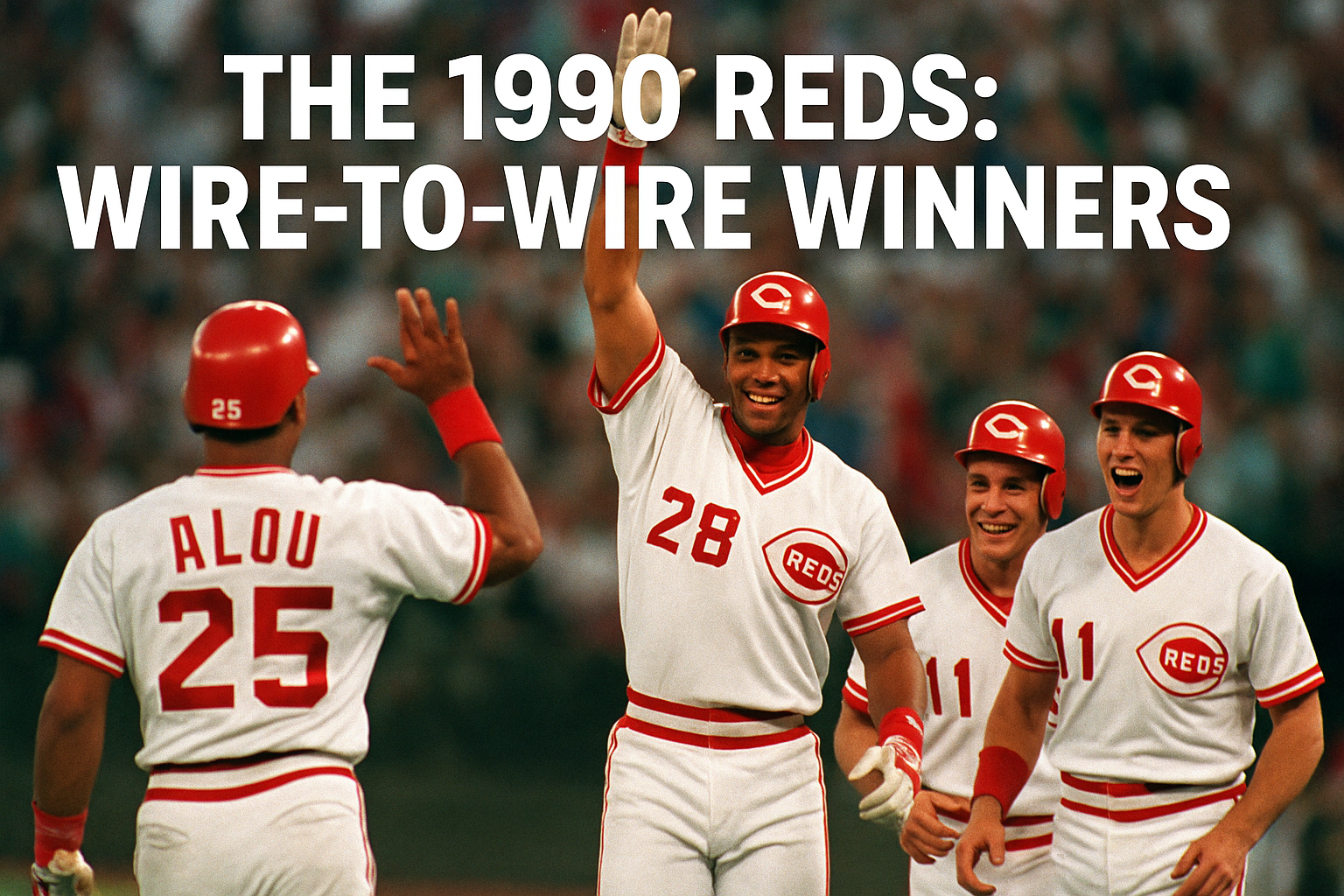
The 1990 Cincinnati Reds stand as one of Major League Baseball’s most extraordinary and memorable teams. Their incredible consistency from the beginning to the end of the season marked a historic “wire-to-wire” championship run that captivated fans and etched their names in the annals of baseball history. The term “wire-to-wire” refers to the Reds’ remarkable feat of leading their division from the very first day of the season all the way through to their World Series triumph. What made this team unique was not just the result, but how they achieved it. Through astute management, a talented roster, and a blend of seasoned veterans and rising stars, the Reds created a formidable force that could not be stopped. As we explore the story of the 1990 Cincinnati Reds, it becomes evident just how special this team was. They displayed tenacity, grit, and an insatiable desire to succeed, attributes that resonate within the core of any championship squad. From their dominating regular season performance to their prowess in the playoffs and eventual World Series victory, the Reds’ journey is one that continues to inspire baseball enthusiasts decades later.
The Cincinnati Reds, during this memorable 1990 season, were managed by Lou Piniella, a figure whose fiery personality and strategic acumen became crucial to the team’s success. As their charismatic manager, Piniella ensured that the team remained focused through the ups and downs of a grueling 162-game schedule. Meanwhile, the Reds boasted a mix of seasoned veterans like Eric Davis and Barry Larkin, as well as young talents such as Paul O’Neill and Chris Sabo. This blend of experience and youthful exuberance fueled a well-rounded team capable of outstanding performances in all facets of the game. As we dive deeper into the team’s composition and season dynamics, the elements that made the 1990 Reds such a dynamic and successful outfit become clear. They not only dominated opponents with a relentless offense but also stifled them through exceptional pitching and defense, embodying a holistic approach that pushed them to the pinnacle of baseball glory.
The Team’s Composition and Strategies
One of the most critical aspects of the 1990 Cincinnati Reds’ success was their well-balanced team composition. Lou Piniella, in his first year as the Reds’ manager, brought his extensive baseball knowledge and fiery brand of leadership to a team eager for success. His approach to the game was characterized by a strong focus on smart decision-making and adaptability in the face of adversity. Piniella’s strategies often involved leveraging the strengths of individual players to complement the broader team dynamics, creating a cohesive and competitive unit.
Piniella’s acumen was evident throughout the Reds’ roster construction, particularly in how he utilized the ‘Nasty Boys’—the formidable bullpen trio of Rob Dibble, Norm Charlton, and Randy Myers. These pitchers became legendary for their ability to effectively close down games, intimidating opposing batters with their high velocity and aggressive style. This trinity of power pitchers was instrumental in managing late-game situations, offering Piniella the flexibility to rotate them based on match scenarios. Their collective ERA hovered at a remarkable level, underpinning many of the team’s victories.
The Reds’ offense was another cornerstone of their wire-to-wire success. Led by team captain Barry Larkin, the lineup was both versatile and potent. Larkin, who played shortstop, provided a mix of power, speed, and defensive prowess, making him an invaluable asset. His fellow veteran, Eric Davis, added a considerable threat. Despite battling injuries, Davis remained an intimidating presence at the plate and on the base paths. The outfield counted on Paul O’Neill, whose consistent batting performance and sharp fielding added much-needed depth and balance.
The infield featured rising star Chris Sabo, known for his tenacity and work ethic. Sabo not only brought solid defense to third base but also contributed significantly to the team’s offense with key hits throughout the season. Add to this lineup first baseman Todd Benzinger, who offered reliable offensive production, and it becomes clear why the Reds were a nightmare for opposing pitchers. Their strategic blend of speed and power forced opponents into difficult situations, often leading to critical game-changing moments.
Jack Armstrong and José Rijo were the stalwarts of the Reds’ starting rotation, with Rijo particularly distinguishing himself as one of the most dominant pitchers in the league. His performance during the regular season was nothing short of sensational, and his World Series MVP title was a testament to his ability to shine on the biggest stage. Armstrong, meanwhile, was a model of consistency for much of the season, earning a spot as the starting pitcher for the National League in the All-Star game.
Defensively, the team was robust, with exceptional fielding providing a strong foundation on which the Reds could rely when things got tight. The ability to thwart offensive plays effectively made the Reds an exceptionally well-rounded unit, complimenting their offensive and pitching strengths.
Dominating the Regular Season
The Cincinnati Reds stormed out of the gates in 1990, dominating the National League, particularly within their Western Division. They opened the season on April 9, 1990, with a victory over the Houston Astros and would embark on an impressive run that see them maintain the top spot throughout the entire season. This extraordinary consistency initially surprised baseball pundits, who had not anticipated the Reds rising to prominence so rapidly.
The team built a formidable lead early on and managed it astutely through a grueling season. The Reds ended the regular season with a superb 91-71 record, amassing six more wins than their closest competitor in the division. Strategically adept and exceptionally talented, their success can be attributed to several key elements. First was the team’s discipline—coaching and players remained focused on each game as it came, avoiding complacency that might have stemmed from their early success.
Second, Piniella’s ability to manage injuries and player rotations intelligently paid dividends. The Reds dealt with injuries to some of their major players, yet management of player fitness and strategic use within games continued to ensure forward momentum. Furthermore, synergy within the team allowed different players to step up when needed. Regardless of the situation, there were always individuals ready to take on responsibility and propel the team forward.
In addition to leadership, the physical and mental toughness of the team was exemplified through many hard-fought victories, particularly during stretches when they faced formidable opponents in back-to-back series. These gritty performances were vital for a team intent on solidifying its place at the top.
The Reds’ record was complemented by strong interleague performances, as they vanquished foes both within their division and beyond. A combination of solid pitching, effective batting, and strategic base running helped set them apart. As the tight duo of Rijo and Armstrong led the charge on the mound, the supporting defense and the ‘Nasty Boys’ in the bullpen provided a strong foundation for their endeavors. Together, these elements constructed a season-long winning strategy that laid the groundwork for postseason triumphs.
Triumphant in the Playoffs
With the regular season behind them, the Cincinnati Reds headed into the playoffs with significant momentum and high expectations. Their vision was clear—they not only wanted to compete but were set on leaving an indelible mark on the baseball world. The postseason began with the National League Championship Series (NLCS) against the Pittsburgh Pirates, a formidable opponent that had shown prowess throughout the season.
The Reds managed to edge the Pirates in a tightly contested six-game series through a combination of strategic pitching, timely hitting, and relentless determination. José Rijo emerged as a critical component in maintaining their playoff push, delivering outstanding performances that neutralized the Pirate offense. Rob Dibble, Randy Myers, and Norm Charlton—the ‘Nasty Boys’—were also vital in securing close games and maintaining the valuable leads the offense provided.
The Reds’ victory over the Pirates propelled them to the World Series against the heavily favored Oakland Athletics, a team renowned for their fearsome lineup and recent success. However, the Reds approached the World Series with confidence and a tactical plan that caught the Athletics off guard.
Rijo became the ace in the hole for Lou Piniella’s squad, producing one of the most memorable and sterling performances in World Series history. His prowess on the mound earned him the World Series MVP award, as he left the A’s potent lineup befuddled and off-balance throughout the series. Coupled with excellent bullpen support from the ‘Nasty Boys,” the Reds’ pitchers stifled Oakland’s sluggers in a manner few foresaw.
Offensively, the Reds were relentless, scoring runs through meticulous execution and making the most of every opportunity against a usually unyielding Athletics pitching staff. The Reds stunned the A’s, sweeping them in four games, with the indomitable eye of their veteran players and the fearless resolve of their youthful talents evident all series long.
Conclusion
The 1990 Cincinnati Reds’ wire-to-wire championship season stands out not merely as a chapter in baseball history, but as a beacon of excellence that teams aspire to. Under Lou Piniella’s fiery guidance, the Reds displayed tenacity, strategic thinking, and resilience, traits that became foundational to their success. Their blend of skilled veterans and promising newcomers worked harmoniously to fortify their collective ambitions and propel the team to new heights.
The team’s exploits during the season demonstrated an unwavering faith in their ability to persevere, and it was this belief that ultimately saw them capture the World Series title. Whether it was the daring runs of Barry Larkin, the doggedness of Chris Sabo, or the flamethrowing brilliance of the ‘Nasty Boys,’ every cog within the Reds’ machine aligned perfectly for a historic campaign.
Decades after their triumph, the 1990 Reds continue to be celebrated for their pioneering style and fearless approach to the game. Their wire-to-wire victory remains a benchmark of excellence, a testament to what is achievable when talent, belief, and strategy intersect to create perfect harmony. In triumphing as they did, the Reds etched not only victory on their banner but left an enduring legacy, one that still inspires fervor, admiration, and respect across the baseball community today.
The Cincinnati Reds’ achievement serves as a reminder of baseball’s unpredictability and enduring appeal. Legends were forged upon the diamond that season, etching stories of triumph against odds, of unity through shared goals, and of a group whose significant achievement continues to resonate vibrantly through generations of baseball enthusiasm, ensuring the 1990 Reds their rightful place among the sport’s storied champions.
Frequently Asked Questions
1. What does “wire-to-wire” mean in the context of the 1990 Cincinnati Reds?
The term “wire-to-wire” in the context of the 1990 Cincinnati Reds refers to their exceptional and uncommon achievement of leading their division from the opening day of the baseball season until its very last game, culminating in a World Series victory. This feat is notable in the annals of Major League Baseball due to its rarity and the level of consistency it requires. The Reds never once relinquished their top spot in the division standings throughout the entire season, showcasing a blend of talent, determination, and strategic brilliance that allowed them to steadily maintain their lead over competitors. Their unwavering dominance from start to finish is what truly sets them apart as one of the most extraordinary teams in MLB history.
2. What were some key factors that contributed to the Reds’ success during the 1990 season?
Several factors played pivotal roles in the Cincinnati Reds’ success during their 1990 wire-to-wire season. Firstly, the team boasted an impressive roster, including standout players like Barry Larkin, Eric Davis, and Chris Sabo, whose performances were instrumental in both offense and defense. The pitching staff, led by José Rijo and Tom Browning, provided the caliber and resilience necessary to dominate opponents consistently. Additionally, the managerial acumen of Lou Piniella strategically guided the team with smart in-game decisions and effective leadership. Another critical aspect was the bullpen trio known as the “Nasty Boys” — Rob Dibble, Randy Myers, and Norm Charlton — who often decimated the competition late in the game with their power pitching. The cohesive teamwork and strong clubhouse chemistry also created an environment conducive to exceptional performance and heightened focus.
3. How did the Reds perform during the postseason, and which teams did they defeat?
The Cincinnati Reds carried their dominant form into the 1990 postseason with remarkable poise and tactical expertise. In the National League Championship Series (NLCS), they faced the formidable Pittsburgh Pirates and managed to dispatch them in a tense, well-fought series that highlighted the Reds’ depth and versatility. The pivotal NLCS showcased their adaptability in intense, pressure-filled matchups, ultimately winning in six games. In the World Series, the Reds took on the heavily favored Oakland Athletics, a team that had been overpowering in previous seasons. Defying expectations, the Reds swept the Athletics in a decisive four-game series that demonstrated their superior preparation and execution. With their strategic gameplay and relentless competitiveness, the Reds completed their wire-to-wire triumph with aplomb, earning them immense respect and admiration from fans and analysts alike.
4. What impact did manager Lou Piniella have on the Reds’ 1990 season?
Lou Piniella’s impact on the Cincinnati Reds during the 1990 season cannot be understated. As the manager, his fiery personality and intense passion for the game provided the team with a strong leadership presence both on and off the field. Piniella effectively harnessed the various talents of his players, maximizing their performances in critical scenarios and creating a cohesive, tightly-knit team culture. His strategic decision-making was a cornerstone of the Reds’ success, especially in terms of utilizing the bullpen effectively, including the “Nasty Boys” trio, for high-leverage situations. Piniella’s ability to maintain the team’s focus and composure throughout the season played a crucial role in their consistent performance and unwavering confidence. His leadership style fostered an environment of accountability and perseverance, ultimately guiding the Reds to achieve their banner wire-to-wire season.
5. Why is the 1990 Reds’ achievement still celebrated and revered today?
The 1990 Cincinnati Reds’ wire-to-wire achievement is celebrated and revered today primarily due to its rarity and the sheer determination required to maintain such consistency over an entire Major League Baseball season. In a sport characterized by its unpredictability and relentless schedules, leading a division from start to finish is an extraordinary accomplishment. The Reds’ triumph underscores themes of perseverance, teamwork, and resilience, qualities that resonate both within and beyond the realm of sports. Additionally, the colorful personalities on the team, the strategic brilliance of their managerial team, and the sheer drama of their postseason run have immortalized their achievements in the collective memory of baseball enthusiasts. The 1990 Reds are remembered not just for the results they achieved, but for the dynamic and thrilling manner in which they captured the imagination of fans and left an indelible mark on the history of the sport.