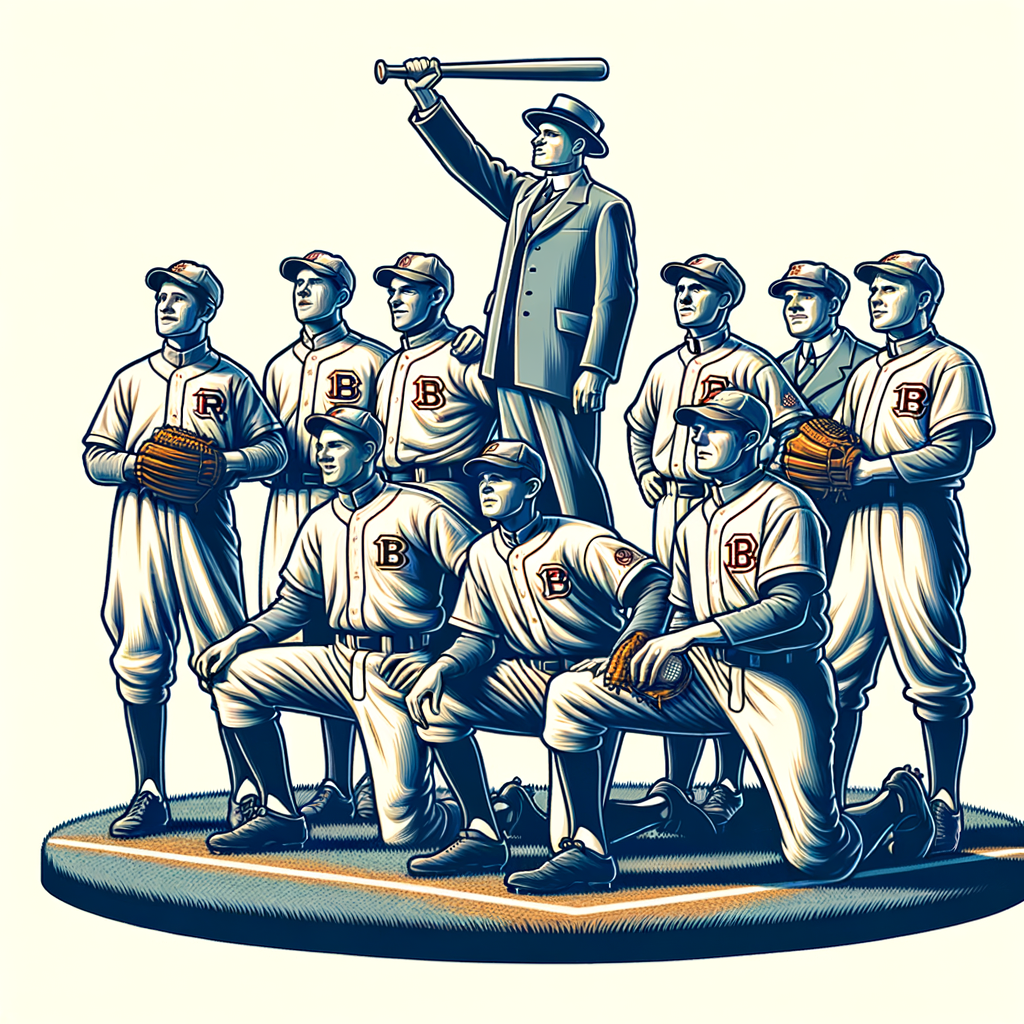
The 1933 season for the Washington Senators often gets lost amid the annals of baseball history, overshadowed by the dominant dynasties of the Yankees and the iconic images of the Babe Ruth era. However, for those knowledgeable about the nuances of the game, the 1933 Washington Senators’ season was nothing short of a masterclass—a veritable presidential performance that saw the team not only reach the World Series but challenge the conformity of baseball’s usual suspects of success. Set against the backdrop of a rapidly changing America, with Franklin D. Roosevelt’s pragmatic leadership style echoing throughout Washington, the baseball team mirrored their locale’s quest for positive change and renewed hope.
This astonishingly proficient baseball team achieved feats that were as thrilling as they were inspirational. In an era when baseball sought heroes and the nation craved moments of collective cheer amid economic adversity, the allure of the Senators was more than mere sport—it was morale, hope, and a quintessential example of American resilience. In this analysis, we’ll uncover how the 1933 Senators encapsulated a quintessential presidential performance in a season that marked a thematic unison between the suspense of the diamond and the societal resolve that characterized 1933 America.
The Inception of Success: Building a Contender
As the Great Depression cast a shadow over much of the nation, the Washington Senators, once mostly overlooked, were in the preliminary stages of executing a remarkable transformation. The strategy commenced in earnest in the early 1930s under the astute guidance of team manager Joe Cronin, whose youth belied his prodigious baseball intellect. Tasked with revitalizing a team, Cronin assembled a roster of players whose talents perfectly complemented each other. His success in leadership was predicated on welding together a lineup and pitching staff that could compete with any team, relying heavily on his ability to extract peak performance from every roster member.
The Senators flourished around cornerstones like Goose Goslin, an exemplary hitter with a knack for coming through in clutch moments, and Heinie Manush, whose batting prowess ensured crucial runs scored. Their offensive contributions were augmented by Joe Kuhel, whose consistent presence at first base provided an invaluable cornerstone. These players, seamlessly integrated into a meticulously managed team, formed the nucleus of an unlikely Cinderella pursuit in the American League. The team put together extraordinary runs through outstanding field tactics, unquestionable team spirit, and innate process execution, positioning themselves as legitimate contenders by mid-season’s crescendo. The Senators’ rapid ascent in skill and confidence was an impeccable demonstration of collective effort supported by strategic thinking.
The Presidential Parallel: Strategies and Leadership Styles
The alignment between the Senators’ strategies and the contemporary political climate was not purely coincidental. Franklin D. Roosevelt’s presidency, inaugurated in March 1933, advocated for innovative policies meant to tackle the nation’s daunting challenges. Roosevelt inspired hope and action—qualities mirrored by the Senators’ determination to defy expectations. Much like FDR leveraging the New Deal aiming to combat the Depression, the Senators focused on leveraging their development and strengths for immediate realignment and superiority.
An impressive component of the Senators’ influence rested on effective leadership that emulated Roosevelt’s own approach. Just as Roosevelt entered office with an unyielding determination to inspire confidence in a disheartened country, manager Joe Cronin brought an assured presence and dynamic approach. Cronin embraced momentum and adaptation while ensuring his players remained calm under pressure and well-drilled in their roles. While traditional strategies and methods were undeniably present, Cronin wielded an insightful gaze towards innovation, blending convention with audacious choices, thus revitalizing a team that dared to dream.
The Senators’ 1933 Peak: The World Series Journey
The culminating factor of the 1933 Senators season was their impressive path to the World Series. Their performance during the regular season saw them rise to the very top of the American League standings, proving their mettle at every turn against formidable adversaries. Players displayed an extraordinary melding of prowess and intuition, resulting in an electrifying journey ripe with storied plays that inspired an entire city, if not the entire nation.
At the heart of the Senators’ World Series push was incomparable pitcher General ‘Gump’ Bonura, whose control and perseverance came to symbolize the club’s fighting spirit. Another significant player was Earl Whitehill, a pitcher with a staggering zeal to surprise even the most expectant of opponents with unforeseen curveballs and unfaltering strategy. In conjunction with solid defense, these efforts resulted in the team executing incredible victories that meant more than mere wins; they articulated resistance and resilience.
As the Senators geared up to face the legendary New York Giants in baseball’s ultimate showdown, the stage was set for a fierce competition. Fans, buoyed by the team’s regular-season success, witnessed a series that was both thrilling in complexity and engaging in its shifts. The Senators proved themselves capable tacticians, matching the Giants’ skills throughout each game. Despite eventually falling to a loss in five games, the Senators earned respect and adulation as a team that defied the odds within America’s pastime, bringing immense pride and honor to Washington’s beleaguered populace.
Contributions Beyond the Field: Community and Legacy
The impact of the 1933 Senators extended far beyond their style of play. Like Roosevelt’s political moves, they fortified and synthesized the community around them, delivering intangibles that transcended sport itself. Players and management invested in their relationship with fans, recognizing that their efforts could ignite a flame of optimism within their city’s morale. The Senators’ approachability and integrity built an energetic fanbase that stood ardent behind the team as both a sports franchise and a medium for enduring impacts beyond the ballpark.
While the paths of Washington’s Senators—beyond 1933—eventually diverged, the season left a vital legacy enriched with moments that bridged sport and personal connection. The vigour, tenacity, and brazen courage displayed symbolized a future nearby with potential, much like the social promise underpinning the New Deal at large.
Conclusion
The 1933 Washington Senators offered a remarkable demonstration of how baseball, as both competition and spectacle, can align with broader historical narratives to become more than sport. As with Franklin D. Roosevelt’s compassionate presidential tenure inspiring countless citizens, the Senators’ performance that year ignited hope and resilience in equal measure. As the ebb and flow of seasons transform and the sphere of play advances, memory retains the core narratives of the Senators’ distinct impact during the poignant 1933 era. They stood tall with a foundation not merely of athletic excellent but of lasting unity—a presidential performance on and off the field. Though their World Series aspirations ended in a noble loss, the team exemplified how a season can encapsulate much of the true spirit of what baseball and its poignant facets can achieve.
Through determination and the fusion of insightful management, unwavering player commitment, and a progressive ethos, the 1933 Senators had authored a special chapter in baseball’s storied legacy. That season emboldened dreams and aspirations were not confined to the field but served as a canvas for an entire community’s belief in collective growth and triumph over adversity. As moments fade into the murkiness of yesteryears, the essence distilled in those seasons remains thematically immortal—speaking to generations keen for inspiration.
In totality, the legacy and influence of the 1933 Senators extend much beyond their win-loss record, standing as a pivotal example of achievements flowing symbiotically alongside visionary leadership akin to that of a tenacious president guiding through turbulent waters. The Senators’ essence shared an eternal bond, held within both the archives of baseball ephemera and the lodges of American historical consciousness: a timeless representation of aspiration, integrity, and the splendid scope of dreams daringly executed against uncertainties.
Frequently Asked Questions
1. Why is the 1933 Washington Senators’ season referred to as a “Presidential Performance”?
The 1933 Washington Senators are often described as delivering a “Presidential Performance” because they defied the odds and surpassed expectations during a period dominated by other major teams. This wasn’t just a catchy phrase; it held deep significance. During this season, the Senators captured the spirit of embodying the leadership and determination akin to a president steering his nation through challenging times. Under the brilliant leadership of player-manager Joe Cronin, the Senators’ strategy, skillful displays on the field, and seamless teamwork lifted them to reach the World Series. This accomplishment was monumental because they beat out more popular teams like the New York Yankees during a time when the Yankees’ presence in the World Series was almost a given. Their success resonated with the audacity of breaking norms and reaching for greatness, much like how a commander in chief would in a time of national need. The ’33 squad played with precision and cohesive flair worthy of admiration, thus crystallizing their performance into baseball folklore as presidential.
2. Who were some key players on the 1933 Washington Senators team?
The 1933 Washington Senators boasted several pivotal players who made significant contributions to the team’s legendary season. At the forefront was Joe Cronin, the player-manager whose tactical ingenuity led the Senators both on and off the field. His leadership wasn’t just about spearheading strategies in-game; he also played a massive role directly in the field with his bat, finishing with a .309 batting average and 45 doubles. Then there was Lefty Stewart, leading the pitching staff with precision and exhibiting reliability throughout the season. Alvin “General” Crowder also stood out with notable performances that earned him 24 wins, showcasing what it took to be an effective pitcher in any era. Another critical element to their success was Heinie Manush, whose hitting prowess contributed substantially—his .336 batting average and consistent performances were instrumental. These players, among others, helped weave the storied narrative of that season, combining their talents to challenge the baseball hegemony effectively.
3. How did 1933’s economic context impact the Washington Senators’ success that season?
The broader economic context of 1933, part of the Great Depression era, played a multifaceted role in shaping various aspects of baseball, including the Washington Senators’ success. The Depression affected team budgets, player salaries, and fan attendance. For many teams, the challenge was fielding a competitive team without overspending, a reality starkly different from the opulent teams like the Yankees. The Senators managed to navigate this turbulent period through shrewd management and resourceful scouting, assembling a team that concentrated on chemistry and dynamics rather than star-studded, high salary rosters. This approach was not just financially astute but also fostered unity and common purpose among the players. Moreover, baseball during the Depression was a figurative lighthouse, a place where the nation could find a sliver of hope and entertainment amidst economic despair. The Senators were part of this Americana, bringing aspirations to Washingtonians and boosting morale—a symbolic sign of resilience through their surprising victories, illustrating that with tenacity and teamwork, adversity could be transformed into triumph.
4. What was the outcome of the 1933 World Series featuring the Washington Senators?
The 1933 World Series marked a momentous occasion for the Washington Senators as they faced off against the New York Giants. It was a competitive showdown, lauded for its spirited displays and closely contested matches. After battling through grueling games, the Giants emerged victorious in five games, securing a 4-1 series win. However, the Senators’ journey to the World Series itself was an accomplishment of significant magnitude. Demonstrating commendable brinkmanship and resolve, they managed to provide a formidable challenge to the Giants’ stronghold, especially considering the Giants were seasoned World Series participants. Despite the loss, the Senators’ performance further cemented their 1933 season as memorable and worth celebrating, leaving a lasting legacy that testified to their ability to punch above their weight class.
5. How has the legacy of the 1933 Washington Senators endured over time?
The legacy of the 1933 Washington Senators has endured as a classic tale of determination and excellence against the odds. Historians and baseball aficionados often reflect on this season, recognizing it as a cornerstone of Washington baseball history. Their story is a testament to a team that meshed together uniquely and succeeded at the precipice of baseball’s Golden Era, which has been dominated by dynastic teams. While many subsequent replacements and transformations in the Washington baseball landscape have occurred, with teams such as the Senators retracting and the Nationals emerging, the ethos instilled by the 1933 squad reverberates through generations. Vintage baseball enthusiasts, whether through stories or special fan tributes, continue to celebrate the valiance of Cronin’s boys who dared to be ambitious. Reminders of their path-breaking journey are preserved in baseball literature, discussions, and memorabilia, keeping their pioneering spirit alive for future generations to draw inspiration from, both emblematic in America’s pastime and beyond.