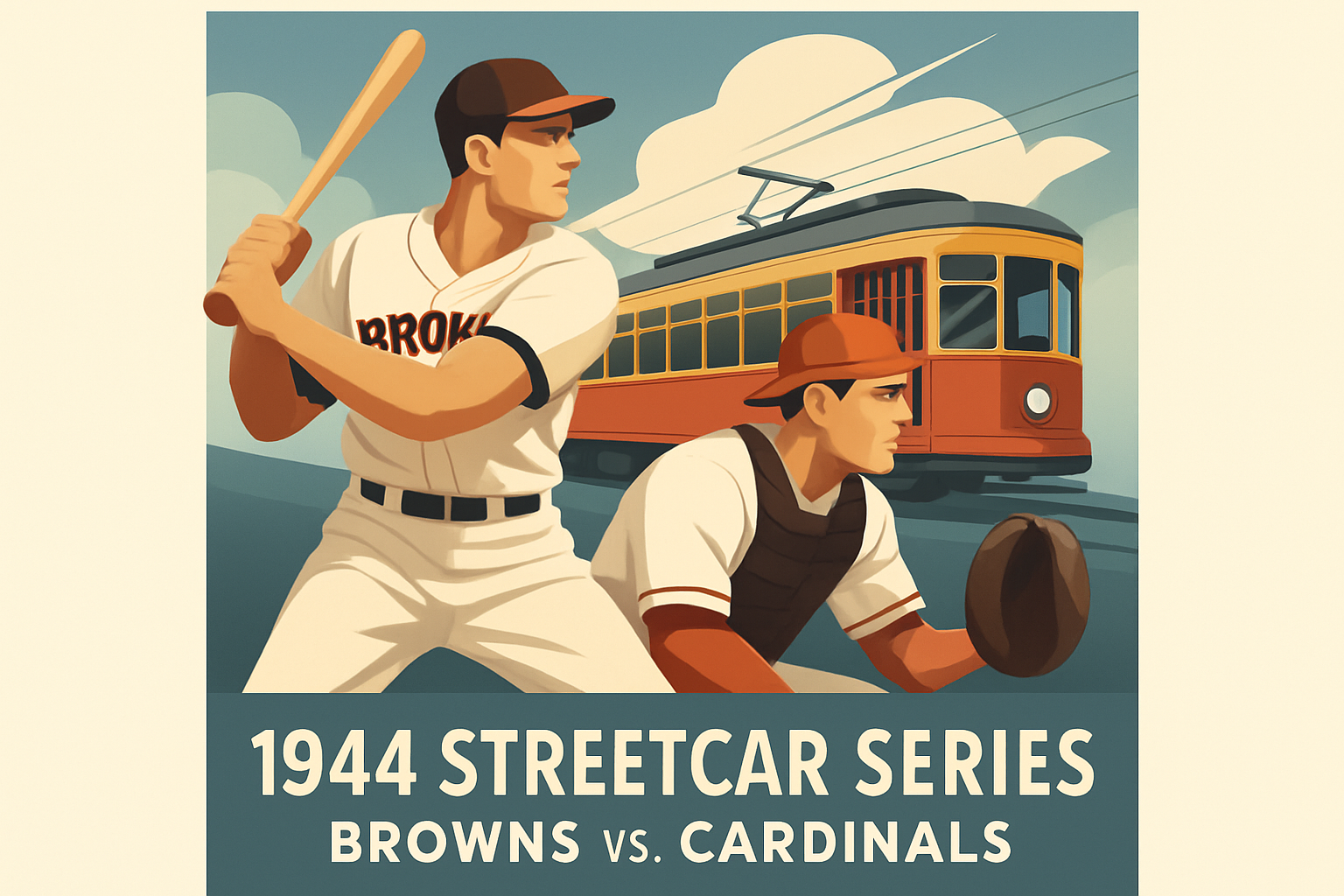
The 1944 ‘Streetcar Series’ stands as one of the most unique and compelling World Series in Major League Baseball (MLB) history. This wasn’t just an ordinary World Series; it was a battle between the two teams of St. Louis: the Cardinals and the Browns. Occurring during World War II, a time when many star players were enlisted in military service, the series showcased the talents of less renowned players, creating an atmosphere rich in local rivalry and unexpected heroism.
The term ‘Streetcar Series’ comes from the fact that both teams shared Sportsman’s Park as their home field, allowing fans to take a streetcar to each game regardless of which team was the nominal host. Key terms that define this competition include “World Series,” the annual championship series of MLB, consisting of the American League (AL) champion versus the National League (NL) champion; “Browns,” which refers to the St. Louis Browns, an AL team that later became the Baltimore Orioles; and “Cardinals,” a successful St. Louis-based NL team that has won numerous championships.
This series matters because it reflects a period in history when baseball was adapting to wartime conditions. The 1944 matchup became a symbol of resilience, community pride, and the enduring nature of baseball even in challenging times. Understanding this series offers insights into the dynamics of sports during global conflicts and sheds light on how local rivalries can invigorate community spirit.
The Context of the 1944 ‘Streetcar Series’
To appreciate the significance of the ‘Streetcar Series,’ it’s crucial to examine its historical and cultural backdrop. During World War II, many MLB players had enlisted in the military, leading to a reduction in the overall talent pool. This scenario opened opportunities for players who might not have had a chance to shine under normal circumstances. The St. Louis Browns, historically an underdog and often overshadowed by their NL neighbors, seized this opportunity to reach their first World Series.
One noteworthy example from the series involved Browns pitcher Denny Galehouse, who had an astonishing season and was instrumental in leading the Browns to the World Series. His performance is a testament to the unexpected heroes that emerge during times of need. The series proved that talent and opportunity could arise from the most surprising places.
The proximity of the Browns and Cardinals, combined with a shared stadium, created a unique rivalry. The cultural climate of St. Louis at the time was charged with anticipation, with citizens proudly supporting their respective teams. The significance of this local rivalry extended beyond the field, fostering community engagement and a fierce, albeit friendly, competition that kept spirits high during wartime.
Game-by-Game Breakdown
Understanding the 1944 ‘Streetcar Series’ requires a close look at each game, framed within the events of World War II. The series, played over six games, offered dramatic moments that remain in the annals of baseball history.
| Games | Date | Winning Team | Score | Key Moment |
|---|---|---|---|---|
| Game 1 | October 4, 1944 | Cardinals | 2-1 | Mort Cooper’s pitching dominance |
| Game 2 | October 5, 1944 | Browns | 6-2 | Nelson Potter’s four-hitter |
| Game 3 | October 6, 1944 | Cardinals | 2-0 | Abe Bowman’s critical save |
| Game 4 | October 7, 1944 | Cardinals | 5-1 | Stan Musial’s clutch hitting |
| Game 5 | October 8, 1944 | Browns | 2-1 | Vern Stephens’ decisive home run |
| Game 6 | October 9, 1944 | Cardinals | 3-1 | Dixie Walker’s key double play |
Each game showcased moments of strategic brilliance and individual prowess, set against the unique backdrop of St. Louis’s local rivalry. The notable participation of players like Stan Musial, who later became a baseball legend, added depth to the narrative. In Game 4, Musial delivered crucial hits, leading the Cardinals to victory, which exemplified his pivotal role in the series and his career.
The Players: Unlikely Heroes
With many regular MLB stars conscripted into military service, the 1944 ‘Streetcar Series’ became a platform for unlikely heroes. Names like Denny Galehouse and Nelson Potter rose to prominence, demonstrating that perseverance and opportunity can open doors to greatness.
One of the most significant players in the series was Denny Galehouse, whose pitching was spectacular throughout the season. Despite being overshadowed by his own personal struggles and injuries, Galehouse’s dedication and skill proved vital in the Browns’ surprising success.
Similarly, Nelson Potter’s Game 2 performance marked a turning point for the Browns. His command on the mound and ability to stifle the Cardinals’ offense with a four-hitter put the Browns on competitive footing. This example illustrates the theme of emergence under pressure—players who might otherwise have been sidelined rose to prominent roles when given the chance.
The Legacy of the ‘Streetcar Series’
The legacy of the 1944 ‘Streetcar Series’ resonates well beyond the confines of Sportsman’s Park. Primarily, it symbolizes the spirit of resilience evident during a trying era. The Browns’ World Series appearance and their eventual defeat by the Cardinals underscored the unpredictable nature of sports competitions, epitomized by a rivalry filled with local pride.
The series holds a cherished place in the hearts of baseball enthusiasts, particularly those connected to St. Louis history. Its lessons remind us of the potential that lies untapped in less heralded players and teams, waiting for the right circumstances to showcase remarkable talent and determination.
Moreover, the Browns’ journey to the World Series has a continuing impact, particularly in its historic significance. While the Browns later moved to become the Baltimore Orioles, the legacy of their 1944 team remains a point of anecdotal pride and marks a high point in the franchise’s history.
Conclusion: Lessons from the ‘Streetcar Series’
The 1944 ‘Streetcar Series’ between the St. Louis Browns and the St. Louis Cardinals offers valuable lessons even today. Through challenging circumstances brought about by global conflict, baseball proved its adaptability and resilience. This series illustrates the power of local rivalry to invigorate communities and offer a sense of normalcy and diversion.
Both the Cardinals and Browns exemplify qualities of perseverance, determination, and the unpredictable joy inherent in sports. These lessons are applicable beyond just team sports, reflecting principles of life in which opportunities may arise from adversity, and unexpected heroes can emerge when least expected.
To the modern fan or historian, the ‘Streetcar Series’ invites a deeper understanding of how historical context influences sports and community dynamics. It serves as a reminder of sportsmanship, the beauty of underdog stories, and the importance of recognizing every player’s potential.
As a call-to-action, those interested in baseball history can delve into the stories of players and teams from this series, extracting inspiration and motivation for personal endeavors. Understanding such historical events sustains the legacy of sports history and keeps alive the tales of heroes who lifted spirits in wartime—a lesson deeply enriching for today’s circumstances.
The 1944 ‘Streetcar Series’ stands as a seminal moment in baseball history, encapsulating the spirit of fair competition and the incredible narratives that sports can tell. Embrace these stories, and let them inspire future generations to find courage and opportunity amidst adversity.
Frequently Asked Questions
1. What was the ‘Streetcar Series’ and why is it significant?
The ‘Streetcar Series’ is the popular name given to the 1944 World Series, which stands out as a historical showdown between two baseball teams from the same city: the St. Louis Cardinals and the St. Louis Browns. This unique circumstance earned the series its nickname since fans could travel to games on the streetcar system due to the proximity of the teams. The series is considered significant for multiple reasons. Firstly, it took place during World War II when many of Major League Baseball’s stars were serving in the military, giving rise to unsung heroes and underappreciated talent. This added an unexpected twist to the series as less celebrated players got the chance to shine. Secondly, the intense local rivalry electrified the atmosphere, creating a memorable moment in the fabric of baseball history as this inner-city clash unfolded completely within Sportsman’s Park, which the two teams shared as their home stadium. Ultimately, this series reflects a distinct time in sports history when resourcefulness and local pride took center stage in the absence of some of baseball’s biggest stars.
2. How did the absence of major league stars due to World War II affect the dynamics of the 1944 World Series?
The absence of major league stars during the 1944 World Series due to enlistment in World War II had a profound effect on the dynamics of the series. With many all-star players off to serve their country, teams had to rely on players who might not have otherwise had the chance to take the field, leading to a surprising showcase of unfamiliar talent. This change in team composition meant that lesser-known players had their moment in the spotlight, demonstrating that a commitment to teamwork and strategy could triumph over individual stardom. Each team had to be resourceful, leaning heavily on the talent they had available. For fans, this unpredictability added a layer of excitement, as they watched players rise to the occasion, stepping into roles and handling pressures far removed from the peacetime lineup. It highlighted the resilience and adaptability of the teams involved and underscored a unique chapter in baseball history where the sport persevered through wartime adversity.
3. Who were some of the key players and memorable moments in the 1944 Streetcar Series?
While the 1944 Streetcar Series was devoid of many well-known stars, several key players made a significant impact. For the St. Louis Cardinals, players like Mort Cooper, a formidable pitcher, played a pivotal role with consistent performances. Catcher Walker Cooper provided strong defensive support and also contributed offensively. On the side of the Browns, the spotlight fell on players such as outfielder Chet Laabs, who hit two home runs in Game 6, showcasing his unexpected power and agility in pivotal moments. Another standout was Denny Galehouse, a pitcher who delivered impressive performances under pressure. Memorable moments from the series include surprising plays and critical decisions that turned games around, such as the Cardinals’ Frankie Hayes blasting a key home run, and Brownies’ fans fondly remember the dedication of Vern Stephens, an infielder known for his tenacity. Overall, the series was replete with game-changing plays and surprises, making it a captivating experience for fans.
4. How did the shared stadium setup for the St. Louis Browns and Cardinals impact the series?
Both the St. Louis Browns and the St. Louis Cardinals shared Sportsman’s Park as their home field, making the 1944 World Series even more distinctive. The shared stadium setup meant that every game was effectively a home game for both teams, eliminating the usual dynamics of home-field advantage and travel-related fatigue that are common in modern series. This unique arrangement intensified the local rivalry, as the familiarity with the ballpark for both teams meant that the games centered solely on talent and strategy. Fans from both sides filled the stands, creating a charged and enthusiastic environment that symbolized St. Louis’ deep-rooted passion for baseball. This setup fostered an electric atmosphere where players were spurred on by a raucous hometown crowd regardless of who was considered the designated home team for any particular game. It was a spectacle of community spirit, fostering a shared pride in St. Louis and its baseball culture during a time of global unrest.
5. What was the outcome of the 1944 Day World Series and its impact on St. Louis baseball history?
The 1944 Streetcar Series concluded with the St. Louis Cardinals emerging victorious against the St. Louis Browns, winning the series four games to two. This series marked a monumental moment in St. Louis baseball history, underscoring the Cardinals’ dominance in the sport and adding to their prestigious legacy with another championship title. It also shone a light on the Browns, who despite eventually relocating and rebranding as the Baltimore Orioles, fiercely represented themselves during this patriotic time. The series encapsulated the spirit of perseverance and local love for the sport, leaving an indelible mark in the memories of fans. For the Cardinals, the victory further cemented their status as a leading baseball franchise, while for the Browns, it stood as a peak moment of competition that is fondly remembered by historians and long-time fans alike. The 1944 series reflected not just a local rivalry but a testament to resilience amid challenges, as it vividly illustrated the strong community ties that bolster the spirit of baseball in St. Louis.