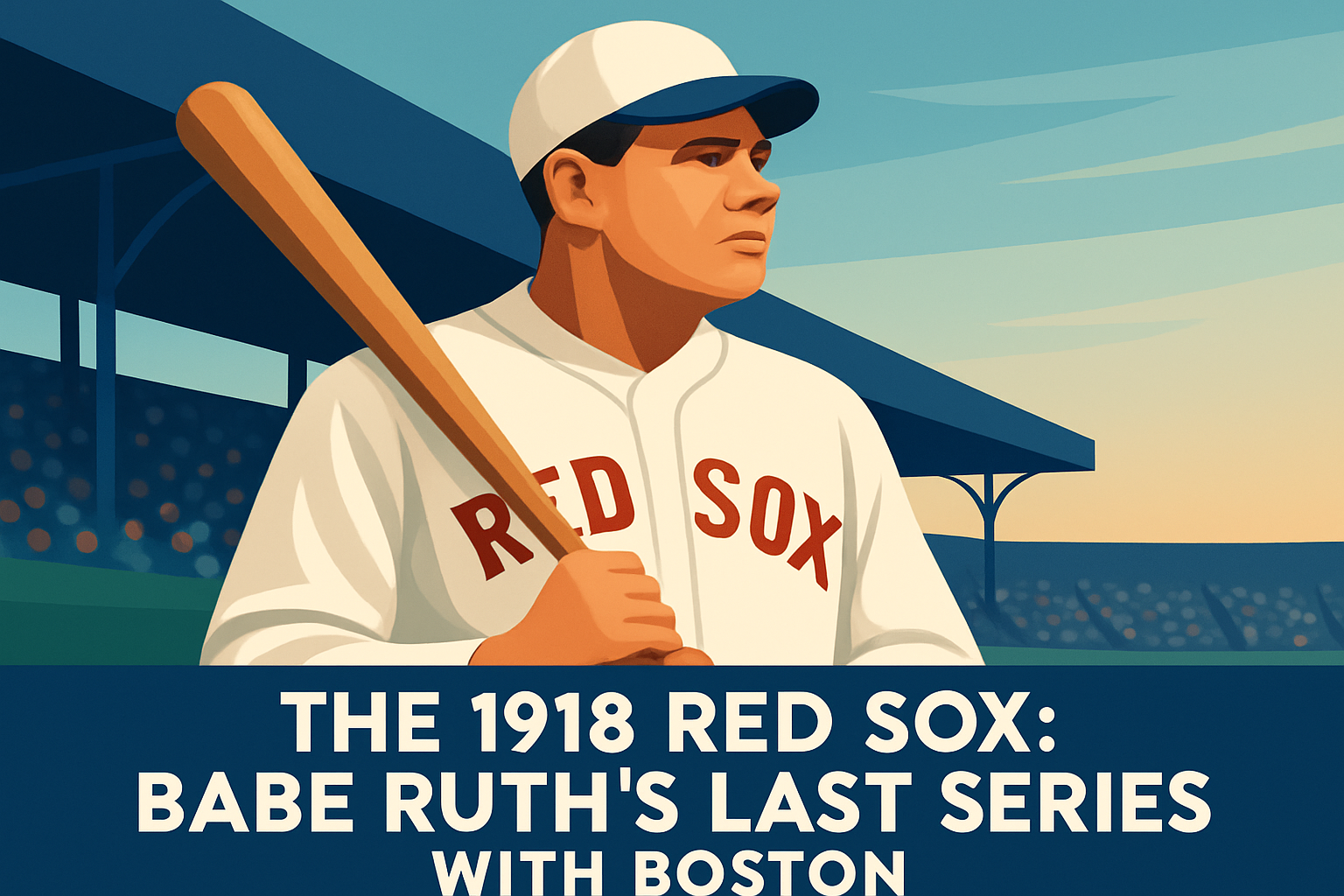
The Boston Red Sox are one of the most storied franchises in Major League Baseball (MLB), with a history filled with legendary players and unforgettable moments. One key chapter in their storied history is the 1918 season, a year that marked the last time Babe Ruth played in a regular-season series with the Red Sox. The 1918 World Series stands out not just due to Ruth’s involvement, but also because it was the year when baseball and the world were dramatically altered by the events of World War I. Understanding the significance of this series provides insight into the evolution of baseball, the impact of the war on sports, and Babe Ruth’s pivotal transition from pitcher to hitter.
The 1918 Red Sox, led by their star player Babe Ruth, clinched the American League pennant and faced the Chicago Cubs in the World Series. Babe Ruth was already a sensation at the time, having displayed extraordinary talent both as a pitcher and a hitter. This duality made Ruth a valuable asset, contributing to his team’s overall success. The Red Sox’s performance that year, culminating in the World Series, was influenced by a combination of talent, strategy, and the extraordinary circumstances of the time. As the war raged on, distractions and player enlistments left their mark on the game. For the Red Sox and Ruth, the 1918 season was a triumphant yet bittersweet moment, marking the end of an era in Boston before Ruth’s eventual trade to the New York Yankees in 1919. The significance of this series lies not only in the victory itself but also in the context of the time, leaving a lasting legacy in the history of baseball.
The 1918 Season’s Landscape
The 1918 baseball season unfolded amid the backdrop of World War I, influencing every aspect of the sport. Players were scarce as many enlisted or were drafted into military service, leading to a shortened 140-game schedule. Even baseball fan-gathering events such as spring training were affected due to travel restrictions and resource conservation mandates during the war. Despite these challenges, the Boston Red Sox fielded a strong team, beginning their journey with optimism and determination.
With a roster featuring stars like Babe Ruth, Carl Mays, and Harry Hooper, the Red Sox secured the American League title, demonstrating a powerful lineup and formidable pitching strength. Ruth’s contribution as a pitcher was essential, but he also began showcasing his prowess as a hitter, hinting at his future stardom as a home run slugger. His performance both on the mound and at bat played a crucial role in propelling Boston to success.
The league was filled with change, including a scarcity of professional players due to the war. The draft introduced novice players to the field, impacting the caliber of the game and presenting team managers with new tactical challenges. Yet, the Red Sox maintained their upper hand, leveraging Ruth’s unique talents to dominate opponents. As the regular season concluded, with America narrowly focused on the war’s outcome, the Red Sox and Cubs faced each other for a series that promised to be historic.
The World Series: Red Sox vs. Cubs
The 1918 World Series, playing out in September, saw the Boston Red Sox face the Chicago Cubs. It was a time of both tension and excitement, as fans sought a respite from the grim realities of war through America’s pastime. Despite the ongoing global conflict, the series managed to captivate audiences, becoming a beacon of morale and a much-needed distraction.
The series was groundbreaking, being one of the earliest where games were broadcast on radio, bringing the excitement to a wider audience than ever before. Fans could listen to their beloved teams’ exploits, even if they couldn’t attend in person due to the wartime constraints. Moreover, the play itself was tense and closely contested, with every run counting in tightly matched games.
| Game | Location | Winner | Score |
|---|---|---|---|
| Game 1 | Chicago | Boston Red Sox | 1-0 |
| Game 2 | Chicago | Boston Red Sox | 2-1 |
| Game 3 | Boston | Chicago Cubs | 3-1 |
| Game 4 | Boston | Boston Red Sox | 3-2 |
| Game 5 | Chicago | Chicago Cubs | 3-0 |
| Game 6 | Boston | Boston Red Sox | 2-1 |
Babe Ruth’s performance in the series was pivotal. Serving as both a pitcher and hitter, he threw a shutout in Game 1, demonstrating his skill and control on the mound. In Game 4, he stepped up as a hitter, contributing crucial runs. Ruth’s ability to pivot between pitching and batting demonstrated his multifaceted talent.
The 1918 World Series victory cemented the Red Sox’s place as champions amidst tumultuous times. Yet, equally significant was that it marked Ruth’s last series with Boston, as the following year he was sold to the New York Yankees—a transaction that would forever alter the trajectories of both franchises.
The Impact of a Nation at War
The global conflict of World War I deeply affected baseball and the 1918 season in particular, casting a shadow over the sport. This era left an indelible mark on the national pastime, redefining team dynamics, player availability, and the sport’s role in American society.
Player enlistments and the “Work or Fight” policy enacted by the U.S. government meant that many athletes left the diamonds for the trenches. This policy mandated that all able-bodied men, including baseball players, must engage in war-related work if not serving in the military, or else forfeit their baseball careers. In response, teams adapted by pulling talent from any available source, including non-traditional players, leading to an unorthodox season.
Despite the war’s overshadowing presence, baseball offered respite and continued to serve as a unifying factor. Weary citizens clung to baseball as a sense of normalcy, with games representing one of the few escapes from wartime anxiety. The outcome of the 1918 World Series, with the Red Sox emerging victorious, was seen as a symbol of hope, resilience, and American strength.
The conclusion of the series also emphasized the impending changes in baseball with the impending rise of Babe Ruth as a major hitting icon. His contribution to the 1918 World Series highlighted his growing prominence, suggesting the shift baseball was about to undergo with his move to New York and the burgeoning “live-ball” era that would follow.
The End of Babe Ruth’s Red Sox Era
The year 1918 marked the end of an era for Babe Ruth with the Boston Red Sox, but it was merely the beginning of his ascent to baseball immortality. His multifaceted talent was evident in his ability to influence the game both on the mound and as a hitter. However, his eventual trade to the New York Yankees in 1919 paved the way for Ruth to transform into the power-hitting behemoth known as the “Sultan of Swat.”
Ruth’s departure from Boston was seminal, as it initiated what would be known as the “Curse of the Bambino,” a period during which the Red Sox failed to win a World Series for 86 years. This transaction was highly scrutinized and remains a pivotal moment in baseball history, often cited as the start of a successful era for the Yankees and a long drought for the Red Sox.
The Red Sox’s 1918 triumph, however, should not be overshadowed by this subsequent narrative. Ruth’s final series with Boston showcased his versatility and leadership, vital components of a championship team. His departure sparked a narrative of sports fame and transformation, leaving an indisputable mark in baseball legend as he went on to shatter batting records with the Yankees.
Legacy of the 1918 Red Sox and Babe Ruth
The 1918 Red Sox and their star player Babe Ruth’s involvement in that season is an integral chapter in baseball lore, representing a blend of triumph against adversity and significant transition. It encapsulates the end of Ruth’s era with Boston, highlighting his versatile skills that captivated audiences and ensured victories during turbulent times.
Ruth’s eventual trade would lead to a seismic shift in the baseball landscape, initiating the Yankees’ prolonged dominance and the Red Sox’s infamous title drought. Yet, the Red Sox’s 1918 World Series win remains a testament to the tenacity and skill of the team and its players during a challenging period.
Recognizing the historical context helps to appreciate the significance of this season beyond just its athletic achievements, acknowledging the vast influence of societal challenges and individual transitions in sports. The enduring legacy of the 1918 Red Sox, intertwined with Ruth’s rise to baseball prominence, continues to serve as both inspiration and a historical milestone.
Conclusion: Lessons from the Past
The 1918 Red Sox and Babe Ruth’s last series with Boston stand as a remarkable story of success amid trials, demonstrating the resilience of sports culture during times of national challenge. The season serves as a pivotal moment in baseball history, underlining the profound impact of societal events such as World War I on the sport.
For fans and historians alike, revisiting this era teaches valuable lessons about adaptability, the influence of individual contributions in team success, and the transformative nature of sports figures like Babe Ruth. Understanding this snapshot of history enriches appreciation for baseball’s rich past and its ongoing evolution.
To truly grasp the essence of baseball’s history, one must consider the pivotal moments that have shaped its course, such as the 1918 season and Babe Ruth’s departure from Boston. As admirers of the sport, we are called to reflect on these precedents and celebrate the enduring legacy they leave in America’s favorite pastime.
Frequently Asked Questions
1. What made the 1918 season significant for the Boston Red Sox and Babe Ruth?
The 1918 season was pivotal for the Boston Red Sox for several reasons. Firstly, it marked the last season Babe Ruth, one of baseball’s most legendary figures, played with the team regularly. At the time, Ruth was not just a power hitter but also an exceptional pitcher, showcasing an extraordinary dual talent that was rare in baseball. His ability to both pitch and hit at elite levels was something that made him stand out in the sport’s history books.
Additionally, the 1918 season was distinctive because it was played under the looming shadow of World War I. The global conflict had a significant impact on Major League Baseball, with players serving in the military and public sentiment questioning whether the sport should continue while the nation was at war. This put additional pressure on teams and players, including the Red Sox, to perform and provide a distraction for the public amid such turbulent times.
The 1918 World Series, in particular, was noteworthy because it was a shortened season, and the threat of further season curtailment due to the war loomed over it. The Red Sox, led by Ruth, went on to win the World Series, cementing their place in baseball history. Ruth’s last regular-season performance with the Red Sox was not just the end of a chapter for the team but also the beginning of his transition into becoming the ‘Sultan of Swat’ with the New York Yankees, where he shifted focus to his hitting prowess. Thus, the 1918 season encapsulated both an end and a beginning, punctuated by the broader context of a world at war.
2. How did World War I affect the 1918 baseball season, and did it influence Babe Ruth’s career decisions?
World War I had a considerable impact on the 1918 baseball season. With many players enlisted to serve, Major League Baseball had to shorten the season, which began later than usual and ended earlier. The U.S. government’s “work or fight” order mandated that baseball players either take part in the war effort or find work in essential industries if they were not enlisted directly in the military. As a result, there was a prevailing atmosphere of uncertainty and pressure regarding the future of their careers and the stability of the league itself.
Babe Ruth specifically was influenced by these events, though more so indirectly. Despite the challenges of the times, Ruth excelled on the field during the 1918 season, notably leading his team to the World Series. This success illustrated his value and led to increased attention on his emerging power-hitting prowess. Recognizing this, Ruth began to see more clearly what his future could hold, straying more towards refining his batting skills rather than splitting focus with pitching.
Moreover, Ruth’s experiences in 1918 may have influenced his decision to eventually leave Boston for the New York Yankees. In New York, he saw the potential for maximizing his exposure and becoming the slugger he’s most remembered for today. Thus, while the war imposed many limitations on baseball and created anxiety around the game’s continuity, it also indirectly set the stage for Ruth’s evolution and the monumental chapter of his career with the Yankees.
3. Why did Babe Ruth’s role with the Red Sox change during the 1918 season?
During the 1918 season, Babe Ruth’s role with the Boston Red Sox underwent a significant shift from being largely a pitcher to taking on more responsibility as a hitter. This transition did not happen overnight but was a gradual recognition of Ruth’s extraordinary talent with the bat. Traditionally known for his exceptional skills as a left-handed pitcher, Ruth’s prowess as a slugger began attracting considerable attention during the 1918 season.
The Red Sox, recognizing that Ruth’s potential with the bat could be a game-changer, started using him more frequently in the outfield to ensure his bat was in the lineup. This strategic shift occurred partly due to Ruth’s own insistence on demonstrating his hitting abilities and partly as a tactical move by the team looking to capitalize on his burgeoning power at the plate. By allowing Ruth to play in the outfield and hit more regularly, the Red Sox were able to provide their lineup with a significant offensive boost—a pivotal factor in their success during the 1918 season.
Ultimately, Ruth’s transition speaks not only to his personal ambition and capabilities but also to a time where the game itself was evolving, placing more emphasis on multi-talented players who could impact the game in more ways than one. The change in Ruth’s role in 1918 marked a turning point in his career trajectory, eventually contributing to his legacy as one of baseball’s greatest home run hitters.
4. How did Babe Ruth perform in the 1918 World Series, and did it have an impact on his legacy?
In the 1918 World Series, Babe Ruth delivered an exceptional performance that solidified his place as a clutch player for the Boston Red Sox. His contributions were instrumental in the Red Sox capturing the championship title. Pitching was still one of Ruth’s primary roles during this time, and he excelled in the World Series by setting a record with a remarkable 29 2/3 scoreless innings streak as a pitcher, which remained unbroken until 1961.
This performance was not only a testament to his skills on the mound but also underscored his versatility in being able to contribute significantly in multiple ways—something not commonly seen at such a high level. Offensively, Ruth provided solid moments at the plate, although his true explosive power as a hitter would surface more prominently after his transition to the Yankees. However, the 1918 World Series showcased his all-around abilities and steely determination under pressure.
The impact on Ruth’s legacy was profound in that this series accentuated Ruth’s reputation as both a pivotal pitcher and a burgeoning offensive threat. It captured the duality of Ruth’s talents before his full evolution into the role of a hitter, further entrenching him as an exceptional two-way player in baseball history. The success of the 1918 World Series certainly laid a foundation for the mythic career that would follow, enhancing his narrative as a player capable of performing on the biggest stage. His ability to thrive in these decisive moments endeared him to fans and fortified his place in the lore of baseball.
5. What were the consequences of Babe Ruth’s departure from the Red Sox after the 1918 season?
The departure of Babe Ruth from the Boston Red Sox after the 1918 season had wide-ranging implications, most notably sending ripples through the franchise’s fortunes. The Red Sox, having won the World Series in 1918 with Ruth as one of their central figures, would famously enter a championship drought that lasted until 2004—a span known colloquially as the “Curse of the Bambino.” The trade of Ruth to the New York Yankees in the offseason of 1919 is considered one of the most pivotal and controversial trades in sports history.
Ruth’s move to the Yankees not only changed his personal trajectory but reshaped the landscape of professional baseball. In New York, Ruth transitioned fully to a hitter, transforming into the game’s most prodigious slugger and leading the Yankees to unprecedented success. His presence in New York heralded the beginning of the Yankees’ dominance of Major League Baseball throughout the 1920s and beyond. Ruth’s home run exploits captivated the public and fostered a renewed enthusiasm for the sport in the post-war era.
For the Red Sox, the sale of Ruth would haunt the team for decades. The financial decision by owner Harry Frazee to sell Ruth to the Yankees was driven by his need to finance a Broadway musical, leaving many fans and historians reflecting on what might have been had Ruth stayed in Boston. The team went through numerous seasons without tasting championship success, suffering heartbreaks and close calls, contributing to the narrative of the “Curse of the Bambino” that tied the historic fate of the franchise to Ruth’s departure.
In essence, Ruth’s move to the Yankees marked a watershed moment in baseball history—one that highlighted the dramatic impact a single player could have on the fortunes of teams and the league. It was a shift that cemented Ruth’s pivotal role in the sport’s evolution and left an indelible mark on both the Red Sox and the Yankees, shaping the narrative of baseball in the 20th century and beyond.