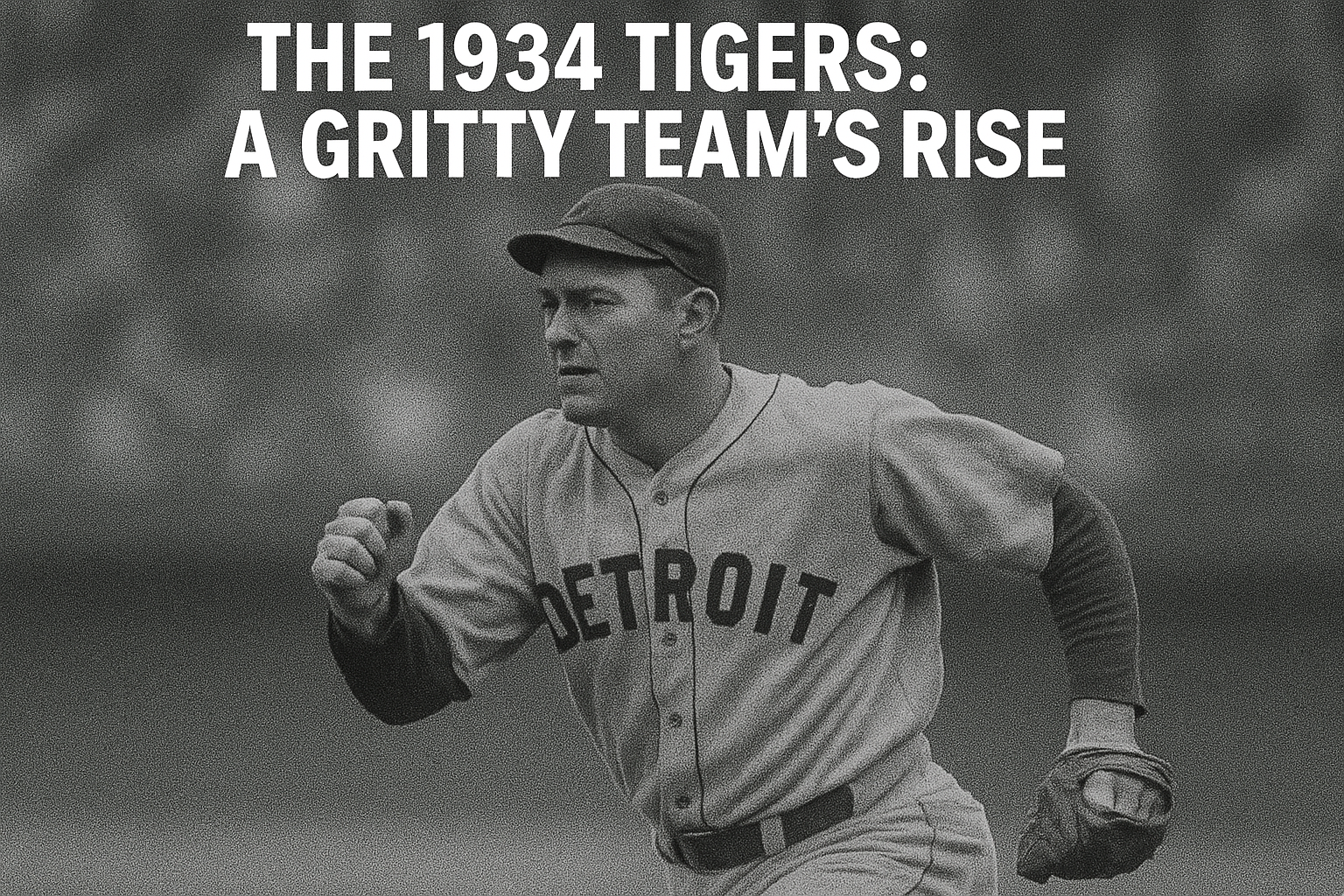
In the annals of baseball history, the Detroit Tigers of 1934 stand out as a memorable team that captured the hearts of fans with their raw talent, dogged determination, and true grit. Emerging from a period of mediocrity in the late 1920s and early 1930s, the 1934 Tigers symbolized a comeback, driven by an audacious goal to conquer the American League and secure a World Series triumph. Their journey is not merely the tale of a successful season; it is a testament to the spirit of resilience and tenacity, a narrative rich in character, excitement, and sheer love of the game. With the vivacious Mickey Cochrane driving them, Detroit swept through the league, leaving behind a legacy marked by passion and persistence. The Tigers, with achievements that echoed their dedication and spirit, continually drew attention, and admiration, and eventually became one of the emblematic symbols of baseball prowess during the Great Depression era. The story of the 1934 Tigers isn’t simply about a season – it’s about the sheer will that transformed underdogs into legends. It showcases an era when baseball was a necessary escape, a source of joy, forging heroes in ballparks across America. From the hours of grueling practice to the critical games that defined their season, each moment is a chapter in their compelling saga.
The Assembling of a Stellar Lineup
The heart of the 1934 Tigers’ success story starts with the astute assembly of one of the decade’s most formidable lineups. At the helm was Mickey Cochrane, a player-manager whose leadership abilities were second to none. Cochrane’s role with the team was transformative, as he managed not only to orchestrate strategies that brought out the best in his players but also played a critical role as a catcher. His understanding of the game allowed him to coach his team through tight spots and make tactical decisions that would turn defenses into unstoppable forces. The acquisition of Cochrane in 1934 was more than a strategic one; it was an inspirational move that ignited a winning spark within the Tigers’ ranks, unifying the team in pursuit of their ambitious goals.
Apart from Cochrane, the Tigers were fortified with players who were equally determined and talented. Hank Greenberg towered over opponents as an imposing figure at first base, displaying a mixture of power, focus, and tactical skill that would cement him as a central force in the Tigers’ offense. Greenberg’s prowess with the bat was matched only by the majestic swiftness of Charlie Gehringer at second base. Dubbed as “The Mechanical Man,” Gehringer was known for his consistency, which provided the foundation for the Tigers’ offensive and defensive capabilities. Paired in the field with shortstop Billy Rogell and third baseman Marv Owen, they constituted a formidably synchronized infield unit, which afforded the outfielders the confidence to play aggressively.
The outfield itself was no less impressive, boasting names like Goose Goslin, known for his formidable hitting and timely homeruns that would often turn the tide of the game. Adding to this mix was Schoolboy Rowe, notable for his pitching feats that were as formidable as they were essential. With performances that sparked inspiration across the nation, Rowe emerged as a pivotal figure, capturing hearts as he led the pitching rotation with intelligence and ferocity, complemented by the likes of Tommy Bridges and Elden Auker. These athletic stalwarts formed a team that seamlessly blended youth with experience, exuberance with calmness, and spontaneity with strategy, all of which Cochrane masterfully orchestrated to make the Tigers formidable opponents.
The Regular Season: A Dominant Journey
The Tigers commenced their regular season campaign with a clear vision, determination to assert their presence across the league evident from the very first pitch. As the dual forces within the team worked in concert – the pitching formidable and stable, the batters precise and potent – they embarked on a sequence of victories. With Cochrane’s strategies playing out like well-rehearsed orchestrations, the Tigers consistently found themselves in winning positions. By the end of May, the team had established their prominence, fending off other teams with their dominant performances.
Their approach melded strategic gameplay with dynamic adaptability, allowing the Tigers to edge out even the most determined opponents in closely contested matches. Key matches against rivals such as the New York Yankees and the Cleveland Indians became high stakes contests. These encounters were pivotal, defining their character as pressure-healers who thrived on the tension of crucial moments. Games were salvaged in the dying innings, often by Gehringer and Greenberg’s timely interventions, and secured by astonishing saves and tightly managed pitching. It was within these cauldrons of competition that the Tigers asserted their will.
Despite fierce competition, the Tigers clinched the American League pennant with an impressive record, a reward reaped from their consistent focus and intensity. Key wins during mid-season, including a streak that stretched through July, showcased the unyielding temperament of Cochrane’s side. They not only held their nerve during close games but also expressed a brand of joyful baseball that thrilled their audiences. Their style was a refreshing blend of calculated tactics and unfettered passion, defining their regular season from start to finish.
The American League Pennant and the World Series
Against the backdrop of an electrified fanbase, Detroit marched into the postseason destined to challenge for the World Series title. Having successfully acquired the American League pennant, the Tigers were now pitted against the St. Louis Cardinals, a team equally equipped with talent and enthusiasm. The Cardinals, known as the Gashouse Gang for their rough-and-tumble style, would go on to provide the Tigers with their most formidable challenge yet.
The World Series games were a true spectacle, with a level of intensity so palpable it permeated every pitch and every swing. The Tigers battled with all their might, bringing their full array of skills to the fore. While the Tigers boasted a finely honed lineup with precision and power, the Cardinals matched them with wit and cunning, each game turning into a chess match played out on baseball’s broadest stage. Both teams exemplified courage and skill across the seven-game series.
Though ultimately the Tigers fell short, losing the series in seven grueling matches, their journey was one fraught with moments of brilliance and unforgettable memories. Schoolboy Rowe’s pitching duels were epic in proportion, while Greenberg’s homerun prowess was as thrilling as ever, reminding fans why they loved the sport. Every player offered their talents and strengths, making each game a dynamic and engaging spectacle.
Conclusion
The 1934 Detroit Tigers’ story is more than a tale of a season well played, but a narrative filled with triumph, trials, and unwavering dedication. Their rise to fame, fuelled by unswerving commitment and heart, reshaped the city of Detroit’s sporting heritage. The team provided an emotional lift to the community, as their plucky performances mirrored the resolve and determination that came to define an era marked by struggles of adversity across the nation.
Though they missed securing baseball’s ultimate glory, the Tigers of 1934 left an indelible mark on the sport’s history. The journey of a team that refused to lose sight of its objective, that showed character beyond comprehension, and played with a humility that set a standard for sportsmanship, continues to inspire. The lessons from their dedication, teamwork, and fighting spirit echo down through generations, reminding us of the enduring power and appeal of America’s beloved pastime.
This is the legacy of the 1934 Tigers: a gritty team, a beacon of resilience, whose pursuit of excellence is deserving of its celebrated place within baseball lore.
Frequently Asked Questions
1. What made the 1934 Detroit Tigers team so memorable and unique?
The 1934 Detroit Tigers are widely remembered for their exceptional blend of raw talent, unwavering determination, and gritty style of play that captured the hearts of fans and cements them as one of baseball’s most compelling teams. Emerging from a period marked by mediocrity in the late 1920s and early 1930s, the Tigers of that year embodied a spirit of revival and resilience that resonated deeply with their fanbase. The team wasn’t just a collection of skilled players; they were warriors on a mission, playing each game with the intensity and drive of seasoned contenders. Their goal was clear: to not only conquer the American League but also to clinch a World Series title. This journey was emblematic of a comeback, a transition from obscurity to national prominence, all achieved as they played with heart, grit, and an audacious, do-or-die attitude. Filled with pivotal moments and dramatic comebacks, their season captivated the imagination of fans and remains etched in baseball lore. Every inning, every game was part of a bigger narrative of perseverance, making the 1934 Tigers a truly unforgettable squad.
2. Who were the standout players on the 1934 Detroit Tigers, and what impact did they have?
The 1934 Tigers roster was laden with remarkable talent that played a key role in their season’s success. Chief among them was the legendary Hank Greenberg, whose performance at first base and power hitting were instrumental in driving the team forward. Hank’s prowess at the plate served as the backbone of the team’s offensive strategy, consistently delivering key hits and crucial RBIs that kept the team’s momentum rolling. Other notable figures included Charlie Gehringer, known for his exceptional fielding and strategic play, and the stalwart Mickey Cochrane, the player-manager who brought his sharp baseball acumen and leadership both on and off the diamond. Cochrane’s ability to inspire his players and make critical decisions during pivotal moments set the tone for the team. Additionally, the Tigers boasted a robust pitching staff anchored by Schoolboy Rowe and Tommy Bridges, whose combined talents stifled opposing batters and gave the team the defensive edge needed in high-stakes matchups. Together, this ensemble of talent and leadership formed the bloodstream of the 1934 Tigers, pushing the dimensions of teamwork and translating ambition into tangible success on the field.
3. What were the biggest challenges faced by the 1934 Tigers during their season?
The journey of the 1934 Detroit Tigers was fraught with its fair share of challenges, compelling the team to dig deep into their reserves of resolve and resilience. One of the foremost hurdles was shaking off the psychological and structural mediocrity that had plagued them in previous seasons. Adapting to a new mentality of winning under Mickey Cochrane’s leadership required grit and determination. The Tigers also faced fierce competition within the American League, contending against formidable teams with their own aspirations for the pennant. Each game was a battle, a testament to the survival-of-the-fittest ethos that baseball can sometimes embody. Injuries, of course, added another layer of adversity, testing the depth of their roster and the durability of their star players. And then there were the challenges on the mound—consistently locking down opposing teams’ offenses was a critical aspect of their campaign, particularly during pressure-cooker playoff scenarios. The amalgamation of these factors turned every game into a test of their mettle, pushing the Tigers to sharpen their focus and solidify their cohesive team dynamics. Addressing and overcoming these obstacles not only forged their identity as the relentless 1934 Tigers but also set the precedent for overcoming the odds in pursuit of greatness.
4. How did the 1934 Detroit Tigers perform in the World Series, and what was the outcome?
The illustrious run of the 1934 Detroit Tigers culminated dramatically in a high-stakes World Series showdown against the vaunted St. Louis Cardinals, known famously as the “Gashouse Gang.” The series was closely contested, with both teams battling fiercely as the tension escalated through each game. While the Tigers had shown superior play during the regular season, the Cardinals brought an unparalleled level of grit that matched the Tigers stride for stride. The series progressed through various dramatic twists and turns, with nail-biting moments that kept spectators on the edges of their seats. Ultimately, the Tigers fell short, losing to the Cardinals. It was a heartbreaker, concluding in a tense seven-game series that saw Detroit’s hopes dashed. Despite the loss, the Tigers’ performance captivated fans and resonates as a proud chapter in the team’s legacy, demonstrating not just their ability to reach the pinnacle of baseball competition but also their indomitable will and tenacity under pressure. The 1934 World Series was a testament not to the disappointment of loss, but to the valor and dignity with which the Tigers played, holding their heads high even in defeat.
5. What legacy did the 1934 Detroit Tigers leave within the baseball world and beyond?
The legacy of the 1934 Detroit Tigers goes well beyond the statistics and scores. They left an indelible mark on the fabric of baseball history, providing an example of how determination and teamwork can elevate a team from a place of mediocrity to a position at the heart of a national narrative. The team’s grit and resilience painted a vivid picture for fans and aspiring athletes alike, showcasing the power of belief and perseverance. The impact extended far beyond Detroit, as their story served as a beacon of hope and inspiration during the trying times of the Great Depression. They symbolized how relentless effort and a collective spirit can spark transformation, pushing beyond previous limits and transcending the barriers of doubt. In modern times, the echoes of the 1934 Tigers’ season continue to be celebrated as an era-defining moment in Major League Baseball. Their journey is remembered not simply as a story of glory and competition but as a narrative of staying power and unwavering human spirit, a saga revered by baseball purists and history enthusiasts across generations. Their story forever entrenched within the halls of Tiger legends, it serves as a reminder of what it truly means to play and compete with heart and honor.