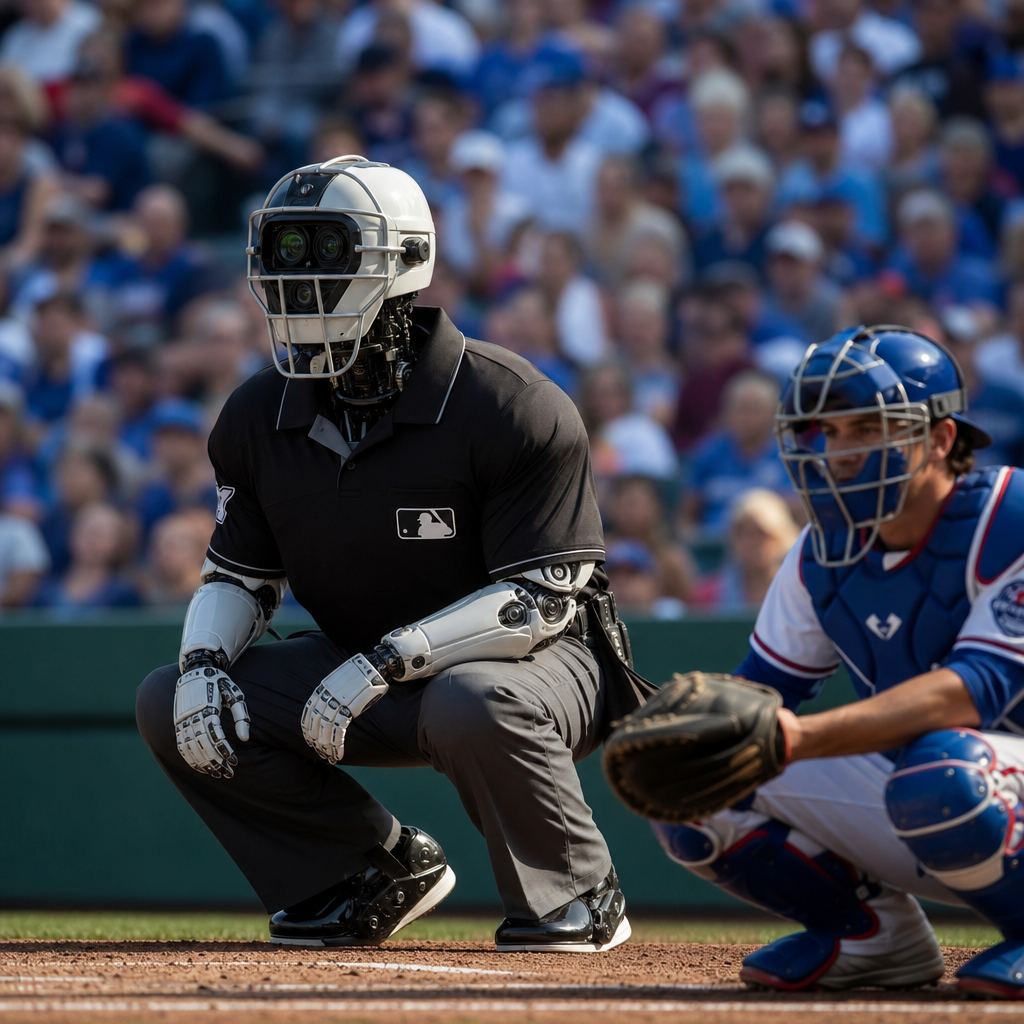
Robot umpires are no longer a science-fiction punchline in baseball; they are a practical officiating system being tested, debated, and refined as leagues search for a better strike zone. In professional baseball, the term usually refers to the automated ball-strike system, often shortened to ABS, which uses tracking technology to judge whether a pitch crossed the rule-book zone. That distinction matters because most current experiments do not replace the human home-plate umpire entirely. Instead, they automate the hardest judgment in the sport while keeping the umpire on the field to manage the game, announce decisions, handle plays at the plate, and enforce pace and sportsmanship rules.
The subject sits at the center of baseball’s wider technology shift. Teams already rely on Statcast data, Hawkeye camera systems, bat sensors, biomechanics labs, replay review, and player-tracking metrics to evaluate performance and reduce error. Officiating was always going to be part of that wave. The reason robot umpires matter is simple: ball and strike calls affect every plate appearance, every pitching plan, and ultimately wins and losses. A missed strike on 0-2 can turn into a walk, a home run, or a pitching change. Over a full season, those marginal calls shape standings, player salaries, and fan trust.
I have worked with pitch-location data and game review processes long enough to know that this debate is not really about whether umpires are good or bad. Major League umpires are highly skilled, and independent evaluations have shown strong accuracy rates. The real question is whether baseball should use available technology to make a high-volume, high-leverage decision more consistent. Supporters argue that an automated strike zone can reduce variance, remove catcher framing from the rule-book call, and give hitters and pitchers a zone that is more predictable. Critics counter that baseball is not played in a laboratory. The strike zone is three-dimensional, hitters change posture, technology can create new edge cases, and the human umpire is part of the sport’s rhythm and authority structure.
As a hub for technology’s impact on the game, this article examines how robot umpires work, why the idea gained momentum, what the minor-league tests have shown, and how adoption would affect players, teams, fans, and baseball’s identity. The goal is not to treat automation as inevitable progress or a threat to tradition. It is to explain, clearly and practically, what problem baseball is trying to solve and what tradeoffs come with the solution.
What Robot Umpires Actually Mean in Baseball
In baseball discussions, “robot umpires” is catchy but imprecise. The system under active consideration is an automated ball-strike process built on optical tracking, most notably the Hawkeye system that Major League Baseball uses for Statcast and replay support. Multiple stadium cameras track the baseball in flight, model its path, and determine whether any part of the ball passed through the strike zone as defined by the rules. The result is transmitted to the home-plate umpire, who signals ball or strike.
That is different from replacing the umpire with a machine voice and removing human oversight from the field. In practice, leagues have tested two main formats. One is full ABS, where every pitch is judged automatically. The other is a challenge system, where the home-plate umpire calls the game normally, but pitchers, hitters, or catchers can challenge a limited number of ball-strike calls. This hybrid model preserves most of the traditional look of baseball while allowing technology to correct the most disputed pitches.
The key technical issue is the strike zone itself. Rule-book language defines the zone by the midpoint between a batter’s shoulders and belt at the top, and the hollow beneath the kneecap at the bottom, measured when the batter is prepared to swing. That is not as simple as drawing a static box on television. Different players stand differently, crouch to different depths, and move during the pitch. A reliable ABS must calibrate each hitter’s zone accurately and quickly, then process ball trajectory with minimal delay. The challenge is not whether computers can track a pitch; it is whether they can interpret a living, moving rule consistently enough for elite competition.
Why Baseball Started Testing Automated Strike Zones
Baseball’s push toward automated officiating grew from three overlapping pressures: accuracy, transparency, and entertainment value. The first pressure came from data. Public pitch-tracking systems and league tools made it easy for teams, broadcasters, and fans to review missed calls in real time. Once every game produced a digital map of the zone, inconsistency became more visible. What had once been accepted as part of the sport now appeared measurable and therefore fixable.
The second pressure was fairness. Front offices now evaluate players in extraordinary detail, and players are paid according to outcomes shaped by strike-zone decisions. A borderline pitch called a strike can inflate a pitcher’s strikeout rate, suppress a hitter’s on-base percentage, and alter arbitration or free-agent value over time. When clubs invest hundreds of millions of dollars in roster construction, they naturally want fewer avoidable errors in the most repeated judgment of the game.
The third pressure was pace and fan confidence. Long arguments over the zone rarely improve the viewing experience. Replay review already accustomed fans to the idea that some calls should be corrected with technology. In that environment, keeping the least precise high-frequency call entirely human became harder to defend. MLB and its minor-league affiliates began testing ABS not because umpires had suddenly become inadequate, but because the rest of the sport had become more data-driven and less tolerant of silent inconsistency.
How the Technology Works on the Field
At the stadium level, an automated ball-strike system depends on calibrated camera arrays, synchronized timing, and software that models both the baseball and the batter. Hawkeye, the tracking platform used across MLB parks, captures pitch movement in three dimensions. The system estimates where the ball crossed the front of home plate and compares that location to a batter-specific zone generated from tracked body points. If the pitch intersects the zone according to the configured rules, the system returns a strike.
The communication chain matters almost as much as the tracking. In full ABS tests, the decision is relayed to the umpire through an earpiece, typically within a fraction of a second, so the mechanic still looks natural from the stands. In challenge formats, a player immediately signals a review after the call, and the corrected pitch graphic appears on the scoreboard. For the system to work smoothly, latency must be low, calibration must be checked regularly, and park crews must maintain consistent hardware alignment.
Baseball also has to decide which strike zone it wants to automate. A pure rule-book zone can produce outcomes that feel unfamiliar because the called zone in professional baseball has historically differed slightly at the top or bottom, and catcher framing has influenced edge pitches. Once technology enforces the formal zone more strictly, pitchers and hitters have to adapt. That is one reason implementation has moved gradually through the minors rather than arriving overnight in the majors.
What the Minor Leagues Have Taught Baseball
Minor League Baseball has served as the live laboratory for ABS, especially in the Florida State League, Triple-A, and selected showcase events. Those trials have revealed that the central debate is not whether the system can function, but which version produces the best game. Full ABS delivers the most objective ball-strike calls, yet some players and coaches have said it can feel rigid, particularly on the upper edge of the zone or with hitters whose stance changes late. The challenge model has generally received warmer feedback because it limits obvious mistakes without turning every pitch into a machine-led event.
From practical experience, the challenge system solves several problems at once. It keeps the home-plate umpire active, preserves catcher presentation on unchallenged pitches, reduces prolonged complaining, and creates a simple strategic layer. A team must decide whether a borderline second-inning pitch is worth using one of its limited challenges. That tension can improve engagement rather than interrupt it.
| System | How it Works | Main Benefit | Main Limitation |
|---|---|---|---|
| Full ABS | Every pitch is judged automatically | Maximum consistency on ball-strike calls | Less flexible, less traditional game feel |
| Challenge ABS | Human umpire calls pitches, players challenge select calls | Corrects major misses while preserving flow | Some incorrect calls remain unchallenged |
Another lesson is that player education is essential. Hitters need to know how their personalized zone is set. Pitchers need confidence that the bottom of the zone will be called the same way in April and September. Umpires need clear authority protocols when technology fails. Testing has shown that acceptance rises when the system is transparent and when participants understand exactly what is being measured.
How Robot Umpires Would Change Players and Strategy
An automated strike zone would reshape baseball tactics immediately. Catcher framing, one of the most valued defensive skills of the pitch-tracking era, would lose much of its importance under full ABS. Teams that invested in catchers who steal strikes on the edges would see that advantage reduced, while blocking, throwing, game-calling, and handling a staff would become relatively more important. Under a challenge system, framing would still matter on most pitches, but its value would decline in the highest-leverage moments because an obviously missed call could be overturned.
Pitchers would adjust too. Many modern staffs are built around high-spin fastballs at the top of the zone and breaking balls that finish just below it. If ABS consistently rewards true knee-high strikes and does not expand the zone from effective receiving, sinkerballers and command artists could benefit. Hitters, meanwhile, might become more selective if they trust the automated boundaries. That could increase walks in the short term until pitchers recalibrate attack plans.
There are developmental consequences as well. Amateur players often grow up under inconsistent zones. A standardized pro system could improve the transition from the minors to the majors, but only if colleges, high schools, and youth showcases increasingly adopt compatible tools. Otherwise, hitters and pitchers may still face a jarring officiating adjustment at each level. Technology tends to standardize elite environments first, and baseball will need to decide how much standardization it wants across the broader ecosystem.
Benefits, Risks, and the Question of Baseball’s Identity
The strongest case for robot umpires is consistency. A league that can measure a pitch precisely should not ignore that ability when the call influences every game. More consistent strike calls can improve competitive fairness, reduce public controversy, and align officiating with the rest of baseball’s analytical infrastructure. For fans, a transparent challenge review can be easier to accept than a prolonged argument over a missed edge pitch.
The strongest case against full automation is that baseball is governed by rules, but experienced through people. Umpires manage confrontation, read intent, and keep order in ways a tracking system cannot. Even on balls and strikes, a perfectly rigid zone may not produce a version of baseball that players or spectators prefer. A technically correct top-of-zone strike that has rarely been called for decades can feel wrong, not because the machine failed, but because the sport has evolved around a practical zone rather than a literal one.
There are also operational risks. Camera-based systems need maintenance, backup procedures, and weather resilience. Any automated standard can embed calibration error at scale if setup is wrong. And while technology removes one type of bias, it can create a false sense of certainty around a complex rule. Baseball’s best path is not to ask whether humans or machines are inherently better. It is to decide where automation genuinely improves the game and where human authority remains essential.
The Broader Technology Hub: What This Means for Baseball’s Future
Robot umpires are the most visible officiating innovation, but they belong to a larger transformation in baseball. The same logic that supports ABS also drives bat-speed metrics, defensive positioning models, injury-prevention monitoring, replay systems, and broadcast enhancements that explain the game more clearly. Technology is changing how baseball is played, judged, coached, and consumed. That is why this subject works as a hub within innovations and changes in baseball: it connects on-field fairness, player development, roster value, fan experience, and governance in one issue.
The future is unlikely to be a total human retreat. More likely, baseball will keep building hybrid systems in which technology handles narrow, repeatable judgments and people handle context, communication, and game control. That model already fits replay review and increasingly fits ball-strike adjudication. If MLB adopts ABS at the highest level, the challenge format appears to have the clearest path because it balances accuracy with familiarity.
For readers following technology’s impact on the game, the central takeaway is straightforward. Robot umpires are not really about robots. They are about how a traditional sport absorbs precise tools without losing the pace, tension, and authority structure that make it compelling. Watch the minor leagues, league rules committees, and spring testing environments closely. They will show whether baseball chooses total automation, selective correction, or a longer compromise. However the final model looks, the strike zone is no longer just an umpire’s interpretation. It is now a technology policy decision, and that makes it one of the most important changes in modern baseball.
Frequently Asked Questions
What are robot umpires in baseball, and how does the automated ball-strike system actually work?
In baseball, “robot umpires” usually refers to the automated ball-strike system, or ABS, rather than a fully robotic official standing behind home plate and handling every aspect of the game. ABS uses advanced pitch-tracking technology to determine whether a pitch passed through the strike zone defined by the rules. Cameras and sensors track the ball from the pitcher’s hand to the plate, calculate its trajectory, and judge whether it crossed the relevant area over home plate and within the batter-specific vertical boundaries. In most current implementations, the system is focused only on ball-and-strike calls, not fair-foul rulings, tag plays, obstruction, or other judgment-based decisions.
That distinction is important because ABS does not necessarily remove the human home-plate umpire from the game. In many trials, the umpire still stands behind the catcher, manages the pace of play, handles check swings, confirms substitutions, oversees on-field order, and relays the system’s ruling. In other words, the technology often serves as a tool for calling the strike zone more consistently, while the umpire remains central to game administration. The result is less about replacing umpires altogether and more about changing one of the sport’s most debated responsibilities into a technology-assisted process.
Why is baseball experimenting with robot umpires now?
Baseball is testing robot umpires because the strike zone has long been one of the sport’s most persistent sources of frustration. Players, managers, broadcasters, and fans regularly debate missed calls, inconsistent zones from one umpire to another, and even changes in the same umpire’s zone from inning to inning. Since balls and strikes influence nearly every plate appearance, even small inconsistencies can shape game outcomes, player development, and strategic decision-making. As tracking systems have become more accurate and widely available, leagues have gained a practical way to address that issue rather than simply arguing over it.
There is also a broader competitive reason for the experimentation. Modern baseball relies heavily on data, and teams train hitters and pitchers around highly specific zone expectations. When the called zone differs too much from the rule-book zone, it can create tension between what teams teach and what actually gets rewarded in games. ABS promises a more uniform standard, which could help align player development, scouting, and in-game performance with the official rules. At the same time, leagues are not treating the issue as simple or solved; they are testing because they want to balance accuracy with the rhythm, tradition, and human feel that many people still value in baseball.
Would robot umpires replace human umpires completely?
No, not under the way most current systems are being used or discussed. The most realistic near-term future is not a fully automated officiating crew but a hybrid model in which technology handles the strike zone and human umpires continue to manage the rest of the game. The home-plate umpire still has responsibilities that go far beyond saying “ball” or “strike.” That official helps control tempo, communicates with players and managers, watches for catcher’s interference, rules on swings when appealed, and serves as an essential on-field authority during unusual situations. Those responsibilities are difficult to reduce to a simple tracking system.
Even in leagues that test ABS, the conversation is often about how much automation should be used rather than whether humans should disappear entirely. Some formats let the system call every pitch, while others use a challenge model that allows players or teams to contest a limited number of ball-and-strike calls. That approach preserves a visible role for the umpire while introducing a technological backstop for the most disputed pitches. So when people ask whether robot umpires are coming, the more accurate answer is that baseball is exploring technology-assisted officiating, not necessarily eliminating human officiating from the sport.
What are the biggest benefits and drawbacks of using robot umpires for balls and strikes?
The biggest benefit is consistency. ABS can apply the strike zone the same way from pitch to pitch and game to game, reducing the variability that comes with human judgment. That consistency could improve competitive fairness, limit arguments, and give pitchers and hitters a clearer understanding of what will be called. It may also increase confidence in high-leverage situations, because fewer people will wonder whether a key at-bat turned on an avoidable missed call. From an organizational perspective, a reliable automated zone can also support better player evaluation and development by ensuring that prospects are judged against a more stable standard.
The drawbacks are more nuanced but very real. First, baseball’s rule-book strike zone is not always identical to the zone that players, coaches, and fans are accustomed to seeing called in practice, so a more “accurate” zone can still feel unfamiliar or even wrong. Second, there are concerns about whether technology can perfectly account for batter height, stance changes, and edge cases in real time. Third, some critics believe a fully automated zone removes an element of the game’s personality, including the way skilled catchers frame pitches and the way experienced umpires manage a contest. There is also the practical issue of fan experience: if communication is slow or confusing, even a correct system can feel disruptive. That is why leagues are testing different versions carefully rather than rushing to a universal rollout.
Are robot umpires likely to become the standard in professional baseball?
They are increasingly likely to become part of professional baseball, but the exact form still matters. The trend suggests that some version of ABS has a strong future because the technology is no longer theoretical. It has already been tested in meaningful competitive environments, and the sport has invested too much time and attention in the concept for it to fade away as a novelty. However, “becoming the standard” may not mean every pitch is automatically called by a machine with no human discretion. A challenge-based system, where only disputed calls are reviewed through ABS, may prove more acceptable to leagues that want both improved accuracy and a familiar on-field feel.
The long-term outcome will depend on how baseball defines success. If the priority is a rule-book strike zone with maximum consistency, wider ABS adoption makes sense. If the priority is preserving tradition, game flow, and the visible authority of umpires, then hybrid systems may be more attractive. What seems clear is that the debate is no longer about whether the technology is possible; it is about how much of it the sport wants to use and under what conditions. In that sense, robot umpires do look like an important part of baseball’s future, even if they arrive as partners to human officials rather than outright replacements.