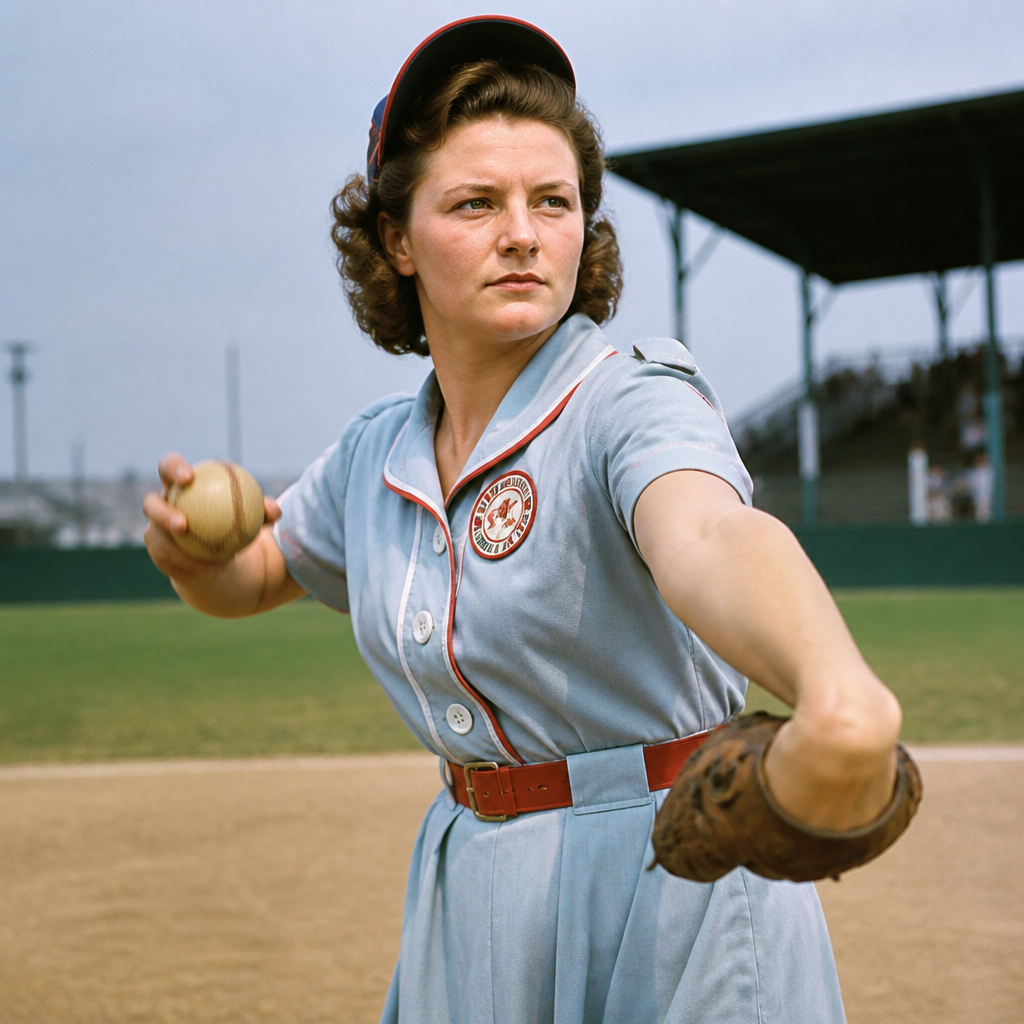
Jean Faut stands among the most important pioneers in women’s baseball, not only because she dominated in the pitching circle, but because her career revealed how skill could challenge entrenched prejudice. In the history of women in baseball, her name belongs beside the sport’s most accomplished competitors, yet she is still less widely recognized than many male players with smaller achievements. That gap matters. When people study women’s baseball, they are not simply recovering overlooked statistics; they are tracing how female athletes built legitimacy in a game long framed as a male preserve.
Pitching against prejudice describes two contests at once. The first was literal: Jean Faut was an elite right-handed pitcher in the All-American Girls Professional Baseball League, the wartime and postwar league that operated from 1943 to 1954. The second was cultural: every appearance on the mound pushed back against assumptions that women lacked the strength, control, endurance, or competitive instinct for high-level baseball. Faut’s career makes that struggle visible because her excellence was measurable. She did not merely participate. She led, won, adapted, and set standards.
Any serious look at Jean Faut’s impact on women’s baseball has to begin with definitions. Women’s baseball is baseball played by women under baseball rules, distinct from softball even when the two sports overlapped in public imagination or league marketing. The AAGPBL itself evolved from a hybrid format toward a game closer to regulation baseball, and that evolution is central to understanding Faut. She succeeded during a period when the league changed pitching distances, ball size, and style of play, demanding technical flexibility from every player. In my experience studying women’s baseball archives, that adaptability is one of the clearest markers of true greatness, and Faut had it in abundance.
This topic also matters because Jean Faut’s story acts as a hub for larger questions in the miscellaneous branch of women in baseball: how leagues were marketed, how media coverage shaped memory, how wartime labor shifts opened doors, how skill was evaluated differently for women, and how later generations inherited both opportunities and erasures. Her life and career connect on-field performance with institutional history. If you want to understand not only one star pitcher but also the broader mechanics of women’s baseball recognition, Jean Faut is an ideal focal point.
Jean Faut’s rise from talented athlete to league-defining pitcher
Jean Faut was born in 1925 in East Greenville, Pennsylvania, and developed her athletic reputation before joining professional ball. Like many women of her era, she came up through local competition rather than a robust national development pipeline. There were no widespread girls’ baseball academies, no major collegiate baseball programs for women, and no established professional ladder comparable to men’s baseball. That context is crucial. Talent had to be noticed in fragmented settings, and female athletes were often expected to prove themselves repeatedly in environments that treated them as novelties.
Faut entered the AAGPBL in 1946 and played primarily for the South Bend Blue Sox. From the beginning, she was known for pitching quality that separated her from ordinary league contributors. She combined command, poise, and movement rather than relying on one overwhelming trait. Contemporary accounts and league records show a pitcher who could suppress offense consistently, not just survive on a roster built for publicity. In practical baseball terms, that means she turned opportunities into outs with repeatability, the defining test of any ace.
Her rise was not automatic. The league was demanding physically and socially. Players traveled, performed under strict conduct rules, attended charm school sessions, and carried the burden of representing women’s sports respectability while also competing to win. I have always found that tension instructive: male players were generally allowed to be athletes first, personalities second, while women in baseball were asked to embody a marketable version of femininity at all times. Faut excelled within that system without letting it define the whole meaning of her career.
The South Bend Blue Sox became one of the league’s strongest clubs, and Faut was central to that status. A great pitcher stabilizes everything around her. She reduces pressure on hitters, shortens defensive exposure, and gives managers tactical freedom. That effect was evident with South Bend, particularly as Faut matured into a staff anchor. Her value was not abstract inspiration alone. It was innings, wins, earned run averages, and pennant races.
How Jean Faut’s performance changed the argument about women’s baseball
Statistics matter because prejudice often hides behind claims that women’s sports are appreciated in theory but inferior in execution. Faut’s numbers left little room for condescension. She was a multiple-time league leader and one of the AAGPBL’s most decorated pitchers. In 1951, she posted one of the finest pitching seasons in league history, winning 27 games and recording an earned run average around 0.98. A sub-1.00 ERA over a full season is not a novelty statistic. It reflects sustained dominance, regardless of era.
She also threw perfect games and no-hitters, achievements that carry symbolic power because they are universally understood signs of pitching mastery. A perfect game means no opposing batter reaches base at all, requiring command, defense, and emotional control across every inning. When a woman accomplishes that in a professional baseball setting, it directly counters simplistic assumptions about women’s competitive ceiling. Faut did that more than once in effect, because even where the exact feat differed, the message remained: elite execution was present in women’s baseball, and it was undeniable.
Her 1953 season further cemented her legacy. She won the league’s Player of the Year honor, a distinction equivalent in impact to a most valuable player recognition. That award matters because it placed a pitcher at the center of league excellence during a period when women’s baseball still fought for seriousness in the public mind. She was not treated merely as the best “female” pitcher under a reduced standard. She was recognized as the standout player in the professional environment she inhabited.
| Season or Achievement | Why It Mattered | Impact on Perception |
|---|---|---|
| 1946 debut with South Bend | Established her as a serious professional prospect | Showed women could transition from local talent to pro success |
| 1951 dominant season | 27 wins and roughly 0.98 ERA demonstrated sustained excellence | Refuted claims that women’s baseball lacked elite pitching |
| No-hitters and perfect-game level performances | Placed her in baseball’s rarest achievement category | Created memorable proof of technical mastery |
| 1953 Player of the Year | Recognized overall value, not just novelty appeal | Validated women’s baseball as a serious competitive league |
When I assess historical impact, I look for moments where performance changes public language. Faut supplied exactly that. Writers, teammates, and opponents had to describe her in baseball terms first: control, velocity for the era, stamina, pressure pitching, big-game reliability. That shift is significant. Once athletes are discussed through the vocabulary of the sport rather than the vocabulary of exception, prejudice loses ground.
The AAGPBL’s contradictions and the burden women players carried
The All-American Girls Professional Baseball League opened doors, but it did so through contradictions. The league promoted legitimate competition while packaging players through uniforms, beauty expectations, and behavioral rules designed to reassure skeptical audiences. Skirts were mandatory. Makeup and grooming were monitored. Publicity often emphasized charm alongside athletic ability. Anyone researching women in baseball miscues the story if they ignore that structure. Players were not entering a neutral marketplace; they were navigating a system built to make athletic ambition culturally acceptable.
Jean Faut’s impact is sharper when viewed against that backdrop. She had to be excellent enough to transcend the marketing frame without ever fully escaping it. That is a harder task than many sports histories admit. Even outstanding women athletes were often covered as curiosities, patriotic symbols, or entertainment products before they were treated as professionals. Faut’s sustained dominance made those frames less persuasive. Audiences could still arrive because of novelty, but they stayed because the baseball was good.
The wartime origins of the league also shaped these expectations. During World War II, women entered jobs and public roles previously denied to them, yet many of those opportunities were treated as temporary. Sports followed the same pattern. Women could fill the baseball stage while men were away, but many observers assumed the experiment would end once traditional arrangements resumed. Faut’s postwar success challenged that temporary logic. Her career argued that women’s baseball was not an emergency substitute. It was worthy in its own right.
There were practical burdens as well. Salaries were modest, travel was demanding, and long-term career security was limited. Players needed resilience beyond athletic performance. In archival interviews across the league, former players repeatedly describe bruises from sliding in skirts, pressure to smile through discomfort, and constant proving of legitimacy. Faut’s excellence under those constraints broadens her significance. She was not pitching in a fully supported modern system. She was excelling in a league that expected performance and presentation simultaneously.
What made Jean Faut technically exceptional on the field
Great pitchers separate themselves through command, sequencing, emotional steadiness, and adaptability, and Faut checked each category. The AAGPBL changed rules over time, moving from underhand to sidearm and eventually overhand pitching, while also adjusting ball characteristics and dimensions. Many players were disrupted by those changes. Faut adapted and remained elite. That alone tells experienced baseball observers a great deal. Rule shifts expose mechanical weaknesses quickly. Her ability to thrive through them indicates deep athletic intelligence.
Reports from the period consistently praise her control. Control is not simply throwing strikes. It is placing pitches where hitters cannot drive them, getting ahead in counts, and limiting free baserunners. In leagues with uneven defensive support, command becomes even more important because extra outs are precious. Faut’s low run-prevention numbers suggest she understood pitch economy and contact management long before those phrases became common in analytics.
She was also known for composure. Pressure innings reveal whether a pitcher can execute when fielders tighten up, crowds react, and one mistake changes a game. Pennant races and playoff contexts magnify that test. Teammates trusted Faut because she gave clubs a stable competitive identity. That quality is harder to quantify than ERA, but it is visible in how championship teams are remembered. They usually have one player who makes everyone calmer. For South Bend, that was often Jean Faut.
Another point often missed in general summaries is endurance. Midcentury women’s professional pitchers frequently handled large workloads, just as male pitchers of the era did. Recovery resources were limited compared with modern sports science. No individualized biomechanical labs, no high-speed motion capture, no expansive strength staffs. Durability came from mechanics, conditioning, and grit. Faut’s sustained productivity across seasons shows that her dominance was not based on a brief peak alone. It was built on repeatable craft.
Legacy, memory, and why Jean Faut still matters today
Jean Faut’s impact on women’s baseball extends beyond trophies because legacy is shaped by what later generations are allowed to remember. For years, women’s baseball history was scattered across local museums, family scrapbooks, newspaper morgues, and oral histories rather than integrated into the mainstream story of the sport. Even after the 1992 film A League of Their Own revived interest in the AAGPBL, many individual stars remained underrecognized. Faut was admired by historians, but public awareness still lagged behind her accomplishments.
That underrecognition is exactly why her story belongs at the center of a women in baseball hub page. She connects miscellaneous themes that readers often search separately: pioneering pitchers, gender barriers in professional sports, AAGPBL history, women’s baseball statistics, media representation, and Hall of Fame level legacies. She is a bridge figure. Through Faut, readers can move from one athlete’s record to the broader architecture of exclusion and persistence that shaped women’s baseball in North America.
Her legacy also matters for current debates about pathways for girls in baseball. Today, more girls play baseball rather than being redirected automatically into softball, and organizations such as Baseball for All, USA Baseball’s women’s initiatives, and the Women’s Baseball World Cup structure have expanded visibility. Yet the old prejudice has not disappeared. Girls are still told baseball is not for them, still steered away from advanced competition, and still measured against lower expectations. Faut’s career remains a direct answer to those assumptions: women have already demonstrated professional-level baseball excellence when given the chance.
The most useful way to honor Jean Faut is not through nostalgia alone. It is through accurate, repeated inclusion in baseball history, coaching education, youth development conversations, and women’s sports coverage. Learn her record. Cite her achievements. Share her story alongside the game’s better-known legends. When more readers understand what Jean Faut accomplished, women’s baseball stops looking like a side note and starts looking like what it has always been: a real, competitive, historically significant part of the sport. Explore the related women in baseball stories connected to this hub, and use Faut’s example as the standard for how overlooked greatness should be remembered.
Frequently Asked Questions
Who was Jean Faut, and why is she so important to the history of women’s baseball?
Jean Faut was one of the most accomplished pitchers in the All-American Girls Professional Baseball League, and her legacy matters because she combined elite performance with lasting historical significance. She was not simply a good player in a novelty era. She was a dominant competitor whose success forced audiences, sportswriters, and baseball institutions to confront assumptions about who could excel on a baseball field. At a time when women athletes were often treated as temporary entertainment rather than serious professionals, Faut demonstrated command, consistency, and intelligence at the highest level available to women in the sport.
Her importance also comes from what her career represents. Women’s baseball has often been pushed to the margins of sports history, which means great players like Faut have not always received the same recognition automatically granted to male athletes. Studying her career helps correct that imbalance. It reminds readers that the history of baseball is larger and richer than the traditional men-only version many people grew up hearing. Jean Faut matters because she was excellent, because she helped legitimize women’s professional baseball through performance, and because her story exposes how much talent has been overlooked when prejudice shapes public memory.
How did Jean Faut’s pitching ability challenge prejudice about women in baseball?
Jean Faut challenged prejudice in the most direct way possible: she excelled in a role that demanded precision, toughness, strategy, and control. Pitching is one of the most mentally and physically demanding positions in baseball. A successful pitcher must read hitters, change speeds, locate pitches, manage pressure, and dictate the pace of the game. Faut did all of that at an elite level. Her success directly contradicted long-standing stereotypes that women lacked the athletic ability, competitive focus, or baseball intelligence to thrive in serious professional play.
What made her impact especially powerful is that she did not just participate; she dominated. Dominance changes the conversation. It is one thing for skeptics to dismiss women’s baseball when they imagine it as symbolic inclusion or light entertainment. It is much harder to sustain those dismissive attitudes when a pitcher repeatedly wins, controls games, and earns the respect of teammates and opponents. Faut’s performances showed that prejudice was not rooted in reality, but in cultural assumptions. Her career became evidence that ability does not depend on gender, and that women athletes deserved to be evaluated by the quality of their play rather than by outdated expectations.
What were Jean Faut’s greatest achievements on the field?
Jean Faut built a remarkable record as one of the standout pitchers in the All-American Girls Professional Baseball League. She was known for her effectiveness, poise, and sustained excellence, qualities that separated her from many of her peers and made her one of the defining stars of the league. Among her most celebrated achievements were her league-leading performances, outstanding earned run averages, and her reputation as a pitcher capable of taking control of critical games. She developed into the kind of player whose presence alone could change expectations before a game even began.
Beyond statistics, her achievements included something even more meaningful in historical terms: she established a standard of greatness in women’s professional baseball that still deserves wider recognition. When people revisit the era, Faut’s name repeatedly emerges among the best because she was not just successful for a brief moment. She was consistently elite. That consistency is one of the clearest markers of true athletic greatness. Her accomplishments deserve to be discussed not as a footnote to baseball history, but as part of the sport’s broader tradition of dominant pitching and competitive excellence.
Why is Jean Faut less well known than many male baseball players with smaller accomplishments?
Jean Faut is less well known largely because sports history has not been recorded, promoted, or celebrated equally. For generations, the achievements of male athletes were preserved through constant media attention, institutional support, Hall of Fame culture, and repeated retelling across newspapers, television, documentaries, and classrooms. Women’s baseball, by contrast, was often treated as secondary, temporary, or culturally unusual, even when the level of play was impressive. As a result, extraordinary careers like Faut’s did not receive the same long-term visibility, no matter how strong the actual accomplishments were.
This recognition gap reveals how prejudice can continue long after a player’s career ends. It is not only about what happened on the field during her era; it is also about whose stories were considered worth remembering. Many male players with modest records remained more familiar to the public simply because the structure of sports memory worked in their favor. Jean Faut’s relative obscurity is therefore not a reflection of limited talent or impact. It is evidence of how women’s contributions have too often been minimized. Bringing attention to her career helps challenge that pattern and gives readers a fuller, more accurate understanding of baseball history.
What can modern readers learn from Jean Faut’s legacy today?
Modern readers can learn that talent alone does not guarantee recognition; social attitudes often shape who gets celebrated and who gets forgotten. Jean Faut’s legacy shows that excellence can exist in places history has neglected, and that revisiting overlooked athletes is essential if we want a truthful account of sports. Her career encourages readers to think critically about how prejudice operates not only through open exclusion, but also through silence, omission, and unequal remembrance. In that sense, her story is about much more than one pitcher. It is about how societies decide whose achievements matter.
Her legacy also offers a positive lesson about perseverance and proof. Faut answered doubt with performance. She showed that women in baseball did not need symbolic approval to belong; they belonged because they could play, compete, and excel. For today’s audiences, that remains deeply relevant. Whether the conversation is about gender equity in sports, historical recognition, or access to opportunity, Jean Faut stands as a compelling example of what happens when ability confronts bias head-on. Remembering her is not just an act of tribute. It is a way of sharpening our understanding of fairness, excellence, and the true scope of baseball history.