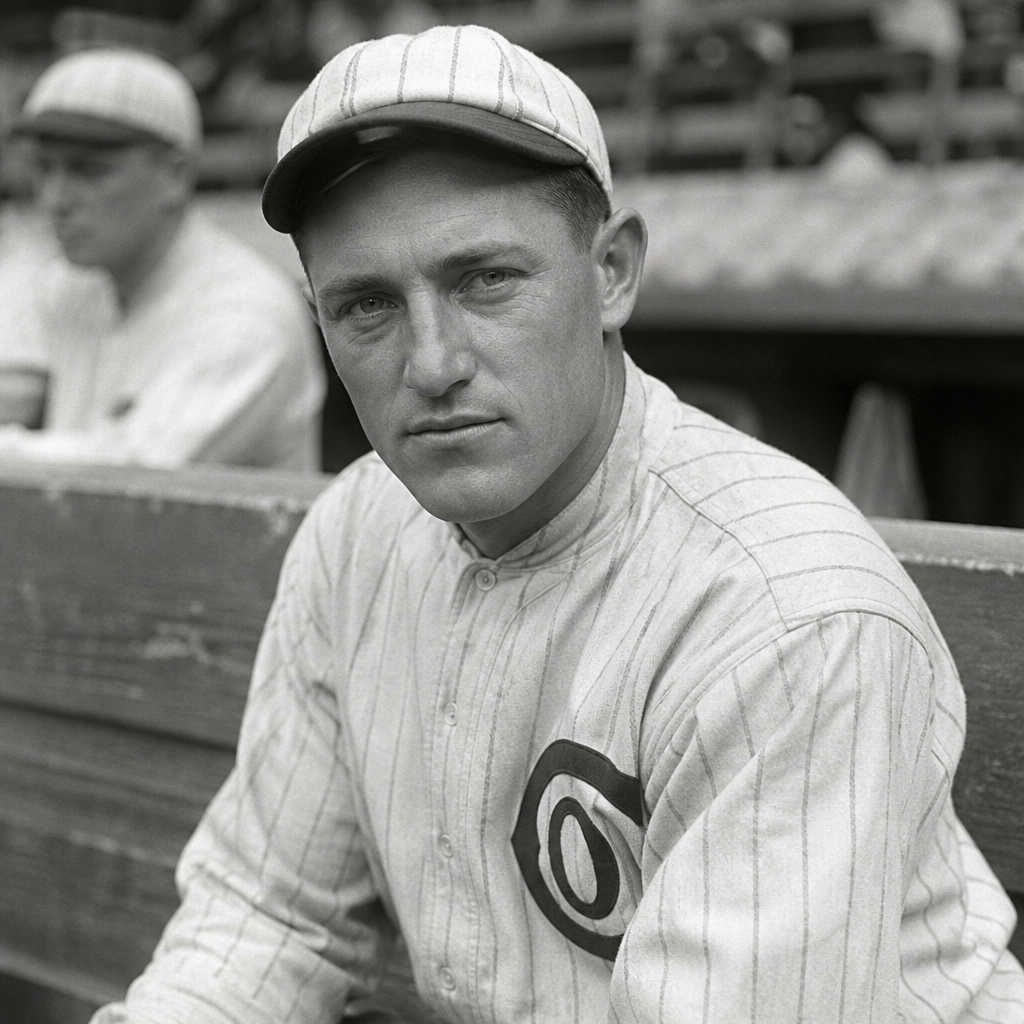
Johnny Evers stands at the crossroads of baseball memory and baseball method, remembered both as the middle name in the game’s most famous double-play phrase and as one of the sharpest strategic infield minds of the dead-ball era. For readers exploring player profiles within any serious Legendary Players collection, Evers is an essential hub subject because his career connects performance, tactics, leadership, controversy, and the evolution of middle-infield play. He was not the most physically gifted star of his generation, nor the most graceful, nor the easiest personality, yet he shaped winning baseball through anticipation, preparation, and relentless competitive intelligence.
Born in Troy, New York, in 1881, John Joseph Evers built a Hall of Fame career mainly with the Chicago Cubs and later with the Boston Braves. He played second base in an age when run scoring was scarce, gloves were primitive, fields were rough, and one tactical edge could decide a pennant. The dead-ball era, roughly the period before 1920, rewarded bunting, base running, hit-and-run timing, defensive positioning, and command of rules that modern fans often overlook. Evers excelled in all of those areas. When people ask who Johnny Evers was, the direct answer is simple: he was a championship second baseman, 1914 National League Most Valuable Player, and one of baseball’s earliest true student-strategists.
His profile matters because it helps explain how baseball greatness is not always loud. Evers hit only twelve career home runs, but that statistic obscures his value. In my experience studying early twentieth-century player records, Evers consistently appears where winning details live: on-base percentage, sacrifice execution, double-play coordination, pitch selection awareness, and pressure management in pennant races. He helped the Cubs win four National League pennants from 1906 through 1910 and a World Series in 1908. He later captained and inspired the “Miracle Braves,” whose stunning 1914 turnaround ended with a World Series sweep of the heavily favored Philadelphia Athletics.
The phrase “Tinker to Evers to Chance” made him immortal in popular culture, but it also flattened him into a literary symbol. This article restores the fuller picture. As a player profile hub, it defines his role, places his achievements in context, and points readers toward the broader themes that matter when evaluating legendary players: defensive value, baseball IQ, leadership style, postseason influence, and legacy beyond box-score glamour. To understand Johnny Evers is to understand a foundational truth about baseball history: strategy, not just talent, wins championships.
Early life, rise to the majors, and the making of a baseball thinker
Evers grew up in a large working-class family and left school early, as many future ballplayers of his generation did. His path to the majors was not polished. He played semi-professional ball, learned quickly, and developed the traits that would define him: urgency, argumentativeness, preparation, and an almost compulsive attention to detail. The Chicago Cubs purchased him in 1902 after he drew notice in upstate New York. His early major league seasons were rough offensively, but the Cubs saw beyond batting average. They valued his range around second, his quick release on pivots, and his intense understanding of game situations.
That rise matters in any player profile because it shows Evers was made, not mythologized from the start. He did not arrive as a polished star. He learned by surviving. Infield play then was physically punishing. Base runners came hard, fields produced bad hops, and double-play feeds demanded courage. Evers compensated for average size with anticipation. He read swings, tracked hitters’ tendencies, and moved before contact more often than many contemporaries. Today, coaches would call that pre-pitch processing and situational positioning. Evers practiced it long before those terms became standard.
He also developed a reputation for knowing the rulebook better than opponents and sometimes better than umpires. The best-known example came in the 1908 Merkle game, when Fred Merkle failed to touch second base after what appeared to be the game-winning hit for the New York Giants. Evers secured the force-out appeal that nullified the run. Historians still debate certain details of the sequence, but the larger point is undisputed: Evers remained alert to a rule most players ignored in a chaotic moment. That awareness changed a pennant race and ultimately the season.
The Cubs dynasty years and the real meaning of “Tinker to Evers to Chance”
From 1906 through 1910, the Cubs were baseball’s standard for disciplined, winning play. Joe Tinker at shortstop, Johnny Evers at second base, and Frank Chance at first base formed the double-play trio memorialized in Franklin P. Adams’s 1910 poem, “Baseball’s Sad Lexicon.” The poem framed them as heartbreak for New York Giants fans, but it also captured a technical truth: Chicago’s infield conversion of ground balls into outs was elite for the time. Their coordination mattered because dead-ball baseball generated constant bunts, steals, and contact. Every extra out prevented was magnified.
Evers’s place in that trio was central. The second baseman often acts as the pivot point of infield defense, and Evers turned that responsibility into an art. He communicated positioning, anticipated steal attempts, and handled feeds under pressure. He was especially effective at reading whether to force the lead runner or secure the sure out. Those decisions do not always survive in basic historical statistics, but contemporary newspaper accounts repeatedly praised his judgment. That consistency across sources is one reason serious baseball historians rate him more highly than casual summaries do.
He was also a productive offensive player within his era’s demands. Evers posted a career .356 on-base percentage, outstanding for a middle infielder in low-scoring conditions. He regularly drew walks, fouled off difficult pitches, moved runners, and made pitchers labor. In modern terms, he created value by extending plate appearances and avoiding empty outs. His best offensive season by OPS+ came in 1913, but his broader offensive contribution was steadiness rather than explosion. On teams built around run manufacture, steadiness was a weapon.
| Career marker | Johnny Evers | Why it matters |
|---|---|---|
| MLB debut | 1902, Chicago Cubs | Entered the majors during the dead-ball era and adapted to its tactical demands |
| Primary position | Second base | Key defensive hub for pivots, relays, cutoffs, and infield alignment |
| World Series titles | 1908, 1914 | Won championships with two different clubs in two distinct roles |
| League MVP | 1914 National League | Recognized for leadership and all-around value during the Miracle Braves season |
| Career on-base percentage | .356 | Shows offensive value beyond power totals |
| Hall of Fame induction | 1946 | Long-term recognition of strategic and competitive importance |
Playing style, baseball intelligence, and why statistics alone miss his value
If you judge Evers only by traditional counting numbers, you will miss the player almost entirely. He collected 1,659 hits, scored 919 runs, stole 324 bases, and batted .270, respectable but not overwhelming totals. The better evaluation starts with context. League offense was low. Equipment was limited. Players traveled hard. Managers prioritized one-run tactics. Under those conditions, a second baseman who reached base, advanced runners, defended expertly, and processed situations faster than everyone else could change seasons without producing modern superstar lines.
Evers was famous for getting angry, but the more useful reading is that he played with constant mental engagement. Teammates and opponents alike described him as combative, suspicious, and exacting. Those traits could create friction, and they sometimes did, especially with Tinker. Yet they also fed his strategic edge. He tracked signs, pitcher habits, batter tendencies, and baserunner risks inning by inning. Many early stars relied on instinct. Evers paired instinct with study. That combination is why he later fit naturally into leadership roles.
Defensively, his strengths included positioning, sure hands on routine chances, and the nerve required to complete pivots with runners bearing down. He was not the flashiest athlete, but he was precise. Offensively, he understood zone pressure before that language existed. He worked counts, accepted walks, and rarely gifted away at-bats. Baseball Reference credits him with strong value relative to his era, and modern analysts continue to note that his on-base skill and defensive reputation compare favorably with many more celebrated infielders. The lesson for player-profile readers is clear: historical greatness often hides in context-adjusted value, not headline totals.
The Miracle Braves, MVP season, and transition from star player to strategist
After leaving the Cubs, Evers joined the Boston Braves and authored the most dramatic late-career chapter any profile of him must center. The 1914 Braves were in last place on July 4, then surged past every National League rival to win the pennant before sweeping Connie Mack’s Philadelphia Athletics in the World Series. Evers, then an older veteran with a battered body but a sharp mind, became the emotional and tactical backbone of that club. He hit .279, reached base consistently, guided infield play, and gave Boston competitive conviction.
He won the Chalmers Award, the period equivalent of league MVP, because observers saw his total influence. This was not an award based on one flashy category. It reflected leadership, timing, defense, and the ability to stabilize a team under pressure. In practical terms, Evers helped transform a roster from uncertain to exact. He demanded crisp execution, understood when to press for one run, and brought postseason-tested calm into a clubhouse that needed it. The Braves’ upset of the Athletics remains one of baseball’s classic examples of belief sharpened by detail.
That season also clarified Evers’s identity beyond the famous poem. He was no longer just the second baseman in a legendary combination. He was the strategic veteran who could transfer winning habits from one franchise to another. Later he served as player-manager and then manager, including time with the Cubs. His managing record was mixed, which is common for brilliant players whose standards are difficult to translate across entire rosters. Still, his post-playing path confirms what his playing career already showed: he thought the game at a managerial level while still on the field.
Legacy, Hall of Fame case, and how this hub connects broader player-profile themes
Evers entered the Hall of Fame in 1946 through the Veterans Committee, a fitting route for a player whose value required informed historical judgment. His case rests on several pillars: central role on a dynasty, elite baseball intelligence, 1914 MVP honors, championship impact with two clubs, and enduring influence on how second base could be played as a command position rather than a merely reactive one. Critics sometimes argue that his induction leans too heavily on the poem. That view is incomplete. The poem preserved his name; his career sustained it.
For a sub-pillar hub on player profiles, Evers also serves as a model for evaluating legendary players across eras. First, context is everything. A dead-ball infielder should not be judged by modern power standards. Second, defense and decision-making matter even when historical measurement is imperfect. Third, leadership can be observed through team transformation, not just captain titles. Fourth, narrative and performance often interact. Evers’s fame began with poetry, but the reason baseball kept returning to him was that his teams kept winning meaningful games when details mattered most.
Readers using this page as a hub should connect Evers to adjacent profile questions that define the broader Legendary Players topic: How do we compare strategic stars with toolsy stars? How should postseason leadership affect historical rank? Which middle infielders changed defensive expectations? What separates famous players from truly influential ones? Johnny Evers helps answer all of those questions. Study his career and you see that baseball history is not only built by sluggers and icons of raw talent. It is built by tacticians who understand leverage, anticipate chaos, and turn knowledge into outs and victories.
Johnny Evers endures because he represents a complete baseball truth: intelligence is a skill, and in the right player it becomes a competitive weapon as real as speed or strength. His story begins with the Cubs dynasty, expands through the Merkle game and the Miracle Braves, and ends with Hall of Fame recognition that rewarded substance over spectacle. Across every phase, he showed how second base could anchor a defense, how patient at-bats could pressure opponents, and how preparation could tilt pennant races. That is why he belongs near the center of any serious discussion of legendary player profiles.
The clearest takeaway is that Evers should be remembered not only as a famous name in a famous line, but as a baseball strategist who won by seeing the field a half-step earlier than everyone else. He understood rules, tendencies, positioning, tempo, and pressure. He converted those insights into championships with Chicago and Boston. For modern readers, that makes his career especially valuable: it teaches how to evaluate players whose impact lives between the obvious statistics. If you are building out your understanding of baseball’s all-time greats, use Johnny Evers as a starting point, then follow the trail into other player profiles shaped by defense, judgment, and winning detail.
Frequently Asked Questions
Why is Johnny Evers still such an important figure in baseball history?
Johnny Evers remains important because he represents far more than a famous name in an old poem. While many casual fans first encounter him through the phrase “Tinker-to-Evers-to-Chance,” his historical significance runs much deeper. Evers was one of the defining second basemen of the dead-ball era, a player whose value came from intelligence, positioning, timing, anticipation, and relentless attention to detail. In an era when games were often decided by a single run, a stolen base, a bunt, or a defensive mistake, Evers understood how to control the hidden margins that shaped outcomes.
He also occupies a central place in the story of how baseball strategy matured. Evers studied hitters, tracked tendencies, and treated infield play as a mental craft as much as a physical one. That made him a bridge between early baseball’s rougher, instinctive style and a more advanced, systematically managed version of the game. He was not the biggest slugger or the most graceful athletic marvel, but he became essential because he thought the game at a high level and executed with unusual precision.
His legacy is also strengthened by his role on the great Chicago Cubs clubs of the early 1900s, teams that helped define National League baseball before World War I. He was a World Series champion, a league MVP, and later a manager, which means his career touches several major themes at once: elite team success, individual excellence, tactical innovation, and leadership. For anyone studying legendary players, Evers matters because he shows that baseball greatness is not limited to power hitting or overwhelming physical gifts. It can also come from preparation, nerve, and strategic command.
What made Johnny Evers such a smart and effective baseball strategist?
Evers earned his reputation as a strategist because he seemed to process the game one step ahead of many opponents. He was known for studying situations closely, understanding baserunner behavior, and recognizing what hitters and managers were trying to do before the play fully developed. In the dead-ball era, when offenses relied heavily on bunting, hit-and-run plays, steals, and advancing runners with precision, that kind of anticipation was a massive advantage. Evers thrived in exactly that environment.
Defensively, he was especially valued for his positioning and his awareness of force-play scenarios, cutoff decisions, and double-play mechanics. He did not simply react to the ball; he prepared for likely outcomes. That is a hallmark of advanced baseball intelligence. Teammates and observers often saw him as an extension of the manager on the field because he grasped not just his own assignment, but the full logic of the inning. He could read leverage, know when to rush a play, and understand when a conservative choice was actually the winning one.
Offensively, his strategic value showed up in subtler forms. He worked counts, got on base, pressured defenses, and appreciated the tactical importance of each plate appearance. He was not a dominant power threat, but his approach fit winning baseball in his era. He also carried a reputation for fiery competitiveness, which sometimes made him controversial, but that same edge fed his concentration and seriousness. In modern language, Evers would likely be praised for baseball IQ, situational awareness, and run-prevention instincts. He was effective because he treated the sport like a problem to be solved pitch by pitch and inning by inning.
Was Johnny Evers’ fame mainly due to “Tinker-to-Evers-to-Chance,” or did his performance truly match his reputation?
The poem gave Johnny Evers lasting fame, but his performance absolutely supports his place in baseball history. “Baseball’s Sad Lexicon” immortalized the Cubs’ double-play trio of Joe Tinker, Johnny Evers, and Frank Chance, turning them into a cultural symbol of infield excellence and frustration for opposing teams. That literary fame helped preserve Evers in public memory, but it did not create his entire legacy out of thin air. He was an outstanding player by the standards of his time and a legitimate star in his own right.
Evers won the National League Most Valuable Player Award in 1914, a major marker of how highly he was regarded during his playing days. He was respected for his on-base skills, fielding, leadership, and tactical sharpness, and he played a major role on championship-caliber clubs. His game was never about flashy home run totals or overwhelming physical dominance, so to modern fans glancing only at basic statistics, his value can be easy to underestimate. But dead-ball era baseball rewarded different strengths, and Evers embodied many of the most important ones.
It is also worth noting that being remembered through a famous phrase can sometimes flatten a player’s identity. In Evers’ case, that phrase tends to make him seem like a supporting figure in a trio rather than a baseball thinker with a distinct style and influence. A closer look shows that he was central to the Cubs’ infield coherence and to the strategic character of the teams he played on. So while the poem amplified his fame, it did not manufacture his stature. His reputation was rooted in real performance, real winning, and a very real impact on how the game was played.
How did Johnny Evers influence the way second basemen and middle infielders were viewed?
Johnny Evers helped elevate the idea that a second baseman could be a tactical nerve center rather than merely a competent fielder standing between first and short. In his era, the middle infield was already important, but Evers gave the position a sharper intellectual identity. He showed that second base required anticipation, communication, coordination on double plays, and mastery of game situation. That made the role feel more active in shaping outcomes, especially on strong defensive teams.
His example reinforced the importance of timing and footwork in turning double plays, but it also highlighted the mental side of infield defense. Middle infielders had to know hitters, read bunts, cover intelligently, and make fast calculations about runners and force situations. Evers made those responsibilities visible because he played with such intensity and because he was known for caring deeply about the details. He was the kind of player who made observers think more seriously about infield craft.
In a broader historical sense, Evers belongs to the lineage of players who proved that baseball intelligence could define a position. Later generations would celebrate middle infielders for smoothness, athleticism, range, and offensive production, but Evers stands as one of the early figures who emphasized command of game flow. That is one reason he remains relevant in discussions of baseball evolution. He helped establish the standard that a great middle infielder should not only field his position well, but also function as a strategist, communicator, and organizer within the defensive system.
What should modern readers understand about Johnny Evers beyond the highlights and legends?
Modern readers should understand that Johnny Evers was a complicated, highly competitive figure whose significance lies in both his achievements and his mindset. He was not a universally beloved personality, and that is part of what makes him interesting. Evers could be combative, stubborn, and intense, qualities that sometimes created tension but also fueled his effectiveness. He played in an era when baseball was rough-edged, emotionally charged, and deeply shaped by internal rivalries, and he fit that world perfectly.
They should also understand that evaluating Evers requires some historical adjustment. If someone looks only for modern-style star indicators such as home run totals or highlight-reel physical dominance, they may miss why he mattered. His greatness was grounded in dead-ball era priorities: run manufacture, defensive execution, game management, and tactical leverage. He excelled in the dimensions of the sport that often disappear in quick statistical summaries. That makes him especially valuable for readers who want to understand not just who was famous, but how baseball itself functioned in earlier eras.
Finally, Evers deserves to be seen as more than a nostalgic symbol. He was an influential baseball mind whose career connects several major themes: the rise of strategic infield play, the cultural mythology of early baseball, the powerhouses of the Chicago Cubs, and the idea that leadership on the field can come from intellect and intensity as much as from size or raw talent. That combination is what keeps him relevant. Johnny Evers endures not only because people remember his name, but because the game still recognizes the kind of player he was: alert, exacting, difficult, and remarkably smart.