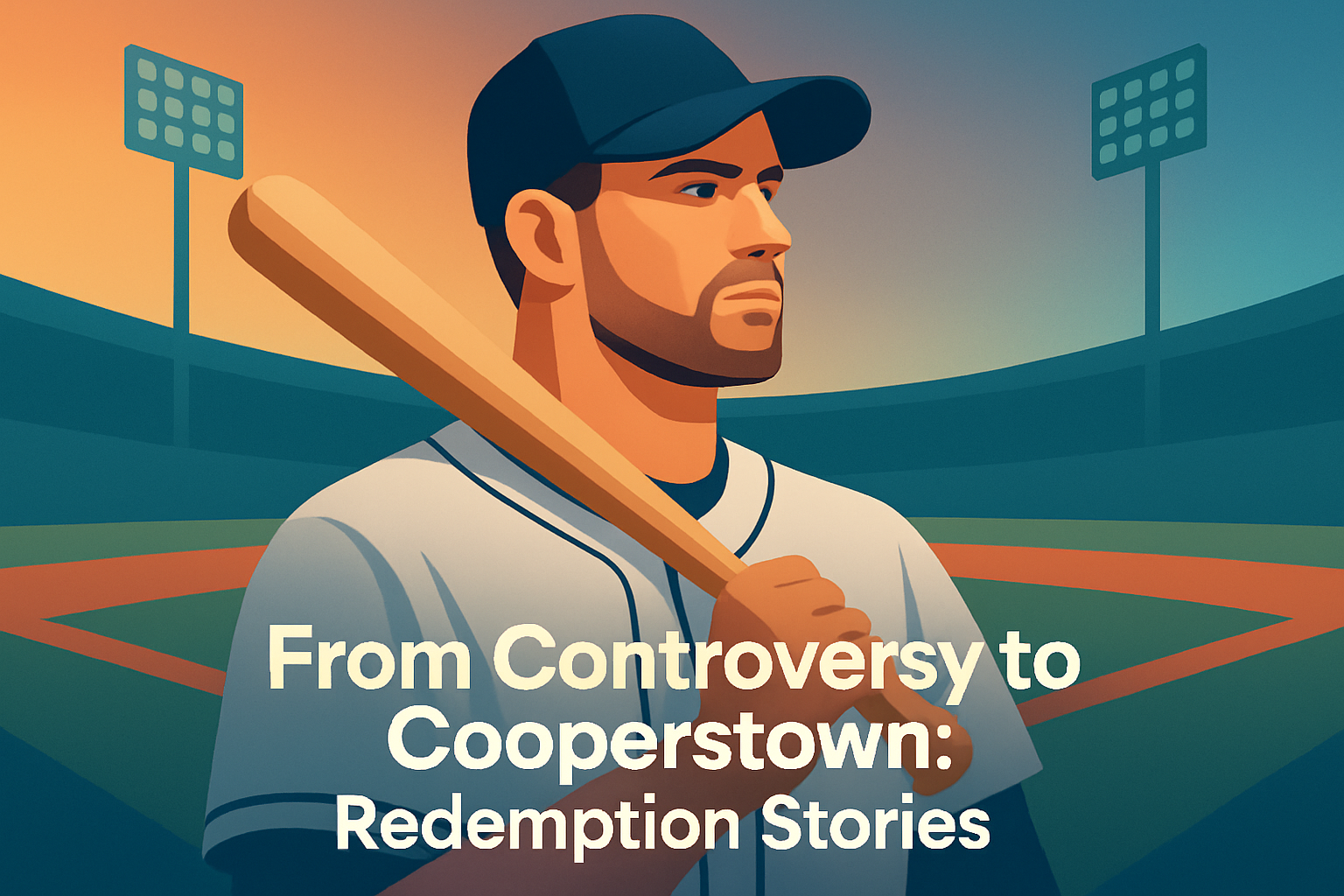
Baseball has always loved a comeback, but its most compelling returns are not measured only by batting average, earned run average, or October heroics. “From Controversy to Cooperstown: Redemption Stories” explores how players, managers, and executives moved from scandal, public disgrace, or bitter rejection toward eventual enshrinement in the National Baseball Hall of Fame. In this context, controversy can mean gambling suspicions, clubhouse conflict, labor warfare, performance doubts, media hostility, or personal conduct that reshaped reputations. Cooperstown, meanwhile, represents more than a plaque in upstate New York. It is baseball’s most visible symbol of historical forgiveness, institutional memory, and public reevaluation. These stories matter because the Hall of Fame does not simply reward numbers; it reflects what the sport chooses to remember, excuse, debate, and celebrate across generations.
Redemption in baseball rarely arrives quickly. It usually requires sustained excellence, changing cultural standards, and advocates willing to argue that one chapter should not erase an entire career. Voters on the Baseball Writers’ Association of America ballot, veterans committees, and era committees have repeatedly revisited players once considered too divisive, too flawed, or too unpopular for baseball’s highest honor. The result is a Hall of Fame populated by figures whose roads were neither clean nor direct. Understanding those paths reveals how legacy actually works in sports: performance opens the door, but time, perspective, and storytelling often turn the handle.
Some redemption stories involve clear misconduct followed by rehabilitation. Others involve reputational damage that later looks exaggerated, politically motivated, or rooted in misunderstanding. A manager vilified for clashing with owners may later be praised as a strategist. A slugger dismissed as selfish can be reassessed as fiercely competitive. An executive blamed for controversy may be remembered for modernizing the game. In every case, Cooperstown serves as the final site of negotiation between achievement and error. Looking closely at several major examples shows how baseball converts conflict into legacy and why redemption remains one of the sport’s most enduring themes.
Babe Ruth, alcoholism rumors, and the making of a national icon
Babe Ruth is remembered now as baseball’s first true superstar, yet his journey to unquestioned reverence was not free from controversy. During the 1920s, Ruth’s late nights, public drinking, reckless spending, and repeated battles with curfews fueled criticism from owners, writers, and league officials. He was suspended for barnstorming after the 1921 season, then publicly scolded for behavior thought unbecoming of baseball’s biggest draw. His personal life generated headlines almost as often as his home runs. At a time when baseball was still repairing its image after the 1919 Black Sox scandal, Ruth’s excesses made establishment figures uneasy.
What transformed concern into redemption was scale. Ruth’s on-field dominance became so overwhelming that he effectively rehabilitated not only his own image, but the public appeal of baseball itself. In 1927 he hit 60 home runs, a number then almost beyond comprehension, and the Yankees became the defining team of the era. Fans saw not a menace to the game but its great attraction. By the time the Hall of Fame opened in 1936, Ruth was one of the first five inductees, joining Ty Cobb, Honus Wagner, Christy Mathewson, and Walter Johnson. His plaque reflected a consensus that brilliance and cultural impact had eclipsed earlier doubts, establishing a pattern the Hall would repeat with other complicated legends.
Leo Durocher and the long reappraisal of a baseball villain
Few Hall of Famers were more controversial in their prime than Leo Durocher. As manager of the Brooklyn Dodgers, New York Giants, Chicago Cubs, and Houston Astros, Durocher cultivated confrontation. His famous line, “Nice guys finish last,” captured his image as baseball’s unapologetic antagonist. In 1947 Commissioner Albert “Happy” Chandler suspended him for the full season over associations with gamblers and other conduct deemed detrimental to baseball. At the time, the punishment looked like a career-defining stain. Durocher was depicted as everything baseball’s guardians wanted to discourage: combative, cynical, and too comfortable in gray areas.
Yet Durocher’s baseball intelligence never disappeared beneath the scandal. He won 2,008 games, captured three National League pennants, and guided the 1954 Giants to a World Series title over Cleveland’s 111-win juggernaut. More important, historians later reconsidered the totality of his influence. He pushed aggressive baserunning, matchup awareness, and psychological gamesmanship that prefigured modern managing. He also supported Jackie Robinson more strongly than some contemporaries, even if his own record remained complicated. When the Veterans Committee elected him in 1994, the vote signaled that baseball was willing to separate disapproved behavior from enduring competitive significance. Durocher did not become lovable; he became undeniable.
Gaylord Perry, the spitball mystique, and acceptance through candor
Gaylord Perry built a Hall of Fame case while everyone wondered whether he was cheating. Across 22 seasons, he won 314 games, took two Cy Young Awards, and mastered the art of suspicion. Hitters, managers, and umpires believed he doctored baseballs with grease, petroleum jelly, or spit, though he was officially ejected for doctoring a ball only once, in 1982. Perry leaned into the reputation with a grin, publishing the memoir “Me and the Spitter” in 1974 and turning allegation into theater. In another era, that image might have permanently disqualified him from formal honor.
Instead, baseball gradually treated Perry as a folk hero of gamesmanship. Part of that shift came from context. Pitchers across eras had bent rules, and many voters saw Perry’s mystique as an exaggerated performance rather than a singular offense. Another factor was durability. He won 20 games in both leagues, succeeded into his forties, and adapted through changing run environments. His election in 1991 showed how transparency can soften scandal. Perry never fully confessed to everything people suspected, but he acknowledged enough to recast himself as a crafty practitioner rather than a corrosive cheat. Cooperstown accepted the wink, the workload, and the wins.
Tony La Russa and the move from personal disgrace to tactical authority
Tony La Russa’s redemption story is different because it centers on personal conduct rather than competitive illegitimacy. Already one of baseball’s most respected managers, La Russa damaged his reputation with a 2007 arrest for driving under the influence in Jupiter, Florida. For a figure known for meticulous preparation and moral seriousness, the incident created sharp public disappointment. The episode became a test of whether leadership credibility, once compromised, could be restored in a sport where managers are expected to embody discipline as much as strategy.
La Russa responded not through a publicity tour, but through continued excellence and visible accountability. He remained deeply involved in animal welfare and charitable work, continued refining bullpen specialization and lineup flexibility, and in 2011 managed the St. Louis Cardinals to an improbable World Series title before retiring. By then, his career totals—2,728 wins, three championships, and pennants with Oakland and St. Louis—made him one of the most influential modern managers. His 2014 Hall of Fame election by the Expansion Era Committee suggested that baseball weighed the DUI seriously without allowing it to become his sole defining fact.
| Figure | Primary controversy | Redemptive factor | Hall of Fame result |
|---|---|---|---|
| Babe Ruth | Public drinking, suspensions, off-field excess | Transformative popularity and historic performance | Elected in 1936 inaugural class |
| Leo Durocher | 1947 suspension, gambling associations, hostile persona | Strategic influence and 2,008 managerial wins | Elected in 1994 by Veterans Committee |
| Gaylord Perry | Persistent spitball and doctoring accusations | 314 wins and candid self-mythologizing | Elected in 1991 by BBWAA |
| Tony La Russa | 2007 DUI arrest | Sustained leadership, charity, and three titles | Elected in 2014 by Expansion Era Committee |
Marvin Miller and the redemption of a man owners despised
No Cooperstown redemption story better shows the power of historical revision than Marvin Miller’s. As executive director of the Major League Baseball Players Association from 1966 to 1982, Miller was hated by many owners and treated warily by parts of the press. He led players toward collective bargaining power, salary arbitration, and eventually the dismantling of the reserve clause. To club executives, he was a labor radical who threatened baseball’s traditional order. For decades, that hostility kept him out of the Hall of Fame despite the obvious fact that few nonplayers shaped the modern sport more profoundly.
Miller’s exclusion became increasingly embarrassing as baseball’s economic realities made his impact impossible to ignore. Free agency changed franchise strategy, player compensation, and competitive planning. Stars such as Catfish Hunter, Reggie Jackson, and Nolan Ryan benefited directly from mechanisms Miller helped establish. Historians and former players argued that if commissioners, owners, and innovators belonged in Cooperstown, the architect of players’ rights had to be included as well. After several near misses, Miller was finally elected in 2019 by the Today’s Game Era Committee. His posthumous induction was redemption not for misconduct, but for institutional opposition. Baseball eventually admitted that one of its central reformers had long been punished for winning.
Orlando Cepeda and the possibility of personal rebuilding
Orlando Cepeda’s route to Cooperstown was shaped by legal trouble and public contrition. A seven-time All-Star and the 1967 National League Most Valuable Player, Cepeda looked like a likely Hall of Famer based on his bat alone. He finished with 379 home runs, a .297 average, and sustained middle-of-the-order production for the Giants, Cardinals, Braves, Athletics, Royals, and Red Sox. But his candidacy stalled after a 1975 arrest in Puerto Rico for attempting to import marijuana. The conviction hurt his image badly and threatened to overshadow his playing accomplishments.
Cepeda spent the following years rebuilding trust in a visible, sustained way. He spoke openly about the mistake, worked in community outreach, and eventually served as an ambassador for the San Francisco Giants. Voters, initially unconvinced, warmed gradually to both his credentials and his evident remorse. When the Veterans Committee elected him in 1999, the decision reflected more than nostalgia for a dangerous hitter. It recognized a man who had done the slower work of accountability after public failure. Cepeda’s case remains instructive because it shows that redemption in baseball can involve genuine personal reconstruction, not merely statistical overshadowing.
What these Hall of Fame paths reveal about baseball memory
These stories expose a truth fans often resist: Hall of Fame judgment is never purely objective. Voters consider statistics, but they also absorb cultural mood, moral fashion, media framing, and the passage of time. That is why some controversial figures eventually gain entry while others remain excluded. Pete Rose, banned for betting on baseball, remains outside despite 4,256 hits because gambling strikes at the sport’s core legitimacy. Barry Bonds and Roger Clemens, linked to performance-enhancing drugs, have not been elected by the writers despite historic numbers because many voters see steroid use as fundamentally altering competitive integrity. By contrast, figures such as Perry or Durocher benefited from offenses perceived as less corrosive, more era-specific, or more survivable through context.
Baseball memory is therefore selective but not random. Redemption becomes possible when achievement is extraordinary, the controversy appears containable, and later generations find a broader story worth telling. Ruth became the face of the game. Miller became the architect of its modern labor structure. Cepeda became evidence that error need not foreclose dignity. Cooperstown does not erase controversy; it domesticates it, placing conflict inside a narrative that ends with contribution rather than collapse. For fans, that is part of the Hall’s enduring hold. It offers not innocence, which baseball rarely possesses, but perspective.
From Ruth to Miller, the road from controversy to Cooperstown shows that baseball’s highest honor often follows argument rather than unanimity. These inductees were not redeemed because people forgot what happened. They were redeemed because time allowed the sport to weigh failure against influence, misconduct against mastery, and scandal against the larger arc of a career. The lesson is not that every wrong should be forgiven. It is that legacy is constructed through evidence, context, and sustained reevaluation.
For players, executives, and fans alike, these stories underscore a practical benefit: reputations are not fixed at the moment of disgrace. Accountability, continued excellence, and historical perspective can change how a career is remembered. Cooperstown remains baseball’s final courtroom, but also its most powerful site of reconsideration. If you want to understand the sport fully, study not only its clean legends, but also the figures who fought their way back into the story.
Frequently Asked Questions
1. What does “From Controversy to Cooperstown: Redemption Stories” really mean in baseball history?
At its core, “From Controversy to Cooperstown: Redemption Stories” is about how baseball figures went through some kind of public fall, serious criticism, or long period of rejection and still found a path to the National Baseball Hall of Fame. The phrase connects two very different worlds. On one side, there is controversy: gambling suspicions, ugly fights with teammates or ownership, labor disputes, accusations about attitude or character, media backlash, postseason failures, or the belief that a person simply was not good enough for baseball immortality. On the other side, there is Cooperstown, which stands as the sport’s highest symbolic honor.
What makes these stories so compelling is that they are rarely simple. Redemption in baseball is almost never a straight line. A player might begin as a superstar, fall into disgrace, spend years being criticized, and then slowly win back respect through performance, honesty, maturity, leadership, or historical re-evaluation. In other cases, a manager or executive may be blamed for conflict, pushed out, or treated as a villain in his own era, only to be recognized later for transforming the game in lasting ways.
These stories also remind us that Hall of Fame recognition is not just about numbers, even though baseball loves numbers. Batting average, home runs, wins, and championships matter, but they do not tell the whole story. Voters, historians, and fans also care about narrative. They think about how a person was viewed at the time, what damage was done to a reputation, whether that reputation was fair, and how the person responded afterward. Did they rebuild trust? Did they grow? Did history soften earlier judgments? Did later generations view the controversy differently?
In this way, redemption can mean several things at once. It can mean restoring a damaged public image. It can mean proving that a career was greater than critics allowed. It can mean surviving a scandal that once seemed disqualifying. It can mean being vindicated after years of rejection by writers or veterans committees. It can even mean that baseball itself changed enough to finally appreciate a person’s contribution.
The “controversy” part is especially important because baseball has always had a complicated relationship with morality and mythmaking. The sport loves heroes, but it also loves cautionary tales. That is why redemption stories hold such power. They sit in the middle of those two instincts. A fallen figure who rises again gives fans a story that feels human. People fail, get misunderstood, make mistakes, clash with institutions, or live through ugly public moments. Baseball history is full of those cases. When one of those figures eventually reaches Cooperstown, the plaque becomes more than a career summary. It becomes a statement that the full life in baseball was larger, more meaningful, and more enduring than the controversy that once threatened to define it.
That is really the heart of the topic. It is not just about scandal followed by praise. It is about how memory works in baseball. It is about whether greatness can outlast disgrace. It is about whether public judgment can change. And it is about why the road to the Hall of Fame is often just as fascinating as the plaque itself.
2. What kinds of controversy usually show up in these baseball redemption stories?
The word “controversy” can cover a wide range of situations, and that range is what makes this topic so rich. In baseball, controversy does not always mean a criminal act or a massive scandal, though sometimes it does. Often, it means a cloud that hung over someone’s career for years and shaped how fans, writers, and decision-makers judged them. Some controversies were rooted in actual wrongdoing. Others grew from personality conflicts, reputation wars, media narratives, or resistance to change.
One common category is gambling suspicion or direct connection to the issue of betting, which baseball has treated as one of its deepest moral fault lines since the Black Sox era. Even when facts are debated, any link to gambling has historically carried enormous weight because the sport sees the integrity of the game as sacred. A person tied to that kind of suspicion could spend decades fighting a damaged reputation.
Another major category is clubhouse conflict. Baseball teams spend months together under pressure, so tension is unavoidable. Some stars were labeled selfish, divisive, difficult, or impossible to manage. Some managers were seen as tyrants. Some executives made enemies everywhere they went. At the time, those labels could become powerful enough to overshadow performance. Years later, though, historians might ask whether those figures were truly destructive, simply intense, or perhaps ahead of their time in a sport that often prefers conformity.
Labor warfare is another big one, especially for executives, owners, and union-connected figures. Baseball’s labor history is full of battles over salary, free agency, player rights, collusion, and power. The people involved were often painted as heroes by one side and villains by the other. An executive who was hated in one era might later be praised for helping modernize the business of the game. A player leader once criticized as disruptive might later be seen as courageous for challenging an unfair system.
Performance doubts also belong in this conversation. Not every redemption story begins with misconduct. Sometimes the controversy is about whether someone deserved respect at all. Certain Hall of Famers spent years hearing that they were overrated, soft in big moments, stat-padders, one-dimensional, or not championship-caliber. For them, redemption meant changing the narrative through sustained excellence, a signature postseason run, or a later analytical understanding of their true value.
Media backlash can be just as powerful as any formal accusation. Baseball’s public memory has long been shaped by newspaper columns, radio, television, and now digital commentary. A player who angered reporters, challenged convention, appeared aloof, or refused to fit an expected personality mold could be framed negatively for years. Sometimes race, class, region, or language also influenced those judgments, even when people at the time did not admit it openly. In those cases, redemption may involve correcting a distorted public record as much as forgiving a personal failing.
There is also the controversy of exclusion itself. Some figures were not disgraced because of scandal, but because they were repeatedly rejected by Hall of Fame voters. That rejection can become its own kind of public controversy. Fans ask why someone with historic numbers is not in. Teammates defend them. Analysts revisit their value. A long wait for induction can turn into a redemption story once the person is finally honored, because the election becomes an acknowledgment that baseball got it wrong for a very long time.
So when people talk about “controversy” in this context, they are talking about a broad field of conflict, stigma, doubt, and damaged reputation. The important point is that these controversies were serious enough to threaten a legacy. A redemption story begins when that legacy is in danger and becomes powerful when the person eventually rises above the version of themselves that the baseball world once tried to freeze in place.
3. How do players, managers, and executives actually earn redemption on the way to the Hall of Fame?
Redemption in baseball is usually built over time, and it almost never comes from one moment alone. Even though fans love dramatic turning points, the truth is that Hall of Fame redemption is typically a long process made up of performance, endurance, changed perception, and historical reconsideration. For players, the most obvious path is continuing to perform at a high level after a major controversy or setback. A star who was written off can force the baseball world to look again by putting together elite seasons, reaching milestones, or delivering unforgettable moments in the postseason. Success does not erase the past, but it can change which part of a career feels most important.
For some players, redemption comes through consistency rather than spectacle. They keep showing up, keep producing, and over the years the narrative begins to lose its grip. Critics who once focused on a scandal or character issue eventually have to confront the total body of work. Numbers accumulate. Awards pile up. Respect grows among peers. The person who once seemed easy to dismiss starts to look impossible to ignore.
Maturity also matters. Some redemption stories involve genuine personal growth. A player may handle the media better, become a mentor to younger teammates, accept responsibility for past mistakes, or simply carry themselves differently as they age. Baseball people notice those things. So do fans. A damaged image can slowly improve when someone shows humility, resilience, and a willingness to evolve. In many cases, redemption is not about pretending the controversy never happened. It is about demonstrating that the controversy does not tell the whole story anymore.
Managers often earn redemption by winning, but not only by winning. A manager who was once called too harsh, too emotional, too old-school, or too combative can reshape that image if players later credit him with building culture, demanding accountability, or holding a team together through adversity. Sometimes a manager’s methods look better in hindsight than they did in the heat of daily criticism. Time has a way of changing how leadership is judged.
Executives and baseball officials follow a different path. Their redemption is often tied to results that only become clear years later. A front-office leader may have made deeply unpopular choices, fought bitter labor battles, relocated resources, rebuilt organizations, or introduced ideas that offended traditionalists. If those decisions later prove transformative, the historical verdict can shift dramatically. An executive once seen as ruthless may later be understood as visionary. An innovator may look far better once the rest of baseball catches up.
Another major part of redemption is the role of changing standards. Hall of Fame voters and committees are not static. The values of one generation are not exactly the values of another. Writers who personally remembered a controversy may vote differently from later voters who are more detached and more focused on long-term impact. Analysts may introduce new ways to measure value. Historians may uncover context that was ignored in the original judgment. As a result, redemption is sometimes less about a person changing and more about baseball changing around them.
There is also the matter of storytelling. Hall of Fame cases are built through biography as much as statistics. A person’s supporters may reframe the career: not as a scandal interrupted by achievement, but as a great baseball life complicated by one painful chapter. That does not mean whitewashing the past. It means placing events in proportion. If the baseball world comes to believe that the contribution, influence, and excellence far outweighed the controversy, redemption becomes possible.
In the end, earning redemption on the way to Cooperstown usually requires a combination of staying power and perspective. The person has to leave behind enough greatness that baseball cannot tell its own history honestly without including them. Once that happens, the Hall of Fame conversation changes. Instead of asking, “Can we get past the controversy?” people begin asking, “Can we really leave out someone this important?” That is often the moment when redemption becomes real.
4. Why are these redemption stories so meaningful to fans and to baseball as a whole?
These stories matter because they reveal something deeply true about both baseball and human nature. Baseball is a sport obsessed with memory. It keeps records more carefully than almost any other game, and it treats history as part of the daily experience. Every season is measured against past seasons. Every great player is compared with earlier great players. Because of that, the sport constantly asks how people should be remembered. Redemption stories matter because they challenge simple answers.
Fans connect to these stories because they are about more than baseball talent. They are about failure, judgment, resilience, and second chances. Most people will never hit a major league home run or manage a pennant winner, but almost everyone understands what it feels like to be misunderstood, publicly criticized, doubted, or defined by a bad chapter. When a baseball figure overcomes that kind of stain and is eventually honored, the story feels personal in a way that statistics alone cannot.
These stories also add emotional depth to the Hall of Fame itself. If Cooperstown only celebrated clean, uncomplicated legends, it would feel less like history and more like mythology. Real baseball history is messy. Greatness often comes wrapped in ego, conflict, stubbornness, ambition, insecurity, and imperfect choices. Redemption stories remind us that the Hall of Fame is not just a museum of ideal behavior. It is a record of impact, significance, and the complicated people who shaped the sport.
For baseball, these stories are especially important because the game has always wrestled with the relationship between moral judgment and competitive greatness. Fans argue constantly about where the line should be. How much should character matter? Can a person’s contributions outweigh misconduct? Should the Hall represent the best players, the best stories, the best citizens, or some mix of all three? Redemption stories do not settle those debates, but they force them into the open. They make the baseball community think more carefully about fairness, forgiveness, accountability, and historical balance.
There is also something uniquely satisfying about delayed recognition. A player, manager, or executive who reaches Cooperstown after years of criticism often arrives with a richer story than someone who sailed in without serious opposition. The struggle itself becomes part of the legacy. Fans remember the boos, the headlines, the accusations, the rejection, and then the eventual celebration. That emotional arc is powerful. It gives the Hall of Fame induction greater dramatic weight because it feels earned on multiple levels, not just statistically but personally and historically.
Another reason these stories resonate is that they show how baseball evolves. What one era condemns, another may understand differently. That shift can reveal growth in the sport. Maybe baseball becomes more open to difficult personalities if they were also brilliant competitors. Maybe it becomes better at recognizing contributions from people once dismissed by bias, politics, or old assumptions. Maybe it learns to separate media narratives from actual value. In that sense, redemption stories are not only about individuals. They are also about baseball correcting itself.
Finally, these stories endure because they preserve tension. Even after induction, not everyone agrees. Some fans see redemption as justice. Others see it as forgiveness too freely given. That disagreement keeps the stories alive. It means the Hall of Fame plaque does not end the conversation; it deepens it. And in baseball, a sport that treasures debate almost as much as it treasures the game itself, that may be the clearest sign that a redemption story truly matters.
5. Does reaching Cooperstown erase the controversy, or does it just change how the story is told?
Reaching Cooperstown almost never erases the controversy. What it does is change the balance of the story. Hall of Fame induction does not rewrite history in the sense of pretending the bad chapter did not happen. Instead, it signals that the person’s full baseball legacy is too large, too influential, or too meaningful to be permanently reduced to that chapter alone. In other words, the controversy remains part of the story, but it no longer gets to be the entire story.
That distinction matters a lot. Erasure suggests forgetting, and baseball is not very good at forgetting. The sport holds on to everything: numbers, headlines, grudges, legends, and scandals. A controversial Hall of Famer carries that history into Cooperstown with them. Fans still debate the details. Writers still revisit the arguments. Historians still examine the damage done, the fairness of the criticism, and the process by which redemption became possible. The controversy lives on, but under a different frame.
Once someone is inducted, the dominant question shifts. Before induction, the debate is often whether the controversy should keep them out forever. After induction, the conversation becomes how to understand the whole life in baseball honestly. That usually leads to a more complete portrait. The person is no longer seen only as a scandal figure or only as a victim of unfair treatment. Instead, they become a more complicated historical figure, someone whose failures, conflicts, and achievements all have to be considered together.
In many cases, Cooperstown turns a controversy into context rather than conclusion. For example, a gambling suspicion, a labor feud, a clubhouse reputation, or a long period of rejection may still be discussed, but now it is weighed against championships, innovation, statistical greatness, leadership, influence on future generations, or a reshaped understanding of the era. The Hall of Fame does not necessarily forgive everything. It recognizes that history has judged the person significant enough that exclusion would distort the story of baseball more than inclusion would.
This is why redemption is not the same as absolution. A person can be redeemed in the baseball sense without being declared innocent of every criticism. Their legacy can be restored without becoming spotless. In fact, some of the strongest redemption stories are powerful precisely because the flaws remain visible. Fans can see both the damage and the greatness. That tension gives the story credibility.
It is also worth noting that induction can change emotional memory. A figure once remembered mainly for disgrace may gradually become remembered for endurance, late-career achievement, leadership, or historical importance. Over time, younger fans may first encounter the Hall of Fame honor and then learn about the controversy as one part of a much larger biography. That does not erase the past, but it does rearrange the order in which the past is understood.
So the best answer is this: Cooperstown does not wipe away controversy. It reframes it. It says that while the controversy mattered, it did not define the total meaning of that baseball life. The plaque is not a declaration that nothing went wrong. It is a declaration that, in the end, the story of the person’s impact on the game was bigger than the scandal, bigger than the rejection, and bigger than the moment when it seemed their legacy might never recover.