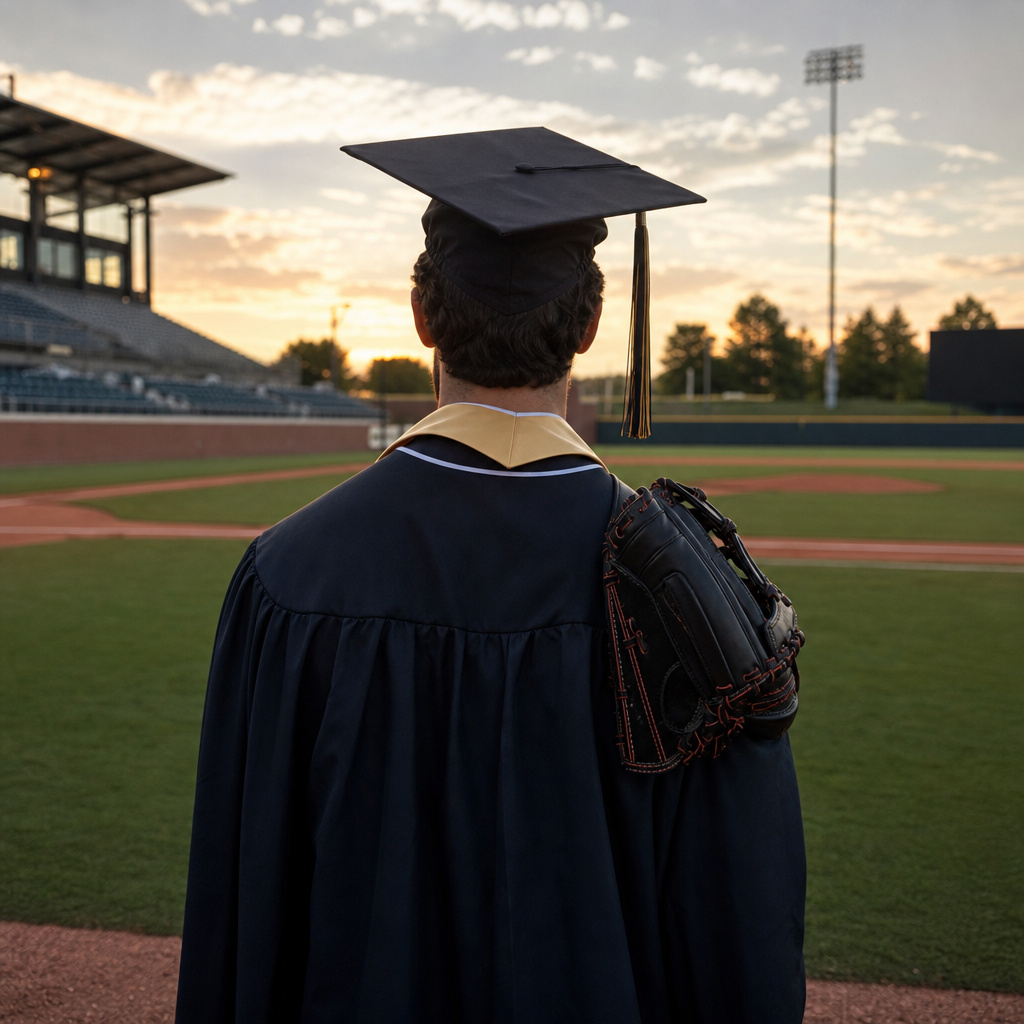
College baseball is often discussed as a pipeline to the draft, the minor leagues, or a long-shot major league debut, but its deeper value is what it teaches players when the game eventually ends. “Field of Degrees” captures that dual mission: athletes compete on the diamond while building academic credentials, habits, and relationships that shape careers far beyond sports. For families weighing college baseball against other development paths, this matters because the overwhelming majority of players will not make a living in professional baseball, while every player will need discipline, communication skills, and a plan for work after graduation.
College baseball refers to intercollegiate competition governed primarily by the NCAA, the NAIA, and the NJCAA. Within that landscape, players balance strength training, practice plans, travel, film study, class schedules, tutoring, and compliance requirements. The environment is demanding by design. A weekday can start with a 6 a.m. lift, continue through classes, and end after batting practice, treatment, and study hall. I have worked with players in exactly that rhythm, and the pattern is consistent: the ones who thrive learn quickly that baseball rewards talent, but college rewards systems.
That is why college baseball prepares players for life in ways that are practical, measurable, and immediate. It teaches time management under pressure, accountability to a group, resilience after failure, and the ability to accept coaching without losing confidence. It also exposes athletes to nutrition planning, sports medicine, data analysis, media training, networking, and leadership roles that mirror modern workplaces. A catcher calling pitches, a captain addressing a losing streak, or a sophomore managing labs during a road series is practicing forms of decision-making employers value. This hub article covers those miscellaneous but essential dimensions comprehensively, connecting college baseball to academics, personal development, career readiness, mental health, finances, and the realities of life after the final season.
Why the college baseball environment builds adult habits
The structure of college baseball forces players to organize their lives at a higher level than many peers. Team calendars are nonnegotiable, and consequences are immediate. Miss treatment, arrive late to class check-ins, or skip recovery work, and performance drops fast. Over time, athletes internalize routine. They learn to use shared calendars, travel itineraries, assignment trackers, and recovery protocols the same way a project manager uses deadlines and status reports. That translation from sport to work is not abstract; it is one of the clearest benefits of the college baseball experience.
Players also operate in a merit-based environment where roles are earned daily. A freshman with a strong work ethic can move up. A veteran can lose innings or at-bats if preparation slips. That constant feedback loop teaches professionals skills many people do not learn until much later: how to respond to evaluation, how to separate identity from results, and how to improve under public scrutiny. In offices, sales teams, classrooms, and technical fields, those same skills determine who adapts and who stalls.
Another overlooked advantage is exposure to diverse teammates and staff. College rosters often bring together athletes from different regions, income levels, school systems, and cultures. Clubhouse life requires cooperation across those differences. Players share buses, hotel rooms, study tables, and pressure situations. They learn how to communicate with personalities unlike their own, which is exactly what collaborative work demands. Baseball becomes the starting point, but emotional intelligence is the lasting return.
Academics, eligibility, and earning the degree that outlasts the season
The degree is not a backup plan; it is a core outcome. Eligibility rules make academics unavoidable, but the stronger programs go well beyond minimum standards. They provide advising, tutoring, monitored study hall, faculty coordination, and structured accountability. The NCAA’s academic framework, along with campus-based support services, pushes players to maintain progress toward graduation. That matters because many student-athletes arrive with heavy athletic identities and only a rough idea of what they want to study. College baseball gives them time and support to turn broad interests into usable qualifications.
In practice, major selection is usually a negotiation between passion, schedule, and workload. Engineering labs, nursing clinicals, business internships, and travel-heavy spring schedules do not always fit neatly together. Good advisers help players plan semesters strategically, use summer terms, and sequence harder requirements around the baseball calendar. I have seen athletes who entered school focused only on velocity or exit speed discover interests in finance, kinesiology, communications, education, and data science because the structure around them created room to explore seriously.
Academic growth in baseball is also highly transferable. Film review strengthens pattern recognition. Scouting reports encourage concise reading and applied analysis. Statistics discussions introduce probabilistic thinking. Writing assignments and presentations sharpen communication that later helps in interviews, graduate school, coaching, sales, or management. Even the discipline of attending class after a rough outing teaches professionalism. Employers do not need a player to have hit .330; they care that he can absorb feedback, finish a degree, and deliver consistently when tired.
Skills college baseball teaches that employers actually recognize
Recruiters and hiring managers regularly say they value candidates who can lead, collaborate, and handle pressure. College baseball produces exactly those capabilities when the experience is approached intentionally. A pitcher learns process orientation by focusing on command, sequencing, and recovery rather than obsessing over one bad inning. An infielder learns communication through defensive alignments and cutoff responsibilities. A hitter learns iterative improvement by adjusting mechanics, approach, and swing decisions with objective feedback. These are workplace skills in athletic language.
The most durable skills usually fall into a few categories: self-management, teamwork, communication, adaptability, and leadership. Self-management includes punctuality, preparation, sleep discipline, and handling competing deadlines. Teamwork includes understanding role clarity and contributing even when not in the spotlight. Communication includes listening to coaches, asking useful questions, and delivering direct feedback respectfully. Adaptability comes from changing roles, facing injuries, and adjusting to higher competition levels. Leadership develops when upperclassmen model standards or younger players influence energy through consistency.
| Baseball experience | Life skill developed | Workplace equivalent |
|---|---|---|
| Managing classes, lifts, practice, and travel | Time management | Handling deadlines across multiple projects |
| Reviewing video and scouting reports | Analytical thinking | Using data to improve decisions |
| Responding after errors or poor outings | Resilience | Recovering after setbacks or missed targets |
| Executing team systems and signs | Collaboration | Following processes within a larger organization |
| Mentoring younger teammates | Leadership | Training new staff and setting standards |
What makes these lessons credible is repetition. Players do not hear one motivational talk about accountability and suddenly become accountable. They practice it for years in visible, measurable settings. That repeated exposure is why former players often transition well into coaching, teaching, operations, finance, law enforcement, medical sales, and entrepreneurship. The game normalizes preparation and performance review, which most professions eventually require.
Failure, resilience, and mental performance beyond the scoreboard
Baseball is uniquely good at teaching resilience because failure is built into the sport. Even elite hitters make outs often, and pitchers with quality stuff still give up hard contact. In college, where competition deepens and scouting improves, players are forced to confront limitation honestly. The productive response is not denial; it is adjustment. Athletes learn to review what happened, separate controllable from uncontrollable factors, and return to work. That pattern is the foundation of resilience in adult life.
Mental performance is more than staying positive. It includes attentional control, emotional regulation, confidence based on preparation, and recovery after stress. Programs increasingly use sports psychologists, breathing protocols, journaling, and pre-pitch routines to help athletes perform consistently. Those tools are useful off the field as well. A player who learns to slow his breathing before a big at-bat can use the same method before a presentation, interview, exam, or difficult conversation. The context changes, but the mechanism is the same.
There are real limits here, and they should be acknowledged. College baseball can also intensify pressure, especially for players managing scholarship uncertainty, social comparison, injury, or the fear that their athletic identity is fading. Healthy programs address that openly. They create access to counseling, encourage honest conversations, and avoid equating personal worth with playing time. When support is present, baseball does not just test character; it helps build a healthier one.
Health, nutrition, injury recovery, and learning to care for the body
One of the most practical life lessons college baseball offers is health literacy. Players learn quickly that performance depends on sleep, hydration, body composition, mobility, and recovery habits. Strength coaches teach periodization, workload management, and movement quality. Athletic trainers explain soft-tissue care, return-to-play progressions, and the difference between soreness and injury risk. Nutrition staff or team dietitians help athletes understand protein intake, carbohydrate timing, supplementation, and how travel disrupts fueling. Many players graduate knowing more about sustainable health behavior than they realize.
Injury recovery is especially formative. A torn UCL, labrum issue, hamstring strain, or stress reaction can interrupt a season and force a player to rebuild patiently. Rehab teaches delayed gratification, compliance, and emotional discipline. It also teaches communication with medical professionals, which is an adult skill with lifelong value. Players must describe symptoms accurately, follow treatment plans, and trust evidence-based progression rather than ego. That experience often changes how they approach health long after baseball ends.
These lessons matter because former athletes do not automatically stay healthy once organized sport disappears. The best college programs help players understand maintenance, not just peak performance. Warm-ups, mobility circuits, workload tracking, and sleep routines can carry into adulthood and reduce the common post-sport drop-off in fitness. When baseball education includes body awareness, it gives players tools for decades, not just for a conference schedule.
Money, career planning, and the transition after baseball
Another miscellaneous area that deserves hub-level attention is financial and career preparation. Many players enter college with a narrow timeline in mind: play well, get drafted, keep moving. The reality is more complicated. Partial scholarships, housing costs, summer ball expenses, and uncertainty around professional opportunities make financial literacy essential. Players benefit from learning budgeting, debt management, tax basics, and the true economics of chasing a pro career. Honest conversations here prevent poor decisions driven by optimism alone.
Career planning should start early, not during senior spring. Internships, alumni networking, informational interviews, and campus career services all matter, but athletes often need help fitting them around the season. Strong programs encourage winter networking calls, summer internships after the season, and relationship-building with donors, former players, and local businesses. Those connections frequently lead to first jobs. I have watched players who were not stars build excellent careers because they treated every team function, class project, and alumni event as part of their professional preparation.
The transition out of baseball is easier when identity has expanded before eligibility ends. Players who see themselves only as athletes often struggle when routines disappear. Players who have also become students, mentors, interns, and emerging professionals tend to adapt faster. College baseball is valuable precisely because it can hold both truths at once: pursuit of performance and preparation for the next chapter. That dual development is the real competitive advantage.
Why this topic sits at the center of minor leagues and college baseball coverage
Within a broader minor leagues and college baseball content ecosystem, this subject functions as a hub because it connects recruiting, scholarships, player development, summer leagues, coaching, academics, and post-baseball careers. A family researching college baseball rarely has one question. They want to know whether a program develops players, supports degrees, handles injuries responsibly, prepares athletes for the transfer portal era, and leaves them better positioned for work if pro baseball does not materialize. This page ties those strands together.
It also clarifies an important distinction between development paths. The professional route can accelerate baseball-specific growth for the small percentage of players signed out of high school, but college baseball offers a broader developmental package: competition, education, physical maturation, social independence, and structured transition planning. For many players, that combination is the better long-term investment. Not because the game matters less, but because adulthood lasts longer than athletic prime.
The most accurate way to evaluate college baseball, then, is not only by wins, draft picks, or radar-gun readings. It is by whether players leave with stronger habits, clearer identities, meaningful relationships, and a degree that opens doors. That is the real field of degrees. If you are building a college list, advising a player, or planning content around minor leagues and college baseball, start with this lens and explore each connected topic with the same question: how does this path prepare the person, not just the player?
Frequently Asked Questions
How does college baseball prepare players for life after their playing careers end?
College baseball prepares players for life after the game by placing them in an environment where athletic commitment and personal development have to coexist every day. Players learn how to manage demanding schedules, balance priorities, communicate with authority figures, and stay accountable to a larger group. Those habits carry over directly into professional settings, where employers value people who can show up consistently, adapt under pressure, and work toward long-term goals even when results are not immediate. In that sense, the lessons of college baseball are not abstract. They are practiced repeatedly through workouts, travel, classes, study halls, film sessions, and competition.
Just as important, college baseball gives athletes time to build an academic foundation and explore interests that may become future careers. While only a small percentage of players will make a living in professional baseball, nearly every college player will eventually enter another field, whether that is business, education, healthcare, coaching, finance, sales, or entrepreneurship. The college experience helps bridge that transition by offering access to professors, advisors, alumni networks, internships, and teammates with different strengths and perspectives. The result is that players leave with more than memories and statistics. They leave with a degree, a professional network, and a set of habits that make them more prepared for life’s next chapter.
Why is earning a degree such an important part of the college baseball experience?
Earning a degree is important because it gives players something durable and transferable in a sport where long-term playing opportunities are limited. College baseball can absolutely open doors on the field, but the degree is what creates options off it. For most athletes, that credential becomes the foundation for future employment, graduate school, career advancement, and financial stability. It also signals to employers that the player completed a rigorous commitment while managing the demands of a competitive athletic career, which often reflects discipline, maturity, and resilience.
Beyond the credential itself, the degree process teaches players how to think critically, solve problems, and communicate effectively. Those skills matter in every profession. A student-athlete who learns how to write clearly, analyze information, collaborate on projects, and meet deadlines is gaining practical preparation for real-world responsibilities. Families often focus on athletic development when evaluating college options, but the academic side deserves equal attention because it shapes what happens when baseball is no longer the center of daily life. In that way, the “field of degrees” idea is not just symbolic. It reflects the reality that college baseball is at its best when it develops both the competitor and the future professional.
What life skills do college baseball players develop that employers and graduate programs value?
College baseball players develop a wide range of life skills that are highly relevant beyond sports. Time management is one of the biggest. Players learn to structure their days around classes, practices, lifting, travel, treatment, and study time, often with very little margin for procrastination. They also develop teamwork in a meaningful way, not just by participating in a group, but by understanding roles, supporting others, and contributing to a shared objective. That translates well into workplaces where collaboration, reliability, and self-awareness are essential.
Another major skill is resilience. Baseball is a game built around failure, adjustment, and response. Players learn how to handle setbacks, criticism, slumps, injuries, and uncertainty without losing focus. Employers and graduate programs consistently value applicants who can recover from adversity, accept coaching, and continue improving. College baseball also builds communication skills, leadership, and composure under pressure. Whether a player becomes a manager, teacher, recruiter, physical therapist, or business owner, the ability to stay prepared, respond to challenges, and work well with others is a significant advantage. These qualities are often developed in a deep and practical way through the daily demands of the college game.
How should families evaluate college baseball programs if they care about long-term success beyond the sport?
Families should look beyond wins, facilities, and professional draft history and ask how a program supports the whole student-athlete. A strong program should have a clear academic support system, realistic expectations around class attendance and major selection, and a culture that values graduation as much as player development. It is wise to ask about graduation rates, academic advising, tutoring resources, internship support, alumni involvement, and how coaches talk about life after baseball. The answers to those questions can reveal whether the program truly sees athletes as long-term people rather than short-term performers.
It is also important to consider fit. That includes the school’s academic offerings, campus environment, coaching philosophy, and the kinds of relationships players build within the program. Families should pay attention to whether current players seem supported, challenged, and respected. A program that helps players grow into responsible adults will usually emphasize accountability, communication, and character alongside competition. Choosing a college baseball path is not just about the next three or four seasons. It is about selecting an environment that can help a player mature, earn a degree, and leave with meaningful opportunities when the uniform comes off for the last time.
Is college baseball still worth it for players who do not expect to play professionally?
Yes, for many players college baseball is absolutely worth it even if professional baseball is unlikely. The value of the experience extends far beyond the possibility of a draft pick or minor league contract. Players gain structure, mentorship, lifelong friendships, and a chance to compete at a high level while pursuing an education. They also benefit from learning how to be part of something larger than themselves, how to lead and follow, and how to push through demanding situations with discipline and purpose. Those experiences often become defining parts of a person’s growth during late adolescence and early adulthood.
For players who understand that baseball may not last forever, college can be one of the best settings to maximize both passion and preparation. It allows them to keep playing a sport they love while also building the academic and professional groundwork for the rest of their lives. That balance is what makes the college route so meaningful for many families. The game provides the daily challenge, but the education, relationships, and personal development provide the lasting return. When viewed through that wider lens, college baseball is not just about extending a playing career. It is about using the sport as a platform to build a capable, confident, and well-rounded future.