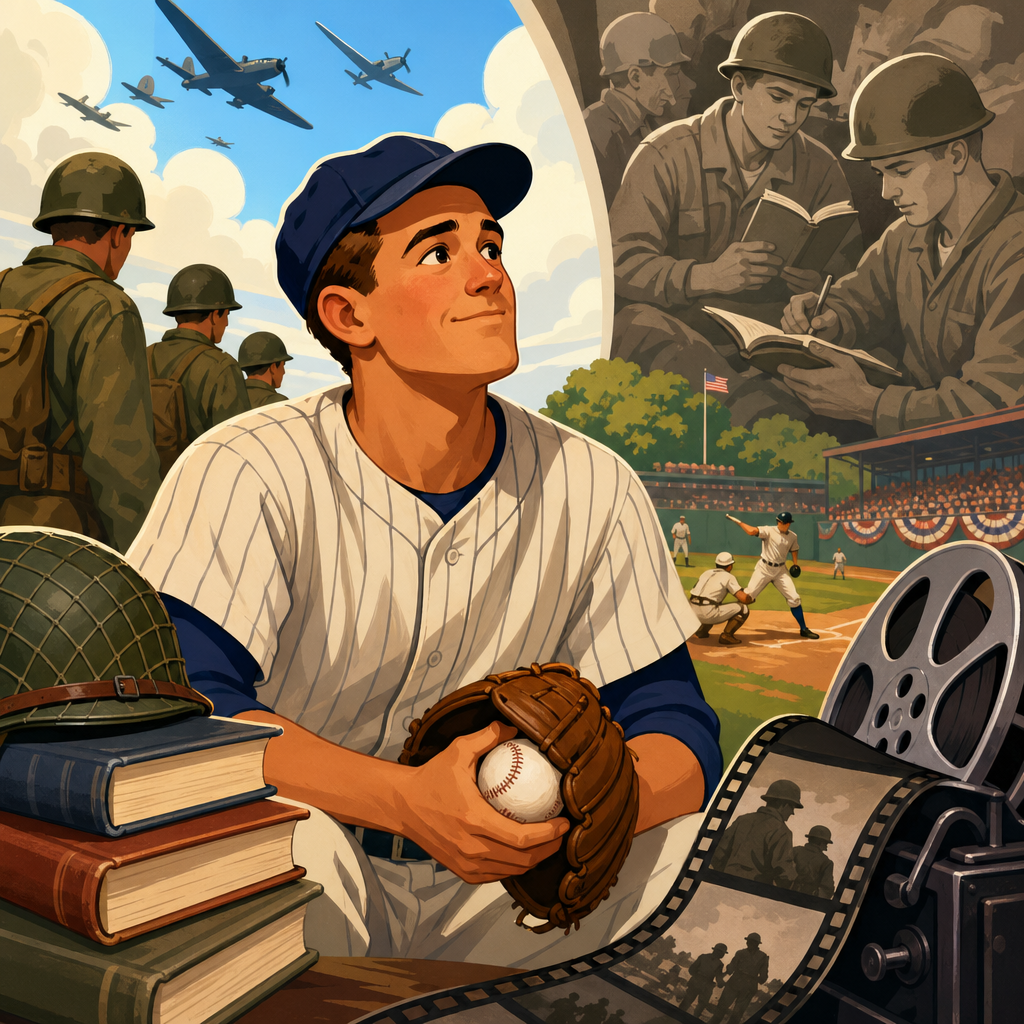
Baseball’s role in war-time literature and film reveals how a familiar game can carry a nation’s fears, ideals, and contradictions through periods of conflict. In American culture, baseball has long functioned as more than recreation: it is a narrative device, a civic ritual, a recruiting symbol, a morale tool, and sometimes a critique of nationalism itself. War-time literature and film use baseball to translate the scale of war into scenes audiences immediately understand. A catch in an empty lot, a radio broadcast from home, or a soldier quoting batting averages can stand in for memory, duty, innocence, and loss. That symbolic flexibility explains why baseball repeatedly appears in fiction, memoir, propaganda, documentary, and feature film whenever societies confront war.
In this context, war-time literature and film includes works produced during wars, works set during wartime, and later works reflecting on military conflict through baseball imagery. The term covers World War I, World War II, Korea, Vietnam, the Cold War, and post-9/11 narratives, along with home-front stories shaped by conscription, rationing, segregation, migration, and gender shifts. As an editor working on baseball and culture projects, I have found that wartime baseball narratives rarely focus only on the diamond. They examine who gets to play, who gets drafted, who is excluded, how media builds myth, and how public memory softens uncomfortable truths. Reading these works side by side shows baseball acting as shorthand for normalcy while also exposing tensions around race, class, patriotism, and sacrifice.
This hub article maps the miscellaneous terrain within baseball in war-time literature and film. Rather than isolating one novel or one movie, it connects recurring themes, notable titles, and useful directions for deeper reading across the subtopic. That matters because the best interpretation of baseball in wartime does not come from nostalgia alone. It comes from seeing how stories about ballplayers, soldiers, families, reporters, and fans construct meaning under pressure. For students, researchers, and general readers, the subject opens a practical way to study propaganda, collective memory, masculinity, women’s labor, integration, trauma, and national identity through one widely recognized sport.
Why baseball became a durable wartime symbol
Baseball became a durable wartime symbol because it was already embedded in everyday American life by the early twentieth century. Newspapers devoted regular space to box scores and pennant races; military camps organized games; and major league stars held unusual celebrity power. When war disrupted normal routines, writers and filmmakers used baseball as a ready-made language of continuity. A single image of boys playing ball beneath factory smokestacks or troops listening to a game on Armed Forces Radio could tell audiences that home still existed, even if only as an idea.
Governments, publishers, and studios also recognized baseball’s propaganda value. During World War II, President Franklin D. Roosevelt’s “Green Light Letter” encouraged professional baseball to continue, arguing that recreation benefited workers and soldiers. That policy did not make baseball apolitical. Instead, it tied the sport directly to wartime morale and production. Literature and film took that premise in multiple directions. Some works celebrate baseball as democratic fellowship. Others show the cost of turning a leisure activity into a patriotic instrument, especially when racial segregation and unequal service complicated claims of national unity.
The strongest wartime narratives succeed because baseball provides both intimacy and scale. It can be local, reduced to a glove and a father’s voice, yet national, connected to radio networks, military logistics, celebrity culture, and state messaging. That range lets creators move fluidly between battlefield absence and domestic longing.
Baseball on the home front in novels, memoirs, and stories
Home-front writing often uses baseball to dramatize disruption without abandoning ordinary detail. In these texts, lineups change because players enlist, neighborhood games shrink because older boys leave, and women or younger children take on roles once held by absent men. Such scenes are not incidental. They show how war enters civilian life through schedules, labor, language, and ritual. Baseball becomes the daily structure that war interrupts.
Memoirs from the World War II generation frequently recall baseball as the grammar of childhood before overseas realities became understandable. Readers see this pattern in recollections where collecting cards, hearing game reports, or imitating stars like Joe DiMaggio and Ted Williams forms a last stable memory before casualty lists and ration books redefine family life. In literary terms, baseball acts as a temporal marker: before the draft, before telegrams, before grief became routine. The emotional force comes from contrast. A sandlot game remains vivid because the world around it is becoming militarized.
Fiction set on the home front often pushes further by showing baseball as compensation. Characters keep scorecards, replay famous innings, or attend diminished local games because those acts preserve connection to absent relatives. In my experience reading these works, the best examples avoid sentimentality by embedding the sport in material conditions. Wartime rail limits affect travel. Industrial shifts alter neighborhood demographics. Black communities build parallel baseball cultures under segregation while also serving the country. Those details make the symbolism credible rather than decorative.
Baseball films and the wartime screen imagination
War-time and war-adjacent baseball films translate the sport into visual shorthand for courage, teamwork, and home. Hollywood understood that audiences recognized baseball gestures instantly. A uniform, a bat rack, or a seventh-inning crowd could evoke national belonging faster than exposition. During the 1940s, studios often paired sports plots with service themes, training camp settings, or patriotic dialogue. Even when baseball was not the central subject, it appeared as a marker of what soldiers believed they were defending.
Later films revisited wartime baseball with more nuance. A League of Their Own remains the essential example because it links the wartime labor shortage to the All-American Girls Professional Baseball League while showing how media, commerce, and gender expectations shaped public reception. The film is comedic on the surface, but its historical framework is serious: when male players entered military service, women’s professional baseball was expanded as both necessity and spectacle. The movie captures wartime contradictions well. Women are invited into public athletic space, yet marketed through charm school, uniforms, and strict behavior codes.
Other films use wartime references to deepen character rather than drive plot. A veteran recalling sandlot ball, a family preserving scorebooks during deployment, or a newsreel montage tying major league continuity to military resolve all rely on baseball as compressed historical meaning. The device works because viewers already understand the sport’s rhythms and social place.
Gender, labor, and the wartime reordering of baseball culture
Wartime literature and film are especially valuable when they show that baseball changed because society changed. With millions of men in uniform during World War II, labor shortages transformed factories, farms, offices, and sports. Women entered workplaces and public roles at unprecedented scale, and baseball culture responded. The All-American Girls Professional Baseball League, founded in 1943 by Philip K. Wrigley and Branch Rickey allies, was not a symbolic footnote. It was a business experiment shaped by wartime necessity, media opportunity, and long-standing women’s athletic talent.
Literary and cinematic treatments of this shift often examine the tension between athletic legitimacy and gender performance. Players were expected to hit, field, travel, and entertain while also conforming to standards of femininity imposed by league management and popular press. That tension makes wartime baseball stories analytically rich. They are about opportunity, but also surveillance. They are about public enthusiasm, but also conditional acceptance. For that reason, baseball in wartime women’s narratives is rarely just inspirational. It is a case study in how crisis can open doors without dismantling hierarchy.
| Theme | What wartime baseball literature and film shows | Representative example |
|---|---|---|
| Morale | Baseball offers emotional continuity for civilians and troops | Home-front memoirs, radio scenes, military camp games |
| Gender change | Women gain visibility in organized baseball during labor shortages | A League of Their Own, AAGPBL histories |
| Race and exclusion | Patriotic rhetoric clashes with segregation and unequal recognition | Negro League war-era biographies and documentaries |
| Memory | Later works use baseball to revisit trauma and absence | Veteran memoirs and retrospective films |
| Propaganda | Studios and news media frame baseball as a democratic national emblem | 1940s newsreels and service-themed sports pictures |
The same framework applies to labor. Wartime baseball stories frequently connect the ballpark to assembly lines, transportation networks, and urban change. Fans are shift workers. Players are war workers. Teams depend on fuel access, travel schedules, and local economies. These stories matter because they place baseball inside the full machinery of war rather than above it.
Race, patriotism, and the limits of national myth
No serious account of baseball in war-time literature and film can ignore race. Wartime rhetoric often celebrated unity, but baseball remained segregated through most of World War II. That contradiction appears clearly in Black newspapers, Negro League histories, biographies, and later documentaries. Black players served the nation, entertained troops, and sustained elite baseball traditions while still being denied equal access to the major leagues. Literature and film that address this honestly are often the most revealing in the entire subtopic.
Writers covering the Negro Leagues during wartime emphasize travel demands, entrepreneurial resilience, and the double burden of representation. Teams played for communities facing discrimination at home while responding to patriotic expectations intensified by war. The “Double V” campaign in Black journalism—victory against fascism abroad and racism at home—frames many of these narratives, even when baseball is not the sole focus. Under that lens, baseball becomes evidence. It shows both Black excellence and the hypocrisy of a segregated democracy claiming universal freedom.
Postwar films and books sometimes simplify this tension by treating integration as an inevitable national correction. The historical record is less neat. Wartime service did not dissolve racist structures in baseball or in American society. What it did do was intensify pressure, visibility, and moral contradiction. When later authors and filmmakers return to the period, the strongest works avoid easy triumphalism. They show progress as contested, uneven, and driven by institutions, activists, journalists, and athletes taking real risks.
Military service, heroism, and the athlete-soldier narrative
The athlete-soldier narrative is one of the most persistent patterns in war-time baseball literature and film. Famous players such as Ted Williams, Bob Feller, Joe DiMaggio, Hank Greenberg, and Yogi Berra became templates for stories in which athletic excellence merges with martial duty. These accounts often emphasize discipline, sacrifice, and leadership, presenting ballplayers as ideal citizen-soldiers. That framing was effective for wartime publicity because it linked celebrity to service and converted sports fame into civic example.
Yet the best writing complicates heroism. Military service interrupted careers, damaged bodies, and altered identities. Williams lost prime seasons to World War II and Korea. Feller enlisted immediately after Pearl Harbor. Greenberg’s service years cut deeply into his playing career. Such facts matter because they counter the myth that wartime sacrifice was symbolically shared but materially equal. For professional athletes, service had measurable consequences in earnings, statistics, and legacy. For less famous players, it could end baseball ambitions entirely.
In memoir and film, the returning veteran often carries baseball as memory rather than destiny. The game becomes a benchmark for the self that existed before combat. Some narratives depict successful reintegration through coaching, fandom, or community leagues. Others imply that baseball remains visible but unreachable, a reminder of a simpler moral universe that war has complicated. That tension gives wartime baseball stories their staying power.
Baseball as memory machine in postwar and later interpretations
Many of the most influential baseball-and-war narratives were created after the conflicts they depict. This distance matters. Immediate wartime works often seek reassurance, while postwar literature and film interrogate memory itself. Baseball is especially useful in retrospective storytelling because it is structured, statistical, and ritualized. In narrative terms, that order contrasts powerfully with the disorder of war.
Later authors frequently use baseball to stage remembrance. A veteran teaches a child to throw. A widow keeps scorecards with letters. A filmmaker inserts period broadcasts to locate emotion in time. These devices work because baseball is archived so thoroughly. Box scores, player records, news photographs, and radio calls anchor fictional memory in recognizable public history. That documentary texture helps explain why baseball remains central in stories about war even when battles happen offscreen.
For researchers, this retrospective mode is where the miscellaneous category becomes especially productive. It includes documentaries, oral histories, juvenile fiction, historical novels, museum exhibits, and regional studies of military-base teams. Together, they show that baseball in wartime is not one story but a network of stories about remembrance, identity, and selective national storytelling.
How to use this hub and where the topic leads next
As a hub within baseball in literature and film, this page is meant to orient broader exploration. Readers interested in women’s baseball should move from wartime overviews to league histories, player memoirs, and film analysis centered on the AAGPBL. Those studying race should pair Negro League war-era materials with Black press archives such as the Pittsburgh Courier and the Chicago Defender. Film-focused readers should compare studio-era patriotic sports pictures with later revisionist works that foreground exclusion, labor, and memory.
Useful reference points include the National Baseball Hall of Fame, the Library of Congress, the National WWII Museum, the Society for American Baseball Research, and scholarly work on sport history, media studies, and American studies. These sources help separate durable historical evidence from inherited myth. They also reveal just how often baseball’s wartime image was curated by owners, studios, journalists, military publicists, and later nostalgia industries.
Baseball’s role in war-time literature and film endures because the sport offers a compact way to tell larger truths about conflict. It can symbolize comfort, but it can also expose exclusion. It can support patriotic feeling, but it can also measure the distance between national ideals and lived reality. Across novels, memoirs, documentaries, and feature films, baseball gives wartime storytelling a language of ritual, longing, service, and revision. Use this hub as a starting point, then follow the strands that matter most—gender, race, propaganda, memory, or military service—and read the sport not as escape from history, but as one of the clearest ways history has been narrated.
Frequently Asked Questions
How does baseball function as a symbol in war-time literature and film?
In war-time literature and film, baseball often works as a compressed symbol for home, continuity, and national identity. Because the game is so deeply woven into American cultural memory, writers and filmmakers can use a single baseball image—a game on a military base, a ball tossed between soldiers, a radio broadcast drifting into a barracks, or a child playing catch while a parent is away at war—to communicate emotional stakes quickly and clearly. Baseball becomes a language for what is being protected, what is being lost, and what people hope to return to once conflict ends.
At the same time, the symbol is rarely simple. War narratives often present baseball as reassuring on the surface while allowing deeper tensions to emerge underneath. The game may stand for democratic ideals such as teamwork, fairness, and shared rules, yet those same stories can also expose contradictions in the nation claiming those values. Questions about race, class, gender, propaganda, and belonging often appear through baseball scenes that initially seem comforting. That tension is precisely why the sport remains so useful in war-time storytelling: it can carry patriotism, nostalgia, grief, and critique all at once.
Why do authors and filmmakers use baseball to make war feel more understandable to audiences?
Baseball helps translate the enormity of war into human-scale moments. War is vast, chaotic, and often difficult to represent directly without overwhelming an audience. Baseball, by contrast, is structured, familiar, and ritualized. It has clear rules, recognizable gestures, and emotional rhythms that many viewers and readers immediately understand. By placing baseball alongside military conflict, storytellers create an interpretive bridge. A game interrupted by enlistment, a team missing players who have gone overseas, or a makeshift diamond on a battlefield can make abstract ideas like sacrifice, waiting, fear, and solidarity far more tangible.
This familiarity also gives war narratives emotional efficiency. Rather than explaining everything in direct political or military terms, a story can show a nearly empty ballpark, a postponed season, or a father teaching a child to throw before deployment. Those scenes do not merely decorate the larger war plot; they help audiences grasp what war alters in everyday life. Baseball turns national conflict into lived experience. It shows how war reaches into leisure, family routines, local identity, and collective memory. In that sense, the game becomes an interpretive tool that helps audiences feel the cultural and emotional consequences of war, not just understand its events.
What themes are most commonly explored when baseball appears in war-time stories?
Several themes appear again and again. One of the most common is morale. Baseball is often depicted as a stabilizing force during wartime, something that offers routine and emotional relief in periods of uncertainty. In fiction and film, games can unify communities, entertain troops, and remind civilians that ordinary life still exists. Another recurring theme is nostalgia. Baseball frequently represents the prewar world—summer, family, neighborhood, and innocence—making it especially powerful in stories about absence, displacement, and longing. A simple baseball scene can signal what soldiers miss and what civilians fear losing.
Another major theme is national identity. War-time stories often use baseball to ask what America means and who gets included in that idea. Because the sport has long been called a national pastime, it naturally invites reflection on citizenship, duty, and shared culture. Yet this theme often overlaps with critique. Stories may highlight the gap between national ideals and social realities, especially around segregation, unequal service, and the use of patriotic symbols for recruitment or propaganda. Baseball can also carry themes of masculinity, resilience, discipline, memory, and intergenerational inheritance. In many of the strongest war-time narratives, the game is not there just to inspire; it is there to test the nation’s self-image.
Does war-time literature and film portray baseball only as patriotic, or can it be critical as well?
It can absolutely be critical, and some of the most compelling war-time works use baseball precisely because it appears so patriotic at first glance. On one level, the game is a natural fit for patriotic storytelling. It evokes national unity, tradition, and a sense of common purpose. In war-time films and literature, baseball may be used to boost morale, encourage sacrifice, or frame military service as an extension of civic duty. Those uses are historically significant and culturally influential, especially during periods when governments, studios, publishers, and the press were deeply invested in shaping public feeling.
But baseball also gives artists a powerful way to question that same patriotic framework. Because the sport is associated with American ideals, any exclusion or hypocrisy shown within baseball imagery becomes especially revealing. A story might contrast the rhetoric of freedom with segregated leagues, depict how patriotic spectacle can mask grief or coercion, or show how communities cling to baseball rituals while war erodes the very values those rituals are supposed to represent. In these cases, baseball becomes a lens for examining nationalism rather than simply celebrating it. That dual capacity—to comfort and to interrogate—is one reason baseball remains so prominent in war-time cultural works.
Why does baseball remain such a lasting image in stories about war and memory?
Baseball endures in war-related stories because it is uniquely suited to memory. The game is full of pauses, repetitions, seasonal rhythms, and ceremonial acts, all of which align naturally with reflection and remembrance. In literature and film, baseball scenes often feel suspended in time: a final game before departure, a glove left behind, a radio call echoing from another era, or a reunion on a field years after the fighting has ended. These moments allow creators to connect personal memory with national history. The game becomes a container for mourning, survival, and the desire to recover what war disrupted.
Its lasting power also comes from its flexibility. Baseball can signify childhood, adulthood, local identity, family continuity, military camaraderie, or a broader national story, depending on the context. That range makes it especially valuable in war narratives, which often move between intimate and collective scales. A single baseball image can hold private grief and public symbolism at the same time. For that reason, baseball remains one of the most durable motifs in war-time literature and film: it allows stories to explore not only what happened during conflict, but how conflict is remembered, interpreted, and carried forward long after the war itself has ended.