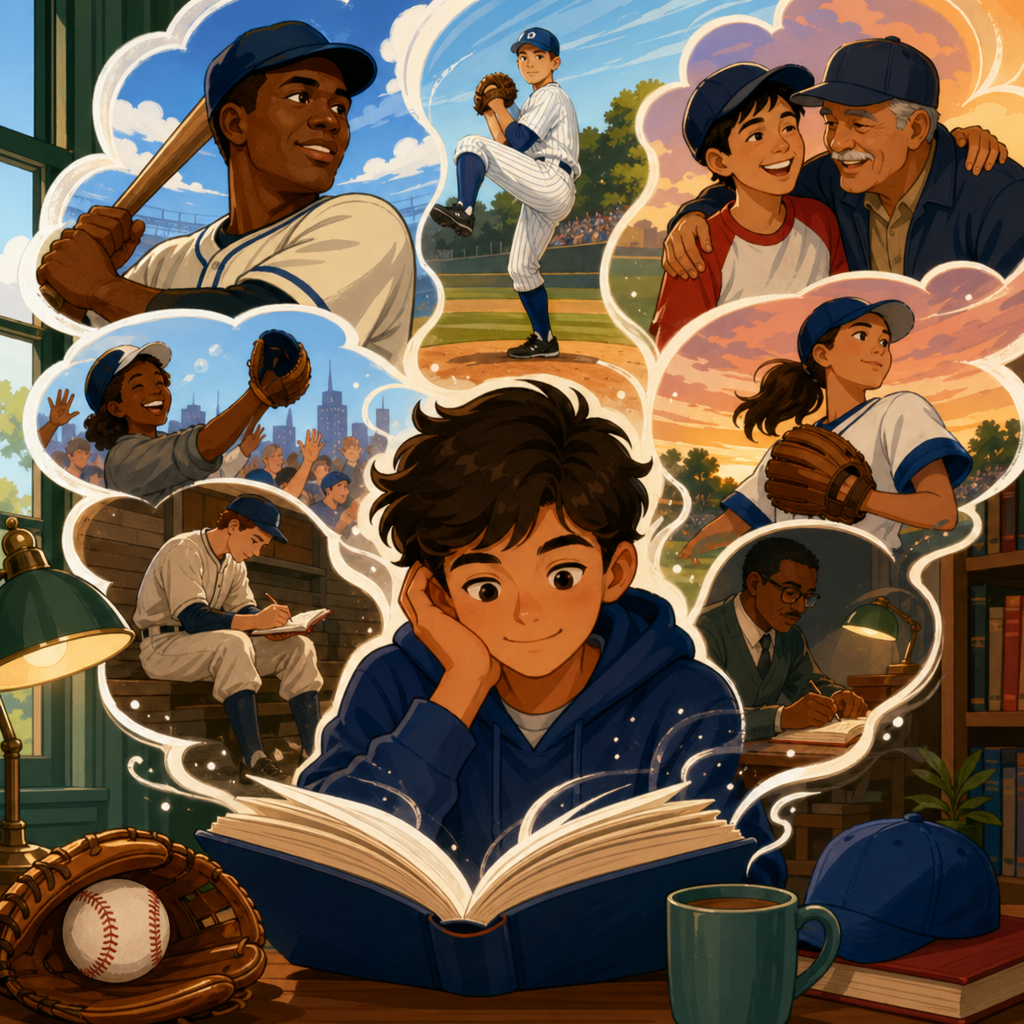
Baseball literature is often introduced through pennant races, legendary players, and the pastoral mythology of the diamond, but the strongest books about the sport are usually driven by personal stories. In this miscellaneous hub for baseball in literature and film, the focus shifts beyond box scores to memoir, biography, oral history, family narrative, social commentary, and hybrid works that use baseball as a lens for identity. Personal stories in baseball literature are accounts grounded in lived experience: a player recalling a minor league bus ride, a daughter reconstructing a father’s vanished career, a journalist tracing a city’s attachment to a team, or a novelist using baseball memory to explore grief, class, race, or immigration. These narratives matter because baseball has always generated records, yet records alone do not explain what the game feels like from the inside.
After years of reading this category closely, one pattern is unmistakable: the books that stay with readers are rarely the ones that simply recount seasons in chronological order. The memorable works connect the game to work, masculinity, family inheritance, regional identity, exclusion, aspiration, and aging. Baseball is especially suited to literary treatment because it combines repetition and interruption. There is time to think between pitches, time to remember, and time to project meaning onto failure and success. That structure allows writers to tell intimate stories without losing the sport’s larger cultural frame. For readers exploring baseball in literature and film, this hub maps the personal-story side of the field and explains what kinds of books belong here, how they differ, and why they remain central to understanding baseball as culture rather than spectacle.
What counts as a personal story in baseball literature
A personal story in baseball literature is not limited to autobiography. It includes memoirs by players, biographies built from interviews and archives, essay collections, oral histories, investigative narratives, and literary nonfiction centered on a baseball life. It can also include fiction when the emotional engine is interior experience rather than game action. Roger Angell’s baseball essays, for example, are journalistic, but their enduring value comes from attention to human texture: the cadence of a clubhouse, the vulnerability of pitchers, the emotional weather of September. Jim Bouton’s Ball Four remains essential not because it explains strategy better than a coaching manual, but because it demystifies professional baseball through voice, candor, and daily detail. That book changed sports publishing by proving readers wanted honesty about labor, clubhouse culture, insecurity, and performance pressure.
Biography belongs in this category when it reconstructs a life rather than merely summarizing statistics. Jane Leavy’s work on Sandy Koufax and Mickey Mantle is instructive because it situates athletes within media expectation, family formation, physical pain, and national mythmaking. Memoirs such as Willie Mays’s recollections or David Cone’s reflective writing bring readers directly into decision-making, superstition, travel, injury management, and post-career self-understanding. Even books about teams can function as personal-story literature when they use a roster as a set of intersecting lives. Studs Terkel’s oral-history method shaped the expectation that many voices together can reveal a social truth that a single official account cannot. In baseball writing, that approach is invaluable for showing how a season feels differently to a star, a backup catcher, a scout, a spouse, and a fan in the upper deck.
Why personal narratives reveal the deepest truths about baseball
Baseball generates more quantifiable data than most sports, which creates the illusion that the game is fully knowable. Personal narratives correct that illusion. Statistics can tell you that a hitter batted .240 after the All-Star break; they cannot tell you that he was playing through a divorce, trying to keep a roster spot, or relearning timing after a hand injury. The gap between outcome and experience is where literature becomes indispensable. That is why books centered on individual perspective often outlast annual recaps. They explain not only what happened but what it cost.
These stories also make visible the sport’s hidden labor. In professional baseball, most players never become stars. They spend years in developmental systems, face fragile employment, and absorb constant evaluation. I have found that readers who think they want books about greatness often respond more strongly to books about uncertainty, because uncertainty is the common human condition. A minor leaguer’s story of sharing cramped apartments, eating poorly on road trips, and chasing a promotion often reveals more about baseball’s structure than a polished Hall of Fame memoir. Personal narratives show the sport as work: contractual, bodily, repetitive, and psychologically demanding.
Another reason these narratives matter is that baseball has served as a stage for major American conflicts. Questions about race, citizenship, assimilation, regional belonging, gender access, and media power appear vividly when filtered through one life. Jackie Robinson’s story is inseparable from the broader history of integration, but it is powerful because it remains specific: the strain of restraint, the calculations of risk, the burden of symbolic representation. Personal literature keeps history from becoming abstract.
Major forms readers will encounter in this hub
This miscellaneous hub covers several recurring forms. The first is the player memoir, ranging from confessional works to carefully managed legacy projects. The best examples combine anecdote with self-interrogation. Bouton did this memorably; so did Dirk Hayhurst in writing about the precarious life of players below superstardom. The second is literary essay and reportage. Roger Angell, Donald Hall, and others used baseball to investigate time, mortality, and place while preserving factual precision. The third is biography, where authors rely on archival records, newspaper databases, interviews, and institutional histories to reconstruct baseball lives in context.
A fourth form is oral history. This method is particularly effective for baseball because memory is distributed across a community. A single postseason game can be retold by players, broadcasters, groundskeepers, and fans, each revealing a different layer of meaning. The fifth form is family narrative, a rich but sometimes overlooked category. Here baseball becomes a language between generations, whether the subject is inherited fandom, a parent’s unfinished dream, or the way a child understands an absent adult through scorecards, radio calls, and old photographs. The sixth form is crossover narrative, where baseball intersects with subjects like war, migration, religion, labor law, or urban change. These books are valuable hub material because they connect baseball literature to broader cultural reading paths.
| Form | Core focus | Representative value for readers |
|---|---|---|
| Memoir | First-person lived experience | Explains pressure, routine, and self-perception from inside the game |
| Biography | Researched reconstruction of a life | Places players within family, media, and historical context |
| Oral history | Multiple voices on shared events | Shows how memory and meaning vary across participants |
| Essay/reportage | Observation, reflection, and scene-building | Connects baseball to time, place, and cultural interpretation |
| Family narrative | Baseball as inheritance or relationship | Reveals why fandom and memory endure beyond careers |
| Hybrid cultural study | Sport linked with social issues | Helps readers understand baseball as part of national life |
Key themes that make baseball stories personal
The most important recurring theme is identity under pressure. Baseball exposes players to public judgment through measurable failure. Even elite hitters fail in most plate appearances, and that reality gives writers a powerful framework for exploring confidence, shame, routine, and resilience. A second major theme is memory. Because baseball is archival by nature, it invites retrospection. Writers return to lineups, ticket stubs, radio voices, and neighborhood fields to explain who they were when the game first mattered to them.
Family is another central theme. Many baseball books are really stories about fathers and sons, mothers and daughters, siblings who rooted for rival teams, or grandparents who passed down rituals. This can become sentimental in weak books, but in strong ones it reveals how sport organizes affection and silence. Class matters too. Baseball has long carried a myth of democratic accessibility, yet equipment costs, travel ball systems, academy pipelines, and unequal development opportunities complicate that claim. Good personal narratives show those tensions on the ground, in specific neighborhoods and households.
Place is equally important. A memoir from Brooklyn means something different from one rooted in the Dominican Republic, rural Georgia, Oakland, or Hokkaido. Ballparks are not interchangeable stages; they are civic spaces tied to local economies and memories. Finally, aging and bodily decline appear constantly. Because baseball careers are finite and often end abruptly, the literature is filled with reckonings: the player who realizes his bat speed is gone, the writer who revisits old parks, the fan who understands that a team memory is bound up with mortality.
How baseball literature expands beyond players and famous teams
One mistake readers make is assuming baseball literature is only about major league stars. In practice, some of the richest personal writing comes from people adjacent to the spotlight. Scouts, umpires, front-office analysts, translators, Negro Leagues researchers, and longtime fans all produce narratives that deepen the record. A scout’s memoir may explain how projection works, how biases creep into evaluation, and how many judgments are made in dusty backfields far from televised games. An umpire’s account can illuminate conflict management, concentration, and the ethics of authority. A translator’s story can reveal how language shapes trust for international players navigating a new culture under public scrutiny.
Readers interested in baseball in literature and film should also notice how these written stories inform screen storytelling. Many of the most compelling baseball films borrow personal-story architecture rather than pure sports-drama structure. They emphasize memory, relationships, and private cost. Even when a film invents characters, it often draws from literary patterns established in memoir and reportage: the aging player confronting obsolescence, the fan processing loss through a season, the child who interprets adulthood through a team’s fortunes. That crossover makes this hub especially useful as a foundation page, because it points toward biographies, memoirs, documentaries, adaptations, and criticism across media.
This wider field also includes neglected and corrective narratives. Books on the Negro Leagues, women in baseball, queer fandom, immigrant communities, and labor exploitation in development systems do more than add diversity to a reading list. They repair the historical record. Personal storytelling is one of the strongest tools for that repair because it restores names, motives, constraints, and voices that official baseball memory has often flattened.
How to read this subtopic as a hub, not a single list
The best way to use a miscellaneous baseball literature hub is to treat it as a map of entry points. If you are new to the subject, start with a memoir such as Ball Four or a strong essay collection to hear the game in a human voice. Then move to a biography for historical grounding, followed by an oral history or cultural study that broadens perspective. If your interest is family narrative, pair baseball books with works about memory and inheritance. If your interest is social history, move from player-centered books to studies of integration, labor, and globalization. Reading in this sequence helps you see how one person’s story connects to institutional structures.
It is also worth reading across levels of play. Major league narratives often dominate publishing, but college, minor league, youth, and international baseball literature can be more revealing because the stakes are exposed differently. Not every book in this area is equally reliable. Some memoirs are ghostwritten and flatten complexity; some nostalgic works romanticize the past while skipping exclusion and inequality. The strongest writing balances affection with scrutiny. It loves baseball enough to tell the truth about it.
As this hub grows within the broader baseball in literature and film topic, it should anchor related articles on memoirs, biographies, baseball family stories, overlooked voices, documentary storytelling, and adaptations. The central idea is simple: to understand baseball fully, you have to read lives, not just seasons. Personal stories show how the sport is inhabited by real people with bodies, jobs, loyalties, and histories.
Baseball literature becomes most meaningful when it moves beyond heroic summary and allows readers into private experience. Personal stories explain how the game shapes identity, family memory, community belonging, and historical change. They reveal the hidden labor behind performance, the emotional cost of failure, and the ways baseball intersects with race, class, gender, migration, and aging. For a sub-pillar hub under baseball in literature and film, this miscellaneous category is essential because it gathers the forms that do the broadest cultural work: memoir, biography, oral history, essays, family narrative, and crossover studies.
If you are building a reading path, use this hub to move from intimate voice to larger context. Start with a firsthand account, add a researched life, then branch into neglected perspectives and film connections. That approach will give you a clearer understanding of baseball as lived experience rather than mythology alone. Explore the related articles in this subtopic and read for the people inside the game; that is where baseball literature becomes unforgettable.
Frequently Asked Questions
What does “personal stories” mean in baseball literature?
In baseball literature, “personal stories” refers to writing that treats the game not just as a sport, but as a lived experience shaped by memory, family, culture, ambition, disappointment, and identity. Instead of focusing only on standings, statistics, or famous pennant races, these works ask what baseball means to the people who play it, watch it, inherit it, or use it to understand their own lives. A personal story may come in the form of memoir, where an author recounts childhood summers at the ballpark, a biography that emphasizes emotional struggle behind public success, an oral history that captures multiple voices from a community, or a hybrid work that blends criticism, history, and autobiography.
What makes these stories especially compelling is that baseball becomes a framework for larger human concerns. A father teaching a child how to keep score can become a story about generational bonds. A minor leaguer’s long bus rides can reveal the hidden labor behind athletic dreams. A narrative about fandom can become a meditation on place, class, migration, race, or belonging. In strong baseball writing, the game often operates as both subject and symbol: it is real, concrete, and deeply physical, but it also serves as a way to explore grief, hope, memory, and self-definition. That is why personal stories often leave a deeper impression than purely game-centered accounts. They remind readers that baseball literature is ultimately about people, not just outcomes.
Why are personal narratives often more powerful than traditional game recaps or season histories?
Traditional game recaps and season histories are valuable because they preserve what happened, explain strategy, and document the evolution of teams and eras. But personal narratives often carry greater emotional weight because they explain why what happened mattered. A box score can tell you who won, who homered, and who struck out; a personal narrative can tell you what that game meant to a player trying to save a career, a fan reconnecting with a parent, or a community seeing itself reflected on the field. That added layer of meaning is what gives baseball literature its staying power.
Personal narratives also widen the scope of the sport. They let readers enter baseball through vulnerability rather than expertise. You do not need to understand advanced metrics or historical rivalries to be moved by a story about immigration and baseball, a memoir of playing through injury, or a family history shaped by a shared allegiance to a team. These works often reveal the emotional architecture beneath the public version of the game: loneliness during road trips, the strain of expectation, the complexity of hero worship, the pressures of race and representation, and the way memory reshapes sports in retrospect. In other words, personal narratives transform baseball from a sequence of events into a human story with lasting literary and cultural value.
What kinds of baseball books best explore identity, family, and social history?
The richest books in this area are usually those that move fluidly between the personal and the historical. Memoirs are especially effective because they show how baseball intersects with the author’s own life, whether through childhood fandom, playing experience, parent-child relationships, or questions of belonging. Biography can also be powerful when it goes beyond career milestones and examines the circumstances that shaped a person’s life, including race, labor, media pressure, regional identity, or family expectations. Oral histories are another excellent form because they preserve multiple points of view and often reveal how one baseball story can mean very different things to players, spouses, reporters, and fans.
Books that explore social history particularly well often treat baseball as an entry point into larger American and international realities. A story about the Negro Leagues, for example, is never only about baseball; it is also about segregation, excellence under exclusion, entrepreneurship, and cultural memory. Writing on Latin American baseball may open up conversations about migration, national pride, economics, and the global movement of talent. Family-centered baseball books can be equally revealing, especially when they show how the sport becomes a language between generations. In the best examples, baseball is not a decorative backdrop. It is a tool for examining how people inherit values, cope with loss, navigate social barriers, and construct identity over time.
How does baseball literature differ from baseball film when telling personal stories?
Baseball literature and baseball film often overlap in theme, but they create intimacy in different ways. Literature has a particular advantage when it comes to interior life. It can linger inside memory, self-doubt, reflection, and contradiction in a way that is difficult to reproduce on screen. A memoir or literary biography can spend pages unpacking a single at-bat, a conversation in a clubhouse, or a recollection from childhood, showing how that moment resonates years later. Books can layer context gradually, weaving together history, emotion, and interpretation so the reader sees not just the event but the consciousness around it.
Film, by contrast, excels at atmosphere, visual symbolism, performance, and immediacy. A movie can make a ballpark feel mythic in seconds, and a documentary can use interviews, archival footage, and sound to create a strong sense of lived reality. But literature often has more room for nuance and complexity, especially in stories that do not resolve neatly. Baseball books can better hold ambiguity: a player can be admirable and flawed, a memory can be cherished and painful, and a fan’s devotion can be sincere yet critical. For readers interested in personal stories, literature frequently offers the deeper excavation, while film provides emotional shorthand and visual resonance. Together, they enrich one another, but books remain especially powerful for exploring the layered meanings people attach to the game.
What should readers look for when choosing meaningful baseball literature beyond famous players and championship seasons?
Readers should look for books that ask larger questions than who won and who lost. A meaningful work of baseball literature usually has a clear human center: a voice, a family, a community, or a conflict that gives the sport emotional stakes beyond competition. It is worth paying attention to whether the book engages with memory, identity, labor, race, class, geography, or generational change. These are often signs that the writing is using baseball as a lens rather than merely as a topic. Books that stay with readers tend to be those in which baseball opens onto something broader and more enduring.
It also helps to seek out a range of forms. Memoirs can offer intimacy, biographies can provide perspective, oral histories can capture collective experience, and essay collections can connect baseball to culture and criticism. Readers should not limit themselves to stories about superstars. Some of the most revealing books focus on minor leaguers, overlooked teams, women around the game, immigrant communities, local sandlots, or lifelong fans whose stories illuminate what baseball means away from the spotlight. Strong baseball literature does not depend on celebrity. It depends on insight, honesty, and the ability to show how the game becomes entangled with real life. When a book leaves you thinking not just about baseball, but about people, place, memory, and meaning, that is usually a sign you have found the right kind of story.