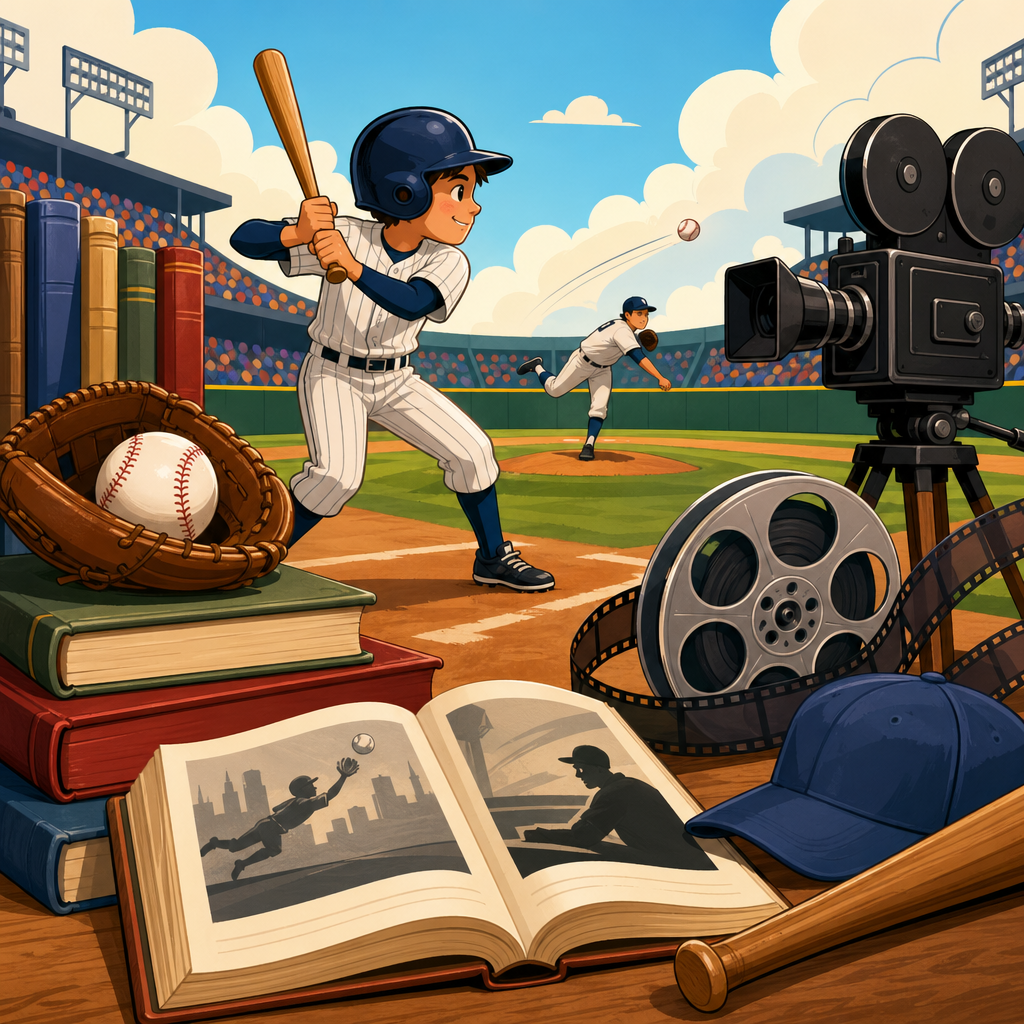
Baseball has always generated its own language, and nowhere is that vocabulary more revealing than in literature and film. The language of baseball includes slang, technical terms, idioms, metaphors, clubhouse phrases, broadcast shorthand, and regionally colored expressions that shape how stories are written, characters are drawn, and games are remembered. In novels, poems, memoirs, screenplays, and movies, these words do more than describe action on a diamond. They establish class, era, geography, and emotional stakes. A character who calls a home run a “four-bagger” sounds different from one who says “went yard.” A scout who talks about “tools,” “upside,” and “makeup” brings an entire professional culture onto the page.
This matters because baseball language is one of the richest vocabularies in American storytelling. Writers and filmmakers use it to communicate tension, nostalgia, rivalry, failure, superstition, and hope with remarkable efficiency. I have worked through baseball novels, classic sports films, old newspaper game stories, and broadcast transcripts, and the pattern is consistent: the terms are never incidental. They carry history. Many phrases migrate far beyond the sport into politics, business, and everyday speech, while others remain stubbornly specific to dugouts and scorecards. Understanding them helps readers interpret subtext, appreciate authenticity, and recognize when a writer is using baseball as a literal subject versus a larger cultural metaphor.
As a hub for miscellaneous baseball language in literature and film, this article defines core categories, explains how terms function in narrative, and maps the expressions that recur across works from Bernard Malamud’s The Natural to W. P. Kinsella’s Shoeless Joe, from Bull Durham and Field of Dreams to Moneyball. It also points toward the wider “Baseball in Literature and Film” topic by showing how dialogue, narration, symbolism, and adaptation all depend on choosing the right baseball words for the right dramatic moment.
How baseball terms create character, setting, and authenticity
Baseball language signals who a character is before the plot explains it. In fiction, a veteran catcher who says a pitcher is “nibbling” or “working backwards” sounds seasoned because those are precise strategic terms. In film, a scout who calls a prospect “projectable” reveals the evaluative mindset of professional baseball. Writers use this vocabulary the way crime fiction uses police procedure or legal drama uses courtroom jargon. The right phrase can imply years of experience, a specific social world, and a hierarchy within the team.
Era matters too. Deadball-era writing often includes terms such as “bunt-and-run,” “inside baseball,” “southpaw,” and “twirler,” while modern scripts are more likely to mention “exit velocity,” “launch angle,” or “OPS.” Even when a period piece avoids overwhelming readers with jargon, a few well-placed terms anchor the time frame. Philip Roth’s The Great American Novel plays with this effect satirically, while films set in earlier decades often rely on broadcasters, beat writers, or old-school managers to establish verbal authenticity.
Regional and class distinctions also appear in baseball speech. Sandlot dialogue is usually looser, comic, and full of boasting. Front-office language is denser and more analytical. Broadcast language tends toward rhythm and clarity because it must paint the game in real time. In my experience, the most convincing baseball scenes balance these registers carefully. Too little terminology feels generic; too much becomes performative and distracts from story.
Essential categories of baseball vocabulary in books and movies
Baseball terms in literature and film generally fall into several overlapping groups. The first is rules-and-action language: strike zone, balk, sacrifice fly, double play, walk-off, squeeze bunt, and hit by pitch. These terms explain what happens on the field and often drive plot points. A disputed balk or a botched rundown can become the turning point in a chapter or scene because the terminology itself carries dramatic specificity.
The second group is player-evaluation language. Scouts and coaches talk about arm strength, bat speed, command, mechanics, makeup, and ceiling. Moneyball popularized another layer: on-base percentage, slugging percentage, and market inefficiency. This analytical vocabulary changed how baseball stories sound. It did not replace older idioms; it added a second dialect, one spoken by executives, analysts, and increasingly by fans.
The third group is folklore and superstition. Players speak of the “hot hand,” the “yips,” “seeing the ball well,” “jinxing” a no-hitter, or having a “lucky glove.” These expressions often matter more in character-driven narratives than strict rules language because they reveal belief systems. Baseball fiction repeatedly returns to rituals, omens, and curses because the sport’s slow pace invites reflection and anxiety.
The fourth group is metaphorical language that escaped the ballpark: stepping up to the plate, covering all the bases, out of left field, touch base, in the big leagues. In novels and films, these phrases can be used sincerely or ironically. A corporate speech that leans on baseball clichés may suggest a character grasping for familiarity, while a family drama may use them tenderly to connect generations.
Iconic terms and what they mean in narrative context
Some baseball terms appear so often in literature and film that they function almost like symbolic shorthand. “The show” means Major League Baseball and carries the emotional force of arrival, validation, and economic survival. “The minors” or “the bush leagues” can imply hardship, stalled ambition, or comic grit. “A cup of coffee” describes a brief major league stint, often tragic in memoir and bittersweet in fiction because it represents both fulfillment and loss.
“Southpaw” is more than a left-handed pitcher. In screenwriting, it often suggests a visual and tactical problem for hitters, which helps externalize conflict. “Chin music” refers to high, inside pitching meant to intimidate; in movies, it can establish old-school toughness or ethical tension. “Can of corn” describes an easy fly ball and frequently appears in broadcasts or period dialogue because it instantly conveys routine. “Rhubarb,” meaning an on-field argument, is especially useful in prose because the word itself is noisy and theatrical.
Another durable term is “five-tool player,” referring to hitting for average, hitting for power, running, fielding, and throwing. When a novel labels a teenager a five-tool prospect, readers understand both promise and pressure. “Golden sombrero,” four strikeouts in one game, can add humor or humiliation. “Mendoza Line,” usually around a .200 batting average, gives a writer a quick benchmark for futility. These terms compress complex baseball realities into vivid narrative units.
| Term | Plain meaning | How literature and film use it |
|---|---|---|
| The show | Major League Baseball | Signals arrival, status, and the dream of legitimacy |
| Cup of coffee | Brief major league appearance | Conveys fragile success and missed opportunity |
| Chin music | High inside pitch used to intimidate | Creates conflict, menace, and old-school code |
| Five-tool player | Elite all-around prospect | Represents potential, hype, and burden |
| Mendoza Line | Very poor batting threshold | Marks decline, embarrassment, or comic failure |
| Can of corn | Easy fly ball | Adds period flavor and broadcast realism |
Baseball slang in major literary works and baseball films
In The Natural, baseball language supports myth. Malamud blends realistic game terms with heightened, almost legendary phrasing, turning ordinary play into fable. In Kinsella’s Shoeless Joe, the vocabulary is softer, more pastoral, rooted in memory and oral storytelling. The baseball words are important, but so is the cadence around them, which makes the game feel inherited rather than merely observed. That tonal difference matters when comparing literary baseball language across authors.
Bull Durham remains one of the sharpest examples of baseball speech on screen because it distinguishes among the rookie, the veteran, and the fan. Crash Davis talks like a career minor leaguer: practical, sardonic, intimate with failure. Nuke LaLoosh begins with raw talent and cliché. Annie Savoy speaks baseball as seduction, philosophy, and education. The film’s language works because every character uses the sport differently. That is a key lesson for any analysis of baseball dialogue.
Field of Dreams treats baseball terms almost ceremonially. Names, positions, and famous phrases carry spiritual weight. By contrast, Moneyball foregrounds the language of valuation and roster construction. Its most quoted scenes revolve around replacement value, on-base percentage, and the inefficiencies of traditional scouting. The film captures a real transition in baseball discourse during the late 1990s and early 2000s, when quantitative analysis moved from niche practice to mainstream argument.
Other works broaden the field. Roger Angell’s essays refined literary baseball prose without abandoning technical precision. Don DeLillo’s Underworld uses baseball language as cultural memory. August Wilson’s Fences transforms terms like “strike” and “safe” into moral and familial metaphors. Together these texts show that baseball vocabulary can be comic, mystical, analytical, elegiac, or political depending on context.
Why baseball metaphors travel so easily beyond the game
Baseball metaphors thrive in literature and film because the sport breaks action into discrete, legible moments. Each pitch is a decision. Each base is visible progress. That structure makes the vocabulary adaptable. “Step up to the plate” clearly means accepting responsibility. “Curveball” means surprise because an actual curveball defeats expectation through movement. “Out of left field” means unexpected because left field, in popular imagination, feels distant from the center of action.
Screenwriters and novelists use these metaphors because audiences understand them even if they do not follow standings or roster rules. The best uses, however, respect the literal game underneath the figure of speech. A weak baseball metaphor feels interchangeable with any sports cliché. A strong one fits character and situation. In Fences, Troy Maxson’s baseball talk is powerful not simply because the phrases are familiar, but because his life has been shaped by exclusion from the major leagues. The metaphor is biography, not decoration.
This is also why overuse can flatten dialogue. If every conflict is a “ninth-inning situation,” the language loses force. Skilled writers vary between direct baseball terminology and broader emotional description. They know when to let one exact term carry the scene.
How to read baseball language critically
When analyzing baseball terms in literature and film, ask four practical questions. First, who is speaking? A catcher, owner, broadcaster, child, and poet will not use the same baseball vocabulary. Second, what period is being represented? Terms like WAR, launch angle, and tunneling belong to a different baseball culture than pepper, wheelhouse, and beanball. Third, is the language literal, metaphorical, or both? A line about “striking out” may describe an at-bat, a romantic failure, or a social defeat. Fourth, what power relationship does the language reveal? Front-office jargon can dehumanize players; clubhouse slang can build belonging or exclude outsiders.
It also helps to compare dialogue with documented baseball usage. The Official Baseball Rules provide formal terminology. Retrosheet, Baseball-Reference, and the Society for American Baseball Research preserve historical records and language patterns. Broadcast archives show how announcers compress technical detail into memorable phrases. These sources are useful if you are writing criticism, studying adaptation, or building internal links across a broader baseball in literature and film project.
Most importantly, notice when baseball words do emotional work. A father teaching a child the difference between a slider and a curve is rarely just teaching pitch recognition. He is passing down attention, patience, and identity. That is why baseball language endures on the page and onscreen.
The language of baseball is unique because it joins precision with poetry. Terms such as southpaw, can of corn, chin music, cup of coffee, and five-tool player are not random bits of slang. They encode strategy, labor, memory, class, aspiration, and myth. In literature, these words help define voice, era, and symbolism. In film, they create authenticity, sharpen character contrast, and make the invisible logic of the game legible to viewers. Across both forms, baseball language works best when it is specific, historically grounded, and matched to the speaker using it.
As a hub within the broader “Baseball in Literature and Film” topic, this miscellaneous guide offers the vocabulary map that supports deeper reading. It connects rules language, scouting jargon, folklore, broadcast phrasing, and metaphorical spillover into one interpretive framework. That framework is useful whether you are studying The Natural, revisiting Bull Durham, unpacking Moneyball, or tracing baseball idioms in plays, poems, and family dramas. Once you understand the terms, you start to see how often baseball language quietly shapes tone and meaning.
If you are exploring this subtopic further, use this article as your starting point. Build outward into player archetypes, baseball symbolism, famous speeches, adaptation studies, and the history of statistics in narrative. The more closely you read the language, the more clearly baseball reveals itself as not just a sport in stories, but one of storytelling’s most durable vocabularies.
Frequently Asked Questions
Why does baseball have such a distinctive vocabulary in literature and film?
Baseball developed over generations as both a formal sport and a deeply social pastime, so its language grew in layers. Some terms come from official rules and on-field strategy, while others emerged from sandlots, clubhouses, radio booths, newspapers, and regional speech. That combination gives baseball vocabulary an unusual richness in literature and film. A writer or director can use a single term like “southpaw,” “can of corn,” “beanball,” or “small ball” to communicate not just an action, but an era, a social setting, and an attitude. The words often carry the cadence of oral storytelling, which is one reason baseball translates so well to novels, memoirs, screenplays, and movies.
In literary and cinematic works, baseball language also functions as shorthand for character and community. A polished broadcaster speaks differently from a minor league lifer, a deadball-era manager, or a kid learning the game in a neighborhood lot. Dialogue filled with authentic baseball terms can signal class background, region, age, and experience without lengthy exposition. That is why baseball speech feels so revealing on the page and on screen: it does more than identify the sport. It helps build atmosphere, cultural memory, and emotional texture.
What kinds of baseball terms appear most often in novels, poems, memoirs, and films?
The most common categories include technical terms, slang, idioms, metaphors, and broadcast or clubhouse expressions. Technical terms are the most straightforward: words such as “double play,” “bunt,” “walk-off,” “curveball,” “sacrifice fly,” and “earned run” describe specific actions or statistics. These terms anchor realism and help audiences understand what is happening in a scene. In literature, especially in sports fiction and memoir, technical language can establish authority and immerse readers in the mechanics of the game.
Slang and informal phrases often carry even more dramatic weight. Expressions like “heater,” “chin music,” “paint the corner,” “rally cap,” “golden sombrero,” or “cup of coffee” tend to reveal clubhouse culture and the insider nature of baseball speech. Writers and filmmakers use them to make dialogue sound lived-in and credible. Idiomatic expressions derived from baseball, such as “step up to the plate,” “out of left field,” and “touch base,” are also common, especially when baseball language crosses into broader American speech. In poetry and reflective prose, metaphoric baseball terms often become tools for discussing memory, failure, masculinity, aspiration, race, fathers and sons, or the passage of time. In film, broadcast shorthand and announcer language can create immediacy, nostalgia, and rhythm, turning commentary itself into part of the storytelling.
How does baseball language help define character, setting, and historical period?
Baseball vocabulary is one of the most efficient tools for signaling who a character is and where that character belongs. The specific words a person chooses can suggest whether they are a player, manager, scout, announcer, fan, or outsider. It can also indicate whether they learned baseball in a professional environment, on a school field, or through family tradition. A character who speaks in old-fashioned terms may evoke an earlier baseball culture, while someone using analytics-driven language may place the story firmly in the modern game. In this way, baseball speech helps locate a character within a historical and cultural timeline.
Setting works the same way. Regionally colored expressions, local accents, and period-specific phrases can place a story in Brooklyn, St. Louis, the rural South, a Latino winter league environment, or a mid-century minor league town. In literature and film alike, the language surrounding baseball can evoke radio-era nostalgia, the hard professionalism of postwar clubhouses, or the commercial polish of contemporary sports media. Even when the game itself is not central to the plot, baseball terminology can shape the emotional geography of a story. It can evoke small-town belonging, urban toughness, immigrant adaptation, or generational continuity. Because baseball has been entwined with so many layers of American life, its language often becomes a subtle but powerful marker of time, place, and identity.
Why do baseball terms in stories often feel symbolic rather than purely descriptive?
Baseball language lends itself naturally to symbolism because the game is structured around repetition, suspense, failure, endurance, and hope. Many of its terms already sound metaphorical, even before a writer gives them added meaning. A “curveball” suggests surprise or disruption, “safe” implies survival or acceptance, and “home” carries obvious emotional resonance beyond the literal plate. In literature and film, these words can do double duty. They describe an event within the game while also reflecting a character’s emotional state, relationships, or moral struggle.
This symbolic quality is one reason baseball language appears so frequently in works that are not exclusively about sports. A strikeout can represent disappointment, a comeback inning can suggest resilience, and a long season can mirror the drawn-out nature of grief, ambition, or personal change. Filmmakers often reinforce these meanings visually, pairing baseball dialogue with shots that emphasize isolation, anticipation, or communal release. Authors do something similar through rhythm, image, and repetition. As a result, baseball terms become part of a larger artistic vocabulary. They do not simply narrate play-by-play action; they help translate abstract experience into scenes and speech that feel concrete, familiar, and emotionally charged.
How can readers and viewers better understand baseball terminology when analyzing literature and film?
The best approach is to pay attention to context rather than treating every term as a piece of trivia. Start by asking what a word means literally in baseball, then consider what it contributes to the scene beyond its direct definition. Is the term used to establish realism, reveal character, mark social belonging, create humor, or suggest a metaphorical theme? For example, a manager’s blunt clubhouse phrase may communicate authority or old-school values, while an announcer’s polished expression may create nostalgia or public drama. Looking at who uses the term, when it appears, and how others respond to it can uncover layers of meaning that go well beyond the game itself.
It also helps to recognize that baseball language changes over time. Some expressions belong to specific eras, and others vary by region or by level of play. A reader or viewer who notices those differences can better appreciate how carefully a writer or filmmaker has shaped voice and setting. Consulting a baseball glossary, historical commentary, or even listening to archived broadcasts can be useful, but close reading and close viewing matter most. Baseball terminology in literature and film is rarely there by accident. It often serves as a compressed form of storytelling, carrying information about culture, memory, identity, and emotion in just a few words. Understanding that is what turns baseball language from background color into a central element of interpretation.