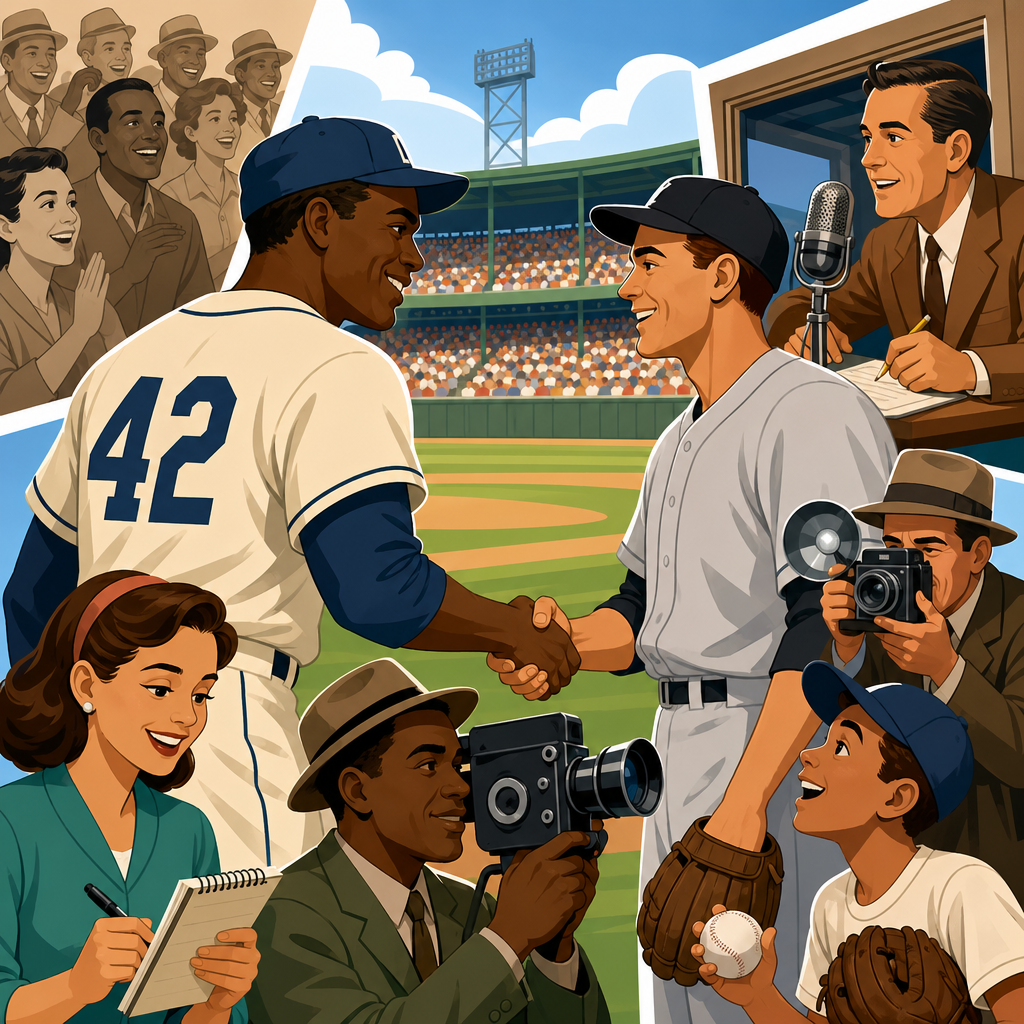
Baseball’s integration era changed far more than lineups and box scores; it transformed how Americans told stories about race, citizenship, heroism, and the national pastime itself. In this sub-pillar hub for Baseball in Literature and Film, “miscellaneous” does not mean minor. It refers to the wide range of media forms that carried integration into public consciousness: newspapers, radio broadcasts, newsreels, photography, memoir, magazine features, documentary film, children’s books, television dramas, and later historical fiction and biopics. The integration era usually begins with Jackie Robinson breaking Major League Baseball’s modern color line in 1947, but the story stretches backward to Black newspapers and Negro League coverage in the 1930s and 1940s, and forward into decades of reinterpretation. Media mattered because most Americans did not witness integration in person. They encountered it through headlines, commentary, images, scripts, and later archival retrospectives. Those representations shaped public memory as powerfully as the games themselves. Understanding this media ecosystem helps readers see why baseball became a central narrative vehicle in American culture and why integration stories remain essential across literature, film, and broadcast history.
Why media became the battleground for baseball integration
Before television made every major game visible, print and radio determined who was seen, heard, and believed. In my work reviewing midcentury sports archives, one pattern appears repeatedly: mainstream outlets often framed integration as a problem of “temperament” or “timing,” while Black press institutions treated it as a question of rights, merit, and overdue recognition. That difference was not cosmetic. It influenced whether audiences understood Robinson, Larry Doby, Roy Campanella, Don Newcombe, and Satchel Paige as pioneers, threats to custom, or symbols of democratic progress.
The Black press was indispensable. Newspapers such as the Pittsburgh Courier and the Chicago Defender had long campaigned for equal opportunity in baseball, covering Negro League excellence with the seriousness mainstream sports desks often denied. Wendell Smith, one of the most consequential journalists of the period, did more than report events. He advocated, documented discriminatory treatment on the road, and helped contextualize Robinson’s burden for readers who knew integration would not be solved by one contract. For a hub article, that is the key point: media did not merely reflect integration; it actively organized the debate around it.
Mainstream white newspapers were inconsistent. Some editorials endorsed integration in cautious civic language, especially after Robinson proved commercially successful and athletically undeniable. Others focused obsessively on crowd reactions, clubhouse tension, and incidents of abuse, sometimes turning racist hostility into spectacle. This framing could distort reality by making white resistance the story and Black achievement the subplot. Yet these same outlets also created the public record historians now mine. Reading them critically reveals the era’s biases and its change over time.
Newspapers, magazines, and the making of public memory
Newspapers were the first draft of integration history, but magazines often gave the story emotional scale. Daily coverage tracked batting averages, beanballs, and pennant races. Weekly and monthly features turned players into symbols. Robinson’s rookie season with the Brooklyn Dodgers generated constant copy because he was not only a second baseman. He was a test case for Branch Rickey’s experiment, a target for racist abuse, and a measuring stick for whether organized baseball would honor competitive fairness. Writers used these layers to build drama, sometimes responsibly and sometimes reductively.
Sportswriters shaped reputations through tone. A gamer that praised Robinson’s baserunning intelligence and restraint under pressure advanced one narrative. A column that described him primarily as controversial advanced another. The language mattered because sports pages reached millions and were often read as objective. In practice, they were full of value judgments. Even neutral-seeming phrases like “natural speed” could rely on racial coding, while references to “discipline” and “composure” often reflected expectations Robinson had to meet that white rookies never faced.
Magazines such as Life expanded the visual dimension. Photo essays brought integrated dugouts and hostile road crowds into American living rooms. That mattered in a pre-digital age. A single image of Robinson stealing home, taking spikes, or sitting quietly under pressure could communicate dignity and danger at once. The combination of caption, layout, and editorial context taught audiences how to interpret what they saw. This is why integration-era media study belongs inside Baseball in Literature and Film: the storytelling techniques of framing, sequencing, characterization, and selective emphasis were already in place long before later movies codified the myth.
For readers exploring this hub, useful adjacent topics include Negro League journalism, Branch Rickey in biography, Jackie Robinson memoirs, and the evolution of baseball photojournalism. Together they show how media forms reinforced one another and how a newspaper campaign could become a book chapter, a documentary scene, or a classroom staple decades later.
Radio, newsreels, and early television changed the sound and image of integration
Radio gave integration a live soundtrack. Announcers translated split-second action into narrative, and their word choices influenced whether players sounded exceptional, ordinary, threatening, or admirable. Because radio was intimate, heard in kitchens, cars, bars, and neighborhood stoops, it normalized integrated baseball for some listeners simply by making Black stars part of the daily rhythm of the season. At the same time, local commentary could preserve prejudice through insinuation, selective praise, or silence about abuse from fans and opponents.
Newsreels added spectacle. Before widespread television ownership, short films shown in movie theaters presented highlights and personality pieces that blended journalism and entertainment. Robinson and other pioneers often appeared in this format as visual proof that change was happening. But newsreels condensed complexity. They favored concise narration, triumphant endings, and memorable images over structural analysis. As a result, audiences often saw integration as a dramatic breakthrough rather than a prolonged contest over labor, travel, lodging, and unequal treatment.
Early television deepened this effect. By the 1950s, televised games and interview programs brought players into homes with a sense of immediacy that print could not match. Television also rewarded simplified character arcs. A player was cast as calm, fiery, humble, or heroic because those traits read clearly on screen. Robinson’s intelligence and competitiveness were evident, but television often softened the institutional context around him. Segregated hotels, threats in southern spring training, and the economic dislocation of Negro League clubs did not fit neatly into short segments. Later documentaries would revisit these gaps, but during the integration era itself, broadcast formats often prioritized access and inspiration over critique.
Literature and film turned athletes into enduring national symbols
Books and films gave baseball integration its longest afterlife. Memoirs, juvenile biographies, historical fiction, and studio pictures converted recent events into national legend. I have found that the most revealing works are not always the most famous. A children’s biography that introduces Robinson as brave and disciplined tells us how schools wanted the era remembered. A more adult memoir that details retaliatory pitches, hate mail, and daily calculation tells us what sanitization leaves out.
Robinson’s own writing, including I Never Had It Made, remains central because it insists on complexity. He was not simply patient or noble. He was strategically self-controlled under an agreement with Rickey, then later outspoken about civil rights, politics, and the limits of symbolic progress. That distinction matters for anyone studying media representations. Popular culture often freezes pioneers at the moment of breakthrough and ignores what they said once the cameras moved on.
Film followed a similar pattern. The Jackie Robinson Story appeared in 1950, with Robinson playing himself, an extraordinary act of self-representation in American cinema. Yet the film also reflects the constraints of its moment. It is earnest, accessible, and historically important, but careful in ways later works are not. Decades afterward, documentaries and feature films could incorporate broader archival evidence, civil rights context, and a clearer vocabulary for institutional racism. The comparison reveals how each era remakes integration in its own image.
| Media form | Typical strength | Common limitation | Representative example |
|---|---|---|---|
| Black newspapers | Context, advocacy, community perspective | Smaller national distribution | Pittsburgh Courier coverage by Wendell Smith |
| Mainstream newspapers | Broad reach and daily reporting | Racial bias in framing | National coverage of Robinson’s 1947 season |
| Radio | Immediacy and routine audience contact | No visual evidence; tone shaped perception | Game broadcasts featuring integrated rosters |
| Newsreels | Powerful moving images for mass audiences | Compressed, simplified storytelling | Theatrical baseball highlight reels |
| Memoir | First-person insight and retrospective nuance | Selective memory and self-fashioning | I Never Had It Made |
| Feature film | Large cultural reach and emotional narrative | Mythmaking and dramatic compression | The Jackie Robinson Story |
As a hub page, this section connects naturally to articles on baseball biopics, sports memoir, Black authors writing baseball, and the portrayal of race in postwar American film. Those branches help readers move from the central integration story to the wider literary and cinematic landscape it influenced.
Beyond Jackie Robinson: wider stories media often compresses
Jackie Robinson belongs at the center of any integration-era account, but a strong hub must widen the frame. Larry Doby integrated the American League in 1947 and endured many of the same hostilities with less media attention. Campanella and Newcombe became foundational stars for the Dodgers, demonstrating that integration was not a one-man exception but a sustained competitive reality. Paige arrived in the majors late, carrying a legend built in the Negro Leagues and on barnstorming circuits, while also exposing how much prime Black talent major league segregation had wasted.
Media coverage frequently personalized what were actually systemic issues. Club owners calculated gate receipts. Commissioners balanced public pressure and private caution. Minor league affiliates and spring training sites in the South raised legal and logistical barriers. Integrated baseball was not simply a moral awakening; it was an uneven institutional process shaped by labor markets, geography, and media visibility. The Brooklyn Dodgers are remembered as progressive, and in baseball terms they were, but even they operated inside a segregated society with clear limits.
Another undercovered story is the cost to Negro League institutions. Integration opened deserved opportunities for players, but it also drained star power from Black-owned teams and businesses that had served communities excluded from white baseball. Responsible media history acknowledges both truths at once. Celebration without economic context becomes sentimental. Critique without recognition of the breakthrough misses the magnitude of the barrier that fell.
How modern documentaries, classrooms, and archives keep rewriting the era
The integration era remains active in media because archives keep expanding and each generation asks different questions. Ken Burns’s Baseball, PBS documentaries, Hall of Fame exhibits, digitized newspaper databases, and university special collections have made it easier to compare contemporary coverage with retrospective interpretation. In practical terms, that means readers and researchers no longer have to rely on one heroic narrative. They can examine box scores beside editorials, oral histories beside studio scripts, and photographs beside police reports or travel records.
Classrooms have also changed the conversation. Teachers increasingly pair Robinson with broader civil rights history, military desegregation, postwar migration, and media literacy. That shift improves understanding because students learn to ask not only what happened, but who narrated it and why. A textbook excerpt, a newspaper front page, and a film scene may describe the same event while assigning very different meanings to it. Learning to read those differences is one of the lasting benefits of studying baseball in literature and film.
For this hub’s readers, the practical takeaway is clear: use integration-era media comparatively. Read Black press reporting alongside mainstream dailies. Watch early films beside later documentaries. Treat memoirs as essential but incomplete. When multiple media forms converge on the same detail, confidence rises. When they diverge, the gap itself becomes evidence of the culture’s struggle over memory and meaning.
Baseball’s integration era endures because it offers more than a sports milestone; it provides a case study in how media can resist injustice, soften conflict, distort reality, and preserve testimony all at once. Newspapers campaigned and caricatured. Radio normalized new heroes while exposing old prejudices. Newsreels and television made change visible, even when they simplified it. Literature and film extended the story across generations, sometimes deepening it, sometimes turning history into myth. As a sub-pillar hub within Baseball in Literature and Film, this “miscellaneous” page is the map that connects those forms and shows why they belong together. The essential lesson is that integration was never only about one player entering one league. It was about who got to narrate America to itself. To keep exploring, move from this hub into focused articles on Negro League media, Robinson biographies, baseball documentaries, and race in sports cinema, and compare how each medium remembers the same turning point.
Frequently Asked Questions
Why is baseball’s integration era so important to the history of media, not just the history of sports?
Baseball’s integration era matters so deeply to media history because it changed the subjects, language, images, and moral stakes of American storytelling across multiple formats at once. When Black players began breaking through the color line in Major League Baseball, the story was never only about on-field performance. It immediately became a national media event tied to questions of democracy, civil rights, belonging, and the meaning of American identity after World War II. Newspapers covered integration as both a sports development and a social test. Radio announcers shaped public feeling in real time, giving audiences a way to hear tension, triumph, hostility, and admiration unfold inning by inning. Photographers and newsreel crews captured visual evidence that could not be ignored: integrated dugouts, hostile crowds, quiet dignity, and moments of public acclaim.
Just as importantly, the integration era exposed how media institutions themselves were divided. Black newspapers had long covered Negro League excellence and advocated for equal opportunity, while many white mainstream outlets either ignored Black baseball or framed integration as a disruptive controversy rather than a correction of injustice. As integration advanced, these differences became part of the story. The era revealed who had the power to define heroism, whose voices were treated as authoritative, and how editorial choices could either reinforce racial hierarchy or challenge it. In that sense, baseball became one of the clearest examples of how media can shape public understanding of social change.
This period also expanded the range of sports storytelling. Memoirs, long-form magazine profiles, documentary footage, and later television retrospectives helped transform athletes into symbols, witnesses, and historical actors. Integration forced media makers to move beyond simple game summaries and confront larger themes such as exclusion, resilience, respectability, and national myth. For an article about “Stories of Change in Media,” baseball’s integration era is essential because it shows how a sport can become a stage on which a country reimagines itself through headlines, broadcasts, images, and memory.
How did different forms of media cover baseball integration differently?
Different media forms covered baseball integration in distinct ways because each medium had its own audience, pace, limitations, and emotional power. Newspapers often provided the most immediate and sustained record. Daily sports pages tracked performance, clubhouse reactions, travel conditions, and fan response, but they also reflected the assumptions of their publishers and writers. Black press outlets frequently treated integration as a civil rights milestone and placed Black players within a longer tradition of achievement in the Negro Leagues. Many mainstream white papers, especially in the early years, were more likely to focus on novelty, controversy, or whether a player could “handle” pressure, language that often revealed racial bias even when coverage seemed supportive.
Radio operated differently because it created intimacy. A listener did not just read about a breakthrough; they heard a voice narrate it live. Broadcasters could influence tone enormously. A respectful announcer could normalize integrated play for a mass audience, while a dismissive one could subtly reinforce prejudice. Radio also widened access, especially for fans who could not attend games or read multiple newspapers. In this way, it became one of the most powerful vehicles for making integration part of everyday American life.
Photography and newsreels added a visual dimension that words alone could not match. Images of players taking the field, enduring isolation, signing autographs for children, or standing alongside white teammates carried symbolic force. Visual media could humanize integrated baseball, but it could also simplify it, turning a complex struggle into a few iconic images while leaving structural inequities unexplored. Magazine features often had more room for personality and interpretation, allowing writers to profile athletes as pioneers, professionals, or embodiments of postwar ideals. Memoirs later deepened the record by revealing the private costs behind public milestones.
Television, children’s books, documentaries, and educational programming extended the story into family life and national memory. Television brought faces and gestures into living rooms, making integrated baseball more visible to audiences that may have encountered racial integration unevenly in their own communities. Children’s books often distilled the era into teachable narratives about courage and fairness, helping create a moral framework for younger readers. Documentary film, especially in later decades, revisited the integration era with archival footage and retrospective interviews, connecting baseball to broader civil rights history. Together, these forms did not simply report events; they interpreted them, and those interpretations helped shape how generations understood both baseball and race.
What role did Black newspapers and journalists play in telling the story of integration?
Black newspapers and journalists were foundational to the story of baseball integration, and any serious discussion of the era has to place them at the center rather than at the margins. Long before white mainstream sports pages gave meaningful attention to Black players, the Black press documented the excellence, business infrastructure, and cultural importance of Negro League baseball. These outlets did not discover Black talent only when integration became fashionable; they had already been covering it for decades. That meant Black journalists approached integration with historical perspective, skepticism, and urgency. They understood that the issue was not whether Black athletes were skilled enough, but whether white institutions were willing to abandon exclusion.
Publications such as the Pittsburgh Courier, the Chicago Defender, and the Baltimore Afro-American gave readers a richer and more accurate framework for understanding integration. Their coverage often linked baseball directly to larger struggles over employment, military service, education, and citizenship. Black sportswriters were often among the first to challenge the hypocrisy of celebrating democracy abroad while maintaining segregation at home. They also highlighted the emotional and economic complexity of integration, recognizing both its promise and its costs. As Black stars entered the major leagues, the Black press celebrated breakthroughs, but it also paid attention to what was being lost: Negro League teams, institutions, and communities that had sustained Black baseball culture under segregation.
Black journalists also served as advocates, critics, and memory keepers. They pushed owners and executives to act, questioned tokenism, and refused to let symbolic gestures substitute for structural change. Their work preserved stories that mainstream outlets often overlooked, including the role of lesser-known players, coaches, barnstormers, and organizers. In doing so, they challenged the tendency to reduce integration to a single heroic figure or a single franchise. For media history, their contribution is especially important because it shows that the integration story was not simply “covered” by the press; it was actively shaped by journalists who understood the stakes and insisted on a fuller truth.
How did media portray integrated players as symbols of race, citizenship, and heroism?
Integrated players were often portrayed as far more than athletes, and that symbolic burden shaped nearly every major media narrative of the era. In newspapers, magazines, radio commentary, and film, Black players were frequently cast as tests of racial progress, embodiments of dignity under pressure, and proof that America could live up to its democratic ideals. That framing created admiration, but it also imposed extraordinary expectations. A player was not merely expected to perform well; he was expected to represent his race flawlessly, respond to abuse with restraint, and carry himself in ways that reassured white audiences. Media narratives about citizenship and heroism often celebrated discipline, composure, and patriotism, suggesting that a Black player’s acceptance depended in part on his ability to fit ideals already defined by a segregated society.
At the same time, these portrayals could be genuinely transformative. Heroic coverage challenged racist assumptions by presenting Black athletes as intelligent, resilient, skilled, and central to the nation’s favorite game. Feature stories, photographs, and documentary treatments often emphasized perseverance in the face of hostility, helping audiences understand integration as a moral drama rather than a simple roster decision. For many readers and viewers, these stories created new ways of seeing Black public life. A baseball player could become a national figure through whom broader questions of equality, sacrifice, and belonging were debated.
Still, the symbolism came with limitations. Media often preferred narratives of exceptional individuals over stories about systemic injustice. By focusing on singular heroes, coverage could understate the daily labor of less-famous players and the wider structures of segregation in travel, housing, fan behavior, employment, and front-office decision-making. It could also flatten personality, making integrated athletes appear saintly or stoic while leaving little room for anger, complexity, vulnerability, or contradiction. That is why historians and critics pay close attention not only to what media celebrated, but also to what it omitted. The heroism of the integration era is real, but the media construction of that heroism tells us as much about American expectations as it does about the athletes themselves.
Why do books, documentaries, and other later retellings still matter when discussing baseball’s integration era in media?
Later retellings matter because the integration era has never been a finished story; it has been continually revised, expanded, simplified, and contested through new media. Memoirs, biographies, documentaries, historical studies, children’s literature, and television specials do more than repeat well-known facts. They decide which voices are remembered, which images become iconic, and which lessons audiences are supposed to carry forward. In many cases, later works correct gaps in earlier coverage by restoring the perspectives of Black journalists, Negro League players, women in baseball communities, families, and local audiences whose experiences were minimized in mainstream reporting at the time.
Documentaries are especially powerful because they bring together archival footage, still photography, interviews, narration, and music to create an emotionally resonant public memory